A mature computer hides resource management behind an abstraction layer, while blockchain has been around for a decade and still requires users to understand Gas in order to use a "world computer".
Written by: Fu Gui
The phrase "Gas is becoming obsolete" does not mean Gas is about to disappear, but rather that Gas's explanatory power as a unified resource abstraction for blockchain is declining. This judgment does not come from the technical upgrades of any single chain, but from four completely different directions, all pointing to the same conclusion.
Four Directions, One Signal
The first direction comes from Hyperliquid. The core users of this decentralized perpetual contract exchange see the trading fees for Maker and Taker on a daily basis rather than Gas multiplied by Gas Price. HyperEVM still uses HYPE as Gas; the base fee and priority fee from EIP-1559 are also in operation, but the transactional layer has packaged the underlying resource costs into trading service fees. When a user opens a long BTC position, they are purchasing matching and settlement, not computational instructions in block space. Gas has not been eliminated here; it has been hidden within the business price.
The second direction comes from Solana. SIMD-0553 had entered accepted and merged statuses but the accompanying governance proposal SGP-0003 was rejected in August 2026, and the resource fee model has yet to be implemented on the mainnet. Nevertheless, its proposal to split — the Base Inclusion Fee and the Resource Fee based on requested cost units — has clearly indicated that Solana is separating the pricing of "being included" from "consuming resources". The Base Inclusion Fee addresses the question, "Is this transaction worth including in the block?", while the Resource Fee answers, "How much of the network's resources does this transaction actually consume?" The Resource Fee is based on requested cost units, which explicitly lists signature cost, write lock cost, instruction data cost, program execution cost, and loaded account data cost. Solana itself is disassembling Gas back into those specific resources it had previously hidden.
The third direction comes from ICP. The Internet Computer has always used cycles instead of Gas, with cycles linked to XDR, measuring real resources such as compute, storage, bandwidth, and messaging. The Cloud Engines launched in 2026 take it a step further, allowing users to choose nodes, node providers, geographic locations, and replication scales, thus creating a dedicated execution environment through the protocol. The official term for this is user-owned slice of Internet Computer capacity. When users purchase a computing environment instead of a transaction, the concept of Gas itself has retreated to the background.
The fourth direction is the most noteworthy as it comes from Ethereum itself. On August 17, 2026, Ethereum launched the Platåberget test net, serving as an early public testing environment for the Glamsterdam upgrade. The official warning stated: wallets, Indexers, and Gas Estimators reliant on fixed Gas Limit assumptions may be disrupted by upgrades. Glamsterdam adjusted Gas costs for state access and other operations, EIP-8037 and EIP-8038 have respectively increased and partially independently measured the costs of state creation and state access, making Gas more aligned with the actual work done by nodes. EIP-7999 is promoting a unified multi-dimensional fee market. Ethereum itself is also disassembling Gas back into things it originally concealed: state access, computation, data, and the different types of node work.
When these four routes are put together, the conclusion becomes clear: Gas is retreating from being a core abstraction of blockchain to becoming a fundamental settlement mechanism within the resource market.
The Problem May Not Be Gas, But the VM
Since Gas is being disassembled, the entire industry focusing on the VM for the past decade may have been wrong from the beginning.
The EVM is the strongest smart contract execution environment in the ecosystem, with network effects formed by Solidity, OpenZeppelin, Foundry, MetaMask, Uniswap, and Aave still facing no competitors. However, as the "underlying execution model of the world computer," the EVM is indeed becoming increasingly difficult to solely bear the responsibilities of the next generation of globally verifiable computing infrastructure. The problem is not that it cannot run programs, but that it has mingled execution, state, resources, and proofs into the same abstraction.
From the perspective of the execution model, the EVM is a Stack Machine, with each stack item being 256 bits. Modern CPUs prefer register architecture, while every ADD and MUL operation in the EVM involves significant stack manipulation. FuelVM uses 64-bit registers, which itself is a direct response to this historical burden.
From the perspective of the parallel model, EVM transactions do not declare state dependencies, making it impossible for the execution layer to schedule in advance. Whether two transactions access the same state is almost invisible in EVM. Solana's Sealevel transforms state dependencies into something that can be anticipated by the scheduler, which requires transactions to declare which Accounts they need to access, allowing the Scheduler to determine dependencies before executing in parallel. This concept is very close to modern CPU dependency graphs. Solana's true revolution lies not in the sBPF instruction set but in transforming "who can execute in parallel" from a runtime hidden state into a first-class citizen of the execution model.
From the proof model perspective, the EVM's 256-bit stack structure and state access mode are naturally not conducive to ZK proving. The zkEVM has long struggled with proof costs, while future chains must assume proofs after execution. The increasing importance of RISC-V is precisely because it is the first to provide a layer of execution standards close to CPU specifications, allowing ecosystems like LLVM and GCC, register architecture, and zkVM standardization to be integrated. The concurrent movement of Ethereum and Polkadot towards RISC-V is not coincidental.
Move's contribution comes from an entirely different dimension. It does not pursue "faster opcodes," but instead transforms assets from data within smart contracts into language-level resources. In Solidity, double spend must rely on audits and libraries to prevent it, whereas Move directly allows the language and type system to impose constraints on it. Resource safety, ownership, and abilities do not address execution speed but rather ensure resource safety management.
Therefore, the competition among VMs is itself a false proposition. EVM provides composable general-purpose smart contracts, SVM provides explicit dependencies and parallel scheduling, Move provides resource safety, RISC-V offers a general execution ISA, and zkVM allows for provable execution. In the future, no single VM will win alone; what is truly being redone is the entire computer.
Blockchain Has Rediscovered "Resources" After a Decade
Blockchain is not the first to invent resource pricing. It has merely taken a decade to rediscover what the computer industry knew decades ago: computation is not a single resource but a set of resources.
Ethereum's classic model is unidimensional Gas, where Fee equals GasUsed multiplied by GasPrice. This model is extremely simple, yet it has a fundamental economic issue: different resources cannot replace one another yet are priced with a single number. A transaction with very high CPU but very low Storage may both be marked as 100 Gas, leading to a price that does not accurately reflect the real bottlenecks of the nodes.
As early as 2018, EOS was dealing with three independent resources: CPU, NET, and RAM. RAM is property that can be purchased, used, and sold back, with prices dynamically changing through the Bancor algorithm. CPU and NET are leased resources, later developed into the PowerUp model, which essentially rents computational and network resources for a period. EOS differentiated between Ephemeral Resource and Persistent Resource much earlier than Sui, which separated Computation and Storage a few years later.
TRON took another route. Bandwidth corresponds to transaction bytes, Energy corresponds to contract execution, and TRON Power corresponds to governance. Users obtain resource quotas by staking TRX and can also delegate resources to others. TRON even allows DApp developers to set consume user resource percent, directly assuming the Energy costs for users. This is already very close to the later Paymaster and Sponsored Transaction.
Hive completely abandoned Gas, opting for the conversion from HP to RC. Resource Credits are not tokens but renewable resource credits that accounts obtain based on Hive Power. RC replenishes automatically after being consumed, with a cycle of five days. This essentially forms a quota model, suitable for social and content applications but not for complex DeFi and high-frequency computations.
These older chains addressed "resource measurement" but did not solve "resource markets" and "resource abstraction". Users still need to understand concepts like CPU, NET, RAM, Energy, and Bandwidth to use the chain effectively. This is one of the reasons they ultimately did not become the standard answer for user experience.
However, their thoughts have not disappeared. Solana has made computation independent as CU, turning transactions into resource applications. Sui has separated Fee into Computation and Storage, for the first time clearly defining "executing once" and "permanently storing 1MB" as two fundamentally different economic behaviors within mainstream L1. Polkadot constructs two-dimensional Weight from ref_time and proof_size, along with storage deposit handling for long-term state growth. Transitioning from Gas to multi-dimensional resources does not indicate that new chains are smarter than old ones, but that the entire industry is gradually acknowledging that the actual resources consumed by blockchain nodes extend far beyond just one type.
The Real War is Resource Pricing
Resource measurement is just the first step. The real issues to address are: who sets the prices for these resources? How are resources allocated? Can resources form a market?
Hedera provides an answer worth studying. It breaks down transaction costs into Node fee, Network fee, and Service fee, weighted behind Bandwidth, Processing, Storage, and Duration so that scarcer resources command higher prices. This is no longer Opcode Gas Accounting but Resource Cost Accounting. More interestingly, Hedera introduced Simple Fees in 2026, packaging complex resource rates into a format of Base plus Extras. This multi-dimensional underlying layer with a unidimensional user interface is technically feasible.
ICP's direction goes even further. Cycles are linked to XDR, meaning that surges in token prices will not lead to an equivalent spike in server resource costs; developers face relatively stable fiat resource prices. Compute Allocation directly charges based on core usage ratios, with a fixed pricing of cycles per one-hundredth of a core every second. This is not a transaction fee; it is a cloud computing bill.
Filecoin illustrates the purest form of resource market. Clients and storage providers negotiate prices directly, and transactions are published on-chain to form a Storage Market. Prices are not fixed by the protocol but are determined directly by supply and demand. This is the closest example in the industry to a decentralized resource market.
Moreover, block space includes a dimension of resource often overlooked: time priority (Inclusion Priority and Ordering Rights). Priority Fee, Jito-style auctions, Execution Tickets, all essentially set prices for "who gets included first and in what order they are executed". If Compute, Storage, and DA correspond to the physical and validation costs of nodes, then Priority corresponds to scarcity within the block. MEV can be seen as a crude, fragmented pricing of this special resource; a mature resource market should explicitly incorporate it rather than let it linger outside the protocol.
From these practices, four levels can be abstracted: Resource Accounting addresses "how much has been consumed", Resource Pricing addresses "how much is it worth", Resource Allocation addresses "who gets the resources", and Resource Market addresses "how resources trade freely". Future blockchain pricing will not be "better Gas" but rather a multi-dimensional resource pricing system where the Fee equals the total of the quantities used for each resource multiplied by the corresponding resource prices, including Compute, State, Storage, Bandwidth, DA, Proof, Concurrency, Messaging, and Priority.
Chain Cloud: When Blockchain Begins to Transform Back into the Cloud
The World Computer has never truly resembled a Computer; the reason lies not in the lack of a sufficiently fast VM but in the absence of complete resource management, scheduling, pricing, isolation, and markets. A real computer would not let each program define its own CPU cost. A true cloud does not require users to understand "how much RAM they are buying right now".
ICP Cloud Engines represent the first true productization of "blockchain plus cloud." Users choose nodes, node providers, geographic locations, and replication scales, with the protocol creating a dedicated execution environment. The official Dashboard already shows data center, node provider, and machine specifications. It must be restrained that this does not automatically prove that ICP is the final answer. It provides a form of chain cloud that deserves observation: blockchain can organize nodes, hardware, location, replication, and execution environments into a cloud service.
Hyperliquid and GameFi demonstrate another direction. Hyperliquid's users purchase trading services, while GameFi's players buy gameplay experiences. Immutable's Orderbook allows users to sign NFTs for listing gaslessly, separating Gas payer from transaction signer. Gas has transformed from a user cost to a platform operational cost. This aligns perfectly with the economic model of Web2: users do not pay for infrastructure but only for products.
Chain cloud is not AWS plus Token. It is a pool of globally verifiable computing resources managed by protocols, priced by markets, provided by nodes, evidenced by cryptography, and connected by unified execution standards.
The Next Generation Blockchain is a Machine
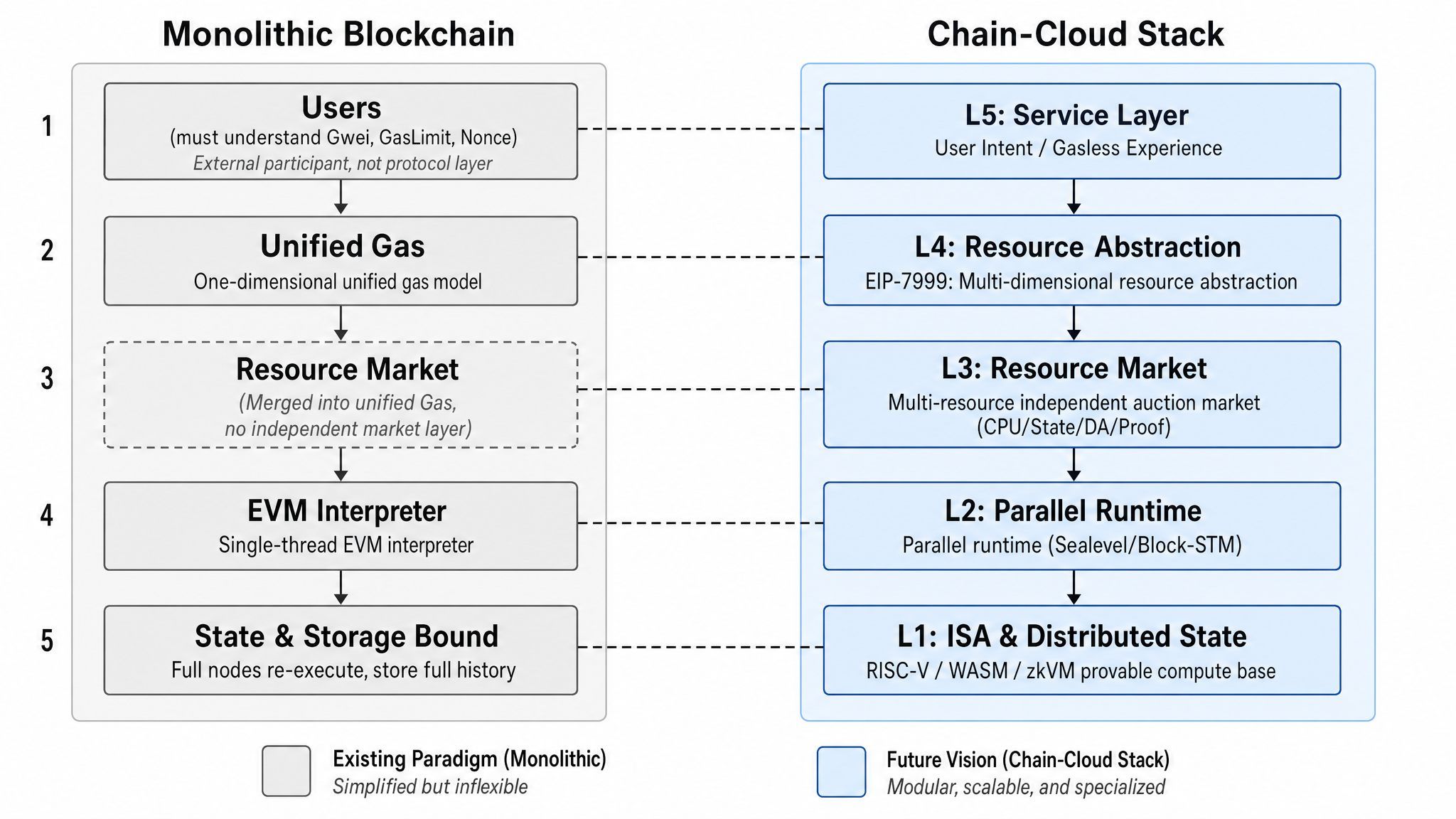
Taking this logic to its conclusion, the structure of the next generation blockchain is no longer "a single chain" but five layered stacks.
At the top is the Service Layer. Applications like Trading, Game, Storage, and AI directly face users, who see business prices rather than resource prices.
Below is the Resource Abstraction. This layer is responsible for packaging the underlying multi-dimensional resources into service interfaces that the upper layer can understand. Ethereum's EIP-7999 has already designed in this direction: multi-dimensional underneath, unidimensional user interface, where users only need to provide a single unified max fee, and the protocol internally allocates the budget across different resources.
Next down is the Resource Market. Compute, State, Storage, DA, Bandwidth, Proof, and Priority each have independent prices determined by supply and demand, forming a tradable resource pool.
Below the Resource Market is the Parallel Runtime. This layer handles dependency graph analysis, concurrent scheduling, and state access management. Sealevel, Block-STM, and Sui Object Model all belong to this layer.
The bottom layer consists of Execution ISA and Distributed State. RISC-V is here, serving as a general execution standard for the chain cloud, not the core. The true core is the combination of ISA, Runtime, State, Resource Market, and Proof.
End Users Should Not Even Know Gas
In the future, users should not encounter terms like Gas, Gwei, CU, ref_time, proof_size, storage deposit. Users should only see things like "Convert 100 USDC to ETH", "Buy a sword", "Store 1GB for 100 years", "Open a BTC long position".
The underlying pricing formula is multi-dimensional: Fee equals the usage of each resource multiplied by its current price. But the user-level pricing formula is entirely different: User Price equals Service Value plus Resource Cost plus Risk Premium plus Platform Margin. The underlying layer measures resources more precisely, while the upper layer increasingly hides them thoroughly. This is what a truly mature computer should look like.
After the World Computer
Gas is not dead but is being deposed. It has transitioned from being a resource itself to becoming a packaging layer for the resource market.
The evolutionary path of blockchain has gradually clarified: from Blockchain to World Computer, to Resource Computer, to Resource Market, and then to Decentralized Cloud, ultimately heading towards Chain-Cloud.
Chain solves trust, cloud solves resources. The next generation of blockchain's task is not to move all computation onto the chain but to turn global computing resources into a verifiable, tradable, and programmable public infrastructure. Once this transition is complete, blockchain will no longer be a faster chain but a truly meaningful cloud guaranteed by cryptography.
免责声明:本文章仅代表作者个人观点,不代表本平台的立场和观点。本文章仅供信息分享,不构成对任何人的任何投资建议。用户与作者之间的任何争议,与本平台无关。如网页中刊载的文章或图片涉及侵权,请提供相关的权利证明和身份证明发送邮件到support@aicoin.com,本平台相关工作人员将会进行核查。


