
Author: Raoul Pal
Translation: Chopper, Foresight News
You have been managing your assets according to the financial strategies taught by others, yet the results are not satisfactory.
Saving a sum of money, allocating a pension, investing in index tracking funds, and purchasing real estate when the timing is right... Each year, you receive a balance sheet of your assets, showing an increase from the previous year. You keep the receipts on hand, gaining a slight comfort in your heart. Twenty years pass quickly, the account numbers keep rising, yet your real life has not changed substantively. You still cannot afford a full year of vacation, nor can you refuse a job you dislike. Logically, by now you should have greater financial freedom, but reality does not align with that. Perhaps at some moment, you will blame yourself for it all.
But the problem does not lie with you. In the past, people suggested to you to build a traditional portfolio: allocate bonds for risk aversion, buy a small amount of gold, purchase real estate if possible, and layout index funds to seek appreciation. This advice has proven effective in the past, but it was suited for a different era, one that has long since disappeared.
I deeply resonate with this; constructing such investment portfolios used to be my job.
I was a hedge fund manager, and this asset allocation logic was not my personal preference, but rather the survival rule of the industry I was in. People constructed a package of assets capable of withstanding various market shocks, hedging one type of risk against another, and felt justified in holding them, because a drastic drop in a single asset would not deliver a fatal blow to overall wealth. I practiced this trading paradigm for many years. For the past twenty-one years since then, I have continued to write research newsletters for hedge funds and family offices, but the macro environment that this system relies on is undergoing dramatic changes.
I will now explain a new approach to asset allocation, and clarify that this plan is not as radically speculative as the general public might stereotype it to be.
The Source of Economic Growth
Let us begin with the underlying logic of economic growth from which all wealth principles derive. A country can achieve wealth growth through three main paths: increasing labor supply, enhancing labor productivity, or borrowing for expansion. This is the entire formula for economic growth.
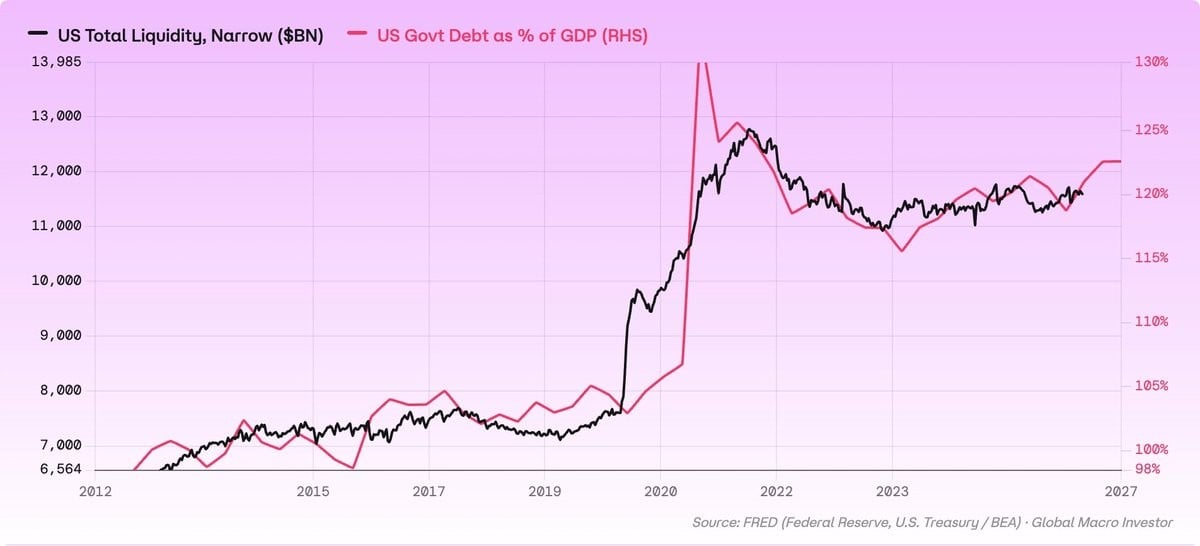
For most of the last century, the first two engines have borne the brunt of economic growth. The population has been continuously growing, and technological innovations have been constantly improving labor productivity, with debt merely playing a secondary role. Today, both major engines of growth have stalled: birth rates began declining decades ago, and the growth rate of labor productivity has been low for years. Economic growth now almost entirely relies on the third path—borrowing, which is a trap in itself. Debt accrues interest, and politically, the only viable way to repay it is through increased money supply.
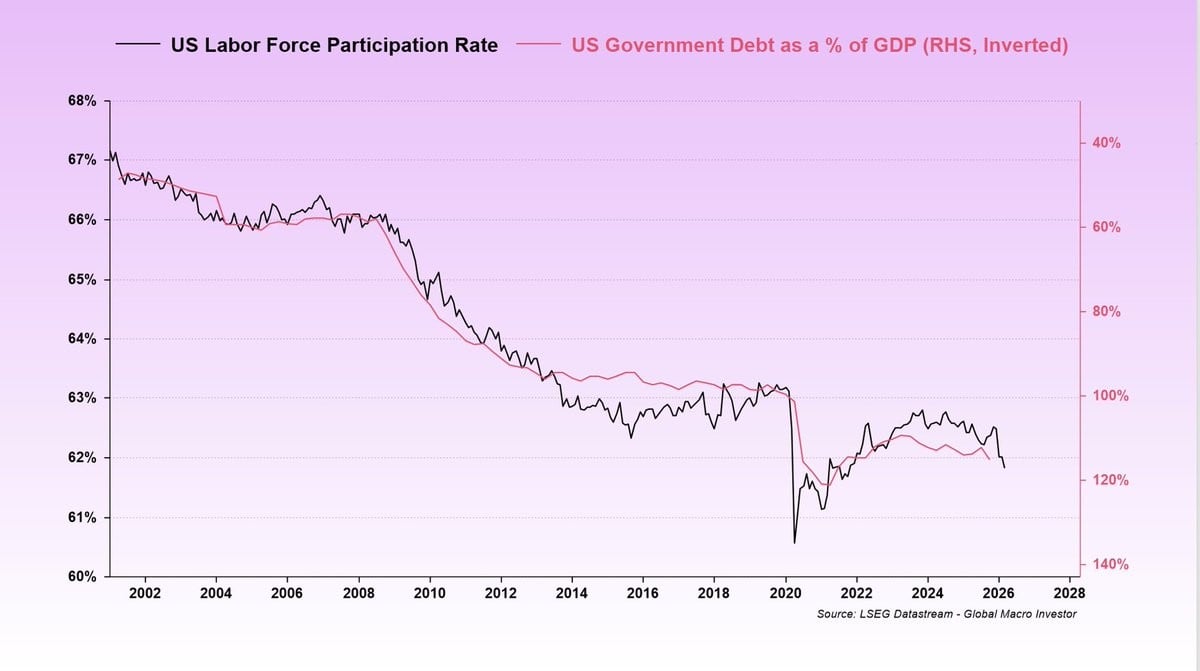
The government continually borrows, interest compounds, and the central bank injects money to absorb the debt, causing the cash you hold to devalue every year.
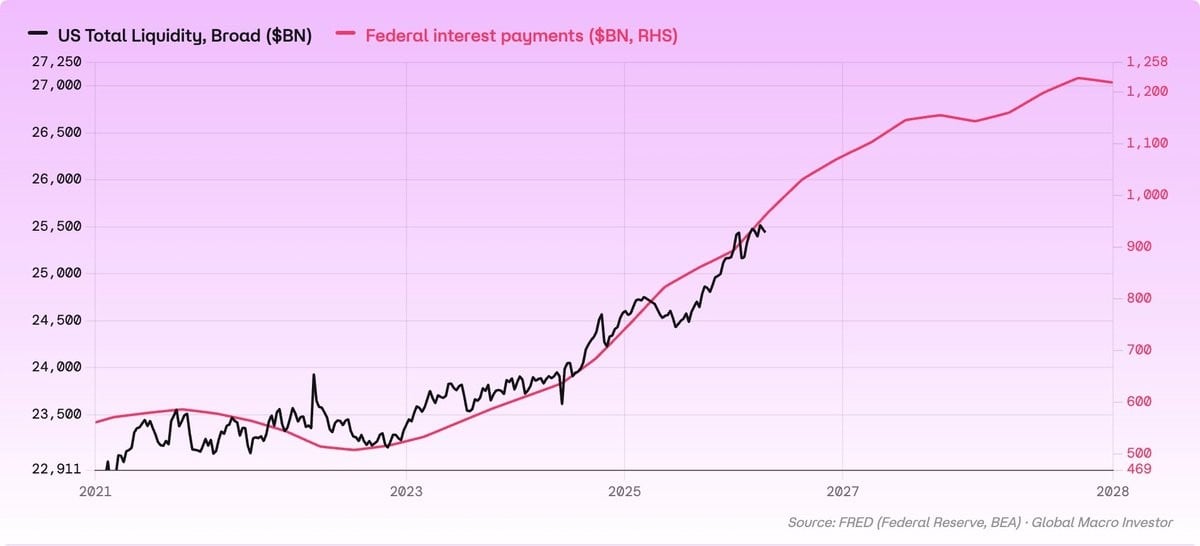
Global liquidity, which is the total volume of money and credit in the entire financial system, expands at about 8% annually, which is the essence of currency devaluation. If the total money supply in the market increases by 8% each year, the scarcity of money decreases by 8%, leading to a waning value of 8% each year. On top of this, daily inflation must also be considered, usually reported as a 2%-3% increase in prices, covering daily consumption and rental costs, as almost everyone considers outperforming this figure their financial goal. Outperforming ordinary inflation merely signifies that you maintain your current living expenses and does not equate to realizing any true increase in your wealth.
By summing these two figures, we identify the true wealth threshold, using an annualized rate of 11% as the benchmark.
If the annualized return of your assets exceeds 11%, your purchasing power can be enhanced; if it is below that line, no matter how good the numbers on your statement look, your purchasing power is eroding because the money in which your assets are valued is continuously depreciating. You need to achieve an annual return of 11% just to preserve your existing wealth level.
This definition fundamentally rewrites the evaluation criteria for asset selection. We no longer obsess over picking seemingly safe, well-diversified assets but instead sift through to find those with an annualized return that can break through the 11% benchmark.
Next, we will assess the mainstream investment categories available in the market.
Assessing Mainstream Assets One by One
Let’s start with bonds. Most people hold bonds but have never truly understood their essence.
Bonds are essentially a form of debt. You lend your funds, earn a fixed interest annually, and recover the principal upon maturity. This is the complete profit model of bonds. The fixed interest rate set by the issuer corresponds to ordinary inflation levels, without accounting for the depreciation loss caused by currency dilution. For example, a government bond with a 4% annual yield promises to pay 4% interest every year, but the currency is depreciating at a rate of 8% annually; by the time the bond matures and the principal is returned, the actual purchasing power of that amount has significantly diminished. Even if you hold the bond until maturity and receive every promised return, your actual wealth still declines.
Real estate is the most controversial category and needs to be approached with caution.
The underlying logic that real estate hedges against depreciation still holds: borrowing at a fixed rate and purchasing a physical asset valued in continuously depreciating currency. The actual burden of debt decreases year by year, and real estate prices rise alongside the increase in currency supply. It cannot be denied that real estate is indeed a good hedge against depreciation; I myself have allocated to real estate.
However, an entire generation has relied on real estate to achieve wealth leaps, and the core dividend does not lie in the real estate itself but in the time window of mortgage lending. If one leveraged to purchase real estate at the beginning of a forty-year long easing cycle, asset valuations would rise annually. This dividend trade can no longer be replicated; interest rates have dropped to zero and then rebounded again.
Now, for the vast majority of people, it has become quite challenging to apply for quality mortgages: the price-to-income ratio remains high, and mortgage rates are also elevated.
Even if you successfully obtain a mortgage, the ability of real estate to hedge against currency depreciation has significantly declined. Since 2007, the rate of global liquidity expansion has far outpaced real estate prices, with the ratio of the two continuously declining. The nominal dollar price of your real estate may have increased, but its actual purchasing power is no longer what it used to be.
Let’s discuss gold; we need to view gold’s value objectively and avoid one-sided judgments that could lead to erroneous conclusions based on near-term movements.
Gold has undergone a historic rally. In January of this year, the price surpassed $5,500 per ounce, setting a new historical high; as of the end of August, the gold price has retreated to around $4,600, with an increase of about one-third over the year. Financial media even dubbed this trend with a specialized term: the devaluation trading market. On the surface, gold’s yields greatly exceed the 11% benchmark; however, I was previously not optimistic about gold’s appreciation potential.
The core distinction lies in comparing gold prices with the scale of central bank balance sheets over the past fifteen years, which shows that gold's value has largely kept pace with the expansion of central bank balance sheets; this is precisely gold's positioning. Gold can maintain purchasing power and hedge against the devaluation risks brought by excessive money supply; this value is undeniable, and I do not intend to diminish gold's role.
Maintaining purchasing power and realizing wealth appreciation are two entirely different matters. Gold lacks a user penetration growth curve, and there is no commercial ecosystem built upon gold. Gold price fluctuations entirely depend on market panic regarding the currency system; when market anxiety is high, gold prices naturally remain elevated. Over long cycles of decades, gold will not achieve compound appreciation simply because the number of global users increases. Gold is responsible for preserving value, not creating new wealth.
Finally, regarding stock assets, the indices commonly held by the public outperform the previously mentioned asset classes. Over the past ten years, the annualized compound returns of the S&P 500 index have been about 13%, barely crossing the 11% threshold; and this achievement relies on a decade-long super bull market in financial history.
The only two types of assets that can reliably and steadily break through this yield line are technology assets and crypto assets.
Why Technology and Crypto Assets
We will horizontally compare the annualized returns over ten years, a period long enough to cover a cycle of sharp declines, while residing fully within the macro cycle of currency devaluation.
Gold's annualized return is about 12%, the S&P 500 is about 13%, and the NASDAQ 100 is approximately 20%; Bitcoin, depending on statistical standards and starting time, has a range of annualized return from 58% to 70%.
In relation to the 11% yield benchmark, the differences are clear.
The logic behind these results is far more crucial than the yield itself. If the returns are merely due to luck, these conclusions hold no practical value.
The reason why these two types of assets can achieve high compounding returns is that both follow user penetration S-curve growth patterns, rather than traditional value assets. Metcalfe's Law indicates that the larger the network size, the more value existing users receive. User penetration does not rise linearly but presents a classic S-curve: initially slow growth, explosive expansion in the middle stages, and saturation in the later stages. As long as the asset is in the steep growth phase of the curve, its returns can outpace the rate of money supply expansion from a fundamental perspective, rather than solely relying on market sentiment to speculate.
Therefore, our focus of discussion is no longer whether technology and crypto assets outperform traditional categories but whether their user penetration curves have reached their endpoints. The answer is negative; the next batch of participants entering the ecosystem will no longer be human users. Later, I will elaborate on this, as it is a long-term variable that the current market seriously underestimates.
Why Traditional Diversified Allocation Loses Its Protective Effect
The traditional investment portfolio is built on a core assumption: bonds, gold, real estate, and stocks represent four completely independent types of risk. Holding all four asset classes means that a single black swan event cannot break the overall asset package. This logic has been valid for a long time, but after 2008, the paradigm has completely changed. Liquidity has become the core force determining the pricing of all assets; the four asset classes no longer correspond to four independent risks but are essentially different pricing products under the same macro-variable.
Your bond trading bets on liquidity changes at its core, gold serves as a liquidity trading asset, real estate similarly fluctuates with liquidity cycles, and index funds are merely better-packaged liquidity assets.
I do not deny the significance of diversified allocation; diversification itself is a rational financial strategy, and I also diversify my holdings. The issue lies with the underlying assets in traditional portfolios: three of the four asset classes cannot exceed the 11% yield benchmark, and the fourth can barely meet it only during the strongest bull market in history. By carefully assembling four asset classes, you are essentially betting on the same macro logic, and the vast majority of assets’ returns cannot outpace the rate of money supply expansion.
The truly thought-provoking question is not the number of held asset classes, but whether the funds you allocate for appreciation are placed in assets with long-term compounding potential. Aim to position as much as possible in real long-term growth tracks; if every asset you diversify into falls short of the benchmark yield, then so-called stable diversification only brings psychological comfort and will not enhance actual returns.
Where True Value Is Ultimately Preserved
In the crypto industry, we must decide which tier of assets to allocate to, objectively weighing choices and avoiding absolute, dogmatic conclusions.
Layered application protocols can indeed generate high returns if one chooses high-quality projects that truly cater to commercial needs; the rewards can even surpass those of underlying public chains.
The challenge lies in precisely selecting superior applications. The underlying public chains carry the settlement activities of the entire ecosystem; no matter which application ultimately prevails, value will settle within the underlying infrastructure. You do not need to predict precisely which application will win; you need to be confident that future economic activities will gradually migrate on-chain. Betting on underlying public chains may yield lower returns than betting on breakout applications, but it has a lower judgment difficulty and still leaves ample room for ecosystem growth.
This is why traditional valuation models do not apply to crypto assets. The industry directly copies stock valuation systems without ever verifying whether these metrics fit the blockchain ecosystem: fee multiples, revenue growth rates, and locked-value ratios. Our institution, GMI, has back-tested all valuation metrics against the twelve major public chains, and none have been able to effectively predict future returns. The only predictive metric is whether funds, after entering the ecosystem, long-term remain within it.
Once you grasp the essence of blockchain, this logic becomes easy to understand. A public chain is not a company selling products for profit; its value derives from all the ecosystem applications built on it, rather than through profit from transaction fees. Valuing Ethereum solely based on transaction fees is akin to estimating the entire internet's value in 1998 based on email service fees.
This is also why I choose to write this article now rather than wait two years.
All market-scale forecast reports hide the same fundamental assumption: ecosystem users are human beings participating in economic activities at the human pace, making a few trades daily, paying small amounts monthly, occasionally initiating queries.
This assumption will soon break down. AI entities, which do not require human instructions, can autonomously perceive, decide, and execute operations, are about to enter the market as independent economic players rather than mere tools. According to industry forecasts I have seen, the ratio of non-human intelligent identities within companies to human employees may even reach 80:1 in the future.
AI entities cannot open bank accounts; they have no legal identity, cannot go to physical branches to conduct business, and cannot tolerate traditional settlement systems that close after 5 PM or take three days to complete a wire transfer. Intelligent entities require a programmable currency, built on an infrastructure that never stops operating, which is precisely what public chains inherently provide and traditional financial systems cannot.
The entire infrastructure is being openly implemented: Anthropic open-source releases model context protocols; Google launches Agent2Agent, releasing the WebMCP preview version, where websites can directly open functional interfaces to intelligent entities without needing to simulate human clicks; Coinbase restarts the x402 protocol, allowing intelligent entities to pay each other through HTTP links.
This set of products being deployed indicates a forward-looking demand for settlement capacity; regardless of whether speculative funds enter the market, genuine business needs will continue to expand.
Risks That Must Be Acknowledged
Betting on a single track makes it easy to fall into survivor bias, and those who deliberately avoid this risk often have marketing agendas.
You will always find someone sharing success stories of going all in on a single asset to achieve financial freedom, yet you won't hear about the thousands of investors who heavily invested in a single asset, ultimately facing zero returns; the failures do not share their stories publicly. Consider reading anonymous trading confession posts; the real outcomes are often bleak, providing a more objective market sample than rapid wealth stories.
Therefore, I do not recommend putting all your funds into a single asset; that has never been my viewpoint.
The true financial logic is as follows: when you identify a genuine long-term growth track, the number of assets held is not determinative. Ultimately, returns are decided by two core variables: the proportion of funds allocated to the growth track and the holding period of the assets.
There is a third rule, a strict prohibition: do not use leverage. Do not use light leverage, nor so-called cautious leverage, nor set stop-loss protections. Leverage will strip away the fundamental confidence of this long-term strategy—under extreme market conditions where assets decline by 50%, you should not be forced to close your position. Even if you are completely correct in your assessment of a ten-year cycle, it is still possible to get liquidated during two weeks of steep declines; the market will not compensate for your losses simply because your long-term logic was correct.
For the vast majority of ordinary people, a reasonable asset allocation plan is tiered. Retain a portion of traditional assets to safeguard asset security and provide peace of mind; allocate a considerable sum for long-term growth tracks, controlling the position of these high-elasticity assets so that even if the assets halve, it won’t force you into making panic decisions; the remaining energy can be devoted to life.
Over the thirteen years I have observed the crypto market, I have found that investors who achieve long-term compounding returns are often not frequent traders. During plunging markets, the retraction is an alarming reality; looking at the longer term, it is merely an insignificant fluctuation on the chart. Doing nothing is in itself a trading strategy, but very few implement this approach; it is far more challenging than it seems.
What True Opportunity Cost Is
If your assets have an annual compound return below the 11% benchmark, the wealth you earned through labor that year can afford you less freedom than the previous year.
Investors who understand this logic ultimately gain not a vast amount of paper money but rather options. You don’t have to closely monitor the market at all times, having the boldness to refuse jobs you dislike, and when still young, being able to go to the places you long for and be with the people you cherish.
This is the true opportunity cost behind the 11% yield benchmark.
I will not directly provide you with a fixed asset allocation list. I do not understand your debt pressure, investment cycle, or risk tolerance personality. Anyone who provides position allocations without knowing these three premises is essentially betting your funds on guesses.
What I can offer you is this set of screening criteria. Use the annual yield standard of 11% to evaluate all the assets you hold one by one. No matter how stable and comfortable your holdings feel, any asset that cannot outperform this benchmark is consuming your time and freedom.
免责声明:本文章仅代表作者个人观点,不代表本平台的立场和观点。本文章仅供信息分享,不构成对任何人的任何投资建议。用户与作者之间的任何争议,与本平台无关。如网页中刊载的文章或图片涉及侵权,请提供相关的权利证明和身份证明发送邮件到support@aicoin.com,本平台相关工作人员将会进行核查。


