A rebound of approximately 71% in a month, has the glory of Circle returned?
Written by: ChandlerZ, Foresight News
On September 3, the stock of stablecoin issuer Circle, CRCL, closed at $103.23, up 16.46%, with an intraday high of $103.28, closing just $0.05 below the day's high. During the same period, Coinbase rose 10.14% to $192.70.
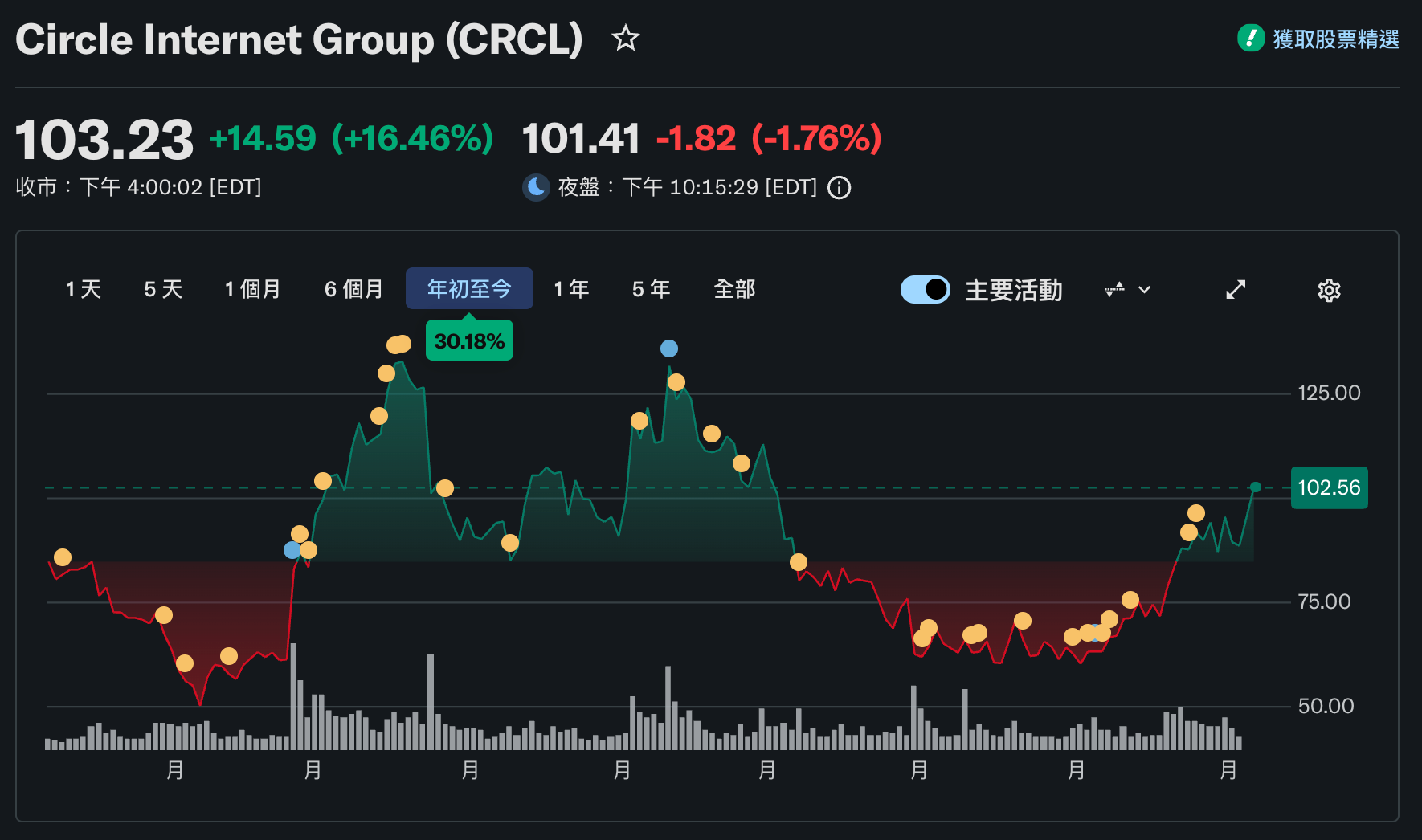
A month ago, on August 3, CRCL closed at $60.35, marking a cumulative rebound of about 71% by September 3. Bitcoin rose 5.02% that day to approximately $81,200, hitting an intraday peak of $82,300, serving as a direct catalyst for the rise of crypto-related stocks. The single-day increase of CRCL also surpassed that of BTC and Coinbase. Over the past two months, Circle received federal and state trust licenses in New York, USDC business continued to grow, and the Arc public mainnet is set to launch on September 16, further heightening market expectations for the company.
This round of rebound also repaired the sharp decline from June to early August. At the end of June, CRCL had a single-day drop of 17.5% after the Open Standard Alliance announced the stablecoin OUSD, supported by over 140 companies. Meanwhile, Morgan Stanley drastically lowered its target price from $106 to $38 at the beginning of August, citing factors including the diversion of tokenized money market funds, competition from OUSD, and a slowdown in USDC growth.
Growth in USDC scale offsets some pressure from interest rate cuts
Circle issues USDC, with interest generated from the cash and short-term U.S. Treasury bonds backing USDC being its main source of income. The larger the circulation of USDC, the more reserve assets Circle can typically allocate; a decline in U.S. Treasury yields would depress the income generated from equivalent reserve sizes.
From the financial report, as of the end of the second quarter of 2026, the circulation of USDC stood at $73.3 billion, a year-on-year increase of 19%, with quarterly on-chain transaction volume reaching $14.8 trillion, up 151% year-on-year. Circle's total revenue and reserve income for the quarter were $701 million, a 7% increase from the previous year, of which reserve income was $668 million, accounting for about 95%; net profit was $48 million, and adjusted EBITDA was $143 million.
In the second quarter, the average circulation of USDC increased by 25% year-on-year, offsetting part of the impact of a 66 basis point decline in the return on reserve assets, with reserve income ultimately growing 5% year-on-year. The Circle Payments Network had an annualized transaction amount of $14.7 billion in the same period, a 76% quarter-on-quarter increase, with the number of financial institutions connected rising to 175. The income from payment networks, technology services, and trading is still in the early stages, with Circle's other income for the quarter totaling $34 million.
Circle's distribution, trading, and other costs in the second quarter amounted to $412 million, of which the distribution cost paid to Coinbase was $324.6 million. If the growth of USDC mainly comes from exchanges and partners that require revenue sharing, a significant portion of the new reserve income will flow to the channel partners.
Circle aims to increase fee income through payment and enterprise services, with BNY integrating USDC custody, issuance, and redemption into its digital asset custody platform, and Nium connecting the Circle Payments Network to local payment networks in over 190 countries and 100 currencies. On August 28, Circle became a major partner of Chelsea FC, with the USDC logo appearing on the front of the men's, women's, and youth team jerseys, marking a shift in brand placement from crypto users to a global sports audience.
The launch of the Arc mainnet adds a second valuation clue for Circle
Circle plans to launch the Arc public mainnet on September 16. Arc is a Layer 1 blockchain designed for stablecoin payments, foreign exchange, and tokenized assets, using USDC to pay for gas fees, offering sub-second finality and optional privacy features, and is compatible with Ethereum development tools.
In August, Circle announced 11 founding validators, including BlackRock, DTCC, Galaxy, ICE, Mastercard, Visa, Standard Chartered, and SBI Group. BlackRock plans to deploy the tokenized money market fund BUIDL on Arc; DTCC plans to support the tokenization of its custodial assets and stablecoin settlements on Arc starting in the second half of 2027. Currently, there are over 100 institutions and ecosystem builders participating in the Arc private mainnet.
Arc extends Circle's revenue opportunities from USDC reserve interest to network fees, development tools, and institutional services, but these revenues will still need to be validated after the mainnet operates. The other income confirmed by Circle in the second quarter accounted for only about 5% of total revenue, and the transaction volume, USDC reserve scale, and institutional application progress after the September 16 launch will determine whether Arc can gradually change the existing revenue structure.
Additionally, on July 10, the Office of the Comptroller of the Currency finally approved Circle to establish a national trust bank, Circle National Trust, allowing it to provide federally regulated digital asset custody services and leaving room for future management of USDC reserves; the New York State Department of Financial Services on July 31 also approved Circle New York Trust to obtain a limited-purpose trust license. On August 6, Circle integrated native USDC and the Cross-Chain Transfer Protocol (CCTP) with OKX's X Layer, continuing to increase the use scenarios of USDC within the exchange ecosystem.
The acquisition of IBM's blockchain patent portfolio on July 27 serves Circle's long-term layout in payments, tokenized assets, and cross-chain infrastructure. Circle did not disclose the transaction price, but officially stated that after the acquisition, the company became the one holding the most blockchain patents in the U.S. The national trust bank provides federal custody qualifications, IBM's patents cover on-chain technology, and Arc introduces USDC into its own settlement network; whether these three investments can increase revenue will still depend on subsequent customer usage verification.
Market valuation still controversial
CRCL has rebounded back to $100, corresponding to a market value of about $26.2 billion, still below the 52-week high of $159.47.
However, there is currently a significant divergence in Wall Street's valuation range for Circle. Bernstein maintained a buy rating and a target price of $140 on August 31, believing that stablecoin payments, RWA, and AI agent payments can continue to expand USDC demand; Goldman Sachs, Wolfe Research, and Morgan Stanley recently set target prices of $81, $65, and $37, respectively.
Institutions that set lower target prices mainly worry about three pressures: interest rate cuts will directly reduce the return on reserve assets, channels like Coinbase have strong bargaining power over revenue sharing, and new stablecoins like Open USD may compete for balances from exchanges and payment institutions. Circle's revenue growth of 7% in the second quarter is significantly lower than the 151% increase in USDC on-chain transaction volume, indicating that on-chain activity has not yet translated into company revenue at the same rate.
On September 15, the U.S. Senate is expected to hold a key procedural vote on the cryptocurrency market structure bill, while the Arc public mainnet will launch the following day. These two events will continue to impact the regulatory premium and growth expectations for CRCL.
免责声明:本文章仅代表作者个人观点,不代表本平台的立场和观点。本文章仅供信息分享,不构成对任何人的任何投资建议。用户与作者之间的任何争议,与本平台无关。如网页中刊载的文章或图片涉及侵权,请提供相关的权利证明和身份证明发送邮件到support@aicoin.com,本平台相关工作人员将会进行核查。


