Author: JamesX
Many people's understanding of Meme KOL harvesting is still at a very basic stage:
The project side gives the KOL a sum of money, or hands over a portion of Tokens, the KOL sends out a few tweets to promote the project, and after the fans rush in, the project side sells at a high position.
Such things certainly exist.
But if you really observe the Meme market over the long term, you'll find that many of the plays are no longer that simple.
Because for a mature Meme operation team, the KOL is never just an "advertising space."
The KOL can be an entry point for traffic, a chip distributor, a price initiator, a project interest community, or even have an entire issuance team.
Sometimes, the so-called "million-dollar Meme Trader" may itself be part of the entire game.
To understand this play, you must first grasp a very basic question:
What is a Meme project truly lacking?
Not Tokens.
Issuing a Token only takes a few minutes.
Not Meme images.
AI can generate dozens in a minute.
Often it isn't even funding.
What is truly scarce is:
People who are willing to buy in at higher prices continuously.
In other words, it is exit liquidity.
Thus, the core chain of the entire Meme market is actually:
Chip → Narrative → Attention → Buy Pressure → Liquidity → Exit
And the KOL is precisely at the most critical position in this chain.
Because the real asset they hold is not "research ability," but:
The ability to convert attention into buy pressure.
Once you understand this, you can comprehend why project sides are willing to bind KOLs with increasingly complex methods.
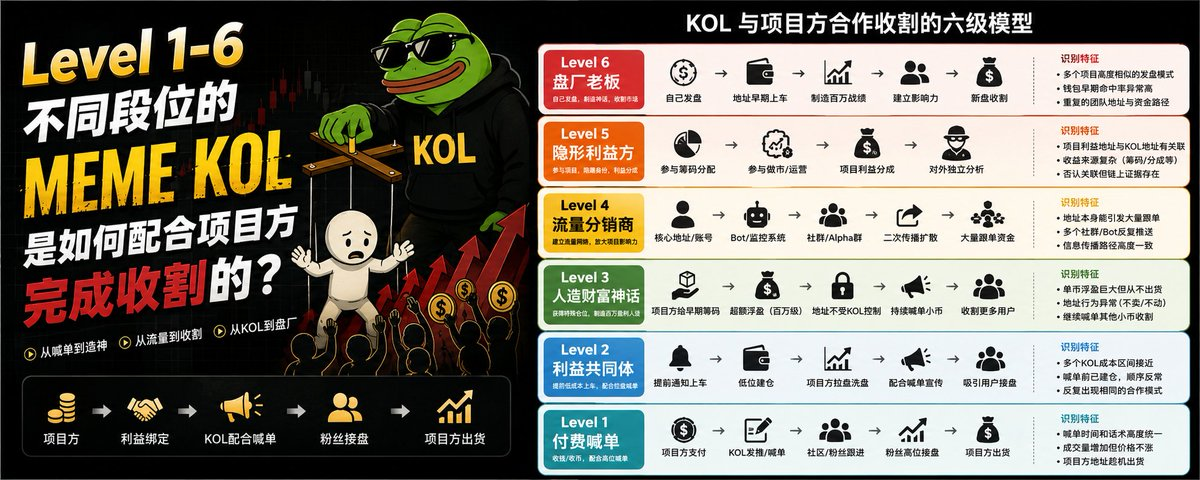
Level 1: The Most Basic Paid Promotion
This is the most traditional and lowest-level form of cooperation.
The project side finds the KOL:
Offering 5,000U, 10,000U, 20,000U, or directly giving a batch of Tokens.
Then requesting the KOL:
To tweet, join Spaces, shout in WeChat groups or Telegram groups, or pretend they just "discovered" this project.
The real issue here is not the advertisement itself.
It's not strange for Crypto projects to do marketing.
The real question is: Were the interests disclosed?
What users see is:
"I recently researched something and found it quite interesting."
The actual situation may be:
"The project side just transferred me 20,000U yesterday."
These two pieces of information are completely different for investors.
A more classic situation is when the project side already holds a large quantity of low-cost chips.
After the KOL starts promoting, many fans rush into the market.
Transaction volume quickly expands.
But the price does not show a significant increase, even consolidating after a spike.
This is a significant warning signal in the Meme market:
Attention ↑
Volume ↑
Price ≈
If a sudden influx of new buy orders enters the market, but the price shows no corresponding elasticity, then at least one question is worth asking:
Who is absorbing these buy orders?
Because buying and selling always happen simultaneously.
A sudden increase in volume without pushing the price often indicates ongoing supply on the other side of the market.
Of course, this alone cannot prove that the project side is offloading stocks.
But if we also observe that:
The project's related wallets, early holders, and team wallets are continuously selling, then the logic becomes increasingly clear.
This layer of KOL essentially serves as:
An advertising channel.
Level 2: The Project Side No Longer Pays for Ads, but Allows KOL to “Earn Irrevocably”
Things start to get interesting at the second level.
Because the project side gradually realizes a problem:
If you give a KOL 20,000U, they might help you post two tweets.
But if you let them earn 200,000U on a project, they might voluntarily promote it for a month.
Thus, the form of cooperation begins to change.
The project side no longer simply purchases ads.
Instead, they start to: Design KOL’s interests.
For example, if the project side has completed early chip collection.
Current project FDV is only 500K.
Then the project side informs a group of well-connected KOLs in advance:
You can get on board now.
So a few people build positions at:
500K, 600K, 700K FDV.
Then the project side starts to pump, wash, build the community, create trading volume, trend, and find more KOLs.
The project moves from:
500K → 2M → 5M → 10M.
At this point, the earliest KOLs have already made tenfold or even several dozen times their gains.
Next, they start tweeting:
"I discovered this project early."
That is true.
"I personally hold a major position."
That could also be true.
"It's already several times up."
That remains true.
This is the smartest aspect of the second-level play:
Almost everything presented to the user can be true.
The only hidden information is:
Why could they buy in so early?
The average user would naturally interpret this outcome as:
The KOL has strong research ability.
But the real situation could also be:
The project side gave them an almost asymmetric entry opportunity in advance.
The biggest difference here is:
Normal Alpha is:
Research → Judgment → Risk Taking → Buying.
But interest-based Alpha may be:
Pre-notification → Buying → The project side operates → Public promotion.
The final outcome looks very similar.
Thus, one of the most worthy signals to observe at level two is:
Multiple KOLs' Cost Ranges Exceptionally Close
Assuming a very obscure Meme:
A buys in at 620K FDV.
B buys at 670K.
C buys at 710K.
D buys at 650K.
Then the project rises to 3M, and these four people suddenly begin to discuss.
Looking at any single wallet individually poses no problem.
But if the same pattern repeatedly appears:
This same group of people can always get Tokens in similar cost ranges that no one else is discussing, and then they start to promote together, it deserves continued tracking.
Especially observe a very critical order of events:
Did they publicly research first and then buy; or did they collectively buy first and then publicly “discover”?
Because many times, what users see is:
The KOL discovered some Alpha, so they bought early.
But the actual on-chain timeline may be:
The wallet bought first → The project began to pump → The KOL started promoting.
The difference between the two is huge.
Another very interesting anomaly occurs:
If a person who trades Meme long-term has almost never failed to heavily invest and each time they do, the project costs are unusually low, it raises a question:
Are they consistently discovering Alpha, or is Alpha always discovering them in advance?
Level 3: The Project Side Directly Creates a “Million-Dollar Profit KOL”
Going up a level, the plays get even more counterintuitive.
The project side is no longer satisfied with letting a KOL earn a few times in a coin.
They start to realize:
A KOL with a huge on-chain PnL is itself a marketing asset.
For example, an ecosystem project side directly gives a batch of early Tokens to a KOL.
Or helps the KOL create an address.
This address gains chips worth 20,000 dollars in an extremely early Meme.
Later, this coin rises 100 times.
So the on-chain tool shows:
PnL +$2,000,000
The community starts taking screenshots.
Twitter begins to spread.
Various Smart Money Bots begin to tag.
Everyone says:
“This person made two million dollars on one coin.”
From that moment on, this KOL's market position completely changes.
Next time they say:
“I bought some XXX.”
It could immediately attract a large amount of following funds.
However, there exists a very important cognitive trap:
Unrealized PnL does not equal Realized Profit.
The on-chain shows a profit of 2 million dollars does not mean this person can actually take away 2 million dollars.
Even:
Who owns the address does not equate to who has control over it.
Some arrangements may be:
The project side holds the private key.
The KOL can only showcase the address.
Or both parties have an agreement that the position can't be sold freely.
Or the entire address is only considered by the market to belong to this KOL.
This explains a very abnormal phenomenon in the Meme market:
Some public addresses hold profits on a coin of:
500K, 1M, 3M dollars.
In the end, the Token drops 90% from its peak, nearly to zero.
Yet, the address has never shown any clear exit.
For a normal trader, this is very hard to understand.
Having made several million dollars, why not sell any?
One possibility worth verifying is:
This position is not freely disposable in the normal sense.
But rather:
Marketing Budget.
The project side uses a batch of low-cost early chips to fabricate:
“A Meme master earning 2 million dollars on a single coin.”
This creates a large credit asset.
Afterward, this person can lead more projects to real funding.
From this perspective:
The earlier 2M profit can even be interpreted as:
Influencer Acquisition Cost.
The project side is not rewarding the KOL two million dollars.
But creating a flow entry that may be worth far more than two million dollars.
Level 4: KOL is no longer just an account, but a set of traffic distribution network
When a KOL's influence is great enough, the liquidity they bring is far beyond their own Twitter followers.
Because now there are a lot of automated follower systems in the on-chain ecosystem.
When an influential wallet buys in, it triggers:
Wallet monitoring Bots.
Smart Money Alerts.
Telegram Alpha Groups.
GMGN, Arkham, Debank user tracking.
Copytrade.
Small KOL secondary dissemination.
Community screenshots.
Thus, a core wallet's transaction creates a complete dissemination path:
Core KOL buys in
↓
Bot monitoring
↓
Alpha Group
↓
Small KOL
↓
↓
Copytrade
↓
More users buy in
At this stage, the KOL is no longer just a content creator.
They resemble:
A channel distributor in the Crypto world.
Sometimes, they don't even need to tweet.
The address itself becomes media.
Address becomes Media.
A wallet with enough followers, as soon as it makes a buying action, can generate Attention.
And Attention creates trading volume.
Trading volume attracts more people.
So what the project side truly wants to bind is no longer just:
“Can you help me send a tweet?”
But rather:
“Can your entire traffic network be activated?”
Level 5: KOL is itself a stakeholder in the project
By level five, the boundaries of “project side” and “KOL” have started to disappear.
On the surface:
This is an independent KOL studying a project.
In reality, they may be:
Participating in early chips.
Involved in token design.
Contributing to market-making.
Participating in project financing.
Engaging in community building.
Involved in marketing.
Even earning a share of trading fees.
At this point, they are no longer just someone who promotes for money.
But rather an:
Invisible shareholder, invisible issuer, or profit distributor of the project.
However, when it comes to public dissemination, their identity may still be:
“I recently discovered a very interesting project.”
This is also the area where users can easily misjudge.
Because the public sees:
Independent Opinion.
The reality may contain:
Undisclosed Conflict of Interest.
Once again, it needs to be emphasized:
Participating in projects, investing in projects, and making money is not a problem.
The real issue is:
A person with an obvious conflict of interest disguises profit-related content as independent investment judgment.
Because once the conflict of interest is hidden, users lose a crucial part of context for evaluating the quality of information.
Level 6: The Highest Level of Play – KOL is the market maker themselves
This layer is truly a complete closed loop.
The KOL no longer waits for the project side to cooperate.
They either own or deeply control a team that:
Issues Tokens, manages chips, operates, markets, and sells.
Their surface identity remains:
Meme Trader / Alpha Hunter / Smart Money.But the underlying business model has changed to:
Create markets themselves, and profit from their market influence.
And the smartest first step in this model is not directly harvesting.
But rather:
First, create a persona as a Meme master.
The First Step: First Build Up Your Public Wallet PnL
Assume a KOL currently does not have sufficient market influence.
The team first issues a few Memes themselves.
Since the entire project is under their control, they know:
When to issue the coin.
When to add LP.
Where early chips are located.
Which wallet won't sell.
When to start pumping.
When to start marketing.
Thus, the KOL's public address can buy in very early.
For example:
10K FDV buy-in.
Then the team starts to operate:
100K.
500K.
2M.
10M.
Finally, on-chain data shows:
This address:
+300K.
+800K.
+1.5M.
After doing this several times, a “on-chain war god” is created.
The most important phrase in this process is:
You think he is predicting the market, but the market may have been created by him.
The logic of a normal Meme Trader is:
Seeing a certain project might rise, so buying in early.
But if the project itself was launched by their own team, then the so-called “accurately seizing a hundred times token” does not involve any predictive problem.
Because:
The questioner certainly knows the answer.
The Second Step: Turn Address Performance into Credibility
Crypto users trust on-chain data a lot.
Because they think:
Tweets can boast, but wallets don't deceive.
So a wallet that consistently yields hundred times tokens will quickly become:
Smart Money.
Various tools start to tag.
Various communities start to track.
More and more people start to pay attention to this KOL.
Finally, the market forms a simple perception:
“This person’s address is particularly accurate.”
However, there is another more concealed issue:
Are you seeing all of their addresses?
A team can completely have:
20 wallets.
50 wallets.
100 wallets.
Different wallets buy different projects.
Most go to zero.
Finally, they only show the success of that one address.
Thus, the public sees:
80% win rate.
In reality, the team's true win rate could be entirely different.
This is a very typical:
Survivorship Bias as Marketing
Packaging survivor bias as trading ability.
The Third Step: The Address Itself Begins to Hold Market Influence
As more people monitor this wallet, a significant change occurs.
At first:
Twitter influences the wallet.
Later:
The wallet in turn starts influencing the market.
For example, this address suddenly buys a Meme with 300K FDV.
A large number of Bots immediately push:
A certain Smart Money just bought XXX.
Hundreds or even thousands of users receive the message.
The first batch of following funds enters immediately.
The price starts to rise.
After the price rises, more Smart Money Scanners take notice.
More users enter.
Then, the KOL tweets:
“I just discovered something quite interesting.”
Thus, the second batch of Twitter traffic enters.
At this point, the wallet itself has already become a:
Price starter.
The Fourth Step: The Team Begins to Use “God-tier Address” to Direct Traffic to Their Own Projects
This is the step that truly completes the closed loop.
The team prepares a new Token in advance.
Completes:
Issuing coins.
Chip distribution.
LP.
Address preparation.
Narrative.
Then, the “KOL Smart Money Address” that already holds hundreds of thousands or even millions of dollars in historical PnL suddenly buys in.
The first wave of robot-following funds enters.
The price rises.
Subsequently, the KOL tweets.
The second wave of fans enters.
Then other KOLs start following the discussion.
The third wave of funds enters.
Trending hits.
More people see it.
The price continues to rise.
Thus, from the outside, the entire story looks like:
A Smart Money discovered a Meme early.
The market gradually discovers value.
The community naturally forms a consensus.
But the reality may be completely the opposite:
The token was launched by their team.
The address was intentionally purchased.
The first wave of rise came from the followers.
The Twitter content is responsible for further amplification.
In the end, the new liquidity absorbs the early chips exiting.
At this time, a complete cycle is formed:
Issuing Tokens
↓
Wallet buys in
↓
Followers enter the market
↓
Price rises
↓
Wallet PnL increases
↓
Meme God persona strengthens
↓
More people monitor the wallet
↓
The next project has a stronger initiating ability
Thus:
PnL → Followers → Liquidity → PnL
Becomes a positive feedback loop.
The most dangerous thing is not Alpha, but Self-Fulfilling Alpha
The most valuable concept of this type of model is:
Self-Fulfilling Alpha
The logic of normal Alpha is:
This coin will rise, so they buy early.
The logic of Self-Fulfilling Alpha is:
Because they buy, this coin starts to rise.
When a wallet has enough followers, their buying behavior itself generates demand.
Thus, a very dangerous cycle arises:
They buy.
Others follow.
The price rises.
Their PnL looks good.
More people believe they are impressive.
Next time more people follow.
From the result perspective:
Their win rate increases.
But this win rate may not necessarily come from predictive ability.
But possibly from:
Market influence itself.
If the project they buy happens to be launched by their own team, then this mechanism turns into a nearly complete liquidity machine.
So how should ordinary users view this?
The most essential point here is:
Do not directly assume that a KOL is colluding to harvest just because several abnormal features appear.
One of the biggest misconceptions in on-chain analysis is treating:
Correlation
Directly as:
Causation.
Multiple wallets buying in together doesn't necessarily represent collusion.
The project side turning tokens may also have reasonable explanations.
If the KOL is buying early, it could actually stem from their research capability.
So what should really be done is:
Observe whether behaviors form statistically significant patterns over the long term.
I generally focus on four things:
1. WHEN: When do they buy?
Did the KOL buy before the public promotion or afterwards?
If repeatedly showing long-term:
Wallet buys first → Price rises → KOL then publicly discusses,
It is worth continuing to track.
2. WHERE: At what cost do they buy?
Are the cost ranges of multiple KOLs abnormally concentrated?
Especially in a Token with extremely low liquidity and almost no discussions.
If the same group of people can consistently enter similar cost ranges, this signal is much more important than a single transaction.
3. WHO: Where do the chips come from?
Are the Tokens bought through normal DEX Swaps?
Or directly transferred from the project side's address?
Who provides the buying funds?
Do the multiple KOL wallets have the same funding source?
Do the same deployers, funding wallets, LP wallets, or counterparties repeatedly appear across different projects?
4. EXIT: Who finally sold?
This is the most important step.
Do not only look at:
How much the KOL bought.
Instead, it should be observed:
After KOL's promotion brought a large volume of transactions, who is continuing to sell?
If during the rapid rise in project popularity:
Some early addresses keep releasing chips to the market,
Then where these new buy orders ultimately go will become increasingly clear.
Valuable on-chain investigations are not about examining a single coin, but rather a network
One individual Meme can often be explained away by coincidence.
What is truly valuable is:
Putting dozens of projects together.
Checking for the same group of addresses.
The same group of funding sources.
The same batch of KOLs.
The same sequence of timing.
The same set of market-making wallets.
The same cadence of promotions.
If a pattern repeats across:
10, 20, or even 50 Memes,
It begins to form a:
Behavioral fingerprint.
This is why truly professional on-chain Meme research should not just ask:
“How much did this KOL earn this time?”
But should ask:
“How did their profits come about?”
Finally
Many people believe the Meme market trades Tokens.
But I increasingly feel:
The Meme market truly trades Attention.
The project side produces chips.
Narrative gives the chips a story.
KOL turns the story into attention.
Attention converts into buy pressure.
Buy pressure transforms into liquidity.
Finally, someone turns that liquidity into real dollars.
So the entire game can ultimately be simplified to:
Token
↓
Narrative
↓
KOL
↓
Attention
↓
Buy Pressure
↓
Liquidity
↓
Exit
The most basic play involves purchasing KOL's traffic.
A more advanced play is binding the KOL's interests.
An even higher level is artificially creating a “million-dollar Meme Trader.”
The highest level sees the KOL having the ability to issue:
Creating markets themselves and then using their created track record to influence the market.
So next time you see a KOL showcasing:
“I bought this coin at 100K FDV.”
“This trade made another 1M.”
The question worth asking might not be:
“Why are they so good?”
But rather three other questions:
Why are they always able to buy so early?
Why do these projects always find them?
And most importantly:
Where do they stand in this chain of interests?
免责声明:本文章仅代表作者个人观点,不代表本平台的立场和观点。本文章仅供信息分享,不构成对任何人的任何投资建议。用户与作者之间的任何争议,与本平台无关。如网页中刊载的文章或图片涉及侵权,请提供相关的权利证明和身份证明发送邮件到support@aicoin.com,本平台相关工作人员将会进行核查。


