Author: Max, 01 Founder
Editor: Max
Three major events happened in Silicon Valley last night.
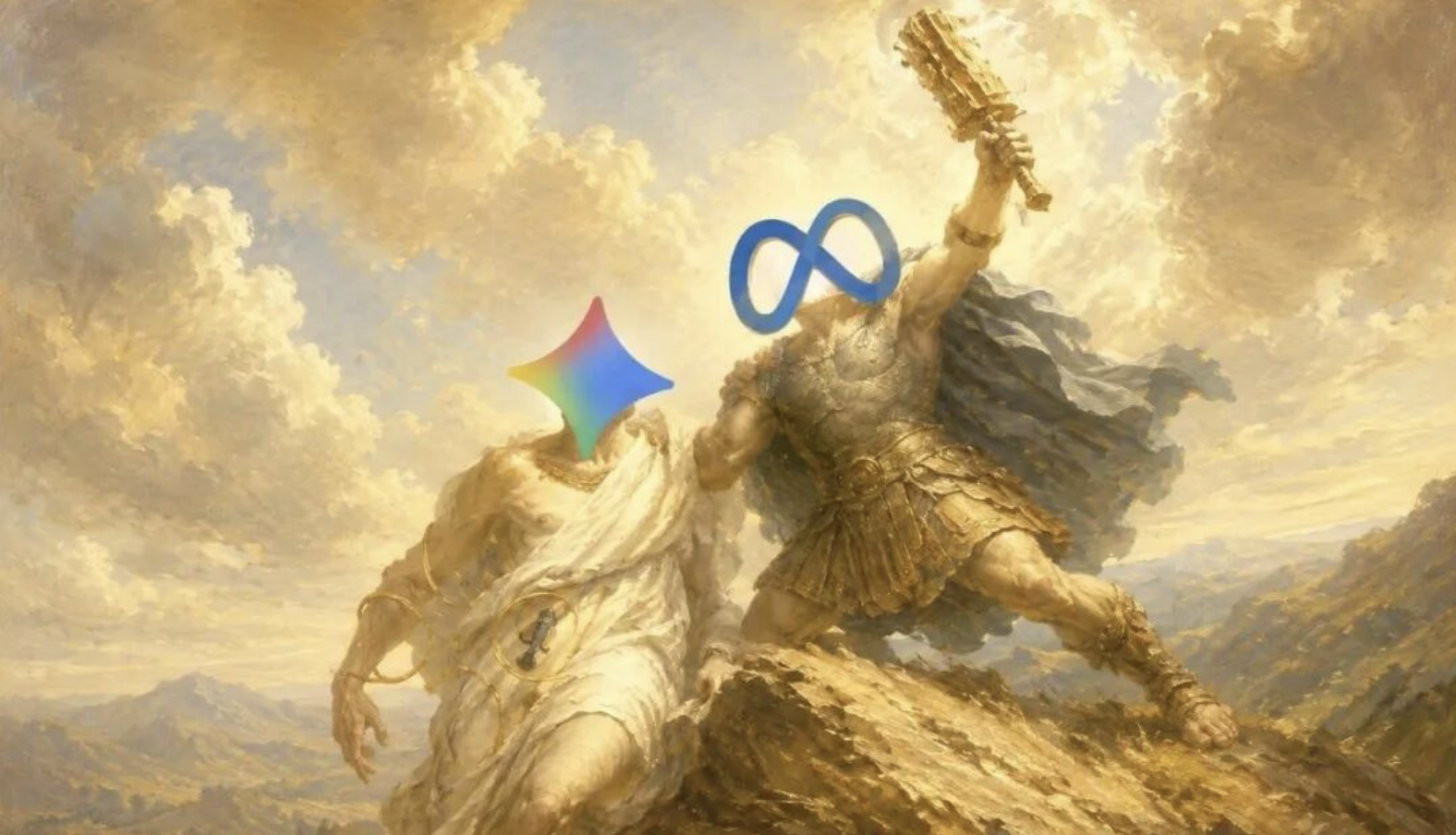
Google released Gemini 3.8 Flash, Meta released Muse Spark 1.3, and a previously unheard startup Mostik was featured in a special interview with the authoritative media WIRED.
Looking only at the first two, it seems like yet another ordinary AI ranking night.
Google had just pushed Gemini to the top of the DeepSWE leaderboard, and a few hours later, Meta announced an even higher score, with the title of the world's number one holding for only a few hours.
By 2026, people had become somewhat numb to this type of event.
Model releases, benchmarks being overtaken, celebrating on X for a few hours, then waiting for the next company to break the record.
However, if we connect the three events from last night, I believe what is truly worth paying attention to is completely outside of those rankings.
The economics of AI are undergoing a transformation.
In the past few years, when discussing AI costs, the most commonly referenced figure was the cost per million tokens.
But with the emergence of Agents, this measurement method is becoming increasingly insufficient.
The truly important questions in the future may not be "How much is one million tokens?" but rather how much it costs to fix a bug, complete a study, or keep an Agent working for three consecutive hours.
Last night, inference costs were decreasing simultaneously from several completely different directions.
Google is stuffing frontier-level capabilities into increasingly cheaper models, Meta is enabling Agents to complete the same task with fewer tokens and tool calls, and Mostik has taken it further by questioning:
If both parties communicating are AIs, why do models still need to communicate using languages designed for humans?
PART.01, Gemini is Back
First, let's look at Google.
Google released their new flagship model Gemini 3.8 Flash, officially stating that it is their most powerful reasoning and coding model to date.
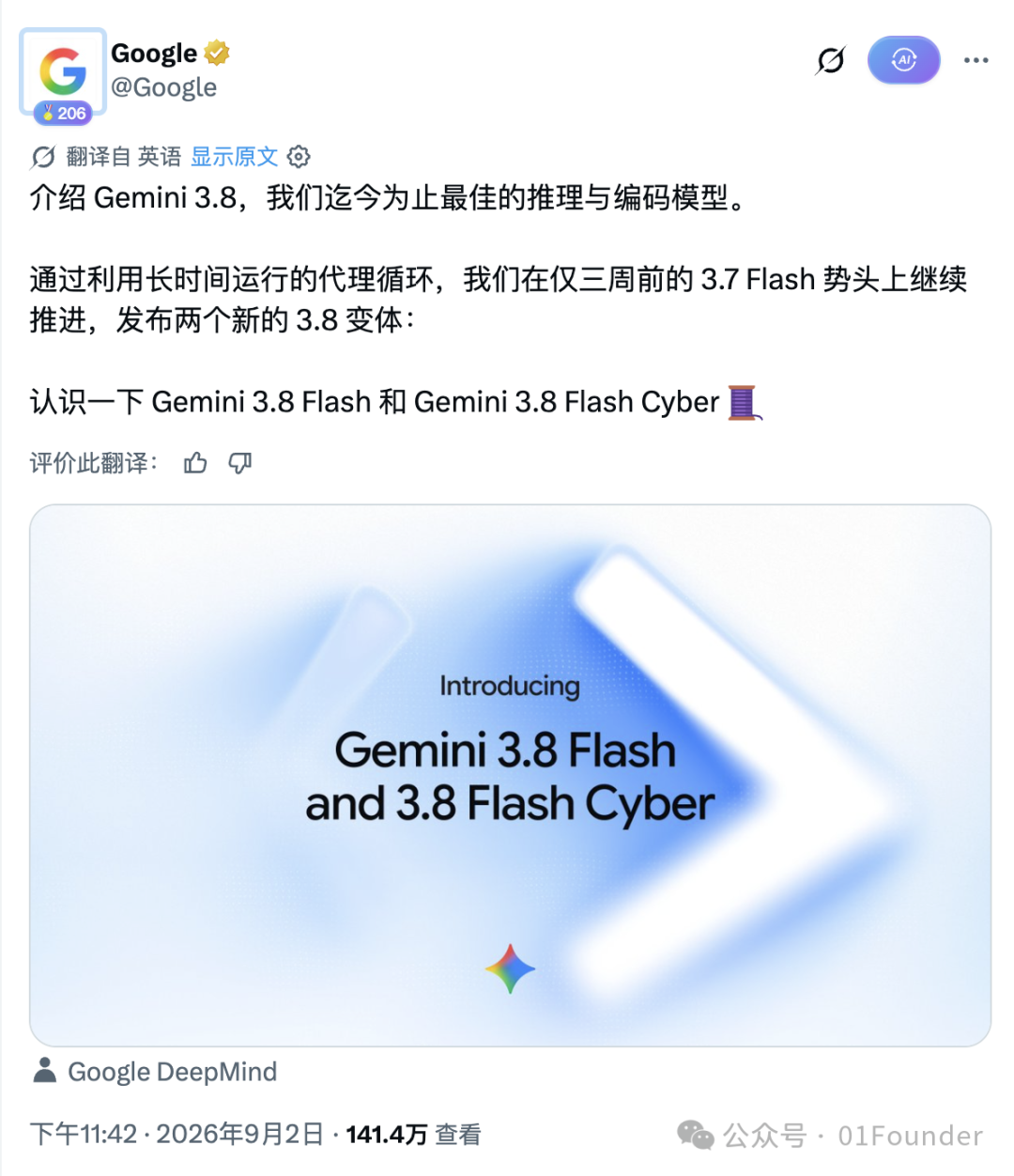
This is also the third update to the Flash series within six weeks, from 3.6 to 3.7, and now 3.8.
Previously, Flash had always been perceived as very simple: faster, cheaper, but less capable than the strongest models.
Google is now gradually changing that definition.
This time, the core enhancements of 3.8 Flash focus on long-horizon coding and agentic workflow.
On the DeepSWE v1.1 benchmark for measuring AI long-cycle software engineering capabilities, it achieved about 74%.
The biggest difference between DeepSWE and traditional code benchmarks is that it does not simply present a model with an algorithmic question; instead, it really puts the Agent into a code repository.
The model needs to understand the problem, search for code, modify files, call tools, run tests, and continue to identify reasons for failure.
A complete task may span dozens or even hundreds of steps.
In such tests, Gemini 3.8 Flash briefly achieved the world number one.
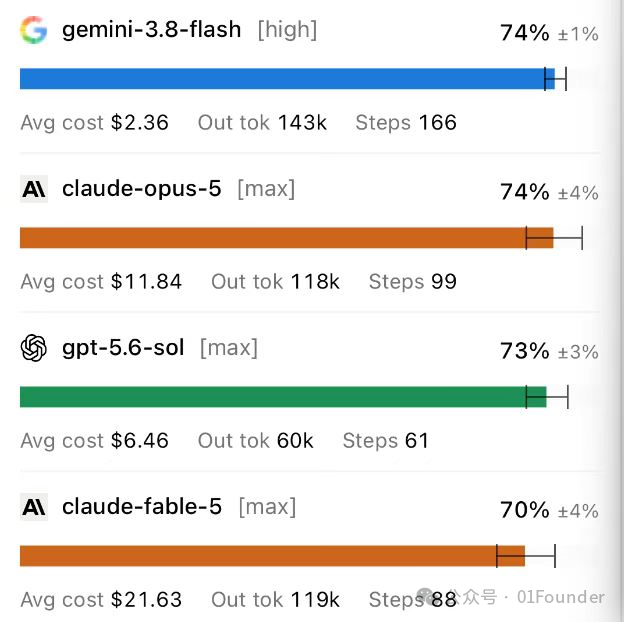
Claude Opus 5 also achieved about 74%, GPT-5.6 Sol around 73%, and the previously leading Fable 5 approximately 70%.
If we look only at capabilities, there is no particularly huge gap among these top models.
What is truly alarming is another figure: money.
The API launch price of Gemini 3.8 Flash remains at $0.75 for input and $3.75 for output per 1M tokens.
Completing a full task on DeepSWE averages only $2.36.
In comparison, Claude Opus 5, also around 74%, has an average cost per task of $11.84; GPT-5.6 Sol, at approximately 73%, averages $6.46.
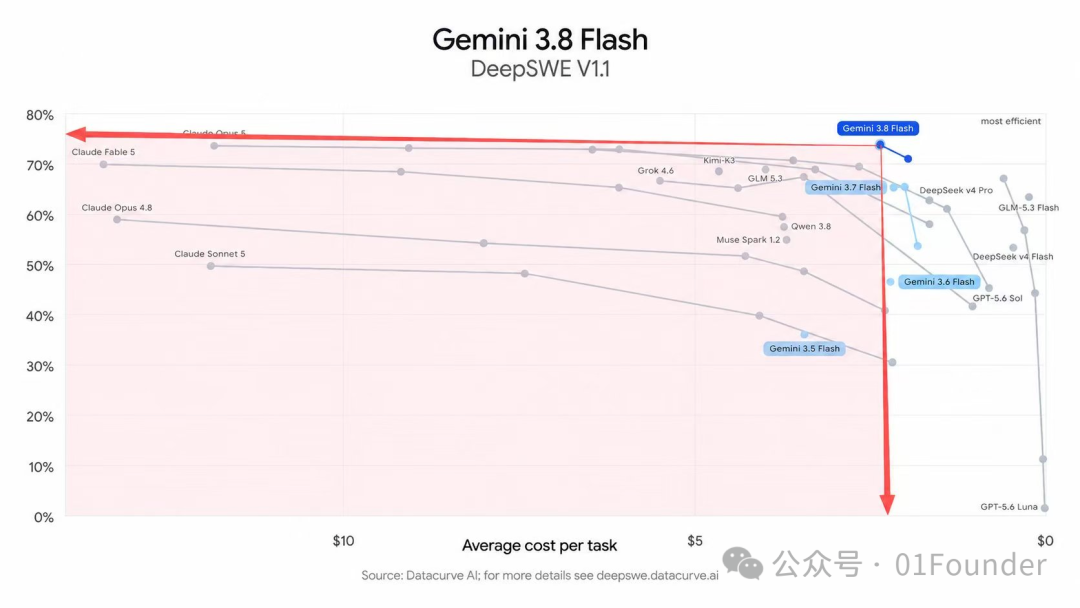
This means that for software engineering capabilities at the same level, the execution costs can differ by several times.
This will become very important in the Agent era.
In the chatbot era, whether an answer costs a few cents more or less was not perceptible to ordinary users.
But Agents are completely different; a coding agent may run continuously for 100 steps, a research agent might search dozens of web pages, read hundreds of pages, and in the future, Agents in companies could even work for several hours in succession.
Google even mentioned that 3.8 Flash will actively work harder, performing more reasoning and tool calls when encountering complex tasks.
Google didn't make the model "think less" to save money, but rather because tokens have become cheap enough, which allows the model to run longer loops.
Therefore, I believe the significant point of 3.8 Flash is not that it has taken another world number one.
Rather, it is that it is pushing capabilities that were previously only available in the most expensive frontier models, into the price range of Flash.
PART.02, Meta Fought Back After Three and a Half Hours
While Google was celebrating the release of Gemini 3.8 Flash, Meta suddenly fought back.
Meta suddenly released the Muse Spark 1.3 model.
According to Meta's published assessment, Muse Spark 1.3 achieved a score of 75.4% on DeepSWE v1.1.
This number surpasses Gemini 3.8 Flash, Claude Opus 5, and GPT-5.6 Sol.
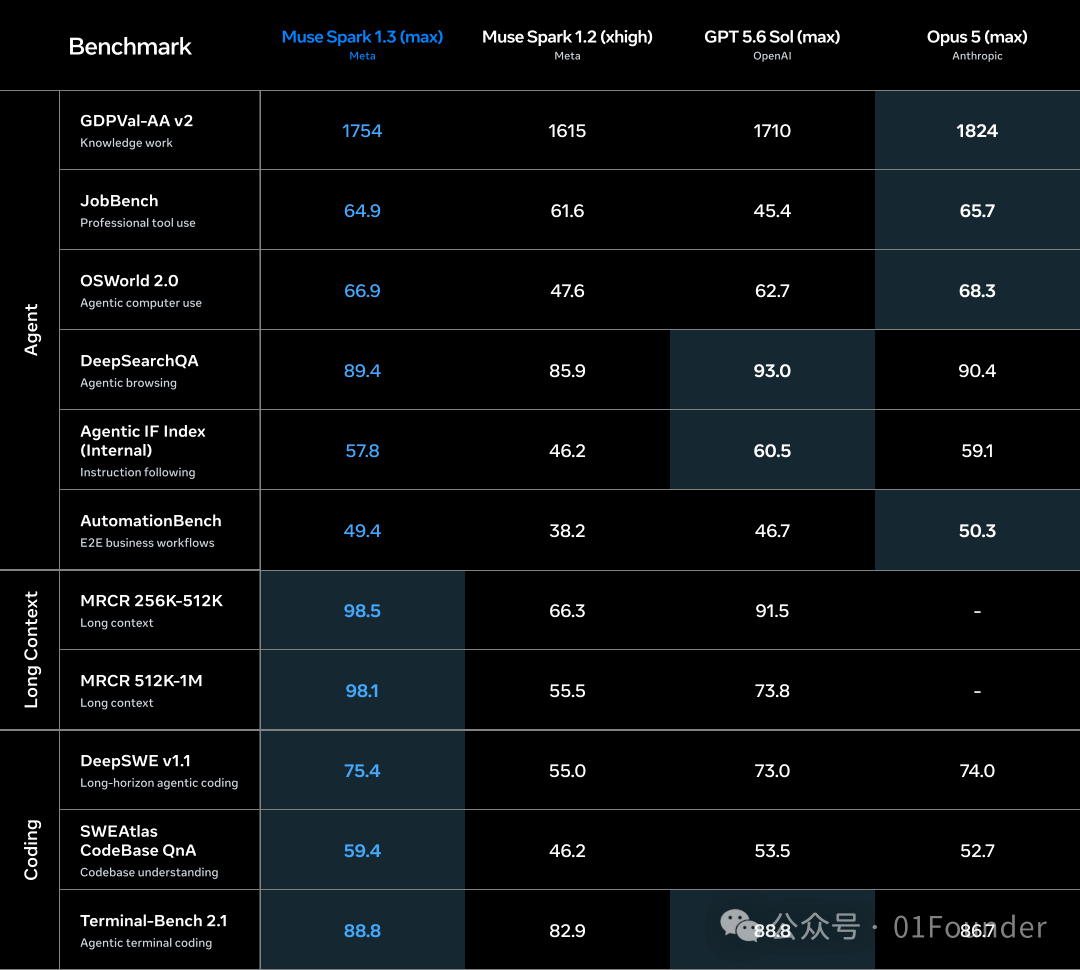
Even more exaggerated is that Muse Spark 1.2 only had a score of about 55% in this test.
From 1.2 to 1.3, a minor version update directly improved the score by about 20 percentage points.
But I think that what is truly worth noting about Meta this time is not the 75.4%.
There are two other figures: Tool calls decreased by about 20%, token consumption reduced by about 25%.
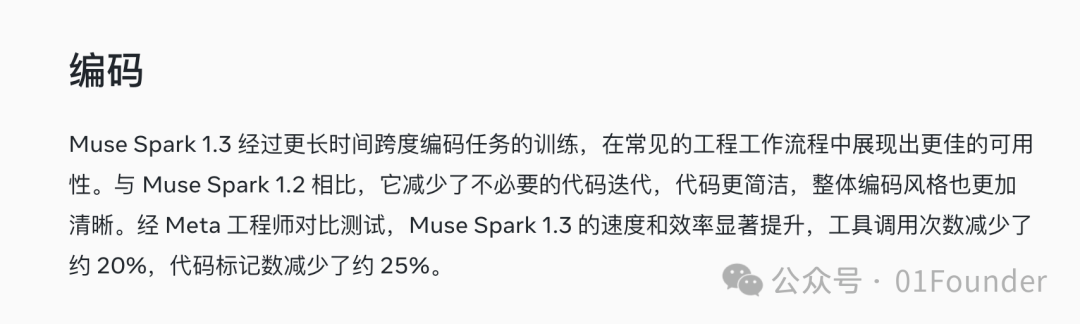
This may easily be overlooked, but it is actually very close to the most important issue after Agents are truly commercialized.
One of the most costly aspects of an Agent often isn’t regular reasoning, but rather going off track.
For instance, if a coding agent misunderstands the requirements at step 20, it may continue to modify five files, run three rounds of tests, and search massive amounts of code, only to discover the route was wrong after wasting dozens of tool calls and thousands of tokens.
So if a model can detect ambiguities in a task earlier, know sooner when it can't proceed, and ask the user sooner, it is directly reducing costs.
Many of the capabilities that Muse Spark 1.3 has strengthened belong to this category: it can maintain multiple workflows simultaneously in long threads, proactively ask about ambiguous tasks, request help for unsolvable problems, confirm before irreversible actions, and after many rounds of running long tasks, it is also less likely to forget initial constraints.
Meta has even begun to emphasize the model's recognition of its own limits: knowing what it can do and what it cannot do.
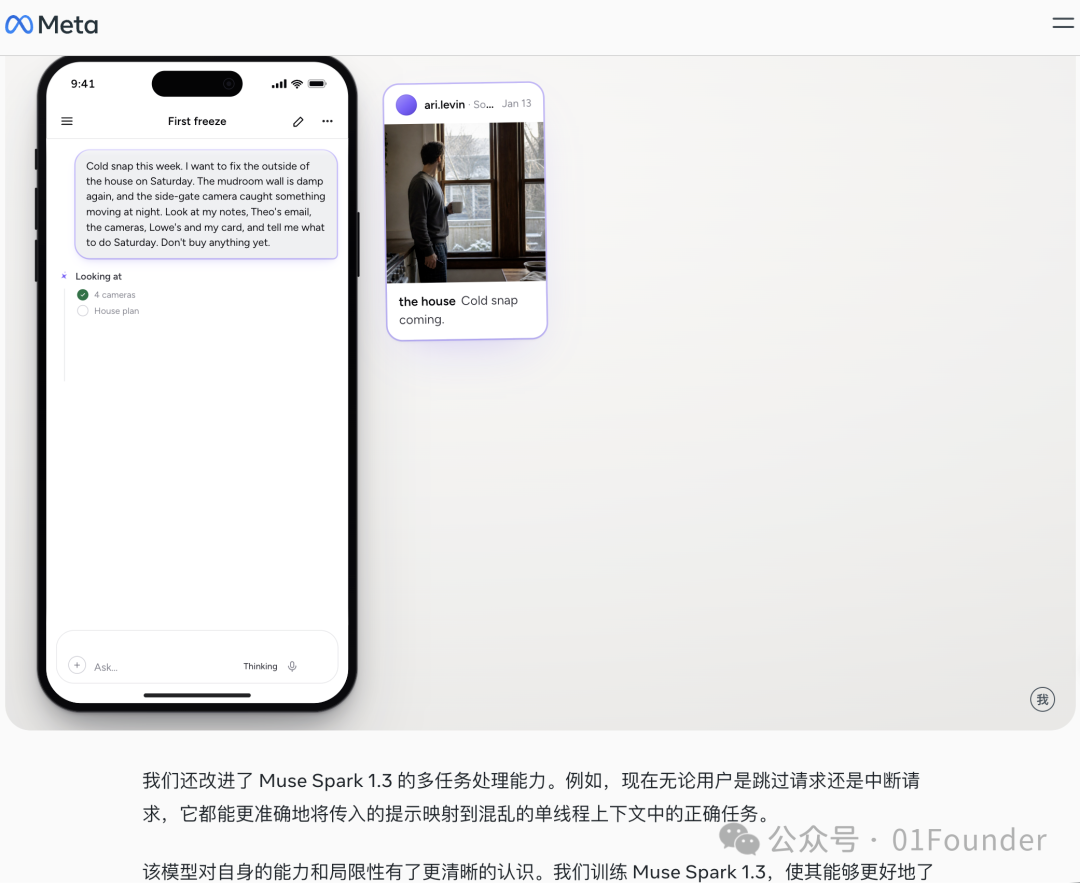
These capabilities may not seem as attractive in the Chatbot era as a 20-point increase in benchmark scores, but in the Agent era, they can be directly converted into money.
Having an Agent make one less mistake is itself an optimization of reasoning.
So when looking at Google and Meta together, the metric of competition among large models is subtly changing.
In the future, people may pay less attention to "How much is one million tokens?" and more to another number:
How much does it cost to run a real task from start to finish?
PART.03, Mostik, a Disruptive Breakthrough
If Google and Meta are still studying how to complete tasks using cheaper and fewer tokens, then Mostik is starting to tackle a more fundamental question:
Why do these tokens have to exist?
Mostik means "bridge" in Russian.
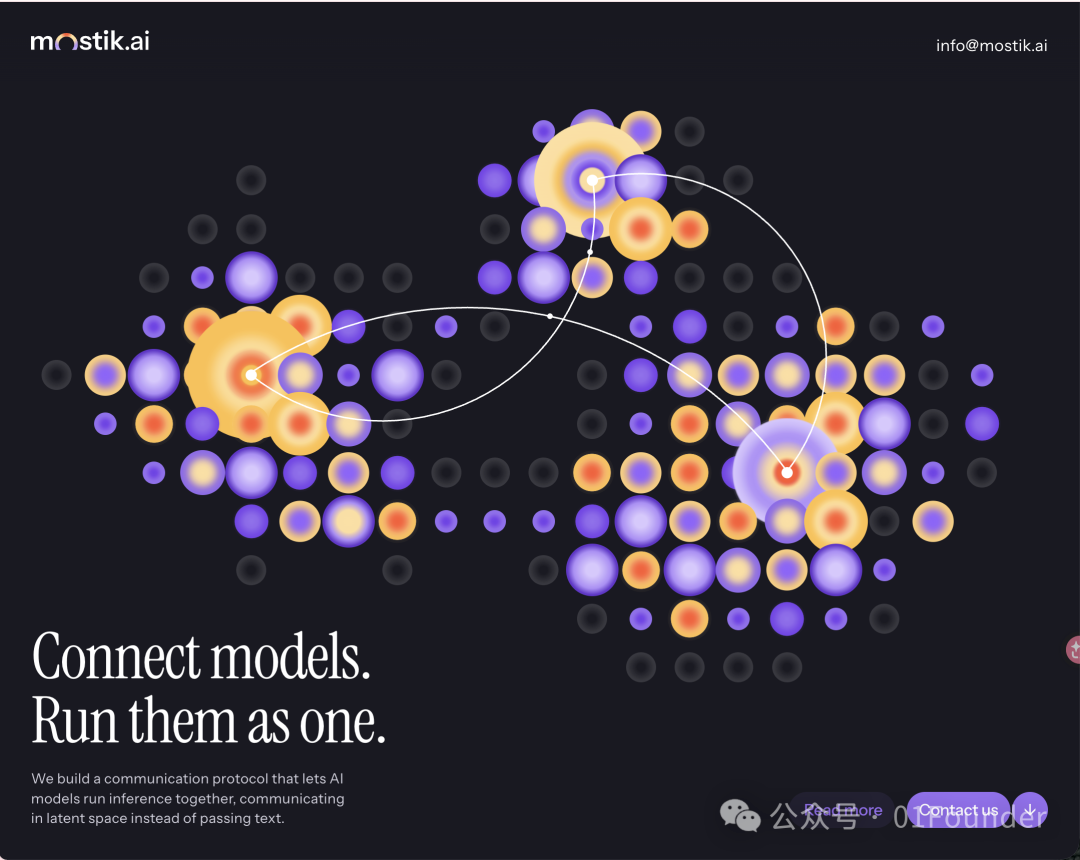
CEO Sasha Malysheva is the main developer of this method, and its chief scientist is Stanislav Smirnov, a professor at the University of Geneva and a recipient of the Fields Medal in 2010.
They are trying to do something that sounds very simple but is actually extremely difficult: making two AI models stop communicating through natural language.
Today, the vast majority of Multi-Agent systems work this way:
Model A receives some information, generates hundreds or even thousands of tokens to express its conclusions in natural language; Model B then reads all this text, reinterprets it, builds its internal representations, and continues reasoning.
The problem is that what large models actually compute is not Chinese or English, but rather:
high-dimensional continuous mathematical representations.
This is akin to two computers that can direct data transfer, but computer A first prints the information into hundreds of pages, then lets computer B scan them one page at a time using a camera for OCR.
People have been researching how to reduce printing costs, while Mostik wants to simply get rid of the printer.
They are attempting to build a bridge between the internal representations of different models, allowing models to exchange latent representations directly without generating natural language first.
An experiment revealed by the authoritative Silicon Valley media WIRED is very interesting.
Mostik bridged a complete GLM-5.2 753B model with a smaller 4B model that can run on mobile devices, Qwen 3.5.
The resulting hybrid system combines capabilities from both models but incurs only 1/20 of the inference cost of the full GLM-5.2.
Of course, it’s still too early to say that Mostik has solved model communication.
Latent communication itself is not a new concept; in recent years, there have been many attempts to exchange embeddings, hidden states, KV caches, etc.
The real challenge lies in the fact that different models have different architectures, parameters, training data, and internal coordinate systems, making the task of getting two models to truly understand each other's latent space particularly difficult.
Smirnov himself has admitted that there is currently even a lack of mature mathematical language to describe the common representations between different models.
But the 1/20 figure still excites me.
Because it makes me seriously contemplate a completely different future AI architecture.
PART.04, In the Future, You Only Need a 0.xB Model
Over the past two years, when discussing edge-side AI, we have been researching how to fit larger models into phones: 7B, 4B, 3B, 1B, continuously distilling, quantizing, compressing.
But if Mostik's approach actually proves viable, I believe future smartphones might not need a "jack-of-all-trades" large model at all.
Your device may only need to run a 0.xB or a few B small model.
It’s inexpensive, can run continuously, is responsible for understanding what app you are currently using, what you have just done, the state of the device, and handle the vast majority of simple, high-frequency tasks.
When truly challenging problems arise, it can call upon the remote large model through latent space communication.
But the key difference is that it will not need to resend a hundred thousand tokens of context to the cloud, letting the remote model start from scratch.
It might only need to transmit a highly compressed latent state.
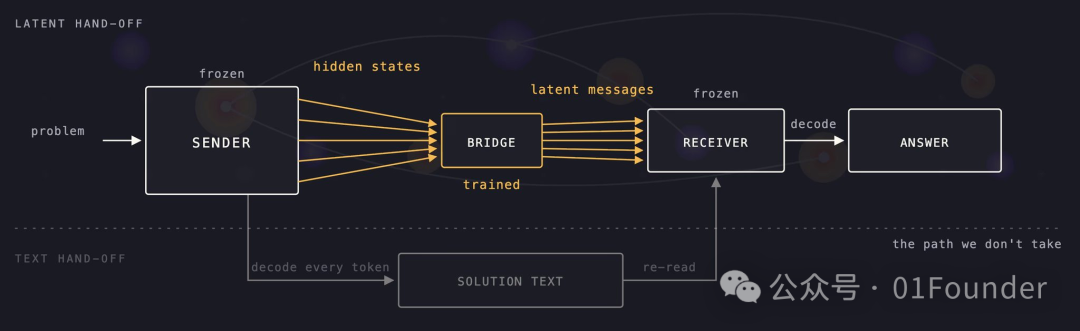
After the remote large model completes complex reasoning, it also doesn’t necessarily need to generate thousands of tokens of natural language explanations for the local model; it can directly send back the new internal representation.
This way, the local small model is responsible for high-frequency, low-cost, continuous operations, while the cloud frontier model only takes on low-frequency but genuinely complex reasoning, with a certain type of bridge facilitating efficient communication in between.
If this can really be achieved in the future, the scale of reduction in reasoning costs might far exceed the current 30% or 50% price drops in model APIs.
It could change the way we organize AI computing itself.
PART.05, Conclusion
So looking back at last night, on the surface, it was three completely different pieces of news.
Google released Gemini 3.8 Flash, pushing frontier-level capabilities into the price range of Flash;
Meta released Muse Spark 1.3, enabling Agents to achieve more with fewer tokens and tool calls;
Mostik took it further by trying to eliminate the need for some tokens in communication between models from the start.
They all point to the same change:
Intelligence is becoming incredibly cheap at an astonishing speed.
And this price reduction is no longer just about decreasing the unit price of APIs.
The cost of models is decreasing, the computational requirements for completing tasks are dropping, and now even the ways in which models exchange information are being redesigned.
The impact this may ultimately bring is far greater than just a few percentage points rise in benchmarks.
Because many technologies truly explode not when they are "first usable", but when they are "finally cheap enough to use without hesitation."
Today, it might be entirely unfeasible for an Agent to spend several tens of dollars to complete a simple task for an ordinary person.
If in the future it only costs a few dimes, many applications that currently wouldn’t even be considered suddenly come into existence.
We currently can't have dozens of Agents running around a single person for 24 hours, but if reasoning costs drop by an order of magnitude, it could become the default state.
It is already seven o'clock in the morning, and I should have gone to sleep several hours ago.
Instead, after Gemini's release, Meta followed up a few hours later, and then I saw Mostik’s 1/20 experiment.
Once I lay down in bed, my mind kept racing with these topics, thinking about the 0.xB model in phones, about the large models in the cloud, and how they might not even need to communicate via natural language anymore.
The more I thought, the less I could sleep, and ultimately I got up to finish writing this article.
Gemini's 74%, Muse's 75.4% may soon be superseded by new numbers.
But I find it truly hard to calm down this excitement.
Because compared to who has claimed the world number one again, I’m increasingly concerned about another question:
Just how cheap can such intelligent AI become?
Once powerful intelligence truly becomes cheap enough to be used at will, I think many AI products that currently seem outrageous are just beginning.
免责声明:本文章仅代表作者个人观点,不代表本平台的立场和观点。本文章仅供信息分享,不构成对任何人的任何投资建议。用户与作者之间的任何争议,与本平台无关。如网页中刊载的文章或图片涉及侵权,请提供相关的权利证明和身份证明发送邮件到support@aicoin.com,本平台相关工作人员将会进行核查。


