Meme can directly borrow a popular stock for narrative, while bringing the funds used for trading Meme into the liquidity of the stock token.
Written by: bootly
Robinhood Chain has undoubtedly become one of the hottest fund venues on-chain. Meme, coin-stock pairs, and high-yield protocols are taking turns in volume, and many early players have already reaped the first wave of dividends.
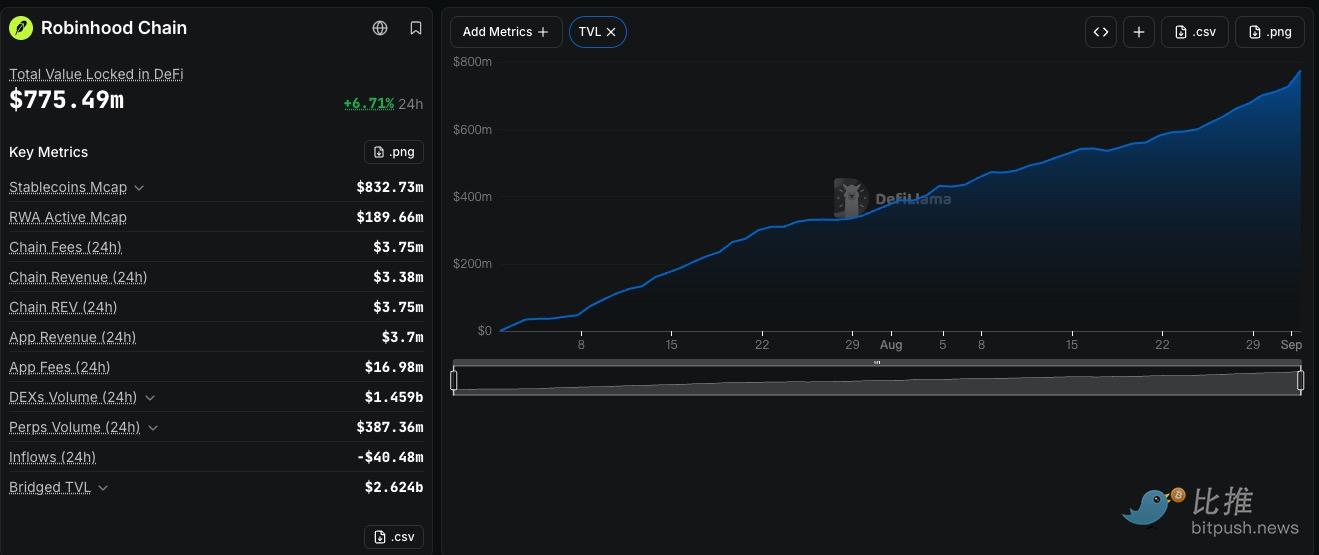
DefiLlama's data from September 2 shows that the DeFi TVL on Robinhood Chain has reached approximately $775 million, with 24-hour DEX trading volume around $1.45 billion and 7-day trading at $7.78 billion, with on-chain revenue once breaking into the forefront of mainstream public chains.
The hottest trend currently is the "coin-stock pairing Meme": Meme no longer just pools with ETH and stablecoins, but directly uses stock tokens like NVDA, AAPL, SPCX as collateral assets.
For example, in the AI/NVDA pool, AI is priced in NVDA. The dollar price of AI depends on the price of AI relative to NVDA, but also on the price changes of NVDA itself. For instance, after pairing $AI, $REAL and NVDA in July, it clearly drove on-chain transactions of NVDA stock tokens; by the end of August, $AI's market capitalization once surpassed $100 million.
However, buying AI does not equal holding NVIDIA. NVDA is just the asset on the other side of the liquidity pool; AI does not have NVDA's equity or redemption rights.
The truly special aspect of this play is that Meme can directly borrow a popular stock for storytelling, while bringing the funds used for trading Meme into the liquidity of the stock token. Launchpad standardizes this process: trading is initiated through bonding curves or automated market makers (AMM).
Surrounding this craze, some popular DeFi projects have begun to emerge on Robinhood Chain.
Pons: One of the Hottest Meme Launch Platforms
Official Website: Pons
Documentation: Pons Docs
Pons can be understood as the Robinhood Chain version of Pump.fun. The project first trades through a Bonding Curve and enters Uniswap V4 once conditions are met.
Its trading cost is not a uniform rate but rather a base trading fee plus a creator tax (Creator Tax), with specific parameters determined by each project and cannot be arbitrarily increased after issuance.
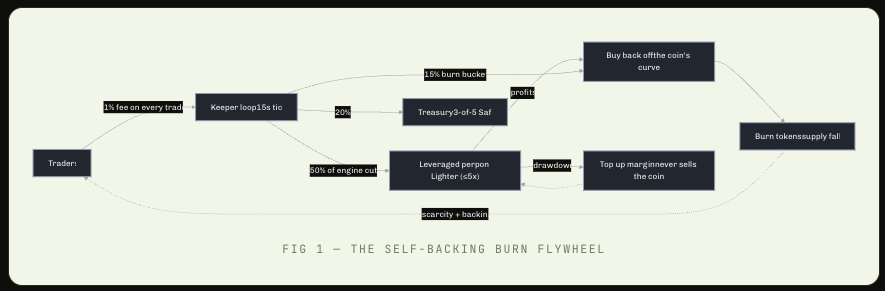
New coins have a snipe tax (Snipe Tax) for early buyers. The mechanism provided in the official documentation indicates that the buy-in tax during the earliest stage may reach about 25%, then rapidly decay to zero in a few seconds. Therefore, regular players do not need to compete with bots for speed in the first second.
Additionally, price impact must be considered. Suppose a Meme has a total trading tax rate of 4%; even if the price doesn’t move, the theoretical loss from a buy and sell will approach 7.8%, and combined with slip from a small pool, the actual loss might be higher.
Pons also launched PONZ, starting to include treasury, protocol-owned liquidity, and borrowing. Currently, the official website shows a borrowing rate of about 0.5% for PONZ.
The Index: Meme Transaction Fees Go to Buying Stocks
Official Website: The Index
The Index's gameplay is very straightforward: buy and sell INDEX with a 3% ETH transaction fee, and the protocol uses part of the fee to buy stock tokens like NVDA, AAPL, TSLA, and distributes them to eligible INDEX holders.
In other words: INDEX trading → collects fees → buys stock tokens → distributes to holders.
The official website currently shows that the protocol has cumulatively collected hundreds of ETH in fees and allocated stock assets exceeding one million dollars; the cumulative protocol revenue and holder income recorded by DefiLlama have also reached the million-dollar level.
The problem with this model is also very direct: the revenue is highly dependent on the transaction volume of INDEX itself.
Moreover, a 3% trading tax is not low. Assuming a buy and a sell each incur a 3% tax, not counting slippage, a complete entry and exit theoretically results in about 5.9% loss. So if the aim is only short-term trading, the cost can easily eat away at the so-called "stock distribution earnings."
Ripe Protocol: Borrowing Against Coin-Stock, Also Can Mine RIPE with Meme
Official Website: Ripe Protocol
Documentation: Ripe Docs
Ripe has recently gained attention, mainly with two sets of plays.
The first set is stock token collateralized borrowing. Users can deposit assets like NVDA, AAPL, GOOGL, TSLA, SPCX, and borrow the protocol's stablecoin GREEN, gaining liquidity without selling their stock exposure.
New borrowing incurs an approximately 0.25% origination fee, and ongoing borrowing interest is required to be paid thereafter.
The second set is community farms. Popular ecological coins on Robinhood Chain like PONS, INDEX, AI, CASHCAT can all be deposited to earn RIPE, with some pools currently offering annual yields still reaching several dozen percentage points.
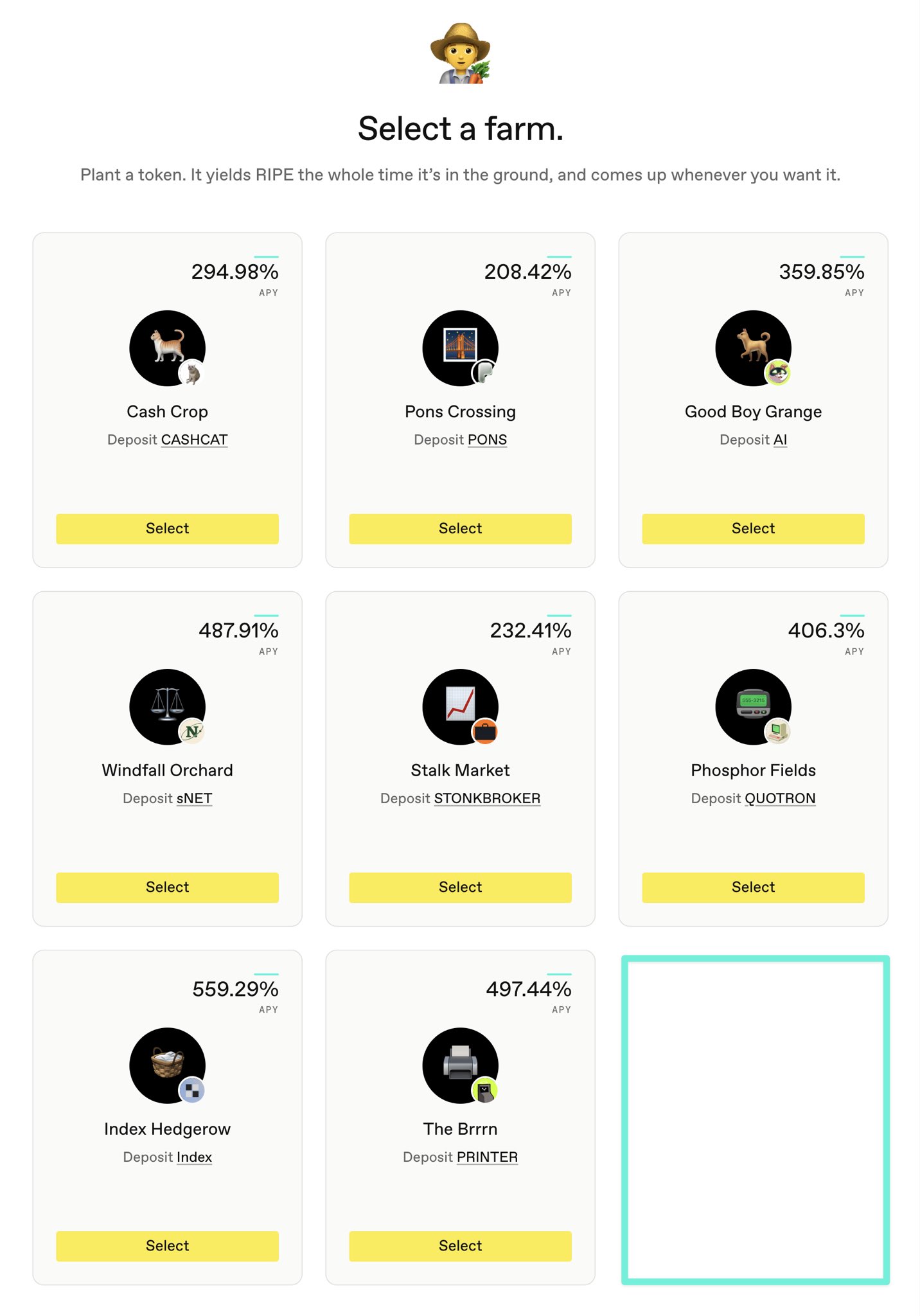
These types of farms are reminiscent of the "Food Farms" of 2020, but it should be noted that a significant part of the high annual yield comes from the issuance of RIPE tokens, and does not represent equal cash revenues generated by the underlying projects themselves.
If using stock tokens to pledge for GREEN, it is also important to be cautious of liquidation. The liquidation fees for different assets range around 5% to 15%, along with keeper rewards, therefore the highest allowed borrowing ratio on the interface does not equal the ratio suitable for regular players.
EARN: Letting Stock Tokens Earn Market-Making Fees Themselves
Official Website and Documentation: EARN
EARN automates market making for stock tokens.
Users deposit stock tokens, USDG, or both, with the vault automatically deploying assets to concentrated liquidity pools and adjusting the market-making range based on price changes. The revenue mainly comes from the real exchange fees paid by traders.
The fee structure is quite clear:
85% of the liquidity fee revenue goes to vault users, and 15% goes to the strategy parties.
Here, the 15% is taken from revenue, not directly from principal.
However, providing liquidity also has a cost that is not directly labeled as "fees": impermanent loss.
For example, if NVDA continues to rise, the liquidity pool will continuously sell part of NVDA for other side assets during the process, which may result in a situation where "earned fees, but the earnings lag behind directly holding NVDA." Therefore, when looking at EARN, one cannot just look at the annual yield, but also compare the vault's net worth against directly holding the tokens.
hoodfi: Hedging Directional Risks
Official Website: hoodfi
hoodfi takes a more strategic approach.
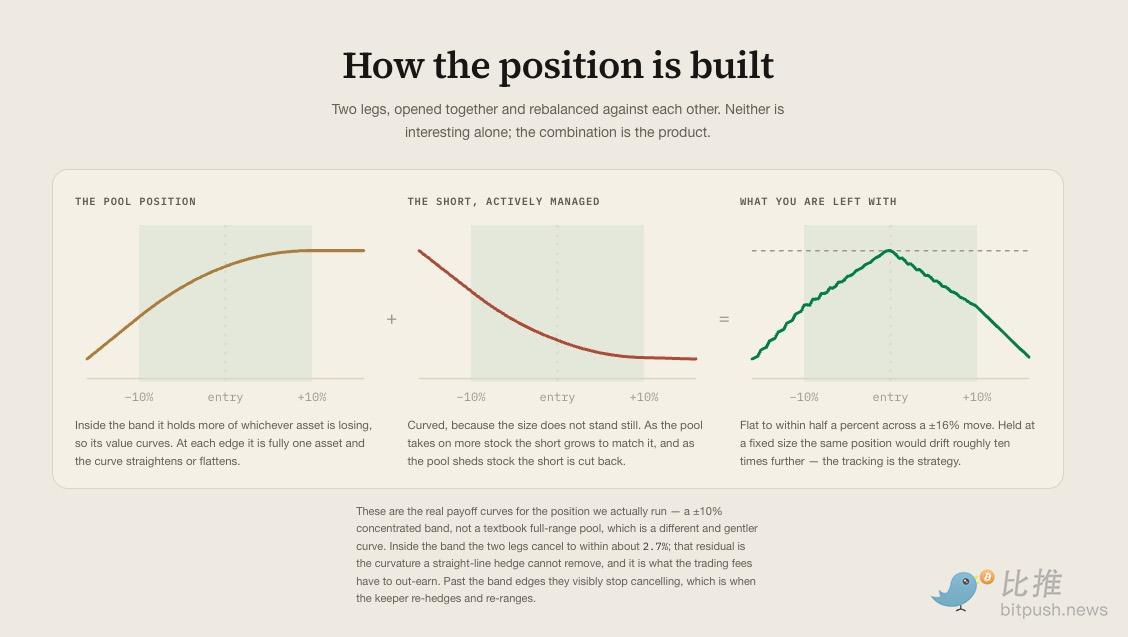
Ordinary NVDA/USDG liquidity providers earn fees while still bearing the price fluctuations of NVDA. hoodfi aims to establish hedge positions outside the liquidity positions, hoping to reduce the directional exposure of the stock itself and concentrate more earnings on trading fees.
Simply put, it does not bet primarily on whether NVDA will rise or fall, but rather on the expectation that there will continue to be trading on-chain for NVDA in the future.
The project is still in its early stages. The official website displays its coverage of market liquidity and trading volume, but these do not represent hoodfi's total locked value, and currently, there is no very clear strategy fee structure like EARN, making it more suitable as an observation project.
A Point Ordinary Players Easily Overlook
The annual yields shown on these project pages are often very high, but when actually participating, it’s best to sum up all costs first.
The Index incurs a trading tax of 3% leading to an almost 5.9% loss for complete entry and exit; Pons has to factor in creator tax, snipe tax, and slippage; Ripe must account for origination fees, borrowing interest, and potential liquidation costs; EARN deducts 15% for strategy sharing and considers impermanent loss.
So when seeing a 50% or 80% annual yield, it’s best to first calculate:
Expected actual earnings during holding period - trading tax - slippage - strategy sharing - borrowing costs.
If only planning to hold for a few days, even the highest annual yields may not be meaningful. A single 5%-8% entry and exit loss can very likely exceed the farm earnings that could be gained during those days.
Recently, the operations of the on-chain address 0x7e3ba illustrate how aggressive this wave of trends has been. According to on-chain tracking data disclosed on September 1, this address first used approximately $106,500 to buy 11.8 million CASHCAT, then sold all for about $672,600, generating a single transaction profit of about $566,000. It then used about $113,700 to buy 10.2 million PONS, and after selling around 1.1 million, it retrieved $117,100, effectively getting back the principal, with the remaining 9.1 million PONS worth around $4.2 million at that time. The total investment of approximately $220,000 at one point had a paper and realized profit exceeding $4.7 million.
This case certainly cannot be simply replicated, but the operational idea deserves attention: it is not frequently switching between dozens of small coins, but rather investing early in a few leading tokens that have started forming liquidity; selling part first to recover the principal after an increase before letting the remaining position continue to be exposed to high volatility.
If you are a regular player with only a few thousand dollars of capital, what is more worth emulating instead: carefully calculate transaction taxes and slippage, control single transaction size; recover the principal in batches once there is sufficient price increase, and do not mistakenly regard high annual yields and paper market values as already realized profits.
免责声明:本文章仅代表作者个人观点,不代表本平台的立场和观点。本文章仅供信息分享,不构成对任何人的任何投资建议。用户与作者之间的任何争议,与本平台无关。如网页中刊载的文章或图片涉及侵权,请提供相关的权利证明和身份证明发送邮件到support@aicoin.com,本平台相关工作人员将会进行核查。


