Author: Alea Research
Translated by: Shen Chao TechFlow
Shen Chao Introduction: Ether.fi's consumer business monthly transaction volume has surpassed 100 million, yet the token ETHFI has dropped 21% since the beginning of the year. Can the buyback vote serve as a price catalyst? This article dissects its account model's revenue structure, sources of buyback funds, and key variables before the voting deadline, which is important for holders and those interested in the on-chain financial account space.
Broader financial accounts. Ether.fi combines investments with daily payments, creating more revenue streams from each customer.
Cash consumption grew by 85%. Monthly transaction volume grew from 54.3 million in January to 100.3 million in July. Its share in tracking card spending remained around 10%.
ETHFI: down 21% year-to-date. Based on $0.55, its trailing annual revenue multiple based on fixed maximum supply is 14.2 times.
Annualized buyback funds of $16 million. This is an example given by the proposal based on July data, pending approval and not deducting rewards distribution.
September 3: Voting deadline. The proposal requires 1 million ETHFI to meet the quorum. Borrowing adds to the fund pool, which is $50 million, while the proposal states $26 million.
Ether.fi's Account Vision
Ether.fi hopes customers manage funds in a self-custody account. It announced its vision of integrating staking, liquidity, and cash in May 2024. Today, the account combines four functions:
Savings and earning. Hold assets in a self-custody vault, with options for staking and investment strategies.
Spending and transfers. Use Cash for payments and transfer funds via fiat and crypto channels.
Trading. Buy and sell cryptocurrencies, tokenized stocks, and metals, depending on local availability.
Borrowing. Gain liquidity with qualified collateral through an exclusive Aave market.
Ether.fi also provides corporate accounts for company treasuries and employee cards. Its client interface combines some services based on partner infrastructure, including Aave lending and card payment gateways. It is this vertical integration, and how all parts work together to form a feedback loop, that gives it a strategic advantage.
The business model and end-user usability stand out due to its practicality. Income-generating assets support collateralized borrowing, funding Cash consumption without needing to sell assets. This creates fee income while reducing the need to transfer assets to other providers. Membership benefits also encourage customers to stake ETHFI, making staking's value derive from all business lines. This makes Ether.fi not only a differentiated on-chain financial account but also highly sticky.
Cash Consumption Nearly Doubled
Paymentscan recorded Cash monthly consumption at $54.3 million in January and $100.3 million in July, an 85% increase.
Monthly active addresses reached 40,040, up 83% from 21,898. The spending per address saw almost no change, increasing from about $2,479 to $2,505. The number of monthly transactions per address dropped by 22%, while the average transaction amount rose by 29%.
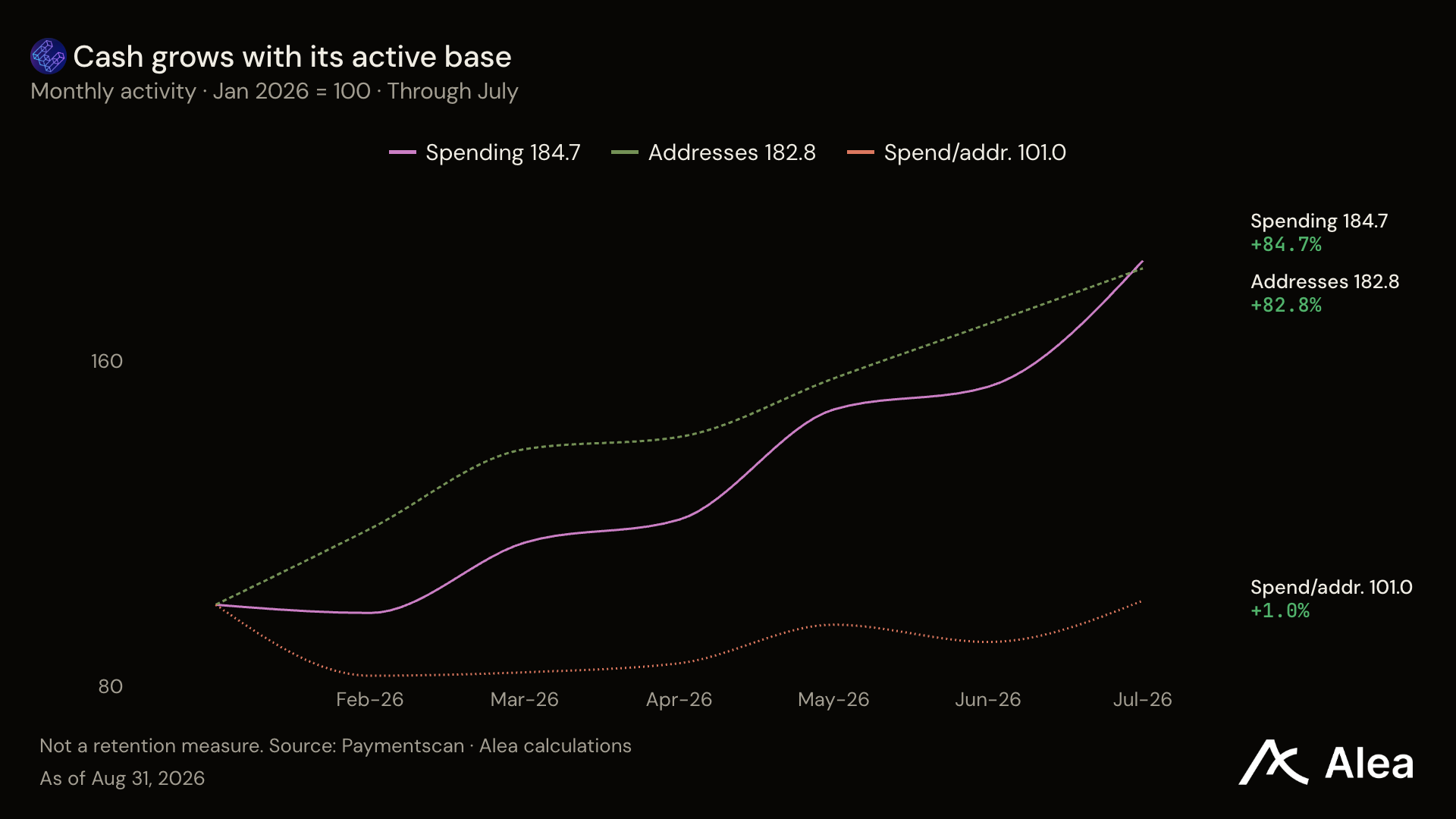
A larger active user base explains most of the consumption growth.
During the same period, the broader tracking market expanded by 81%. Cash's share grew from 9.5% to 9.7%, a relative increase of 2%. Cash has kept pace with this rapidly growing category. Paymentscan reveals that its coverage includes self-reported off-chain data. The sample excludes parts of the card market.
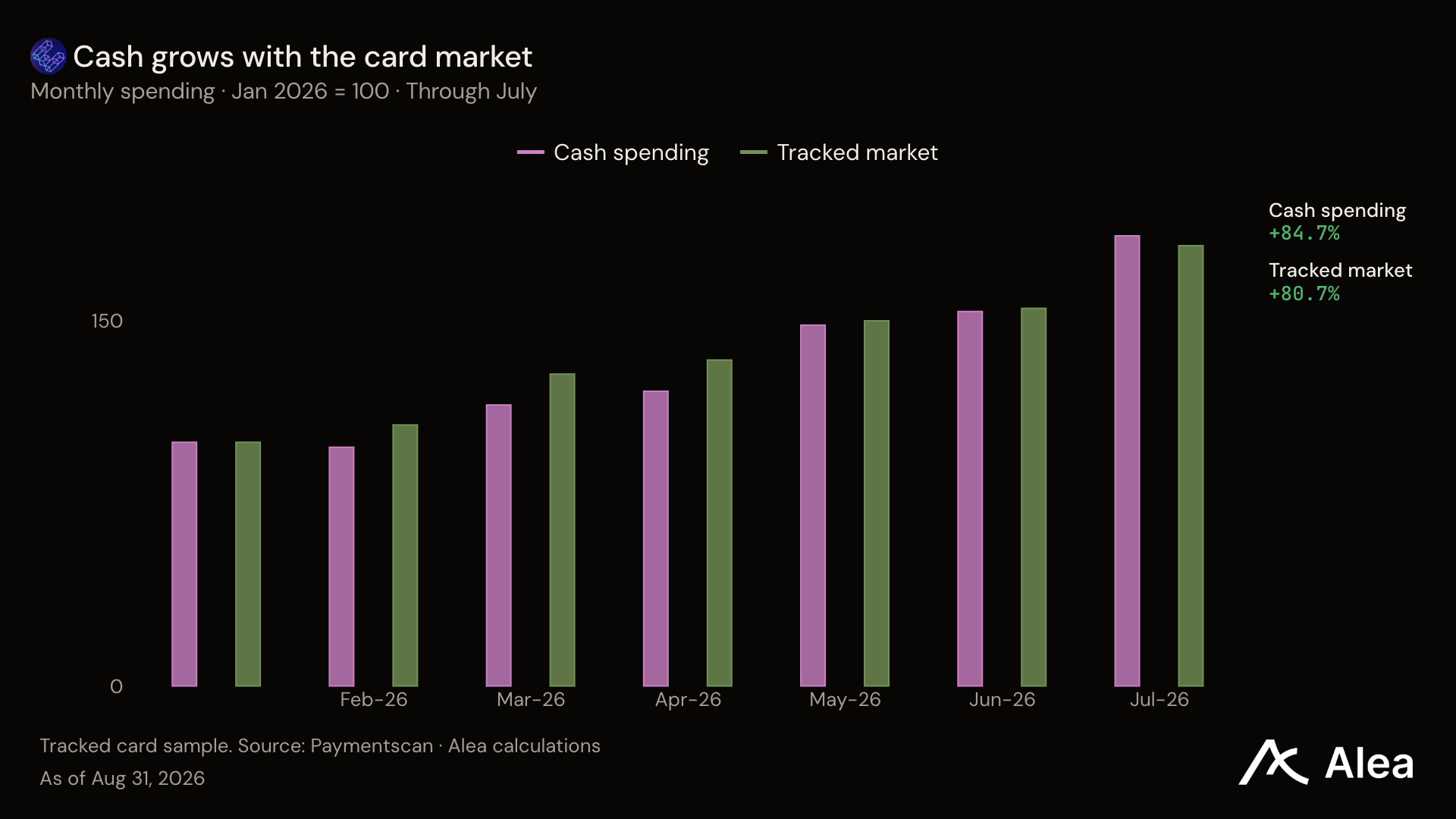
Cash has kept pace with the growth of its category.
Nexo has already combined borrowing and spending. KAST combines cards with accounts and earnings. Gnosis Pay supports self-custody consumption. RedotPay leads in Paymentscan's current transaction volume rankings. However, the competitive opportunity lies in cross-service convenience. The contribution margin after reuse and rewards will determine the strength of this advantage.
How the Account Earns Fees
Cash monetizes spending through card swipe fees. DefiLlama released an adapter estimating revenue at 1.38% of consumption: each $1 billion in annual transaction volume means a pre-cost income of $13.8 million for the company. Earn charges fees for staking and treasury. Increased transactions generate trading fees. Borrowing takes a portion of the fees retained from its lending market.
The Aave proposal dated July 14 disclosed that ether.fi receives 80% of instance protocol fees, with Aave taking 20%. This revenue share does not include loan principal and interest paid to lenders, while Ether.fi is responsible for operational costs and risk management.
According to DefiLlama's report on the four business lines' revenue, as of August 30, its rolling 30-day annualized total revenue reached $38.5 million, of which $17.6 million came from Cash. Cash's annualized run rate has almost doubled since January 1, while total income tracking has dropped by 22%, due to weakened staking and falling ETH prices.
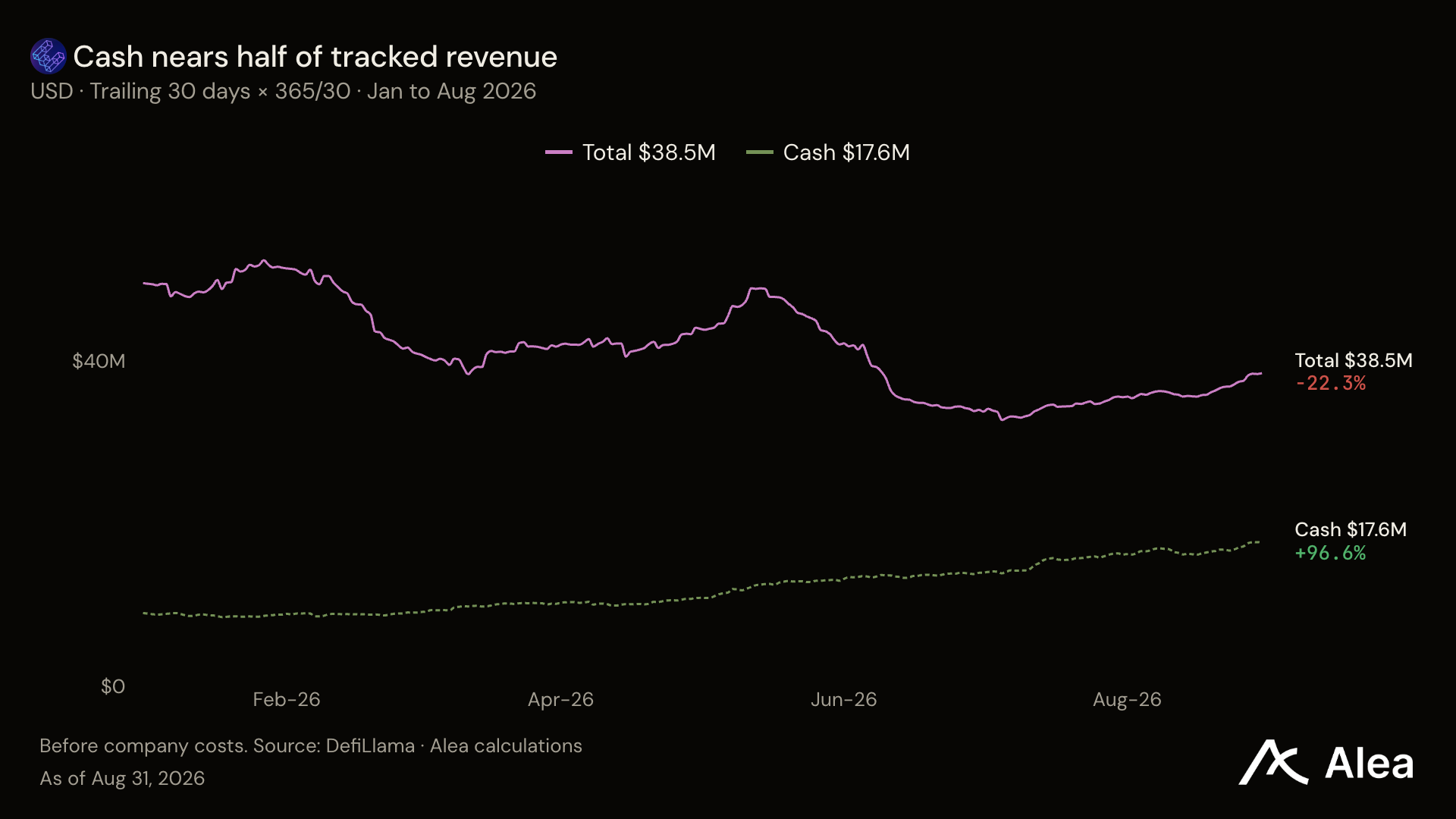
As staking weakens, Cash is diversifying its revenue.
Cash's share in monthly revenue increased from 17% in January to 46% in July.
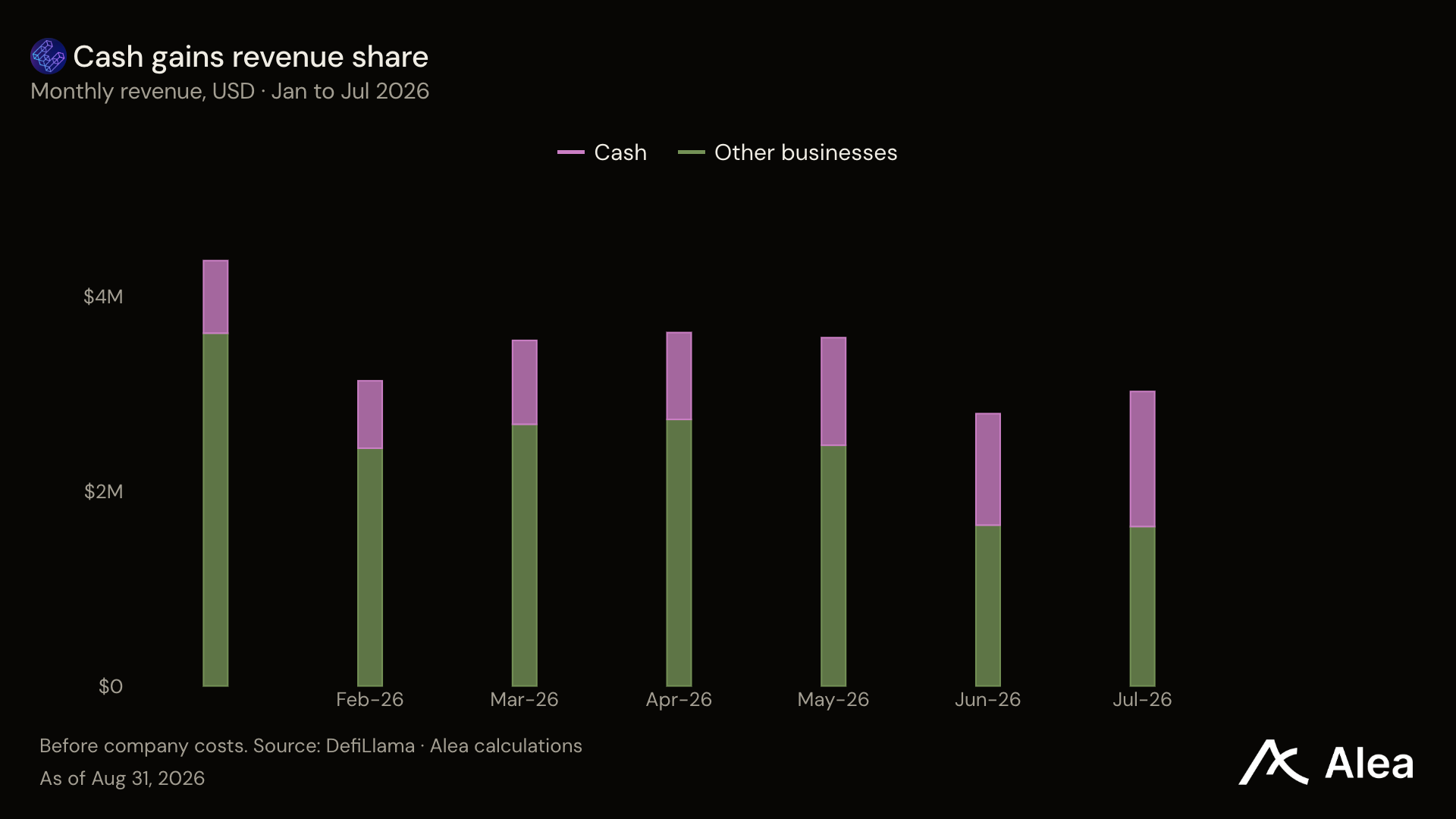
Cash occupies a larger share of the shrinking total revenue.
What was Released on August 13th
The summer version announced on August 13 included trading of tokenized stocks and metals, along with an integrated Aave market. The redesigned app added over 30 currencies and payment methods. These new features were rolled out to new and existing users on the same day.
In this version, management reported having over 500,000 members, with an annual transaction run rate reaching $2 billion.
How Fees Pass to ETHFI
The foundation released a proposal on August 30. Voting ends on September 3.
If approved, contributions from card, exchange, and staking income will fund the foundation's weekly purchases through CoW Swap. Labs must first receive fiat card swipe fees and convert them to USDC. It will then transfer the contributions on-chain. The foundation's example based on July shows $1.33 million monthly, meaning an annualized $16 million, pending approval and execution.
In its example, a $10,000 exchange with a 0.5% fee generates a $50 fee. Labs retains $20. The remaining $30 will be used to purchase ETHFI: $15 remains in the foundation's treasury, and $15 as user rewards.
The proposal also authorizes the use of up to 20 million treasury ETHFI to fill reward gaps.
The foundation can adjust rewards and fees distribution or change the purchasing pace.
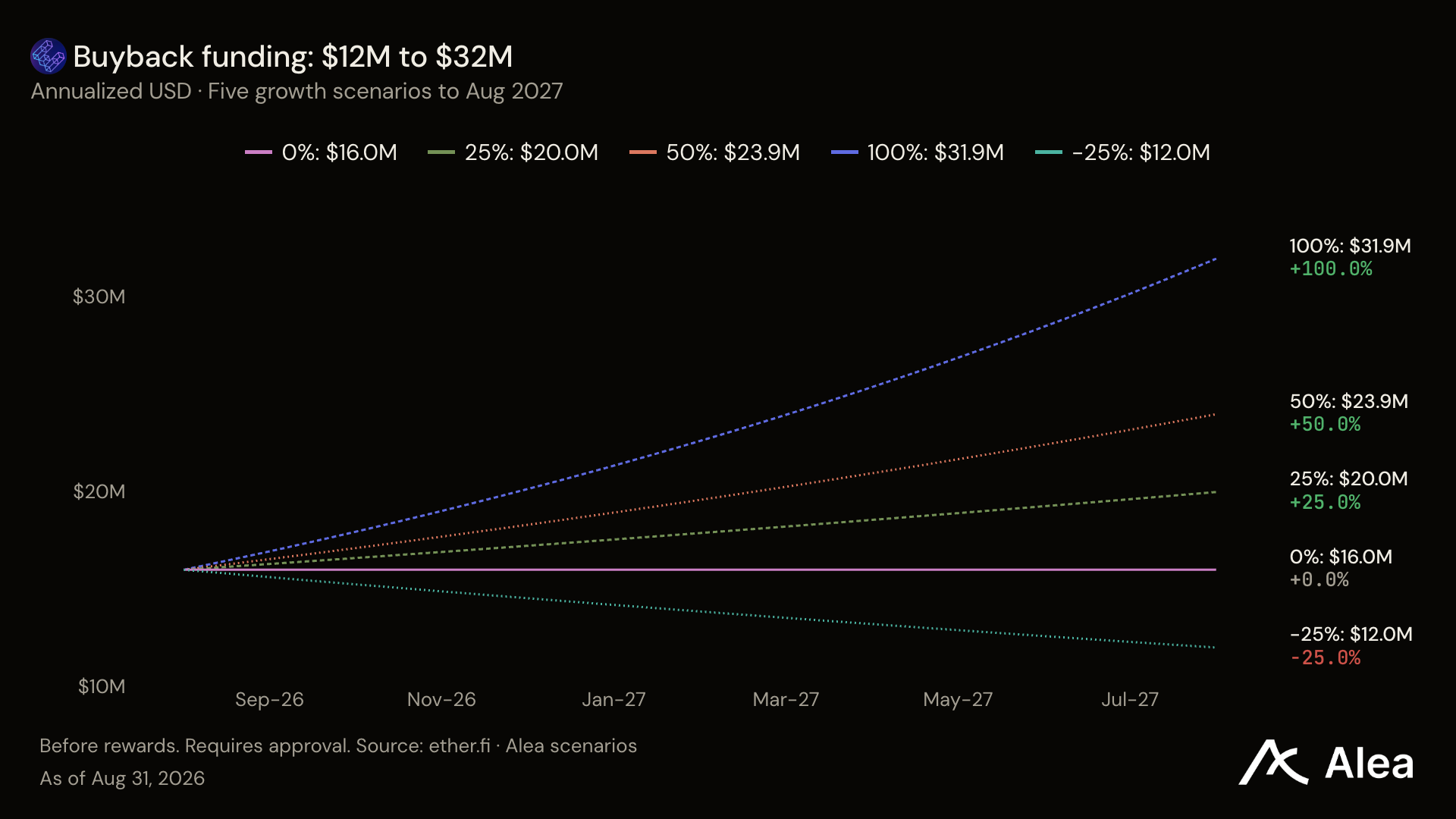
Contribution growth will enhance purchasing power before reward distribution.
A contraction of 25% would lower the same annual fund anchor to $12 million; a 50% increase would raise it to $24 million. At a constant token price of $0.55, $16 million can purchase about 29 million ETHFI. The higher the price, the fewer tokens can be purchased.
Cash Growth, ETHFI Has Lagged Year-to-Date
Cash income has diverged from price this year. ETHFI rebounded 45% from August 13 to August 30, reaching $0.55, yet is still down 21% from January 1.
The price has recently risen above the 30-day and 90-day moving averages.
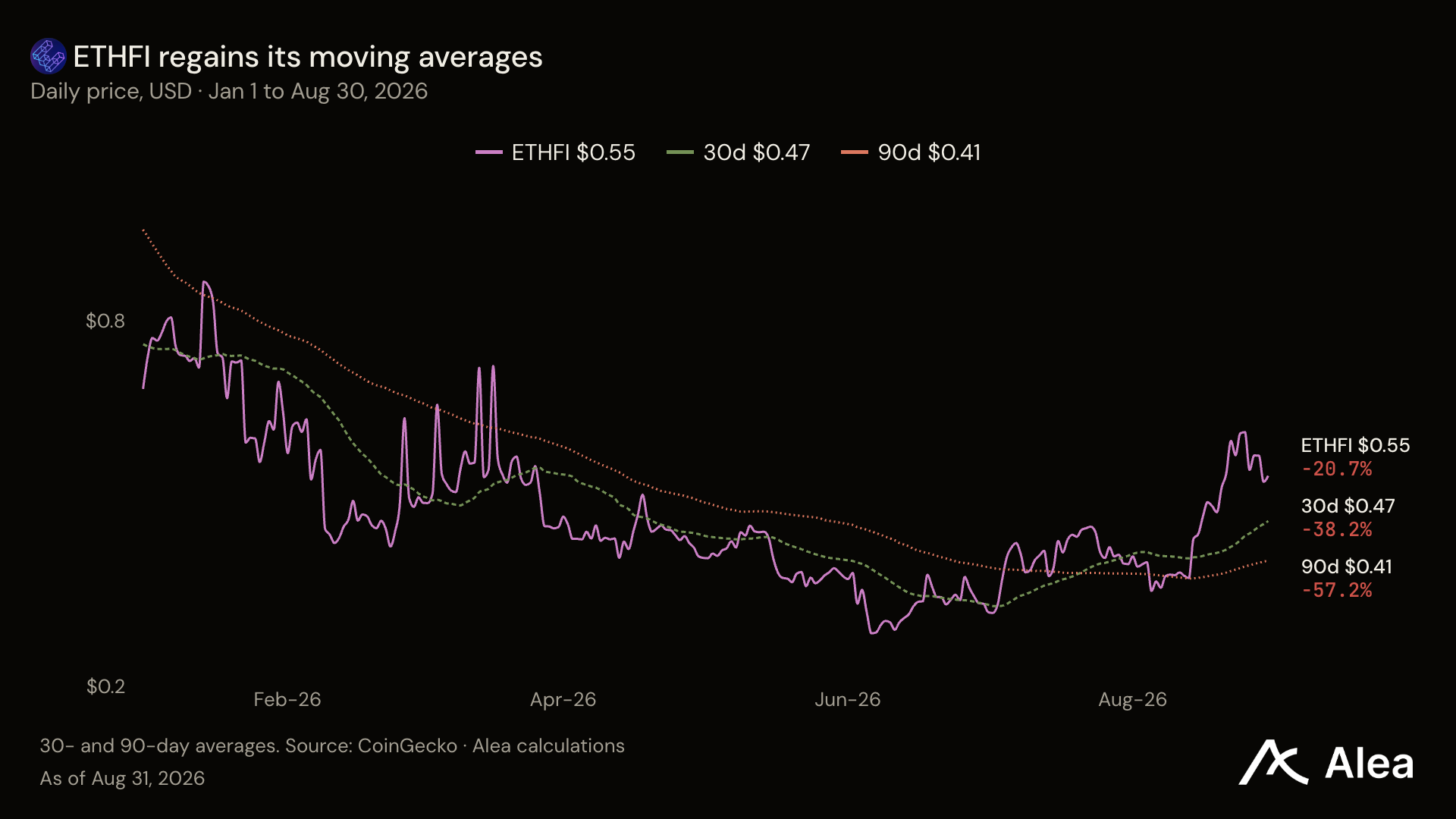
The rise in August still leaves ETHFI below its January starting point.
Based on a maximum supply of 1 billion, this price corresponds to a reference valuation of $545 million, or 14.2 times trailing annual revenue and 3.6 times gross fees. Gross fees include staking rewards and card cashback, which do not belong to ETHFI holders.
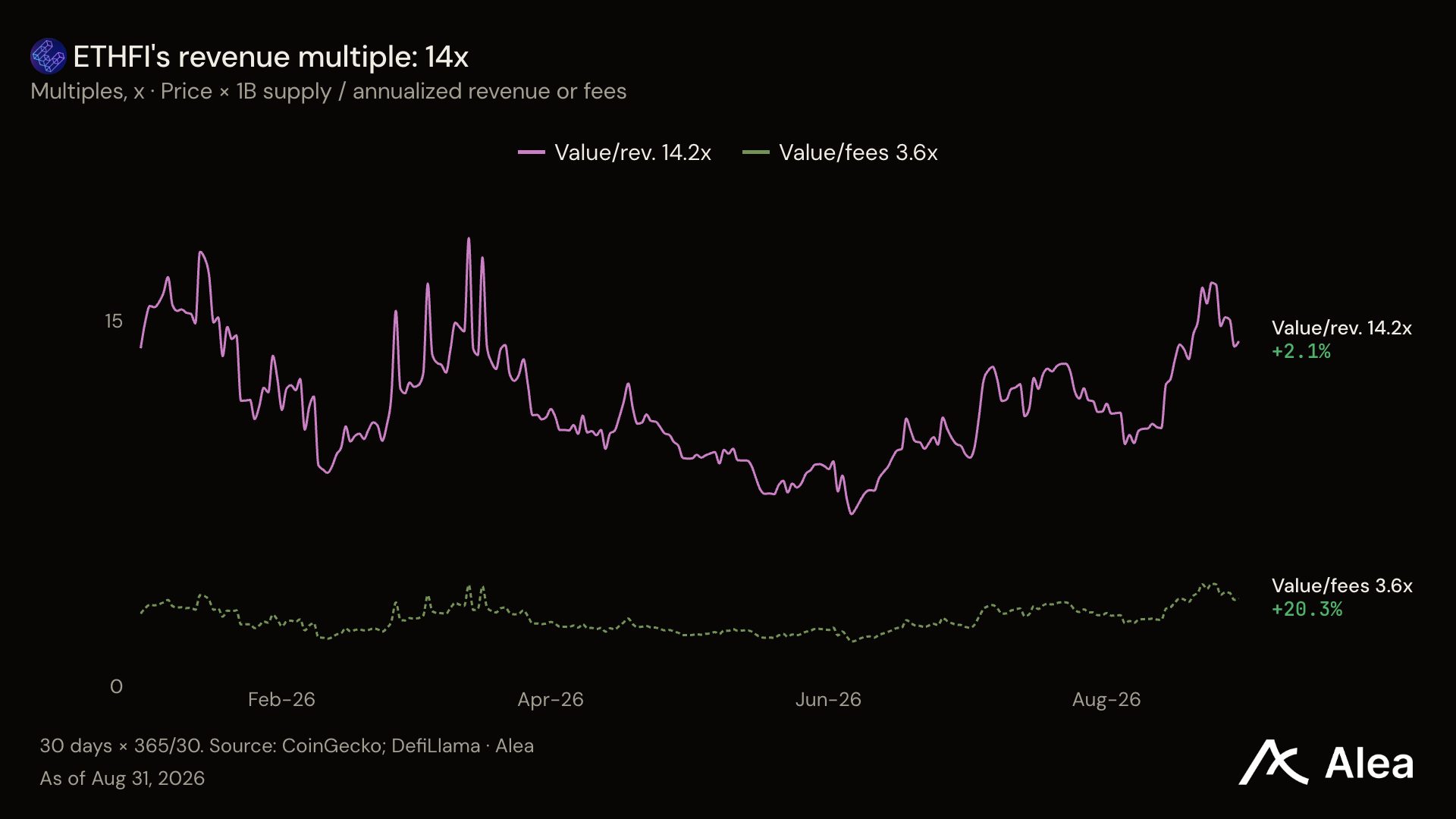
The multiples corresponding to gross fees are far lower than protocol income.
The proposed $16 million annual fund anchor represents 2.9% of this reference valuation, excluding rewards distribution. If contributions increase by 50%, this ratio would reach 4.4% at unchanged prices.
These ratios measure total fund capacity. ETHFI holders have no equity claim against Labs.
Assuming a 10x revenue multiple, maintaining $545 million requires $54.5 million in annual income, which is 42% higher than the current run rate.
September 3 and Beyond
September 3: Voting ended. As of August 31, the voting rights were approximately 245,800 ETHFI, only 25% of the 1 million quorum.
免责声明:本文章仅代表作者个人观点,不代表本平台的立场和观点。本文章仅供信息分享,不构成对任何人的任何投资建议。用户与作者之间的任何争议,与本平台无关。如网页中刊载的文章或图片涉及侵权,请提供相关的权利证明和身份证明发送邮件到[email protected],本平台相关工作人员将会进行核查。

