Author: Gu Yu, ChainCatcher
On August 26, YZi Labs announced the final shortlist for EASY Residency Season 4, with 24 early-stage projects all eligible for a maximum investment of $500,000, totaling approximately $12 million in investment for the season.
From the perspective of project direction, this batch of investments is clearly different from the traditional impression that the outside world has of YZi Labs. The 24 projects are concentrated in areas such as stablecoin payments, cross-border settlement, on-chain foreign exchange, credit, digital banking, institutional liquidity, AI agents, and on-chain asset management. YZi Labs has even listed "global payments" as a key investment theme for this season.
In the context of a still highly concentrated primary market for crypto and a financing environment that is not favorable for early projects, the continuous holding of the Residency and the real monetary investments into numerous early teams undoubtedly send a positive signal to entrepreneurs.
However, for YZi Labs, the question may not be "whether to invest", but rather a more difficult question: as an investment institution managing over $1 billion, with a background tied to the founder of Binance, and possessing global exchange-level resources, can YZi Labs be considered a top-tier VC in the true sense?
If we look at the number of investments alone, the answer seems obvious. According to RootData, YZi Labs had 34 investment rounds in the past year, second only to Coinbase Ventures. But if the measurement criterion shifts from "how much was invested" to "what was successful, why was it successful, and can it define the next round of industry opportunities," the answer from YZi Labs becomes less impressive.
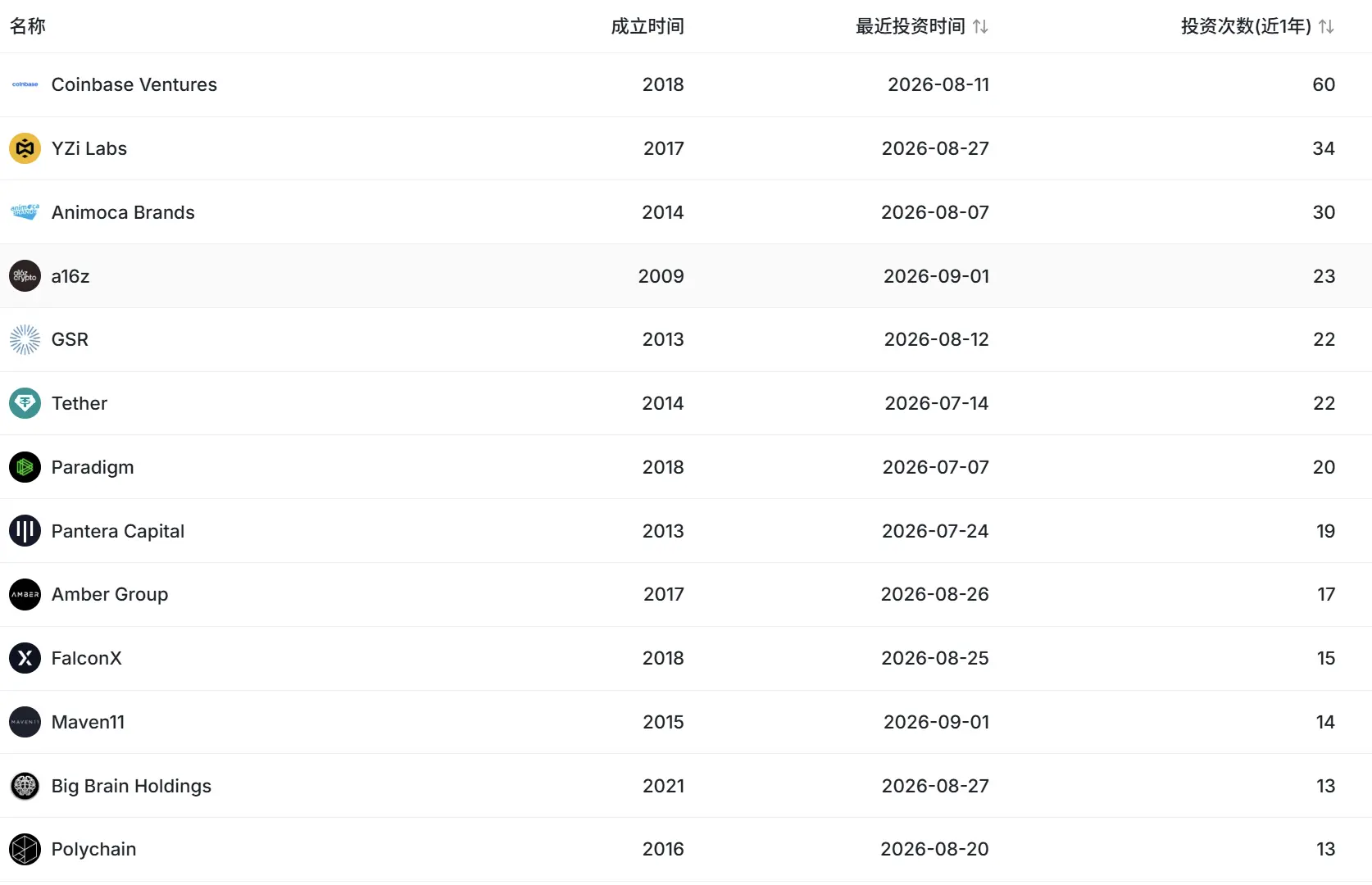
Source: RootData
Looking only at the hottest prediction markets and payment tracks in the past year, apart from a few BNB Chain ecosystem projects, YZi Labs has indeed achieved little in these two areas, missing out on track stars like Polymarket, Kalshi, Rain, KAST, BVNK, and RedotPay.
On the surface, it appears to be one of the most diligent buyers in the market; looking deeper, it seems more like an institution that has not yet completed its self-definition—wanting to be an independent family office but unable to escape the gravitational field of the Binance ecosystem, suffering from inherent deficiencies in investment style and scope.
1. Following Investment and Capability Boundaries
The most unique aspect of YZi Labs has never been its capital scale (boasted to exceed $10 billion), but rather that it once had the world’s largest crypto exchange as a "backing."
As a continuation of the former Binance Labs, YZi Labs' early investments naturally possess capabilities that are difficult for traditional VCs to replicate: the ability to connect exchange users with liquidity, to participate in the ecosystem building of BNB Chain, and to leverage Binance's brand and global entrepreneur network to acquire projects.
Therefore, for many early projects, gaining investment from Binance Labs signifies potential liquidity, market exposure, and ecosystem resources.
This also explains a notable statistic: according to previous statistics from RootData, of the 229 investments made by YZi Labs, 154 projects issued tokens, with 150 listed on at least one exchange, and 95 ultimately landing on Binance.
Of course, this number does not simply prove that "investment equals listing," nor does it imply a so-called direct path of "investment-listing," but it at least indicates a fact: a significant part of YZi Labs' historical investment logic overlaps naturally with Binance's ecosystem capabilities.
This is also the biggest difference between YZi Labs and independent crypto VCs like a16z, Paradigm, and Pantera. Although in early 2025, YZi Labs transformed into a family office, operating independently from Binance, currently managing funds from Zhao Changpeng and a few early Binance executives. However, essentially, YZi Labs still has inseparable interests and team affiliations with Binance.
In fact, YZi Labs' investment style is very distinctive: it favors projects that have already demonstrated real demand, can be embedded in existing ecosystems, and can be rapidly scaled using platform resources.
Previously, this style primarily manifested in investments around DeFi, trading, wallets, and infrastructure related to BNB Chain; in recent years, it has expanded to stablecoin payments, RWA, prediction markets, and AI.
For instance, in the payments field, YZi Labs invested in Better Payment Network this year, betting on multi-stablecoin payments, cross-border settlements, and on-chain FX; in the prediction market field, it entered through projects like Predict.fun and Probable. Now EASY Residency has also focused on areas like stablecoin payments, institutional settlement, and on-chain FX.
The core of this logic is not to "create a market," but to seek the next layer of infrastructure and growth opportunities after the market has been validated.
This is very effective for exchange-related capital: Binance possesses a large user base, liquidity, and a network of entrepreneurs, allowing YZi Labs to quickly capture trends and then utilize existing resources to help projects grow.
However, this also represents its boundaries of capability. One of the rarest abilities among top VCs is to discover opportunities before a market consensus is formed. In contrast, YZi Labs is better at quickly betting after trends emerge and utilizing ecosystem resources to further amplify certainty.
Therefore, the issue is not that it "missed Polymarket, Kalshi, or payment star projects," but that it often makes larger-scale layouts only after consensus has been formed.
Sometimes, the eagerness to “follow the trend” can inadvertently lead to serious mistakes. For example, in July 2025, facing the intense IPO wave of crypto treasury companies, YZi Labs publicly announced support for 10X Capital's BNB Treasury Company project, planning to list on NASDAQ through a shell merger with CEA Industries, creating a public entity for directly allocating BNB assets in the US stock market. The two parties signed an agreement for 10X to act as the asset manager for the BNC assets, carrying out a BNB treasury strategy, while YZi Labs, as a major investor, would provide approximately $100 million and corresponding ecological support.
However, six months later, YZi Labs publicly accused 10X Capital of mismanagement, delayed information disclosure, and lack of governance, threatening to abandon the original commitment to the BNB treasury strategy and pivot to investing in other crypto assets (like SOL), which sharply contrasted with the strategic statements made at the time of PIPE financing in July. Subsequently, both parties became embroiled in prolonged disputes, and so far, there have been no public results.
2. Limitations Brought by Team Characteristics
The investment style of a VC institution is essentially a reflection of its core team's understanding and aesthetics. For YZi Labs, its investment style can also be reflected in the characteristics of its team.
The core staff of YZi is highly homogeneous: Chinese, graduates from prestigious schools, traditional finance or consulting entering crypto. Ella Zhang comes from KPCB and Stanford; the investment partners and directors listed in the public materials frequently feature experience from Goldman Sachs, Barclays, consulting firms, and Stanford Business School; recent additions like Haley Huang and Ricky Wang still predominantly come from trading growth, Asian Web3 projects, and the Chinese founder network.

This arrangement clearly excels at certain tasks: understanding business proposals, handling cross-border transaction documents, rapidly completing due diligence within Asian founder circles, and connecting projects to BNB or Binance's resource interfaces.
Conversely, the things it does not excel at are equally clear.
The coverage of European and American founders is relatively limited. For prediction markets, compliant payments, and U.S. regulatory arbitrage companies, the early circle is concentrated in New York, Chicago, London, and the Bay Area, relying on the same batch of angels, the same law firms, and the same congressional lobbying relationships for information flow. YZi may manage to squeeze in with money in later rounds, but it's hard for them to be the first call for these founders. Companies like Rain and Kalshi seek not just capital but also partners who can translate for them in Washington and Wall Street.
They also have a weak intuition for on-chain products. The aesthetics trained in traditional finance tend to overestimate “licenses, channels, and brands” while underestimating “whether mechanisms can survive in the public mempool.” As a result, the portfolio may contain a lot of seemingly correct infrastructure but very few quirky products that fuse trading, socializing, speculation, and financial primitives together. Early on, Polymarket didn't resemble a polished financial institution's BP; it looked more like a market growing wildly in regulatory gaps. Missing it might not be due to insufficient research, but rather because even if they saw it, they didn't like it.
Externally, YZi rarely produces sharp research continuously. a16z crypto, Pantera, and Variant view research as a tool for expanding influence; YZi appears more like an executing institution—issuing announcements, holding residencies, signing checks, and getting on lists. In the primary market, a buyer that does not speak will gradually transform into a “rich but opinionless” buyer. Founders can take its money but won't treat its judgments as a compass.
Since 2025, Zhao Changpeng has replaced He Yi as one of the most important decision shadows at YZi, and he rarely publicly voices his investment opinions. Additionally, Zhao has openly stated that he first used on-chain AMM products and perpetual contracts in 2025, reflecting a long-term reliance on centralized exchange success path becoming a burden in the new cycle. These limitations in vision and understanding will inevitably restrict YZi Labs' investment results to a significant extent.
3. Conclusion
YZi Labs is currently not lacking in funds, projects, or ecosystem resources. On the contrary, it possesses many advantages that ordinary VCs find hard to replicate: managing assets on the scale of billions, a vast investment portfolio, the BNB Chain ecosystem, and the global network cultivated by Binance over the long term.
However, these advantages are largely aboutscale advantage. What it truly needs to build is acognitive advantageindependent of Binance.
Therefore, what really deserves observation in the next phase for YZi Labs is not how many companies it can invest in a year, nor how many projects eventually land on Binance, but whether it can bet early when the market consensus has not yet formed.
In the past, YZi Labs excelled at capitalizing on opportunities after trends emerged; in the future, it needs to prove that it can see opportunities before trends appear.
EASY Residency is becoming an important tool for it to achieve this transformation. If in the future, YZi Labs can continuously filter out companies that are not popular at the time but become core infrastructure of new tracks a few years later, then it has truly completed the transformation from "Binance ecosystem capital" to "top independent VC."
If YZi Labs still has dreams, it must complete this metamorphosis and transformation. Otherwise, it will continue to be a very powerful capital institution, but this power will stem more from the platform and ecosystem, rather than from unique investment judgments.
免责声明:本文章仅代表作者个人观点,不代表本平台的立场和观点。本文章仅供信息分享,不构成对任何人的任何投资建议。用户与作者之间的任何争议,与本平台无关。如网页中刊载的文章或图片涉及侵权,请提供相关的权利证明和身份证明发送邮件到support@aicoin.com,本平台相关工作人员将会进行核查。


