
Author: Paul Veradittakit, Partner at Pantera Capital
Translation: Deep Tide TechFlow
Deep Tide Introduction: When AI agents begin to possess identity, budget, and settlement capabilities, they are no longer just tools but new clients. Paul Veradittakit draws a map of the real intersection of AI and blockchain today from four perspectives: currency settlement, credit capital, identity control, and computational sovereignty, naming the projects that have already positioned themselves. This article serves as a practical reference for investors and practitioners concerned with the agency economy and crypto infrastructure to assess the landscape of the track.
Summary:
- Last month, I wrote that when prices stop rising, founder-market fit is still compounding. This month, Franklin Bi's "The Battle of 8 Billion Customers" outlines the target market we need to build. It covers 8 billion people, each with several agents, and enterprise agent teams responsible for programming, finance, procurement, and sales.
- The product is actually quite simple: wallets with limits, stablecoin settlements that machines can complete, credentials that agents can present, the computational power you truly own, and proof that does not require a public ledger.
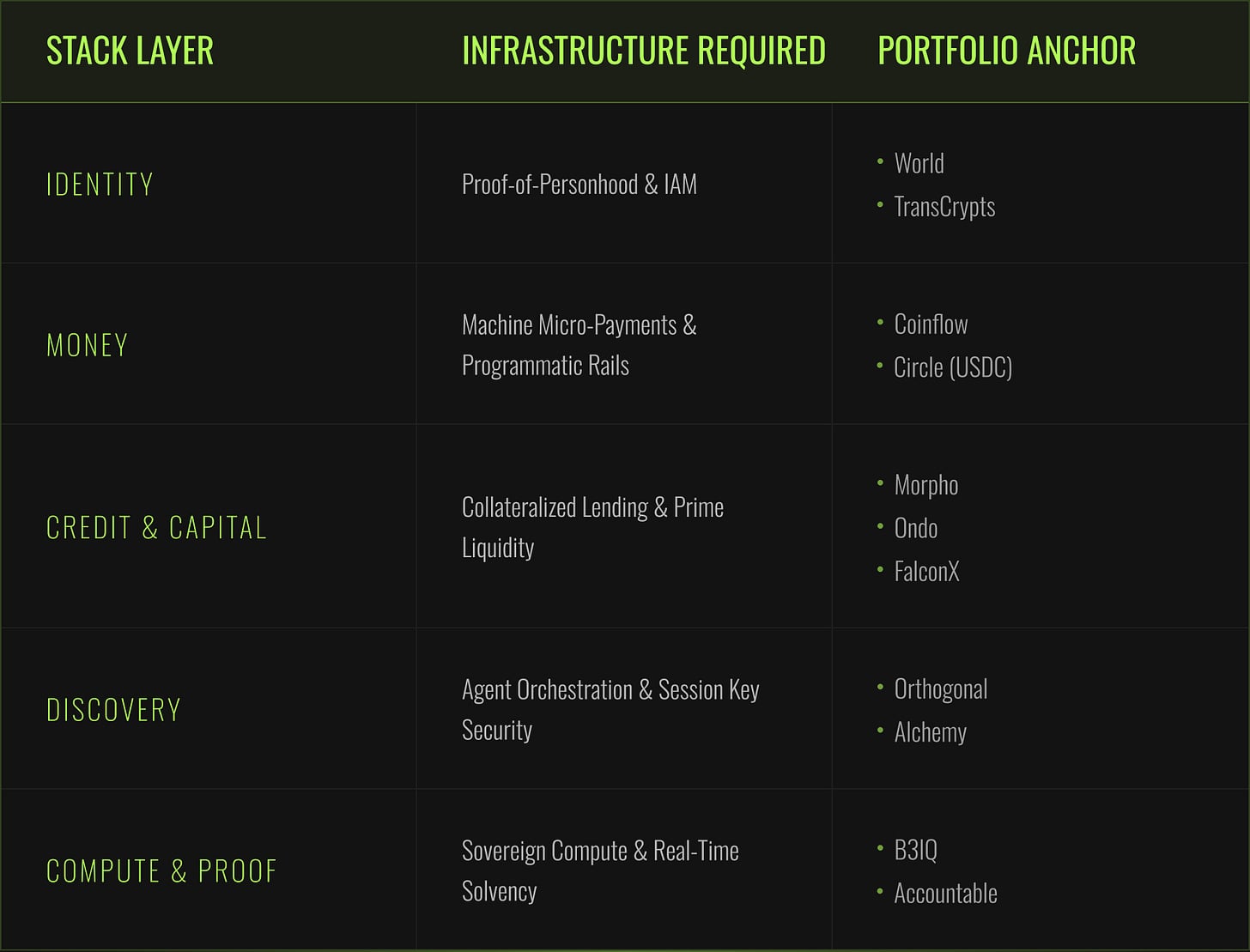
- Pantera already has a number of portfolio companies building at this intersection, including: currency and machine settlement (Circle, Coinflow, OpenFX); credit, capital, and transactions (Morpho, Ondo); identity, credentials, and control (World, TransCrypts, Alchemy); and computational sovereignty and real-time proof (B3IQ, Orthogonal, Accountable).
- Founders and investors often ask me what is happening at the intersection of AI and blockchain. I intend to start writing about it here. If you are building in any of the layers mentioned this time, please contact me or the Pantera team.
In "Founder-Market Fit," I put forth a view: the pairing of specific founders with specific markets is the only thing that can continue to compound during a winter. In simple terms, it is about depth, proactivity, networking, and obsession. Examples I have cited include Offchain Labs, Ondo, Morpho, Circle, and Alchemy.
Last week, my colleague Franklin Bi wrote an important article, "The Battle of 8 Billion Customers," depicting the markets that founders are entering. We are now facing and building for 8 billion people, each owning several agents, and enterprise agent teams responsible for programming, finance, procurement, and sales. This represents tens of billions of new decision and transaction endpoints. When agents possess identity and memory, budget authority, choice and settlement capabilities, and accountability to their owners, they become customers. Gartner predicts that by 2030, agents will influence procurement by $30 trillion. The x402 of Visa, Mastercard, and Coinbase has already issued credentials, making payments under one cent feasible. Cloudflare has also noted that bots now account for more than half of HTTP requests.
8 Billion Customers
8 billion people, each running a set of personal and enterprise AI agents for programming, finance, procurement, sales, and logistics. This represents tens of billions of new independent decision and transaction endpoints.
AI models become economic entities the moment they have the following three things:
Identity and memory: encrypted credentials anchored to the entity.
Budget authority: programmable limits, rate limits, and session keys.
Autonomous settlement: the ability to discover, evaluate, and pay for services on-chain.
Franklin poses a key question to builders: who owns these agents? Is it the humans and enterprises they represent, or the platforms they run on?
If centralized cloud vendors own the identity, memory, and learning loops of your agents, switching vendors means firing your digital workforce and letting a group of amnesiacs start over. Blockchain provides property rights at the base level: portable identity, bounded delegation, and settlement mechanisms that no model vendor can rewrite.
What AI x Blockchain Looks Like in Practice
1. Currency and Machine Settlement
AI agents do not fill out KYC forms, do not wait three days for ACH transfers, and do not manage monthly credit card subscriptions. They need frictionless, sub-cent, 7x24 hour payment channels.
Coinflow: Seamlessly settles cards and bank payments as stablecoins in over 170 countries without exposing users to the underlying chain.
OpenFX: Annually processes stablecoin settlements worth billions, clearly built for software clients rather than human end-users.
Circle (USDC): Launched during the last bear market, it has now become the default accounting unit for machine-to-machine microtransactions and enterprise agent settlements.
2. Credit, Capital, and Transactions
When agents need to authorize borrowing or deploy capital based on configurations, they need a programmable liquidity layer.
Morpho: Acts as a credit backend, embedded by Coinbase, Robinhood, Societe Generale, and Apollo. It provides the default borrowing infrastructure for agents to programmatically query loans.
Ondo Finance: Converts tokenized US Treasuries and equities into productive and yielding collateral. Nathan Allman left Goldman Sachs to solve the issue of institutional asset tokenization, which intersects directly with agent budget issues today.
FalconX (through the acquisition of bloXroute): Assembles a fast prime brokerage and execution stack to serve continuously operating markets — the only operational timeline recognized by AI agents.
3. Identity, Credentials, and Control
In a digital environment filled with synthetic content, proving human intent and agent authorization is crucial.
World: Establishes foundational personality proof primitives; cryptographically proves the existence of unique human actors in production environments, countering bot networks and witch attacks.
TransCrypts: Places employment, education, and legal credentials on tracks controlled by users, enabling agents to verify authority claims without relinquishing sensitive underlying data.
Alchemy: Provides a core developer platform to support agent-specific wallets and session key models. Developers no longer give main private keys to agents but issue fine-grained limits, including counterparty limits, expiration timestamps, and instant revocation capabilities.
4. Computational Sovereignty and Real-Time Proof
B3IQ: Offers sovereignty-as-a-service through a rent-to-buy computational network. To maintain true agent capabilities, institutions must ensure that model weights and execution trajectories stay outside locked vendor environments.
Orthogonal: Operates as the orchestration and discovery layer for agent services. It is among the leading platforms providing metered access and native billing in decentralized networks.
Accountable: Allows financial institutions and autonomous funds to cryptographically prove real-time solvency without publicly disclosing private balance sheets.
What We Look For in Founders Defining Categories
Simply having sovereignty is not enough to become a value proposition. Winning products leverage decentralized infrastructure to provide lower transaction costs, stricter privacy guarantees, faster customization, or execution reliability that closed platforms cannot match.
When assessing teams building at this intersection, we look for four traits:
Deep domain expertise: You have been in the problem, not just read about it. (For example, Ed Felten left Princeton and the White House to build Offchain Labs / Arbitrum).
Strong proactivity: You see the market structure clearly enough that large institutions build on your track. (For example, Paul Frambot founded Morpho at twenty, creating DeFi’s default credit engine).
Unfair networks: Distribution partnerships give you room to continue shipping during market downturns. (For example, Jeremy Allaire enabled Circle to partner with Coinbase, turning USDC into a global settlement standard.)
Obsession: You continue to build across cycles, even when the heat turns elsewhere. (For example, Nikil Viswanathan and Joe Lau turned Alchemy into the default developer platform for Web3.)
If you are currently working at Goldman Sachs, Citadel, Stripe, Block, or frontier AI labs: technical skills that previously seemed adjacent to digital assets are now exactly the job descriptions needed to build the 80 billion customer economy.
If you are building the core layer for the agency economy, please contact me or the Pantera Capital team. We look forward to building with you.
Business
Bitcoin Achieves Best August Since 2017
Bitcoin trading prices approached $78,000, rising about 24% in the month, marking the strongest August in nine years. It briefly broke through $81,000 as the weekend approached. The US spot Bitcoin ETF absorbed about $3.3 billion in August. This is the best month since October 2025, at one point pushing the asset class back above $100 billion. This surge is led by regulated US demand returning through the front door.
Tokenized Spot Stocks Exceed $2.5 Billion
Tokenized spot stocks surpassed $2.5 billion in August, increasing about 8% month-over-month, and growing over 260% year-to-date. BNB Chain, Ethereum, and Solana are splitting the market. The DTCC is also running real-time simulations with about 40 companies. Participants include JPMorgan, Goldman Sachs, Invesco, and Citadel, using tokenized stocks and Treasuries as collateral. On-chain stocks are starting to settle as collateral, rather than just being wrapped.
USDC Supply Jumps, Circle Regains Trading Share
USDC supply increased by about $2 billion within a week after being stagnant for six months. On-chain trackers also showed the issuance of billions of dollars that week, with circulation approaching $74 billion. Bernstein maintains a "beat the market" rating on Circle, with a price target of $140. The firm noted that in 2026, the adjusted trading volume share of USDC exceeded 60%. Dollar tokens that can operate within the US banking boundaries are the ones institutions will expand with.
Regulation
Senate Set to Vote on CLARITY Bill on September 15
The majority leader Thune filed a motion to advance the proposal and submitted an end of debate request. After the recess in August, procedural votes are scheduled into the calendar for September 15. The House has passed the bill; the Senate has a very short window before the next recess, and ethics, DeFi, and Democratic support remain key variables. The market structure will either achieve codified law this fall or will be defaulted to institutional rule-making for the remainder of this cycle.
After Bill Stalled, SEC Introduces Cryptocurrency Asset Regulation Rules
On August 18, the SEC proposed a customized issuance system: a $5 million startup exemption, financing tiers up to $75 million, conditional Howey safe harbor, and state registrations preferred applicability. Chairman Atkins made it clear that this proposal cannot replace legislation. While Congress is on recess, agencies are still writing market rules.
Treasury Proposes Rules Defining Stablecoin Issuance and Sales
The US Treasury has released a third proposal for the issuance and US offers of payment stablecoins, setting a 60-day comment period. The previously final rule deadline of July 18 has been missed. The OCC now aims to complete it by November; the effective date of the law is January 18, 2027. This framework is no longer a debate. It is a compressed implementation clock.
New Products and Transactions
Cryptocurrency Mergers and Acquisitions Reach Historic High in First Half of 2026
Mastercard completed its acquisition of BVNK on August 3, integrating the stablecoin payment stack into its global card network. Total cryptocurrency M&A in the first half of the year reached a record $9.7 billion, although the number of deals has decreased. Significant funds are flowing to licensed payments rather than permissionless experiments. Buyers in the digital asset space are now established payment firms.
Coinbase Establishes Tokenization Hub in Abu Dhabi
ADGM has granted Coinbase a license to arrange investment and custody for tokenized securities backed by underlying stocks. This authorization expands Project Diamond into a regional issuance and custody hub. Transfers are kept within a system that passes sanction screening and wallet-level control. Tokenized stocks are moving out of the demo phase and gaining a regulated foothold outside the queue for US listings.
BlackRock Launches Tokenized Money Market Product Built for GENIUS Reserves
BlackRock has launched an on-chain share class of a Treasury liquidity fund and a multi-chain daily reinvestment reserve tool. Both are designed to meet the qualified reserve requirements for approved US payment stablecoin issuers. The firm manages approximately $60 billion Circle reserves and hopes to become the default reserve manager for this category. The growth of stablecoins is becoming an asset management task.
Pantera News
Bitcoin Turns from Bearish to Bullish After Reclaiming 200-Day Moving Average
Pantera General Partner Cosmo Jiang noted that since approaching a peak of nearly $126,000 in October 2025, there has been a drawdown of about 50% for approximately ten months. With Bitcoin holding the 200-day moving average around $69,000, traders are shifting from net shorts or cash to bullish exposure. He pointed out that friendlier US policies and larger-scale Treasury buybacks are direct catalysts, with $80,000 being the next resistance level.
Fortune Reports on B3IQ's Rent-to-Buy Computation
Pantera portfolio company B3 Labs launched B3IQ. Researchers and enterprises can own US-hosted NVIDIA machines with a 30% down payment, rather than rent hyper-scale computational power locked until 2030. The first wave of advances is quick, with the team reporting that GPU sales reached eight figures within six days and is expanding capacity for startups, labs, and data-sensitive industries. Cryptocurrency-native operators are becoming the ones who can truly deliver scarce computational power.
On Stateful: Why AI Builders Need to Own Their Own Computational Power
Watch the Show · Listen on Stateful
Franklin Bi sits down with B3 co-founders Daryl Xu and Viktoriya Hying and NYU’s Yorke Rhodes to discuss this release. The cost of renting an H200 node for two years is roughly the same as direct purchase. Idle cycles will be matched with acquirers, allowing machines to self-amortize. Closed models have prevented research teams from engaging in population trafficking and warzone evacuation work. Open-source models are catching up with the frontier. Owning hardware is the unlocking mechanism that makes them usable.
免责声明:本文章仅代表作者个人观点,不代表本平台的立场和观点。本文章仅供信息分享,不构成对任何人的任何投资建议。用户与作者之间的任何争议,与本平台无关。如网页中刊载的文章或图片涉及侵权,请提供相关的权利证明和身份证明发送邮件到support@aicoin.com,本平台相关工作人员将会进行核查。


