Written by: imToken
There is no conclusion yet on the Federal Reserve's "interest rate increase or decrease," but Ethereum staking, this "on-chain financial benchmark interest rate," has already begun to discuss "reducing interest rates."
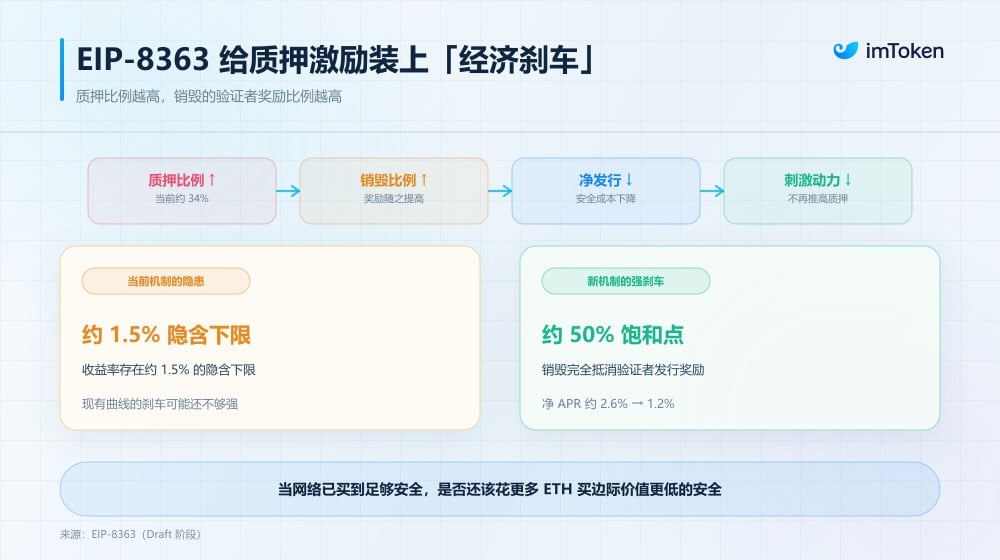
The recently widely discussed EIP-8363 in the community proposes a rather unconventional new issuance mechanism: as the ETH staking ratio continues to increase, the proportion of rewards for validators being destroyed will gradually increase, and when the overall staking ratio approaches 50%, the destruction will completely offset the issuance reward.
In other words, when the total ETH staking ratio reaches 50%, the annualized yield from staking will drop to nearly 0!
Of course, this does not mean that the total yield from staking will strictly drop to zero, because validators may still earn execution layer fees, MEV, and other income, but for the issuance reward, which currently makes up the majority of staking rewards, this undoubtedly comes close to removing the foundation.
A single stone stirs up a thousand waves.
As of the time of writing, more than 40 million ETH have already participated in staking, close to about 35% of the total supply, and the protocol layer APR has already dropped to about 2.6%. Thus, a question that once seemed distant has suddenly been placed before Ethereum:
With an increasing number of ETH willing to participate in staking, does Ethereum still need to encourage more ETH into staking through new issuance?
1. Is Ethereum starting to worry about "too much staking"?
To understand this point, it's essential to review the different phases that Ethereum staking has undergone.
As is well known, when the PoS mechanism was just launched, the most important goal was simply to encourage enough ETH to enter the Beacon Chain and establish sufficiently high economic security for the whole network.
To this end, the protocol rewards validators with new issuance rewards while designing a dynamic yield curve: early participants in staking can earn higher rewards, while yields will gradually decrease as more ETH enters staking.
This is why the early staking APR of Ethereum was once much higher than it is today, and it has now dropped to about 2.6%. Theoretically, this mechanism inherently includes an "automatic brake."
After all, as yields decline, some will inevitably feel it's no longer worthwhile, eventually finding a balance at some level in the entire staking market, but the core premise of EIP-8363 is that this brake might not be heavy enough.
According to the current issuance curve, even with more ETH entering staking, the consensus layer yield for validators still has an underlying limit of about 1.5%. Therefore, theoretically, it’s possible for a situation to arise where, even with just over 1% yield remaining, there are still large amounts of funds willing to enter.
As a greater proportion of ETH is entrusted to trading platforms, custodians, LST protocols, and professional operators, the marginal contribution of additional staking to economic security will diminish, while the risks of staking concentration, governance capture, and a significant amount of ETH being controlled by a few operators may increase.
At the same time, staking rewards essentially come from new ETH issuance. The higher the staking ratio, the greater the issuance cost the protocol bears for network security; ETH holders who do not participate in staking will need to bear the corresponding dilution.
Thus, the problem EIP-8363 aims to address is actually whether it is still necessary to spend more ETH to buy additional security with diminishing marginal value when the network has already purchased enough security.
Of course, the solution it provides is not yet a confirmed monetary policy for Ethereum, and there is considerable debate in the community. One very practical opposing argument is that if yields are pressured too low, the first to feel "it's not worthwhile" and exit might be the Solo Stakers who need to bear hardware, electricity, and operational costs.
Large institutions, due to economies of scale, MEV income, or product demand, may have a greater capacity to stay, which could result in "the staking rate decreasing, but those remaining becoming more concentrated," clearly conflicting with the proposal's aim to improve decentralization and resistance to capture.
On this point, the community is still actively discussing whether EIP-8363 will ultimately be implemented and in what form, as there is still no conclusion.
However, it has at least released a very clear signal that Ethereum has begun to rethink a question that was rarely considered in the past — is the yield from Staking too generous?
2. While preparing to "reduce interest rates," staking has just entered the era of compound interest
Interestingly, while Ethereum discusses lowering long-term staking yields, the funding efficiency of staking itself has just undergone a significant upgrade.
This is the EIP-7251 brought by Pectra (extended reading: "When 8 million ETH begin to "move": in the post-Pectra era, will staking welcome structural transformation?").
Simply put, Ethereum's native staking could not automatically compound interest before; it could only earn on the principal (32 ETH), but the interest would not automatically accumulate as principal to earn more. EIP-7251 finally enables native staking to form a "principal generates ETH → rewards enter the principal → more ETH generates new ETH" compounding cycle.
From the perspective of one or two years, the difference in numbers between a yield of over 2% with or without compounding is not astonishing.
But where it truly plays a role is time.
Assuming a user originally plans to hold ETH for three, five, or even longer, starting staking from day one while continuously reinvesting the generated ETH into the principal would result in a more pronounced difference over the longer term.
For ordinary users utilizing LST, while "compounding" is not a new concept, as several LSD/LST products have already allowed users to indirectly enjoy accumulated staking rewards, the Pectra upgrade enables automatic compounding to be a genuinely supported capability of the protocol itself, instead of relying on external products, which will undoubtedly further enhance the funding efficiency of the entire staking infrastructure.
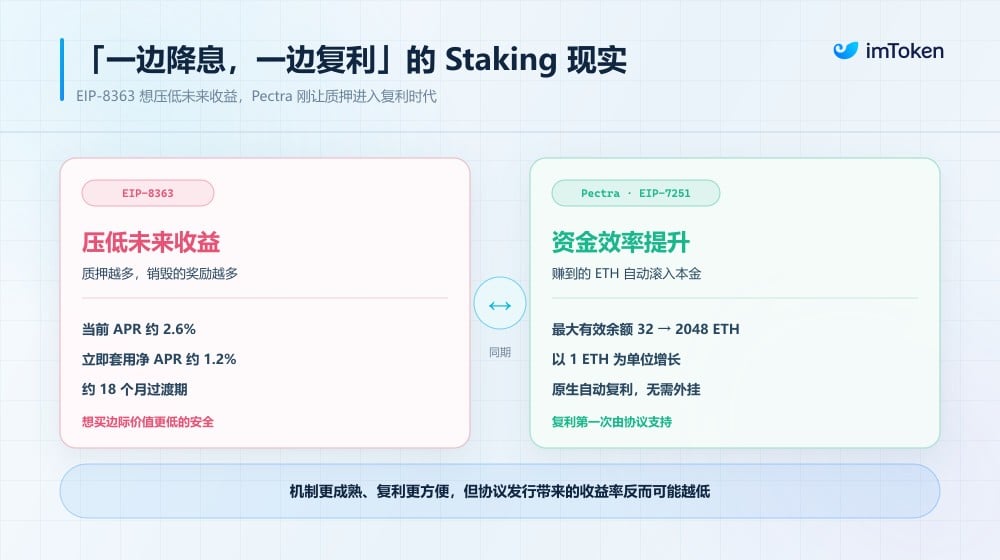
Therefore, considering EIP-8363 and Pectra together forms a seemingly contradictory yet reasonable combination: Ethereum is working to make "how to stake" more efficient, but that does not mean it still hopes to use increasingly more ETH issuance to continuously enhance the economic incentives for "why to stake."
The former addresses funding efficiency, while the latter tackles the question of how much the protocol should pay for security.
For this reason, future Ethereum staking may likely exhibit a growing trend: the mechanism becomes more mature, compounding becomes more convenient, yet the yields obtained solely through protocol issuance may paradoxically decline.
This change at the protocol layer is gradually being transmitted to the product experience of ordinary users. For example, imToken has planned to further support "automatic compounding" for ETH native staking, ensuring that the new capabilities brought by Pectra are not just limited to validators and large staking institutions, but also gradually entering the wallets of ordinary long-term holders.
3. Is now a golden window for Staking?
This brings us back to the question that ordinary ETH holders truly care about.
If future staking APR may continue to decline, does it mean one should "take advantage of the current high yield and jump in quickly"?
Here, we need to eliminate a common misunderstanding that participating in staking now does not lock in today’s yield of about 2.6-3%.
Because Ethereum's staking is not akin to a long-term bond with a fixed coupon after purchasing; even if EIP-8363 ultimately comes to fruition, or if Ethereum modifies the issuance curve through other means in the future, the yields for validators will also change accordingly.
Thus, the so-called "window" is not about rushing to secure a long-term bond at 2.6% before Ethereum "lowers interest rates."
What is truly valuable is actually the time cost.
Assuming a user has a certain amount of ETH and originally plans to hold it for five years. If they do not participate in staking in the first year and decide to start in the second year, it will not lead to a higher yield in the second year, nor can they make up for the ETH rewards missed in the first year. More importantly, the rewards they could have earned in the first year now lose the opportunity to compound for the following four years.
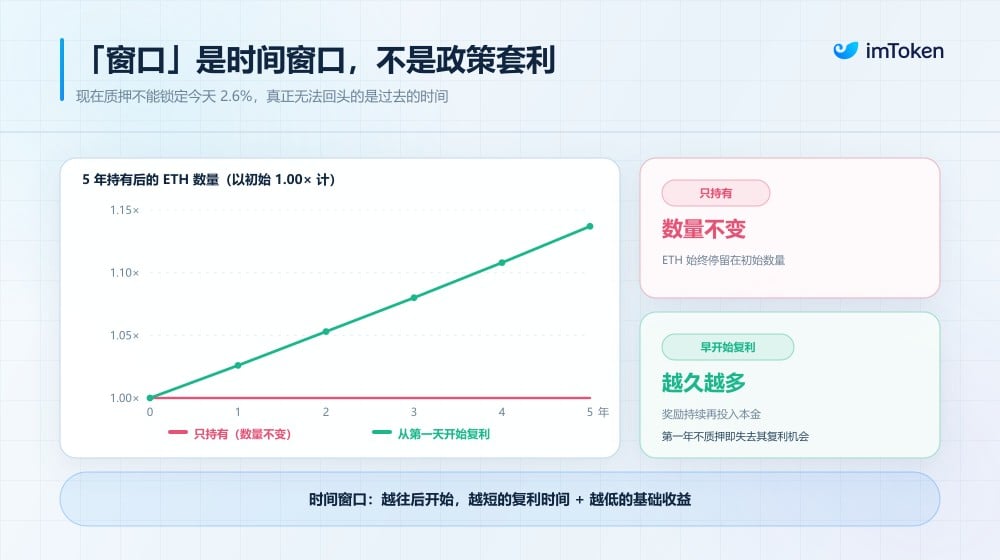
If the overall long-term direction of Ethereum staking indeed trends towards a gradually increasing staking rate and a decreasing yield, this issue becomes even more apparent: the later one starts, the less compounding time they may enjoy and the lower the base yield they may receive.
This is where the notion of "now possibly being a window" truly holds water; in other words, it is a window of time.
Especially for users who originally plan to hold ETH long-term and have no immediate liquidity needs, the decision-making approach regarding staking may also need to change.
Additionally, I personally believe that EIP-8363 is a probing question; regardless of how the community decides in the future, the overarching trend in Ethereum's token economics is destined to transition from coarse incentives to a more refined and restrained issuance design.
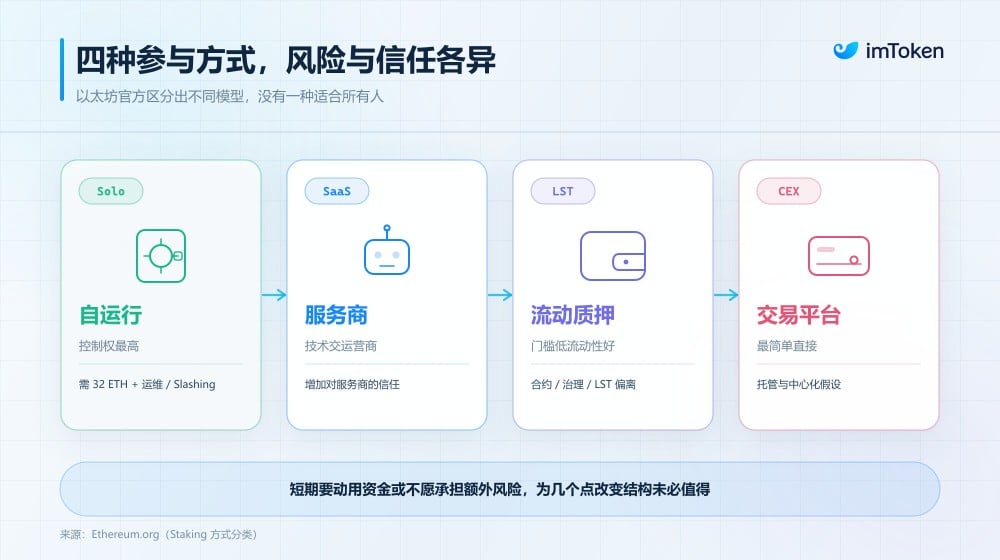
Of course, this does not mean that all ETH should be put into staking, as any yield corresponds to costs and risks:
- Running a native validator oneself can retain control and protocol-native earnings to the greatest extent, but requires at least 32 ETH and the assumption of costs like node operation, offline penalties, slashing, and daily maintenance;
- Staking-as-a-Service can delegate technical work to professional operators, but increases reliance on service providers;
- Liquid staking has a lower capital threshold and better liquidity, for example, users can directly access services like Lido through self-custody wallets like imToken while managing their own wallets and participating in ETH staking, but this also increases risks related to smart contracts, governance, and deviations in LST prices;
- Centralized trading platforms are simpler but imply higher custody and centralization assumptions;
Therefore, for users who may need to sell ETH in the short term, need to frequently move capital, or are reluctant to bear these additional risks, changing their asset structure for a few percentage points of yield may not be worthwhile.
However, if the premise shifts to "this ETH was originally meant to be held long-term," then the answer to the question may start to change.
In conclusion
Looking back at the changes in Ethereum staking over the past few years, it is actually quite interesting.
The completion of the Beacon Chain and The Merge marked the underlying transition from PoW to PoS, and Shapella resolved the question of "can ETH be withdrawn after staking," clearing critical barriers for the further development of the liquid staking market. With Pectra, native validators begin to possess automatic compounding and higher funding efficiency.
Today's EIP-8363 prompts the further discussion of how much new ETH Ethereum should pay for staking when the participants in staking are already numerous.
From "finding ways to encourage more people to stake" to "beginning to worry if too much is being staked," this itself indicates a change in the phase of Ethereum Staking.
Time changes all, and step by step is a question that any market transitioning from early expansion to maturity must confront.
In the future, staking may become increasingly convenient, more mature, and resemble a standardized ETH underlying yield infrastructure, yet it may not necessarily become more profitable. For those truly ready to hold ETH long-term, this may also be another insight left by EIP-8363:
As yields begin to become increasingly scarce, what is truly precious about compounding is time.
免责声明:本文章仅代表作者个人观点,不代表本平台的立场和观点。本文章仅供信息分享,不构成对任何人的任何投资建议。用户与作者之间的任何争议,与本平台无关。如网页中刊载的文章或图片涉及侵权,请提供相关的权利证明和身份证明发送邮件到support@aicoin.com,本平台相关工作人员将会进行核查。