Author: Claude, Deep Tide TechFlow
Deep Tide Guide: On August 11, the Chicago Mercantile Exchange announced that on October 5, it would list the world's first computation power futures in New York, targeting not gold or oil, but the rental prices of AI chips’ computation power. A week later, the U.S. Commodity Futures Trading Commission sent a request for comments to the White House for review, a 30 to 60-day process that could delay the plan. Why offer futures for computation power? Because the spot rental price for NVIDIA's H100 (the most commonly used chip for AI training) has doubled in seven months, with prices varying on the same day across different platforms from $2.78 to $7.18, more than double the difference, creating a chaotic market that makes pricing impossible.
On August 17, Bloomberg reported that the Commodity Futures Trading Commission (CFTC) has sent a request for comments regarding computation power futures to the White House Office of Management and Budget (OMB) for review. Once the review is complete, the CFTC is expected to open a public comment period that typically lasts 30 to 60 days.
Six days earlier, on August 11, the Chicago Mercantile Exchange Group (CME) announced a collaboration with GPU market data company Silicon Data, planning to list two computation power futures contracts on October 5 on the New York Mercantile Exchange (NYMEX), pending regulatory approval. Intercontinental Exchange (ICE) is also waiting for approval for similar products developed in partnership with computation finance company Ornn.
From August 18 to October 5, it is a total of 48 days. However, the CFTC's process has not yet completed its first step.
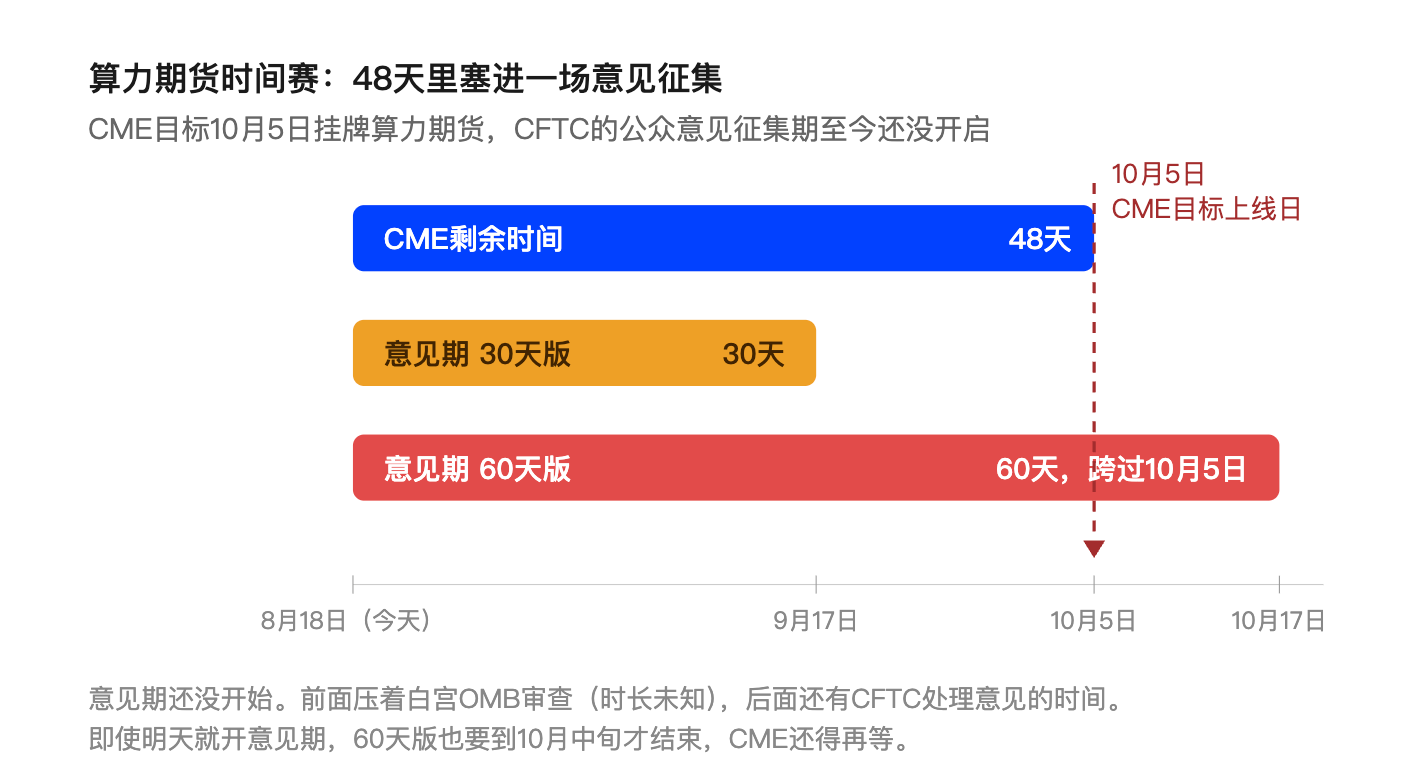
The CFTC has added a barrier for the October listing
According to the procedure, the CFTC will only publicly solicit opinions after the OMB's review is complete. A comment period of 30 or 60 days means that even if the OMB approves this week, the regulatory response would not come until mid to late September, or even later. If the comment period is 60 days, it would extend beyond October 5. Both the CME and ICE's computation power futures products are labeled "subject to regulatory approval"; without the CFTC's nod, October 5 is merely a wish.
The CFTC's choice to go through the public comment process instead of allowing exchanges to quickly list through self-certification indicates that regulators view computation power futures as a new product category that requires additional scrutiny. The CFTC recently announced a simplification of the self-certification process for products but did not expedite the path for computation power futures.
CFTC Chairman Michael S. Selig will chair the first meeting of the Innovation Advisory Committee on August 20, with an agenda that includes regulation of crypto assets, artificial intelligence, and prediction markets. Just a week after CME's announcement of the launch date, the CFTC submitted a request for comments on computation power futures to the OMB, making the timing hard to dismiss as coincidence.
What the contracts look like: 730 GPU hours, cash settlement
The two contracts announced by CME on August 11 are the Silicon Data H100 leasing index futures and the Silicon Data B200 leasing index futures, tracking the GPU hourly leasing price index published daily by Silicon Data. The H100 is NVIDIA's flagship AI training chip released in 2023, currently the most widely held in the industry; the B200 is a newer generation product released in 2024 with higher rental costs. Each contract corresponds to one GPU's monthly leasing computation power, with a contract size set at 730 GPU hours, calculated by 365 days divided by 12 months multiplied by 24 hours. Based on historical prices, the value of a single H100 contract is around $2,000, while the B200 contract is about $4,000. Contracts are cash-settled, meaning participants do not need to actually hold or deliver GPUs.
Silicon Data is a market intelligence and benchmark pricing company for GPUs, backed by trading firm DRW, with index data covering global cloud service providers, major cloud vendors, managed data centers, and private leasing markets.
The CME's plan revealed in May also included an A100 contract, which was ultimately removed in the final version. According to a comparison by Eastmoney Finance of the two versions, the price index for A100 experienced a 35% to 40% price volatility due to changes in compilation rules and historical data revisions, failing to meet the benchmark stability required for futures contracts, in addition to being an older chip released in 2020 with declining activity in the leasing market.
CME's Global Head of Energy and Environmental Products Pete Keavey stated in the announcement, "Computation power has become the currency of the AI era. Just as oil propelled economic development in the 20th century and gradually evolved from spot trading into a global derivatives market, our futures contracts will transform computation power into a standardized, tradable commodity, providing global enterprises a reliable and regulated venue to manage price risks."
Carmen Li, CEO of Silicon Data, expressed more directly: "For years, both companies have purchased exactly the same GPU computation power, but the prices paid could vary greatly, and there was no way to know who got a better price. Now the market finally has a benchmark for comparison."
For the same batch of GPUs, some pay $2 and some pay $7
On August 4, Gavin Baker, Chief Investment Officer of hedge fund Atreides Management, posted a set of data on social media: the spot rental price for the same GPU cluster he tracks has increased from less than $2 per hour to nearly $4 in seven months, doubling. The current spot price is at least twice that of the contract price. Data from SemiAnalysis shows that the annual lease contract price for H100 has risen from $1.70 per GPU hour in October 2025 to around $2.35 per GPU hour in March 2026, a 40% increase. AI inference infrastructure service provider Baseten disclosed that its cloud service providers plan to raise the renewal price for B200 from $2.63 per hour to $5.10 in October 2026, an increase of 94%.
The degree of price dispersion is equally astonishing. The Silicon Data index shows that on August 3, the leasing price for H100 at emerging computation cloud providers (neocloud) was $2.78 per GPU hour, while at cloud giants it was $7.18, more than double the difference.
CME is not the only one rushing to provide hedging tools. ICE announced on May 19 that it would collaborate with Ornn to launch GPU futures based on the Ornn Computation Price Index (OCPI), covering H100, H200, B200, and RTX 5090. On July 1, ICE also announced a partnership with NATIVX to launch computation futures based on the COIL index, which employs an "energy standardization" approach in pricing, eliminating electricity costs and reflecting only the price of GPU computation itself. ICE has positioned these types of contracts alongside existing natural gas and electricity futures for trading.
China is also following suit. On June 2, the Shanghai Municipal Government Office issued "Several Opinions on Deepening the Construction of Shanghai as a Global Asset Management Center," stating the intention to "prepare for the research and development of computation power futures." Cao Yanghui, a manager at the Index Development Department at Nanhua Futures, told Shanghai Securities News that CME's early launch of computation power futures aims to seize the global pricing power of computation: "Once the U.S. dollar is deeply tied to computation prices and computation transactions are incorporated into the U.S. dollar settlement system, the dollar will gain another essential application scenario after oil."
This scene is somewhat reminiscent of the competition between ICE's Brent and CME's WTI for crude oil pricing rights in the 1980s. Whoever accumulates liquidity first may have their standards become the industry benchmark.
For mining companies, computation power finally has a public price tag
For the crypto industry, the implications are concrete: mining companies transitioning to AI finally have a pricing anchor for their assets.
In the past two years, publicly listed mining companies have collectively shifted their focus from Bitcoin mining to AI computation power hosting. According to CoinShares, as of the first quarter of 2026, publicly listed mining companies have announced AI and high-performance computing contracts exceeding $70 billion. TeraWulf signed a data center lease agreement of approximately 401 megawatts and 20 years with Anthropic, with an initial contract amount of about $19 billion; after IREN reached a $9.7 billion cloud service agreement with Microsoft, it disclosed an additional $2.8 billion contract in July; Core Scientific locked in about $10 billion of potential cumulative revenue for CoreWeave. Bitdeer liquidated all Bitcoin inventory in February to raise funds for AI data center construction.
These contracts feature long terms, large amounts, U.S. dollar pricing, and predictable revenues, contrasting sharply with the Bitcoin mining model that relies on volatile coin prices. CoinShares predicts that by the end of 2026, the proportion of AI business revenue for publicly listed mining companies could rise from the current approximately 30% to 70%.
However, the contracts only lock in the portion of production capacity that mining companies sell. The entire GPU leasing market has been reliant on private inquiries for price discovery, and when mining companies value assets and price new projects, there hasn't been a public curve for reference. Computation power futures fill this gap: a public, daily updated, tradable computation price curve. Mining companies can use it to hedge future production price risks, and banks can also reference it for financing assessments of computation assets.
Decentralized computation networks are also within the scope of influence. Networks like Render, Akash, and io.net, which aggregate idle GPUs for rental, have long followed the current spot market for pricing. With the emergence of public benchmark prices in centralized markets, the value anchors of these networks' tokens will also change.
Whether the listing can proceed on October 5 depends on the direction of the OMB review and the public comment period. However, both CME and ICE have prepared their products, and Shanghai is also following up. The computation power is just a nod away from moving from private negotiation to a public price tag with the CFTC's approval.
免责声明:本文章仅代表作者个人观点,不代表本平台的立场和观点。本文章仅供信息分享,不构成对任何人的任何投资建议。用户与作者之间的任何争议,与本平台无关。如网页中刊载的文章或图片涉及侵权,请提供相关的权利证明和身份证明发送邮件到support@aicoin.com,本平台相关工作人员将会进行核查。


