Written by: FinTax
Abstract
As cryptocurrency assets gradually enter the mainstream financial system, the tax treatment across jurisdictions has shifted from an early lack of rules to institutionalization. In 2020, the OECD published Taxing Virtual Currencies, which is one of the earlier studies providing a systematic comparison of the tax treatment of cryptocurrency assets across multiple global jurisdictions. Since then, as the cryptocurrency market has developed, more jurisdictions have begun to clarify the relevant tax treatment through existing tax laws, special regulations, or tax guidelines, and the procedural complexity of cryptocurrency taxation continues to increase.
From the perspective of existing systems, cryptocurrency taxation is still primarily based on traditional tax systems. Jurisdictions typically incorporate cryptocurrency into existing income tax, capital gains tax, corporate income tax, and indirect tax systems based on the nature of the assets and transaction activities, and they further clarify specific treatment through special regulations or tax guidelines. The maturity of rules for different businesses is not consistent; ordinary buying and selling, mining, etc., have entered the tax system earlier, while DeFi, NFT, and other on-chain native businesses involve more complex asset exchanges, income recognition, and transaction structures, and the relevant tax rules are still relatively lagging behind.
At the same time, there are significant differences in tax treatment and actual tax burdens between jurisdictions. Cryptocurrency assets may simultaneously involve direct taxes, indirect taxes, and property-related taxes, and different holding periods, transaction methods, income types, and taxpayer identities can also alter tax outcomes. Therefore, the global cryptocurrency tax system is gradually shifting from whether to tax to more refined classifications and treatments of different assets, transactions, and economic activities.
Expansion of Cryptocurrency Tax Rules
The entry of cryptocurrency assets into the tax system is relatively late. In 2020, the OECD published Taxing Virtual Currencies: An Overview of Tax Treatments and Emerging Tax Policy Issues, which provided a systematic comparison of income tax, consumption tax, and property tax involving cryptocurrency assets based on the participation of over 50 jurisdictions. It was the first comprehensive study targeting such a wide range of jurisdictions at the time. The OECD pointed out that research on the tax impacts of cryptocurrency assets in various places is still in the early stages, and no consensus has been reached on foundational issues such as asset nature, taxable events, income classification, and valuation.
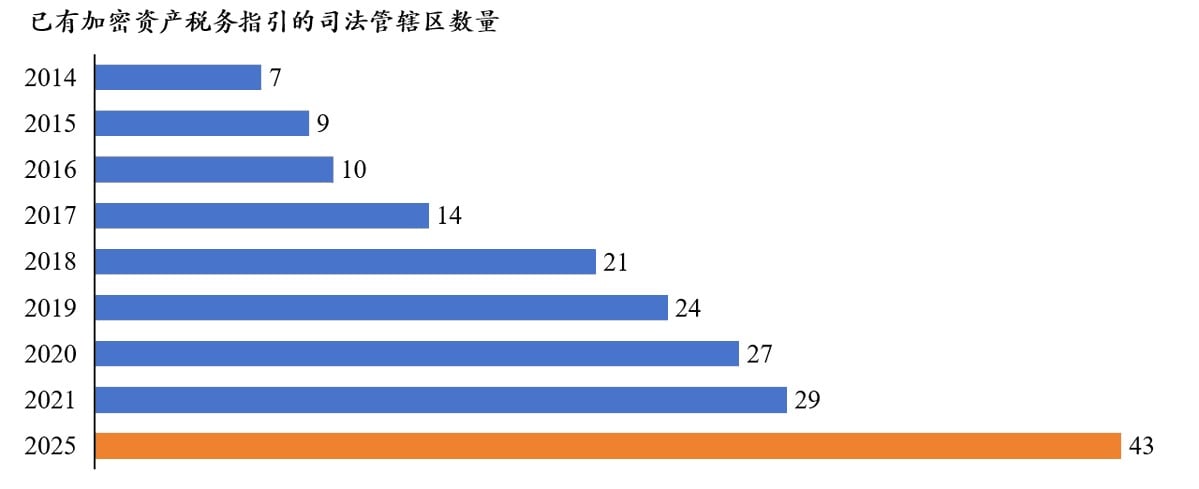
Since then, the coverage of cryptocurrency tax rules has continued to expand. Data released by PwC in 2021 showed that the number of jurisdictions with cryptocurrency tax guidelines increased from 7 in 2014 to 29 in 2021, more than quadrupling in seven years. By 2025, this number has further increased to 43, while the existing systems have also accelerated in refinement and extension.

Existing Tax Systems Remain Dominant, With Diverging Rule Maturity
Currently, cryptocurrency taxation still primarily relies on existing tax systems. The United States continues to treat digital assets as property under general tax rules, and Australia’s 2025 tax review believes that current tax laws can adequately cover digital asset transactions. A comparison by the European Commission among its 27 member states showed that most member states primarily handle cryptocurrency assets within the existing tax framework, and the profits from corporate cryptocurrency operations are included in corporate income tax.
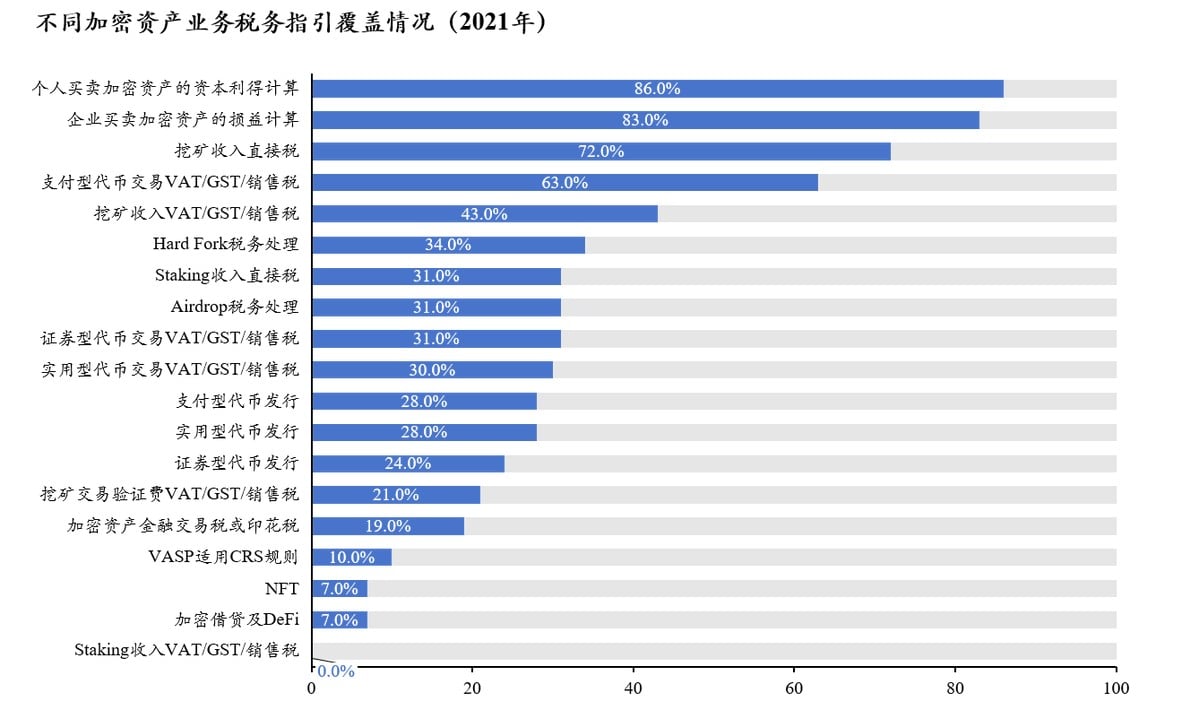
The tax rules for different cryptocurrency businesses are not evenly covered. In a survey by PwC conducted in over 40 jurisdictions in 2021, the proportion of personal and corporate cryptocurrency trading with tax guidelines was 86% and 83%, respectively, while mining was 72%, and staking was only 31%, with DeFi and NFT both at 7%. By 2025, this disparity still exists: Germany's latest cryptocurrency income tax guidelines cover many common transactions, but NFT and liquidity mining have still not been included; Australia also lists DAO, DeFi, GameFi, and NFT as areas that require further research. Overall, businesses that correspond easily to traditional assets, income, and financial transactions are more likely to be directly accommodated by existing tax laws; the more complex the on-chain structure, the more lagging the tax rules tend to be.
Significant Differences in Tax Burdens Across Jurisdictions
The taxation of cryptocurrency assets has a high level of complexity. The tax burden is not determined by a single tax rate but may involve multiple types of taxes including personal income tax, capital gains tax, corporate income tax, value-added tax or consumption tax, property tax, and estate tax. The specific applicability also depends on the nature of the transaction; for example, buying and selling, payments, mining, staking, and operating activities may respectively constitute asset disposals, investment income, or operational income, and apply different tax rules.
Thus, the term "crypto tax-friendly" is a comprehensive judgment that combines individual needs and jurisdiction rules. In addition to nominal tax rates, factors such as tax residency status, individual or corporate entities, income classification, holding periods, exemption thresholds, and long-term holding benefits also need to be considered. The same jurisdiction may be relatively friendly to individual long-term investments but impose completely different tax burdens on high-frequency trading, mining, or corporate operations.
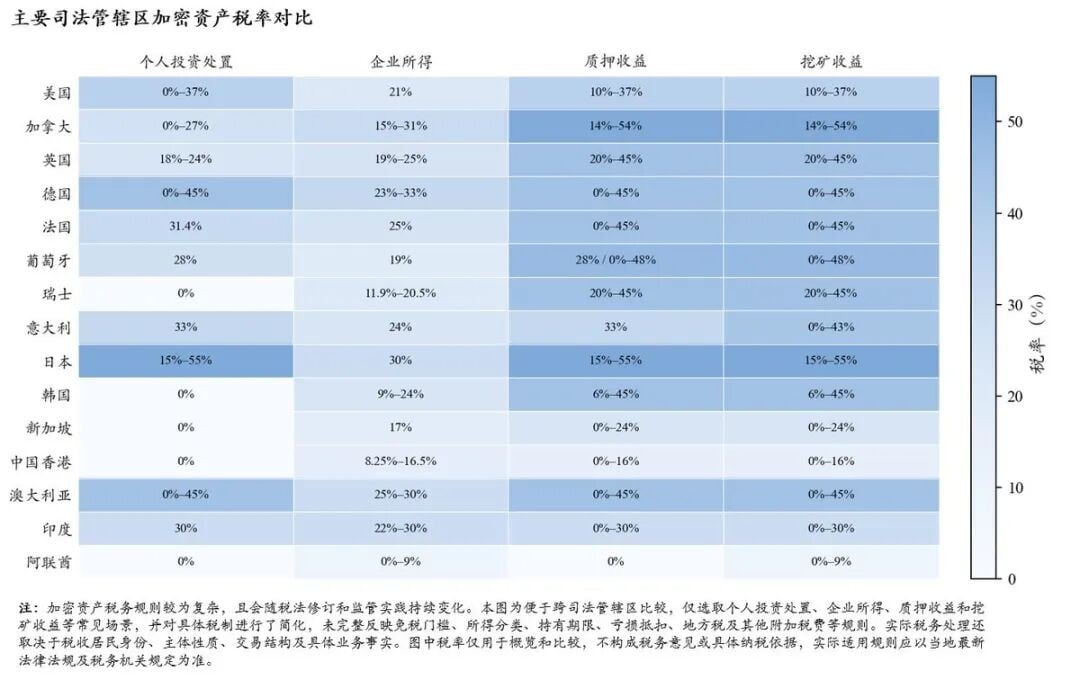
The following chart, starting from common scenarios like personal investment disposal, corporate income, staking income, and mining income, comprehensively considers economic scale, cryptocurrency market activity, and regional representation to compare representative tax rates among major jurisdictions, showing significant actual tax burden differences across jurisdictions. Given the complexity and ongoing changes in cryptocurrency tax rules in various places, certain applicable conditions and special rules have been simplified for easier visual comparison in the chart; for a complete overview of the tax rules in specific jurisdictions, please refer to our series on basic cryptocurrency tax research.
免责声明:本文章仅代表作者个人观点,不代表本平台的立场和观点。本文章仅供信息分享,不构成对任何人的任何投资建议。用户与作者之间的任何争议,与本平台无关。如网页中刊载的文章或图片涉及侵权,请提供相关的权利证明和身份证明发送邮件到support@aicoin.com,本平台相关工作人员将会进行核查。


