Author | King of Techno
May 11, 1997, New York.
IBM's supercomputer "Deep Blue" defeated chess world champion Garry Kasparov 3.5 to 2.5 in a six-game match.
This was the first time humans lost to machines in the highest arena of intellectual games.
The final game of that match took only 19 moves. Kasparov made a rare mistake in a classic opening, and Deep Blue seized the opportunity with precision, quickly pushing the position towards irreversibility.
At the end, Kasparov abruptly stood up and left the board, his face filled with shock and anger. He later publicly accused IBM of using human chess players for assistance behind the scenes and refused to accept the result.
On that day, the whole world was discussing the same question—do humans have dignity in the face of machines?
Fast-forward to March 2016, Seoul.
Google DeepMind's AlphaGo defeated Korean Go master Lee Sedol 4 to 1. This impact was greater than that of Deep Blue because Go is considered "the last bastion of human wisdom." The possible board configurations in Go far exceed the total number of atoms in the universe, and experts had previously predicted that AI would need at least ten more years to defeat top human players in Go. The move Lee made in the fourth game, called the "move of God," won the only game for humans with a probability of one in ten thousand, briefly throwing AlphaGo off track.
It was later realized that this might be humanity's last victory against Go AI.
In May 2017, Wuzhen. AlphaGo swept the then-world number one Ke Jie 3 to 0. In the second game, Ke Jie lay on the table during the middle game and said something during the post-match that left everyone silent, "Last year I felt its moves were still close to human, but today..."
"It plays like the Go god."
In the same year, DeepMind announced AlphaGo's retirement and shifted to more "useful" areas of scientific research.
The war on the board was no longer worth fighting for machines.
From Deep Blue to AlphaGo, these human-machine confrontations formed a clear yet tragic narrative—machines grew stronger, humans retreated, and these ancient intellectual games seemed to be sentenced to death by AI.
But the real story is unexpectedly different, like a game of chess.
In 2026, nearly 30 years after chess was crushed by AI, the world's largest chess platform, Chess.com, boasted 250 million registered users, over 10 million daily active users, and annual revenue exceeding $200 million.
Chess not only did not die but was at an absolute peak of popularity in its thousands of years of history.
A game that has been completely "solved" by machines—how is it that more and more people are playing it?
01 Surging Traffic
Chess.com’s CEO Erik Allebest recently reflected on the story of how people fell in love with chess again in a podcast.
In 2005, he and a friend bought the domain chess.com for $56,000 from a bankruptcy auction. At that time, almost all investors told him it was an "investable niche hobby." His classmates at Stanford Business School also advised him "to do something proper."
No one believed chess could become a big business.
True to expectations, Erik did not raise a single penny and could only rely on savings from selling a previous company, along with some money borrowed from a friend’s mother, for the two of them to start creating products. The site went live in 2007, began charging membership fees after 18 months, and quickly became profitable.
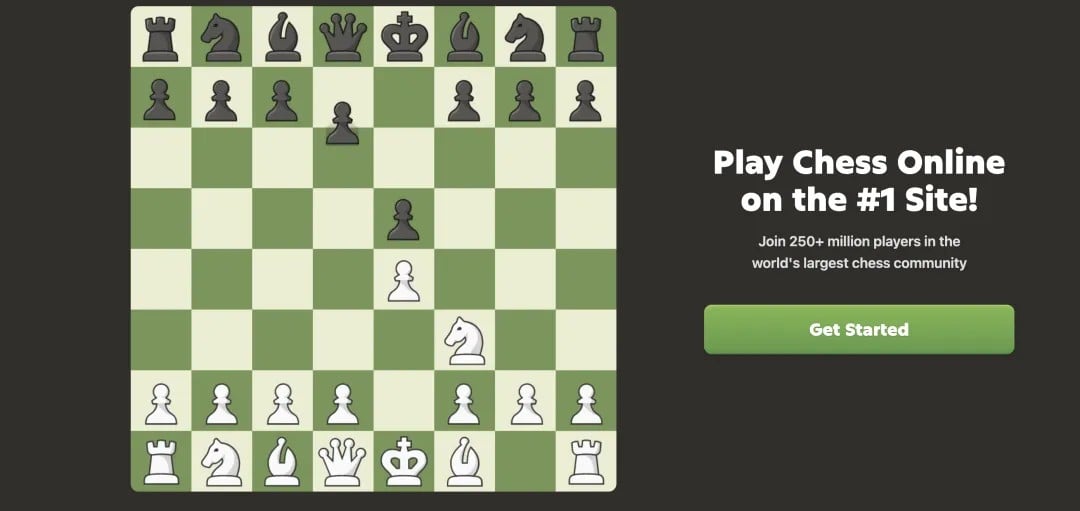
Chess.com’s main business is very simple | Image source: Chess.com
For the next twenty years, Chess.com grew at a pace of "hire as many people as we have money for," never considering financing again.
Interestingly, three small events in the years leading up to this AI boom completely revitalized Erik's chess website.
The first wave occurred in 2020.
The COVID-19 pandemic locked everyone at home, and the hit Netflix series "The Queen's Gambit" premiered the same year. A story about a genius female chess player ignited the global audience's interest in chess, causing an explosive increase in registrations at Chess.com. However, Allebest's reaction at that time was not excitement but concern—"Will this just be a passing fad like buying treadmills and making sourdough during the pandemic?"
The second wave was even more unexpected.
In 2023, chess exploded on short video platforms. A large number of chess content creators emerged on TikTok and YouTube Shorts. Chess.com launched an AI robot called Mittens—a seemingly harmless cartoon kitten, but with the terrifying ability to crush the vast majority of human players.
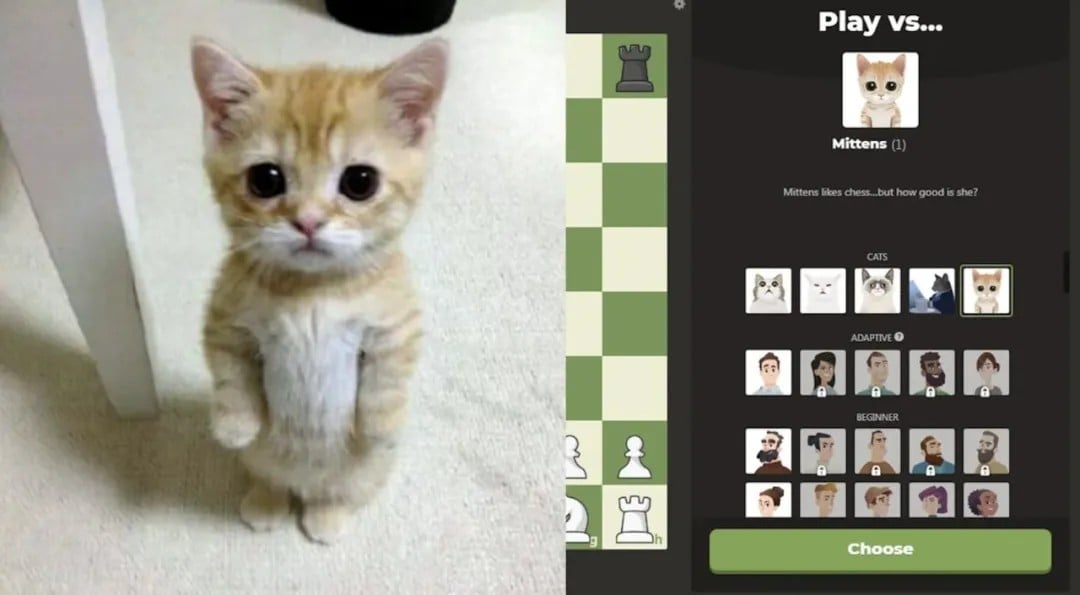
The chess AI Mittens launched by Chess.com "is cute and not overly chatty," but possesses superb chess skills | Image source: Chess.com
This cat sparked viral spread on social media, and "I was crushed by a cat" became a global meme. In the same year, a cheating scandal surrounding young player Hans Niemann hit major news headlines, bringing chess into a broader public view.
One key phenomenon described by Allebest is that—after each wave recedes, the user baseline is much higher than the last time.
This is not a fleeting surge in traffic but a stepped growth. The baseline before 2020, the baseline after the tide receded in 2020, the baseline after the tide receded in 2023, steadily increasing.
Why can the chess website retain users after every surge in traffic? Because chess wasn’t just "recommended" once; people discovered that it is genuinely fun.
This leads to a more fundamental question.
02 Winning is not the purpose; playing is
Allebest said a widely quoted line in the podcast—people want to acquire human skills, even though machines have far surpassed humans in this respect; people admire exceptional human craftsmanship, even though machines can do better.
This is a good statement, but it can be advanced further.
The logic of machines playing chess is purely instrumental.
For Stockfish or any chess engine, every move is a means directed towards one goal—winning. It has no "experience" to speak of. It does not feel excitement when it devises a brilliant move in the middle game, nor does it feel regret when faced with a checkmate from an opponent; it does not experience any "aha" moments during analysis.
Winning is just winning, merely a change in a string of numbers.
But for humans, playing chess is a completely different matter.
An amateur player spending 10 minutes on Chess.com playing a blitz game does not care about how Stockfish evaluates their moves. What matters to them is the small satisfaction of "I saw a tactical combination that my opponent did not see," the tension of a racing heart during the last seconds, and the curiosity to click on analysis after losing to figure out "where exactly did I go wrong?".
All these things encapsulate the entire meaning of the game and are unrelated to winning and losing. To put it more simply— the reward of the game is playing the game itself.
Moreover, the existence of AI precisely amplifies this purity.
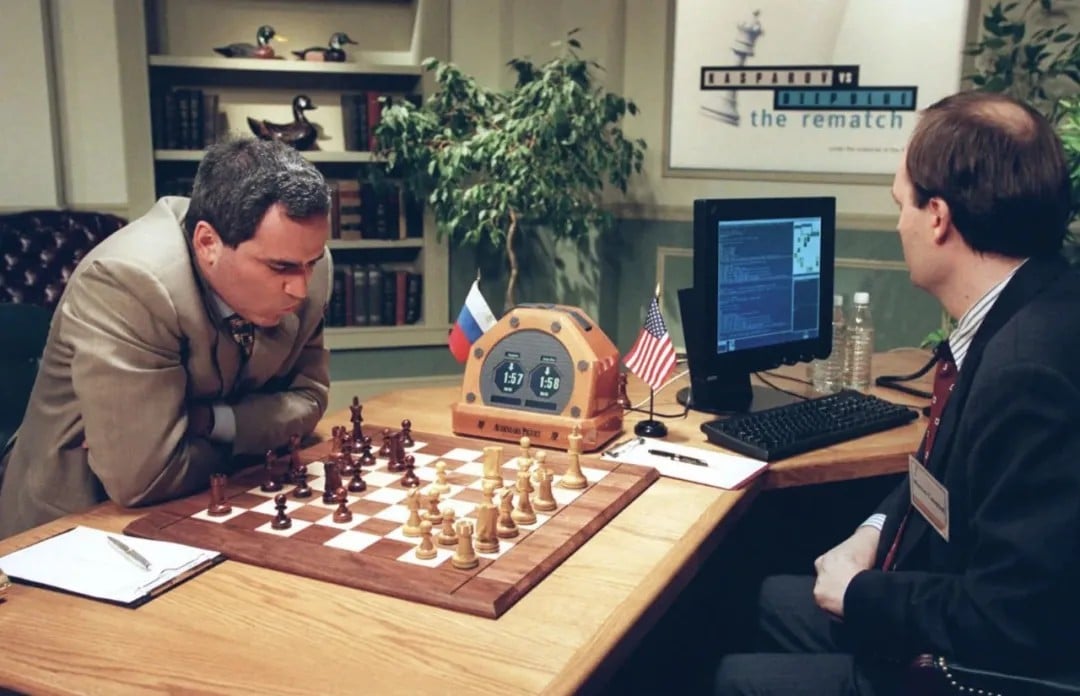
Over 30 years ago, IBM's Deep Blue defeated chess master Garry Kasparov | Image source: Britannica
Before Deep Blue defeated Kasparov, the chess world was enveloped in a narrative of heroism. Who is number one in the world? Can humanity maintain its dignity? The chess championship matches between the US and the Soviet Union during the Cold War were even imbued with ideological significance.
Winning became overloaded with so much meaning.
But when AI completely put an end to the question of "who is the strongest," a wonderful liberation occurred.
Since humanity can never win against machines, human matches no longer become about "competing for the strongest" but return to the most primitive state of the game—playing a game with you is just for fun.
Once the anxiety over winning and losing is removed, the pure joy of gaming is instead released.
At the same time, the role of AI in the chess ecosystem began to resemble "infrastructure."
Chess.com is using AI to create a "pocket coach"—analyzing your recent games, telling you which areas can be improved, and even allowing you to have conversations with the AI coach. In the past, to improve at chess, one had to spend money hiring a human coach; now, opening the phone provides a teaching system at one’s disposal at any time. AI is also used for anti-cheating measures—analyzing move patterns to determine if a player is using engine assistance.
Even AI products like Mittens Bot have themselves become content that attracts new users.
AI has not killed chess; it has become a tool for more people to fall in love with chess.
03 Go—The Silent Mirror
Unfortunately, the same story has not replayed in the world of Go.
Three years after AlphaGo defeated Lee Sedol, he announced his retirement.
He stated that the paradigm shift brought about by AI has ended the "art" of Go, and he could no longer find joy in it. The accumulated "formulas" of over two thousand years in the Go community, which were considered truths by generations of players, have been proven by AI to be nothing more than entrenched biases. Once deemed "rude" and forbidden to teach children, "three-three invasion" quickly became standard practice among professional players after AlphaGo used it without hesitation.
Deeper changes occurred in the cultural dimension of professional Go.
Before the emergence of AI, professional players had distinct styles, and chess fans could differentiate who was playing just by looking at game records, which made Go regarded as an art. After AI arrived, everyone started to mimic AI's moves, competing over who had a higher "AI compatibility." The storytelling in Go commentary vanished, replaced by win rate curves and compatibility data.
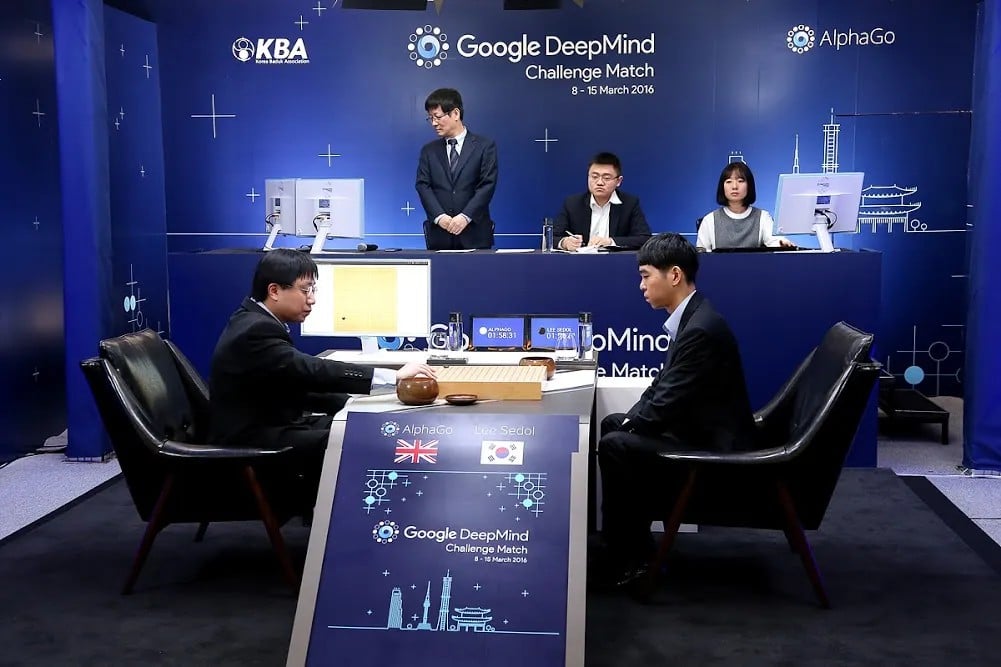
Ten years ago, Google’s AlphaGo defeated Korea’s top player Lee Sedol, nearly breaking the "backbone" of Go | Image source: Google
Korean Go journalist An Sung-won once lamented, "Heroes are no longer being created; all we hear is who ranks where."
Similarly crushed by AI, chess is thriving while Go is experiencing a "collapse of meaning" on a professional level.
The root cause lies not in the complexity differences of Go itself but in the structure of the community.
Chess is a popular game in the Western world—older people playing in parks, school clubs, and bar blitz; its foundation consists of hundreds of millions of amateur players who just enjoy playing. No matter how strong AI is, it does not affect the motivation of this group.
Go's positioning in East Asia is completely different; it is part of "qín qí shū huà" (the four arts of the scholar) and serves as an elite cultivation and educational tool. Chinese children learn Go often follows the same logic as learning the piano—parent-driven, involving level tests and promotions, with utilitarian purposes taking precedence.
When the primary users of a game are those who are "there for the result," when AI destroys the meaning of the result, the game loses its support.
The rise of Ke Jie and the Eagle in Bilibili indeed brought traffic to Go. But honestly, viewers are more attracted to the charm of the players’ personalities and their "abstract" interactions rather than the game of Go itself.
This is the "internet celebrity effect of players," not the "popularization of Go."
Every day on Chess.com, there are tens of millions of games taking place, which is the authentic "people are playing chess"; the celebration in Go live streams is closer to a form of entertainment consumption.
This piece is not meant to praise chess while criticizing Go, but to reflect on some fundamental issues through the success of Chess.com.
As AI is set to crush more and more human skills, a question worth pondering repeatedly is—are we motivated to do something for the sake of winning or for the sake of playing?
Those activities where "the process itself is the reward"—playing chess, playing piano, writing, painting, running, cooking—may not vanish due to AI’s strength; rather, they may become purer as the pressure of "winning" is alleviated.
Meanwhile, those things we only do "for the results," AI may indeed take them away, and in a certain sense, AI should take them away.
The thriving of chess in the age of AI tells us that humans do not stop doing something simply because machines are stronger.
What truly determines whether something can survive is not "who does it better," but rather "what humans enjoy while doing it."
免责声明:本文章仅代表作者个人观点,不代表本平台的立场和观点。本文章仅供信息分享,不构成对任何人的任何投资建议。用户与作者之间的任何争议,与本平台无关。如网页中刊载的文章或图片涉及侵权,请提供相关的权利证明和身份证明发送邮件到support@aicoin.com,本平台相关工作人员将会进行核查。


