Author: Shoal Research
Translated by: Deep Tide TechFlow
Deep Tide Guide: As AI agents begin to select services for users, the value of the payment protocol x402 is no longer just about small settlements, but has become the "search entry" of the agency economy. This article breaks down why early-access providers may buy high-intent demand at an extremely low cost, similar to Booking.com betting on Google Ads back in the day. For investors interested in the intersection of AI and cryptocurrency, this is a chance to understand the new distribution layer.
Before the emergence of search, demand on the internet flowed through brands that people already knew. You would enter a URL, open a directory, or click on a banner ad that took you to a destination. Then search changed the interface. People no longer navigated directly to suppliers but began to describe what they wanted, with machines deciding which provider to present to them. Search became an entirely new distribution channel with a new buyer interface and new gatekeepers.
When Google opened AdWords in October 2000, there were about 350 advertisers, and pay-per-click auctions emerged in 2002. Early movers bought the most intent-driven demand in marketing at very low costs because almost no one was bidding against them. They secured keywords, experimented with ranking logic, and accumulated positions while the channel was still cheap and uncrowded. Later on, the selection itself became the whole game. Who the search engine chose to present won the customer; suppliers that learned to be selected built sustainable advantages. By the time other market players realized this, search had become the most competitive auction in the advertising industry, and newcomers had to pay several times more for the same clicks. One of the most obvious winners was Booking.com, which bet early on paid search, becoming one of Google's largest advertisers and a top player in search engine marketing, making it difficult for competitors to keep up. In contrast, travel companies that relied on free organic traffic, like TripAdvisor, were disintermediated when Google reshaped the search results page. Early advantage meant securing a position while the new discovery layer was still forming.
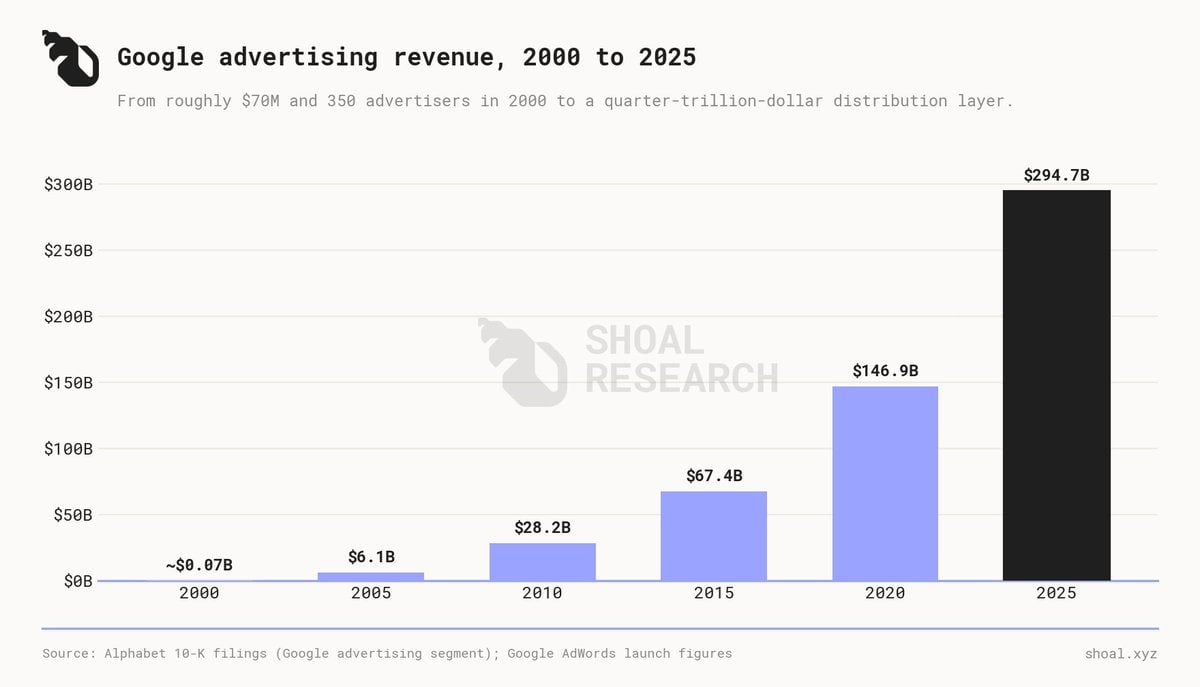
x402 represents a similar transformation for AI agents, who are becoming the buyer interface, much like search did back in the day. Humans no longer browse suppliers, compare landing pages, or choose between SaaS products, but rather services are selected by agents. x402 and machine payment protocols turn paid API calls into selection events within this new channel, and there’s a distinction that makes it sharper than search. In search, clicks are just the start of the funnel. In x402, the moment the agent discovers the service can also be the moment it makes a payment. Discovery and conversion are the same event.
Essentially, x402 is becoming the discovery layer of the agency economy, where agents find the needed services, and providers are discovered and receive payments in the same call. Payment is the visible part; discovery is the emerging opportunity. For providers, value is first manifested as distribution, which is demand arriving with intent and only coming when the agent actually calls it. Agents can accomplish discovery, find the suitable service, and pay in one step. Teams accessing x402 should expect that the first wave of value will appear first as distribution rather than huge revenues.
This argument targets content providers, data providers, and anyone providing services on the open internet, which can be listed and discovered on the supply side. Infrastructure providers like AWS and Cloudflare are at different levels with different agendas and cognitive frameworks, as they control and price the flow of traffic. That layer, along with the subsequent issues of content gatekeeping and attribution, is the subject of another article. The focus here remains on the discovery opportunities for providers built on the track.
Currently, most paid API endpoints are not big businesses, and the publicly available x402scan data supports this. Even though the network shows millions of transactions and a total transaction volume exceeding one million dollars, the visible services at the top of the leaderboard often only transact a few thousand dollars monthly. Considering the scale of some supported providers, like Exa ( @ExaAILabs ) which raised 85 million dollars to build a search engine for AI and supports x402 payments, most individual providers do not have an independent revenue stream large enough to make an impact. At an event we attended, Exa co-founder Jeff stated that he had long been a fan of cryptocurrency and believed it was the natural direction of the agency economy and agents. We are reporting this, but it is noteworthy because it comes from a founder of AI search, rather than any crypto-native person.
For service providers, a paid x402 call is akin to a completed ad click—it is a unit of demand, routed by agents, accompanied by intent, settled at the moment of use, and observable on-chain. Providers collect API call fees, but the strategic value lies in appearing where agent purchasing ability is located.
Providers' mental models should shift from "I support micropayments" to "I am listed where agents purchase services."
Assuming a provider charges 0.50 dollars for a service that costs 0.001 dollars, this price difference seems ridiculous under cloud infrastructure logic but makes sense under marketing logic because the provider is monetizing use while also purchasing distribution, intent capture, routing eligibility, and conversions within the agent’s workflow.
x402 allows agents to pay for APIs, but this phrasing underestimates what is happening. x402 and machine payment protocols (MPP) create a machine-readable market where agents discover services, providers compete to be found and paid, and the payment function acts like a tracking pixel. Paid calls are similar to Stripe checkouts but, at this stage, are more like Google Ads clicks with attached settlements, marking the starting point of a native distribution market for agents.
Everyone is watching the transaction volume of x402, asking how much money is flowing, but a better question is: who decides which service an agent calls. Because once agents become the buyer interface, users no longer browse suppliers, compare landing pages, register, input API keys, or choose between SaaS products. Agents make the selections, making service discovery the new control point.
Calling is a conversion event
Traditional software marketing has a long funnel:
Users see an ad
Users click
Users visit a landing page
Users register
Users obtain an API key
Users integrate the product
Users finally pay
Agent commerce compresses the entire path. Agents find services and pay in the same action to get results; the long human funnel above collapses into an exchange.
This makes x402 payment events extraordinarily dense. It is both a transaction and a signal: agents have intent at the moment of need and selected a specific provider.
For providers, if the first wave of agent commerce adoption is measured solely by provider revenue, the scale may seem small. Monthly endpoint call volumes of a few thousand dollars are insignificant for most SaaS companies or API providers. However, a few thousand dollars in paid calls can still address strategic questions that conventional marketing cannot answer cleanly:
Which agents are calling us?
Which wallets return repeatedly?
What adjacent services are being used by the same wallet?
This is the marketing data carried by payment events.
x402 turns API pricing into marketing spend
This is also the reason companies pay Google for search ads and Amazon for marketplace positioning fees. Companies also pay Apple for App Store distribution fees and affiliate networks for conversion attribution fees. The real value comes from being present the moment demand is formed. Therefore, initial interaction revenue should be seen as secondary.
x402 has the potential to become a native version of that model. Because providers can receive demand without human access to websites, creating accounts, going through procurement processes, receiving sales calls, or managing API key workflows. Agents can call services at the exact moment they need them.
Even if payment volumes are not yet large, this is a powerful distribution front. Yet, it also makes it easier for providers to be replaced. If agents can reach any similar API through the same payment process, the providers' advantage shifts from having user relationships to being chosen by routers.
This means providers need to optimize for agent selection, just as websites optimize for search engine selection. Machine-readable signals, like pricing and reliability, will become core agent SEO metrics.
x402 as real revenue
The distribution framework only stands when there is a path from learning stage revenue to meaningful revenue. How quickly this path forms determines how patient providers need to be.
One of the current core benefits, aside from payment primitives, is open discoverability. Open standards allow agents to discover and combine services they have never directly integrated before. This composability enables a single agent to assemble workflows across many providers. The same openness is also auditable, which is the second benefit. In a closed track, usage numbers from providers are just what their own dashboards report, and outside parties cannot verify them. However, on x402, every call is a public on-chain payment. Anyone can reconstruct the record by payer, time, and wallet. Coinbase, Circle, and the x402 Foundation intend to publicly build this track. The composability and analytics in this article exist solely because they do so. This same transparency allows operators to exaggerate rankings while enabling anyone to leverage this behavior.
To make x402 a real revenue channel for serious SaaS providers, rather than just for the top one or two players, the subset of service markets in the ecosystem needs to reach a scale that is currently unseen in the data. Growth trajectories cannot be validated from a single snapshot. This means that the implicit judgment of this article relies on a hypothesis: the ecosystem continues to expand at a recent pace, followed by the emergence of a breakthrough use case.
Case Study: AWS places x402 behind a quarter of the internet
On June 15, 2026, Coinbase and AWS launched agent payments at the edge. Any site behind Amazon CloudFront and AWS WAF can now charge AI agents in USDC upon request. Settlements are completed through Coinbase's x402 Facilitator and can be configured within the existing AWS console, without needing additional infrastructure. AWS claims that CloudFront and WAF support about a quarter of the internet. This means that a quarter of the web can now treat agents as paying customers.
This process represents an effect marketing model in production environments. Agents request resources, edges return HTTP 402 and a machine-readable list. The list details pricing, accepted networks, and receiving wallets. Agents make payments, and Facilitators verify them on-chain. Content is delivered as part of a single request. Base is the default track because settlement is completed in about 200 milliseconds, with costs far below one cent. This is precisely the cost structure required for pay-per-request pricing. AWS does not take a cut; funds settle directly into the publisher's wallet.
For providers, legitimacy, reach, and the ability to capture agent traffic are more important than any single revenue figure. Agents have been operating freely on the open web, gathering any open data or content they can reach without payment. The on-chain track is the first opportunity to turn that traffic into something visible and chargeable for providers. A large-scale cloud service provider embedding on-chain settlements into its content delivery edge sends the clearest signal yet: paid access for agents is becoming default infrastructure. AWS WAF Bot Control has already categorized over 650 types of agents, including GPTBot, Claude-Web, and Perplexity-Bot. It also allows publishers to price differentiate at different levels. This transforms agent traffic from a bandwidth cost into a priceable, measurable demand channel. It builds on the work of Bedrock AgentCore Payments from May, when Coinbase and Stripe integrated x402 at the agent endpoint. Now both ends of the transaction are located within AWS. Coinbase also released x402 Bazaar, an open searchable registry. Agents can discover x402 endpoints based on price and capability. This represents a discovery market in production.
This case study is not a revenue story yet, as both companies have not disclosed launch customers or early data. The focus here is on the new distribution front. Once a quarter of the internet can accept agent payments via a console switch, the issue for providers is no longer whether agents can pay. The issue shifts to whether providers can be discovered and appropriately priced when agents do pay. This is the issue of effect marketing, now raised at the scale of the open web.
Wallets are the bottleneck
x402 endpoints solve the discovery issue. But this is only half of the conversion. Discovery turns into revenue only when agents can pay at the moment of request.
Instant payments require a configured wallet with funds. Agents need to hold USDC on an accepted blockchain, have a signable key, and enough balance to pay the 402 quote. All of this must be ready at the moment of calling. If an agent, or the user behind them, cannot create and fund a wallet upon reaching the endpoint, the 402 is a dead end. Providers are discovered but have not yet received payment. Even if the site may have payment options, we may see agents looking for other sources rather than wanting to pay.
This gap poses the most obvious recent risk to the argument. The supply side is rapidly resolving this. AWS, various facilitators, and payment layers are removing the barriers to accepting agent payments. The demand side relies on each agent making the call already having a funded wallet. This is not yet the default state. Until wallet configuration and funding are embedded like today’s API keys into scripts and built into agent runtimes, a significant portion of the discovered demand will fail to convert due to buyers’ inability to pay.
The solutions are emerging on the agent side. Tools like Bedrock AgentCore Payments ( @awscloud ), AgentCash ( @agentcashdev ), SpongePay ( @paysponge ), LocusPay ( @PayWithLocus ), Visa CLI ( @Visa ), Coinbase CLI ( @coinbase ), and Circle agent ( @BuildOnCircle ) will configure and fund wallets within the agent loop. Payment layers can also hold wallets on behalf of agents. The mainstream answer is that cryptocurrency will likely need to be entirely abstracted from the experience, and Stripe has already provided that. However, these solutions are not yet universal. Therefore, the readiness of wallets in the agent community is a variable limiting how much x402 discoverability can convert into revenue. It is more important than endpoint availability.
Aggregators may capture workflows
The distributed solution proposed in this analysis faces a competitor, not another payment protocol. It’s a centralized aggregation layer forming within SaaS providers. Workflow aggregators can sit between agents and providers, mastering discovery and routing, turning underlying services into interchangeable backends. OpenRouter already runs this model for language models, routing single requests to hundreds of models from dozens of providers, selecting one based on price and performance, turning the laboratories underneath into commodity vendors behind a single endpoint. Deepline is a clean example. It provides agents with a unified market entry interface, covering 93 or more data enrichment and lead provider options, and automatically waterfalls which provider to call. Agents interact with Deepline, choosing, pricing, and replacing services like Apollo, Crustdata, etc. Stripe is building a similar shape at larger scales through its Agentic Commerce Suite and Projects, allowing agents to register, purchase, and connect to required services from a single interface.
The risk is most pronounced in the strongest x402 workflows; currently, one of the most robust forms of on-chain agent demand is in market entry search and lead development, where agents look for accounts, enrich contacts, and assemble lead lists across services like Exa, Hunter, and StableEnrich. This is precisely the workflow that aggregators are born to own. If an aggregator possesses the lead generation process, the underlying search and enrichment providers are selected and ranked by the aggregator.
Early access to x402 becomes more critical due to early discoverability. Providers establish trust by being callable and appearing in aggregators and distribution tools (like wallets) that route x402 traffic. In any case, the discovery layer is the prize; the question becomes who ultimately owns the routing of workflows carrying the most demand.
Agent SEO opportunities
If agents become buyers, service providers will compete for agent selection. We discussed this shift in Episode 6 of Shoal Signal, "Autonomous Agentic Commerce: Micropayments, AgentCash, x402 & MPP," highlighting that the agent payment track transforms service selection into the new distribution layer. In our Shoal Signal interview with Circle's Corey Cooper, we further explored discoverability, framing discovery as the true value layer.
This competition will differ from human SEO. Agents care less about branding, landing page design, and emotive copy. They select based on machine-readable signals like cost, reliability, and latency.
Providers that emerge victorious in this environment will have the most reliable, machine-readable services and supporting reputation, rather than the best human web pages. x402 should be understood as a discovery infrastructure, on par with payment infrastructure, where payments act as tracking pixels.
Businesses are already being asked
Demand signals are not only on-chain. In our interviews with over a dozen non-crypto engineering and product teams, each team reported that clients or partners have already inquired about agent and stablecoin payments, and each team expressed interest in supporting them. These teams come from outside the crypto space, which is precisely the focus. The pulling power comes from ordinary software companies that see agents starting to transact and do not want to be vendors unable to collect payments, and currently, there is no effective solution.
This is an earlier signal, distinct from revenue; buyers appear ahead of transaction volumes.
Teams should experiment now
The reason providers should now add x402/MPP is that demand for agent intermediaries is beginning to form, and providers need to understand this demand's behavior before the routing layer hardens.
Teams waiting for revenue to become apparent may find that the discovery layer is already occupied. Agent hosts, routers, packaging products, and markets will understand which services work, which services convert, and which services are worth showcasing. Providers far from the track will cede the learning curve to others.
The immediate goals should be simple:
Make agents callable
Measure which wallets and routers generate real usage
Understand what pricing agents can tolerate
Improve the metadata and reliability that influence selections
Establish a path from anonymous paid calls to returning customer value
The first dollar of x402 revenue is less important than the first clear signal: this signal is about how agents discover, select, and reuse your services.
If agents are to become meaningful demand channels, x402 is one of the earliest ways for providers to observe the formation of this channel publicly.
The missing killer use case
The biggest criticism of x402 is the simplest: there has yet to be a killer use case. Most of what is running on the track now is experimentation and research rather than workflows essential to enterprises.
The offset is who is building it; the companies driving agent payments forward are nearly too big to fail at this scale, with Visa, Mastercard, Stripe, Coinbase, Circle, AWS, Google, and Cloudflare all investing infrastructure in the same idea.
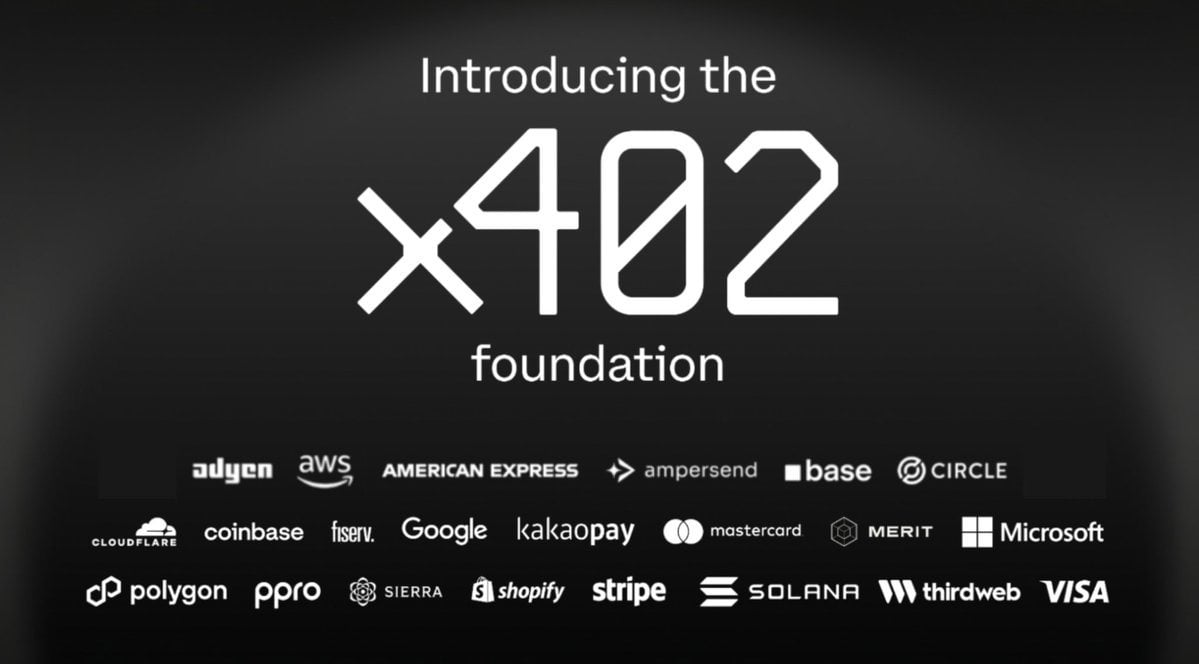
When so many existing giants invest in a design space, regardless of whether a killer use case arrives on time, the track will be built. Strong support does not guarantee success because the metaverse and 3D TVs attracted tremendous coordinated investment without finding use cases, but it does mean that infrastructure will be cheap and ready the moment use cases emerge.
There are two standout candidates. The first is content gatekeeping, pricing AI access for the open web, which we will delve into in a separate article. The second is discoverability and orchestration, where agents find and combine endpoints they did not know existed before. The second case is the main thread of this article. The underlying primitives of x402 are the discoverability of open data and autonomous orchestration. This is for providers wanting to be discovered, as well as agents that can evaluate options better than humans. Agents can index hundreds or thousands of services, test them, and retain those that yield the best outcomes, either by temporarily assembling them or using niche market entry interfaces like Stripe's entrepreneurial market or Deepline. These markets are not x402 in themselves. They are different forms of the same primitive, which are aggregated data and services that agents can easily call and initiate. Today's limitation is the agents' ability to run this discovery themselves, which is precisely the gap that the goal-based shift is narrowing, giving agents a goal rather than a script to find the path.
Conclusion
We have extensively written articles about agent protocols, including: HTTP 402: How Machines Move Money is the technical foundation. It explains why HTTP 402 is important, how x402 and MPP work, and why agents need payment processes that match their resource consumption patterns. That article addressed the infrastructure question of how machines pay for network resources at runtime.
Now, for agents to operate autonomously, they need the capability to discover tools and context on the open internet, and achieving this requires an open standard.
免责声明:本文章仅代表作者个人观点,不代表本平台的立场和观点。本文章仅供信息分享,不构成对任何人的任何投资建议。用户与作者之间的任何争议,与本平台无关。如网页中刊载的文章或图片涉及侵权,请提供相关的权利证明和身份证明发送邮件到support@aicoin.com,本平台相关工作人员将会进行核查。


