Author: SongShu, former member of Swarms Foundation, founder of NexGen Venture
I am not betting on a fairer world.
I am betting that human nature will not change: people will follow winners, scramble for early opportunities, display positions, and use profits and losses to validate cognition.
In the past, these behaviors were scattered among KOL group chats, bot bundles, market-making funds, and different trading terminals. What really merits my research on Blink is not its proclamation of "fairness," but its potential to compress these existing behaviors into a verifiable, distributable, chargeable, and repeatable product chain.
First, clarify my position and my biases.
Recently, I sold $AI on the Long platform and also sold $bStocks on BSC, redirecting my funds and attention to $BLINK. $bStocks later continued to rise, and I indeed missed out on that.
This cannot prove that I made the right switch, or even that I have paid a real opportunity cost for this judgment. But for this very reason, this is not an observational article from the sidelines.
I currently hold over 2% of $BLINK. The following content is a thesis publicly stated by a significant holder, and not a profit promise.
1. The lesson Swarms taught me: Seeing the right industry does not mean buying the right token
I once bet that AI Agents would achieve industry-level landing, and thus bought Swarms. I may have seen the big direction correctly, but I mistakenly assumed an overly long causal chain:
Technological development → Product maturity → User adoption → Revenue generation → Token capturing value.
If any link does not happen according to the same timeline, the token might be eliminated by the market before the product delivers.
That time, I bet on a series of "ifs."
This time, I study Blink, not because it represents a distant technological future, but because the behaviors it seeks to organize already exist today:
Project issuance → Users competing for early participation rights → Participating through Fomo → Positions and Thesis disclosed → Social dissemination → More users and trades → Fees and the next issuance.
This chain does not need to wait ten years. It can be observed today and can be falsified by data.
2. The phenomenon in screenshots is not Blink's function, but the industry's ailment
"Opening + market-making funds + KOL/FNF small groups" describes the real situation of many memecoin projects today: Some provide funds, some provide fame, some organize attention, and let later entrants bear the exit liquidity.
This is not the script I want Blink to replicate; it is precisely why I believe the market needs another issuance mechanism.
If Blink ultimately just replaces bundlers with a KOL whitelist and turns bot advantages into networking advantages, then it has failed.
A truly meaningful fair launch is not about ensuring that everyone makes money, but about making rules more transparent, making early chips harder to be controlled by a single group, and allowing real users rather than a group of hidden wallets to have participation opportunities.
3. After Facebook and TikTok, Fomo is attempting to build a speculation graph
Facebook turned relationships into distribution; TikTok turned interests into distribution; Fomo is attempting to turn verifiable judgments into distribution.
In traditional social media, content can be deleted, losses can be hidden, and KOLs can only showcase successful cases. But when positions, trades, Thesis, and PnL appear in the same account, "what I am bullish on" can finally be tied to "what results I took on for this judgment."
Portfolio becomes profile.
Trades become posts.
PnL becomes reputation.
Of course, a high-leverage profit does not equal credibility, and multiple wallets will not automatically disappear just because they are on-chain. A truly valuable speculation graph should look at long-term, risk-adjusted records and identities that are difficult to reset at will.
But the foundation already exists. The data disclosed by Fomo officially shows 625,000 users, over $4B in trading volume, and 110M social interactions; Profile, Thesis, leaderboards, follows, and trades have also been integrated into the same set of products.
4. Fomo is the main system, Blink should become the entry for issuance and customer acquisition
This must be distinguished between primary and secondary.
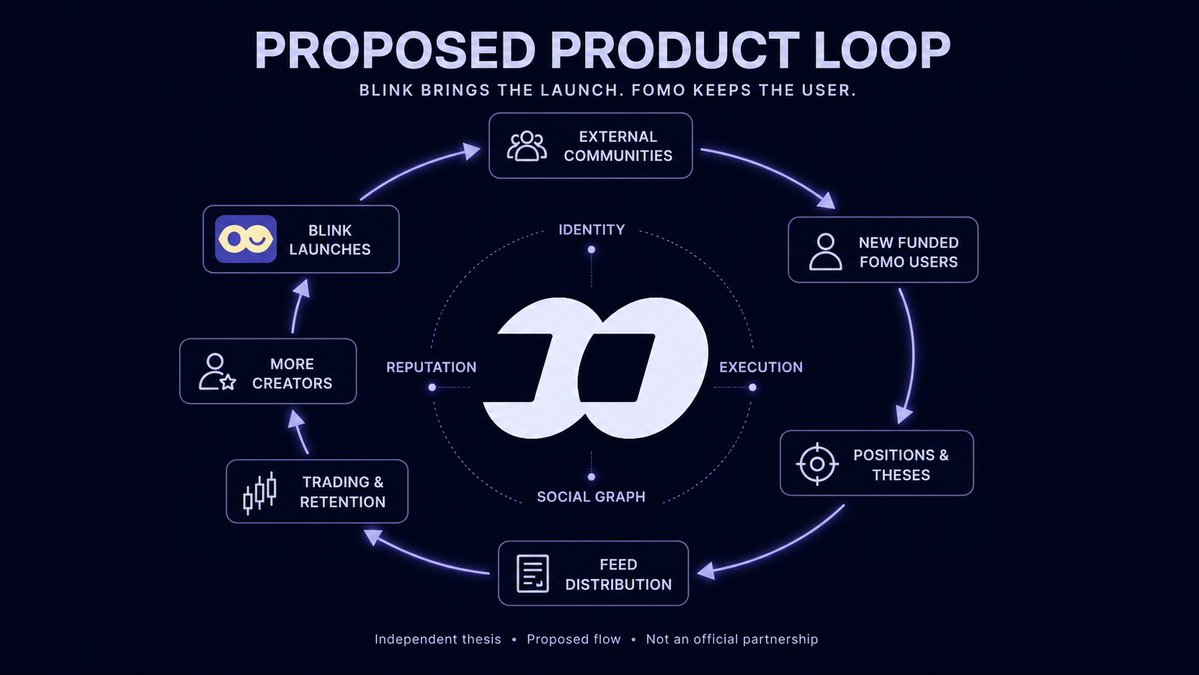
Fomo holds identity, funding access, trade execution, public performance, Thesis, Feed, leaderboards, and user retention. Blink should not replicate another Fomo but should fill the upstream issuance layer that Fomo lacks.
The cycle I expect is:
External creators and communities issue on Blink
→ New users register and fund Fomo to participate in the window
→ Users gain relatively fair early participation opportunities through Fomo
→ Positions and Thesis return to Fomo's public account
→ Feed, leaderboards, and follow relationships continue to distribute
→ Generate more content, users, and trades
→ Attract the next batch of creators to issue.
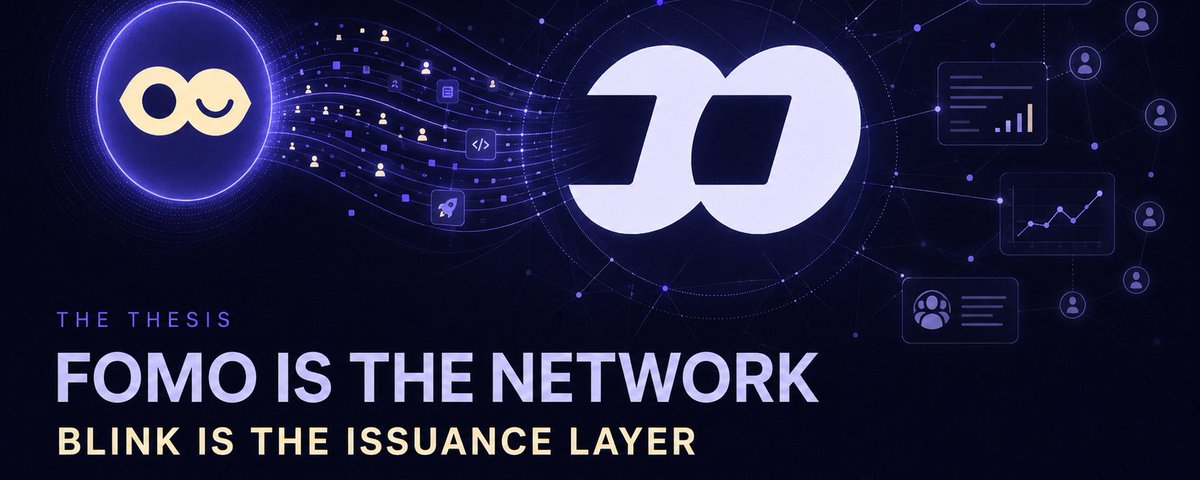
Blink is not a substitute for Fomo. If this logic holds, Blink should become the issuance layer of Fomo's speculation graph; Fomo is the main network for identity, trading, reputation, and distribution.
I cannot invest in Fomo's equity, so I am looking for adjacent infrastructure exposure that may benefit from Fomo's network growth. But buying $BLINK does not equal investing in Fomo, and Blink is not a project officially endorsed by Fomo.
5. "Fairness" only becomes a growth mechanism and is no longer idealism
If Blink can only speak of fairness, it is still idealism.
The real potential reason it may succeed is that relative fairness can yield economic outcomes:
Users hope to reduce the probability of being harvested by bundlers, sniper bots, and hidden associated wallets;
Creators need better issuance, distribution, and sustainable income;
Fomo needs new external users, funding, content, and trades;
Blink requires project supply, trading volume, and fees.
Each party is pursuing its own interests, and no one needs to suddenly become noble.
Fairness here is not a moral endpoint but a product constraint that reduces adverse selection, enlarges real participation, lowers customer acquisition costs, and improves retention.
In the future, Blink can further leverage Fomo's existing signals—verified accounts, public Thesis, historical participation records, and anti-witch proof—to turn verifiable judgments into early participation qualifications. But this is my suggestion and expectation for the product, and not a feature that is already online.
6. Launchpad code is not a barrier; distribution, trust, data, and closed-loop are
Implementing basic bonding curves, token deployment, and DEX migration is not the most difficult or expensive part today.
The real cost lies in production-level security and auditing, data indexing, wallet and terminal integration, anti-bot measures, liquidity, creator supply, user trust, and long-term distribution.
So my judgment is not "the launchpad cost is low, therefore it will succeed," but rather: basic products can iterate quickly, but the ultimate outcome depends on who can establish difficult-to-replicate distribution and value closed loops.
Flap on BSC is a case worth observing. Four.meme's cumulative scale is still leading and has already connected to Binance Wallet's official distribution entry; but this does not mean other platforms lack space.
As of August 13, 2026, data from DeFiLlama on the same chain shows: Flap's BSC curved trading volume in the last 30 days was approximately $872.15M, while Four.meme was about $200.33M; Flap's volume was about 4.35 times that. During the same period, the protocol revenue was about $5.02M compared to $856K, approximately 5.86 times.
This does not prove that Flap has permanently won—Four.meme's cumulative scale still leads—but is enough to prove: the advantage of an official entry is very important but not the conclusion. Flap has found its independent demand through tax/non-tax tokens, creator income, and programmable Vaults.
This is also how I view Blink. It cannot only copy a token issuance page but must integrate Fomo's identity, Thesis, real user distribution, and trading retention into a system that competitors find difficult to replicate directly.
7. How this thesis can be falsified
"Low market value," "High controversy," or "Already destroyed" cannot individually prove value. Low market value will simultaneously amplify both upside potential and zero-risk; destruction is merely value capture after demand occurs, not demand itself.
What I will truly observe is:
How many net new funding users Blink can bring to Fomo;
How many real independent accounts are among the participants, rather than multiple wallets disguised;
Whether users continue to stay on Fomo after the first launch;
Whether creators are willing to issue repeatedly;
Whether the project still has liquidity, trading, and community after 7 and 30 days;
Whether the conversion rates from Thesis to follows, funding, and trading have improved;
Whether fees and token value capture are transparent, sustained, and verifiable.
If bots and multiple wallets can easily bypass the rules, if projects die completely once they leave the blink window, if Blink cannot bring new users and retention to Fomo, then my thesis is wrong.
Conclusion
I have missed out on $bStocks and have suffered significant losses because I believed in a grand technological direction. So this time, I don't want to convince myself with "it will definitely happen in the future."
I am bullish on Blink, not because I believe the market will suddenly become kind, but because I believe human nature will not change: people will always scramble for early opportunities, follow verifiable winners, and invest capital, attention, and identity into judgments they truly believe in.
Fomo is transforming trades into content and performance into reputation. Blink's opportunity is to further convert this reputation and distribution into issuance participation rights while bringing external users back to Fomo.
This is not a completed product, nor is it a risk-free investment. It still needs to prove anti-bot measures, real distribution, creator reissuance, user retention, and value capture.
But at least it no longer requires me to believe in a distant technological miracle.
It only requires proving one thing: can this chain that has already begun to operate become stronger.
Disclosure: I hold over 2% of $BLINK, which creates a clear interest relationship. This article is a personal thesis and does not constitute investment advice. Fomo and Blink are independent platforms, and some of the product logic described in this article is personal advice and not features that are already online or official collaboration commitments.
免责声明:本文章仅代表作者个人观点,不代表本平台的立场和观点。本文章仅供信息分享,不构成对任何人的任何投资建议。用户与作者之间的任何争议,与本平台无关。如网页中刊载的文章或图片涉及侵权,请提供相关的权利证明和身份证明发送邮件到support@aicoin.com,本平台相关工作人员将会进行核查。


