Author: Claude, Deep Tide TechFlow
Deep Tide Introduction: On August 13, X open-sourced the core code of the "For You" recommendation algorithm, including the weight parameters that determine post rankings and the tagging system that manages throttling, with a scale 10 to 15 times larger than the 2023 version. For anyone posting content on X, two previously unanswered questions now have official answers: how to write to get recommended, and whether they have been subject to "shadow throttling".
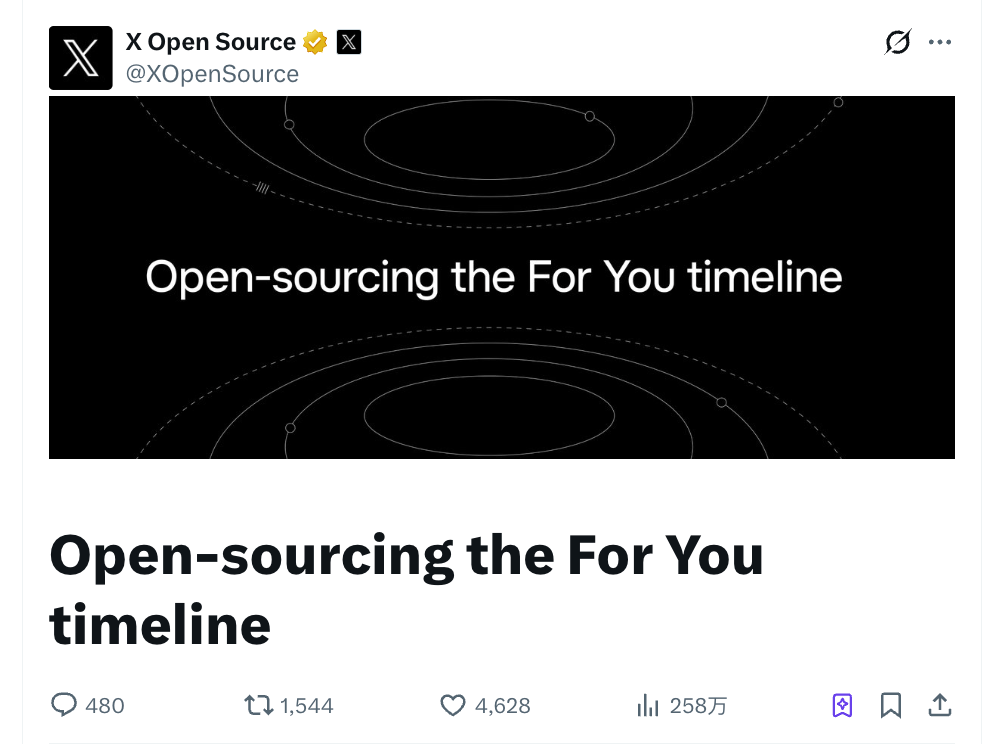
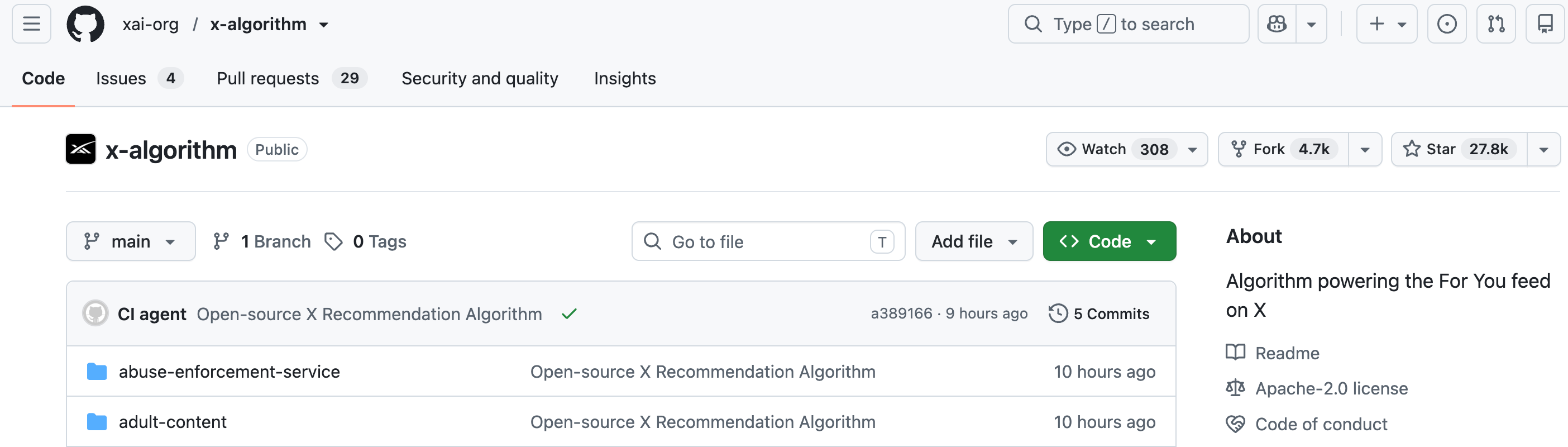
On Thursday, X publicly released the core code of the "For You" timeline under the Apache v2 license on GitHub, in the repository xai-org/x-algorithm. Product Vice President Keith Coleman told TechCrunch, "You will receive the core sorting code for pulling posts, ranking them for users, and assembling the information stream; some systems, like the sorter and scoring logic, you can even run outside the company." Also launched simultaneously is a user-facing "Under the Hood" page, which allows users to download their account data to verify if they have been labeled with "throttling tags".
Whether your post can go viral depends on the algorithm guessing "how people will react to seeing it"
When you open X, the algorithm first retrieves candidate posts from the entire site, half from the people you follow and half from unfamiliar accounts that machine learning identifies as "you may be interested in".
Then, a model called Phoenix predicts the reactions you would have to each post, divided into five groups: Interaction (like, reply, share, send), Click (click on post, on the homepage, on links), Attention (how long you stay, how much video you watch), Follow the author, and Negative responses (not interested, mute, block, report). Each type of response is calculated to yield a probability that is multiplied by their respective weights to obtain the total score for that post.
A high total score does not guarantee the post will be shown as is. There are three additional barriers in the code:
Posts from the same author start to decay in ranking from the second post onward, so flooding is not as effective as quality posting; posts from unfamiliar accounts are discounted as a whole, so a solid fan base remains important; new authors receive a "beginner's support", giving them a guaranteed exposure slot.
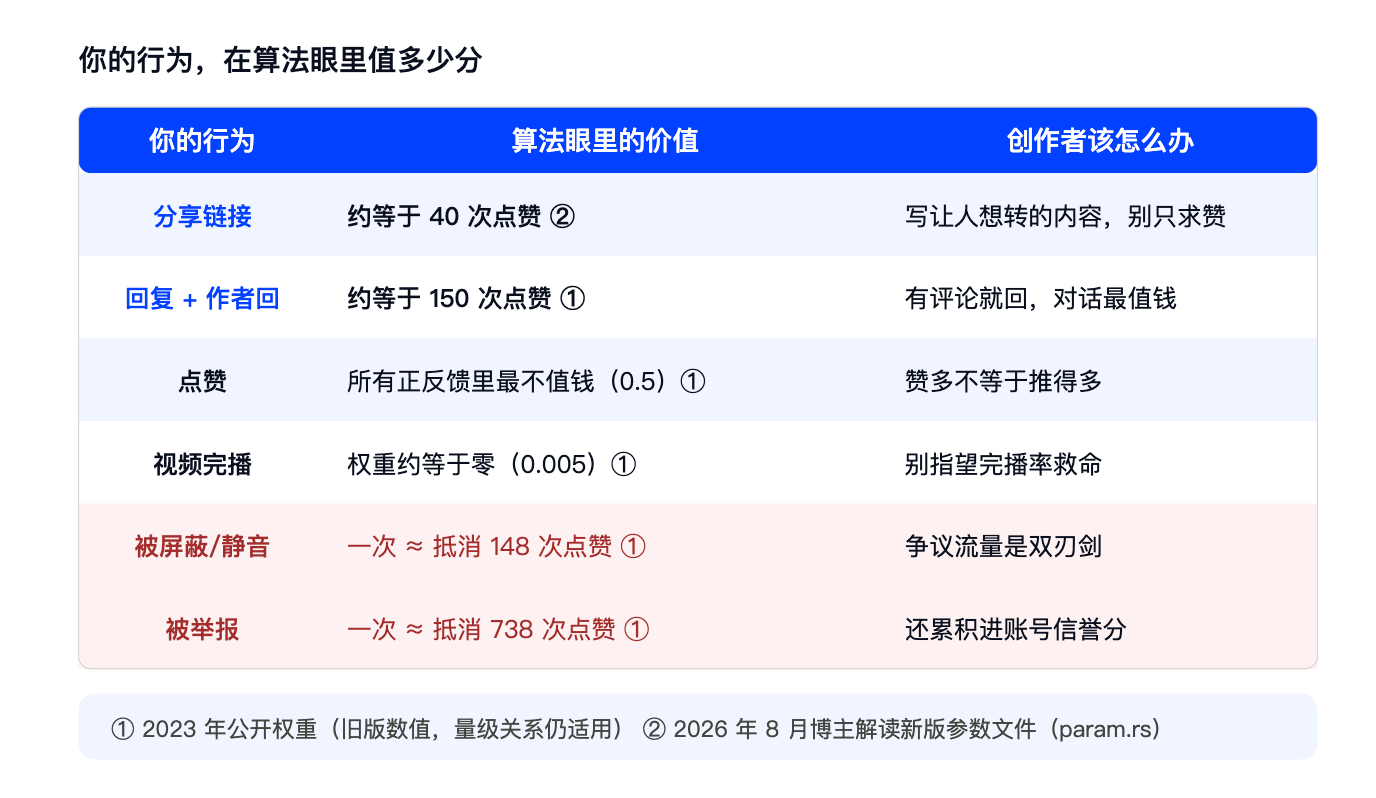
The most striking figure in the weights file is that sharing is worth 40 times more than likes
The most valuable insights from this open-sourcing are found in the home-mixer/params/param.rs parameter file, where for the first time, the point value for each action is clearly specified.
Tech blogger Alex Finn summarized insights from 300,000 lines of code, which have garnered 570,000 views; his core finding is that clicking on a share link is roughly equivalent to 40 likes, "Stop optimizing for likes, start optimizing for shares".
This conclusion is entirely consistent with the design of the algorithm.
Likes are the least valuable among all positive actions, while conversation and sharing are considered the hard currency by the algorithm. The cost of negative feedback is frighteningly high; one instance of blocking or muting requires hundreds of likes to offset and will accumulate into the account's credibility score, affecting the distribution of all subsequent posts. The translation for creators is quite direct: write things that make people want to share, not just like; respond to comments, as conversation is more valuable than unilateral admiration; do not place external links in the main text, if you want to direct traffic, throw it into the comments, as the algorithm does not favor sending users off-site.
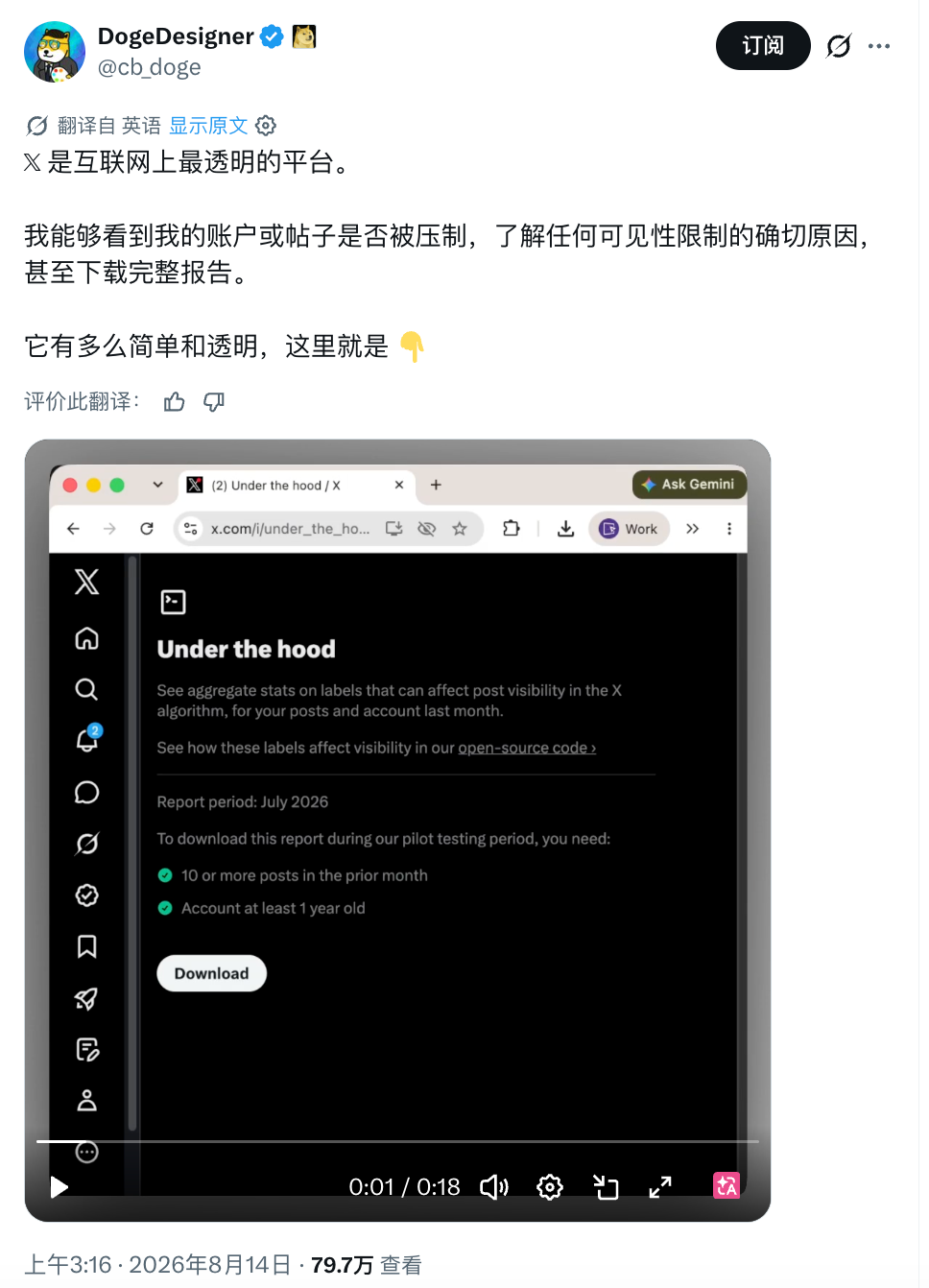
Whether your account has been tagged with throttling can now be checked by downloading data
More refreshing than the code is the tool.
X is piloting the "Under the Hood" page in settings: accounts that have posted more than 10 times in the past month and have been registered for over a year can download a JSON file to check whether their account or posts have been tagged with "visibility restriction" in the past month.
Note that this feature is currently in a small-scale pilot, prioritized for randomly selected users who have accounts older than a year and who posted more than 10 times last month, and will gradually open up thereafter.
(Self-check entry: x.com/i/under_the_hood)
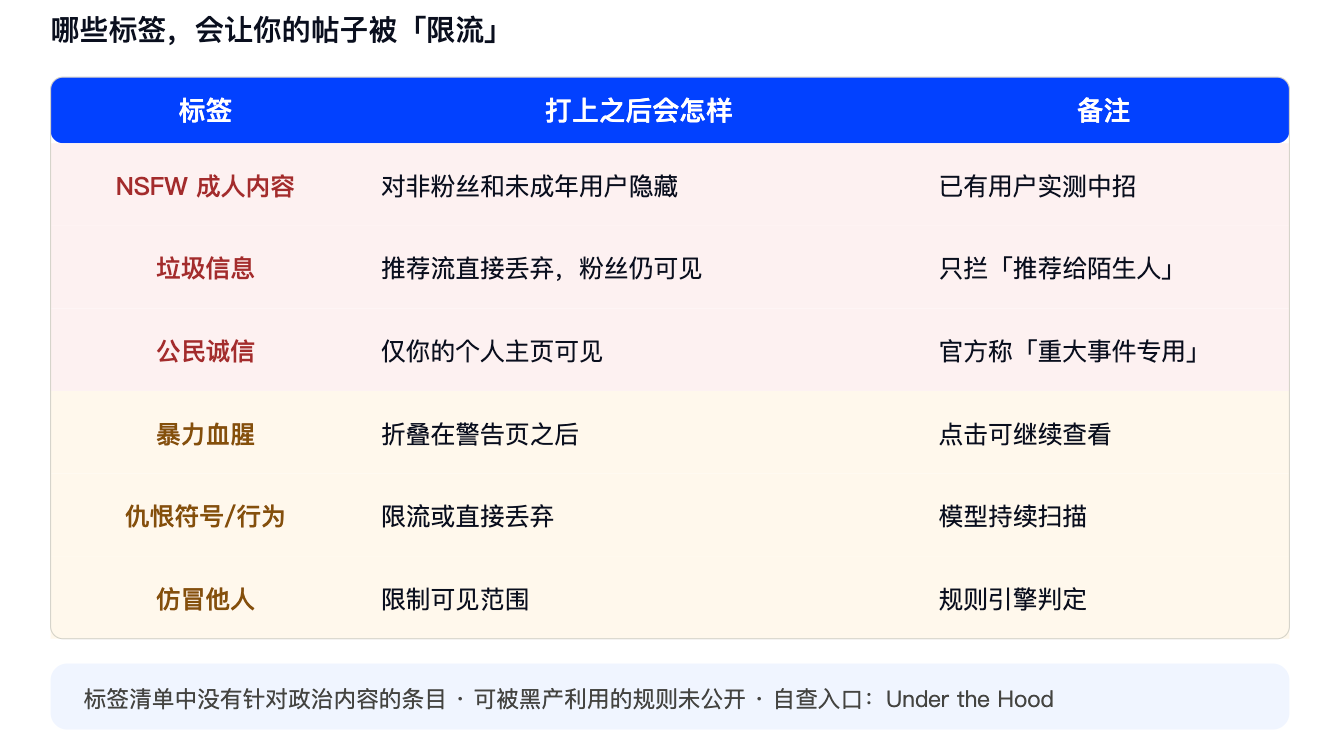
In the repository, the complete tagging mechanism can be seen: classifiers are continuously scanning for spam, adult content, violence, and hate symbols, along with models specifically identifying bot behavior and a credibility scoring system for accounts. Visibility determinations are classified into three tiers: normal display, folded behind a warning page, and outright discarded. One group of rules only applies to "recommended to non-followers", which means that the same post may be visible to your followers but could disappear from recommendation streams, revealing the technical truth behind many users' feelings of being "throttled". Some users have published their data: two posts were tagged with NSFW labels, hidden from non-followers and underage users. Notably, there are no entries in the tag list concerning political content. If you don't understand JSON, it’s fine; the official recommendation is to throw it to a handy large model to translate it for you against the repository.
This is not X's first time open-sourcing an algorithm, but this time it truly reveals its cards
X had previously open-sourced an algorithm in 2023, but that version of the code had not been updated in three years and had already diverged from the online system. The rewritten version from January of this year provided the framework for ranking formulas but did not give the weight values; you could see "weighted summation" but not know what each action was worth. For more details, refer to our previous articles.
Related reading: "Breaking Down X's Open-Sourced Recommendation Algorithm: What Content Is More Attractive to Us?"
This update completes the weight parameters, filtering logic, and model configurations; external researchers can now use the open-source code to independently train and run scoring systems, which had not been achieved in the previous two attempts.
It’s important to remember what has not been provided: warning words used by Grok to determine content violations, some anti-spam rules, and the advertisement system's code are not included in the release scope, officially to prevent malicious entities from using the code to circumvent scrutiny. Furthermore, the self-check tool is currently only open to a small randomly selected range of accounts, most users cannot temporarily download their data. Even so, while Meta, TikTok, and YouTube are still reluctant to share codes and only offer papers, X has laid out both "how to make you popular" and "how to make you disappear" logic on the table simultaneously.
"How to write to go viral" and "whether there is throttling"—these two esoteric concerns that have troubled creators for years, have now been written in an open parameter file and turned into a downloadable JSON file. This cat and mouse game has, for the first time, turned into an open-book test.
免责声明:本文章仅代表作者个人观点,不代表本平台的立场和观点。本文章仅供信息分享,不构成对任何人的任何投资建议。用户与作者之间的任何争议,与本平台无关。如网页中刊载的文章或图片涉及侵权,请提供相关的权利证明和身份证明发送邮件到support@aicoin.com,本平台相关工作人员将会进行核查。


