Author: ETH Daily News
Translation: Deep Tide TechFlow
Deep Tide Introduction: EIP-8363 proposes to burn validator rewards, reducing the staking yield to zero in order to compress the staking scale. However, this analysis argues that the new proposal not only fails to address oligopoly but also puts independent stakers at risk of incurring losses first, which may trigger a chain reaction in DeFi lending and deleveraging. This is an economic model shift risk that ETH holders or DeFi participants must face.

Understanding the Burn Proposal
The progressive burn of issuance compresses the range of unprofitable staking, but independent stakers may still be the first to encounter negative yields.
Happy Monday, August 10, 2026.
The burn proposal (EIP-8363) has dominated the timeline over the past week. This proposal was introduced on August 4, 2026, aiming to burn validator rewards in accordance with a new issuance curve that, once 50% of all ETH is staked, the issuance will drop to 0%. This is a change at the economic level rather than the technical level. The discussions surrounding it are confusing.
Important Note: This article is not a technical explanation and only represents my personal (incomplete) understanding.
Current State: With an issuance lower limit of 1.5% annual yield, the supply of staked ETH is growing and will continue to grow.
EIP-8363: Under this proposal, the supply of staked ETH will not exceed 50%, as the issuance will be 0% (no incentive to stake).
Distinction: The new proposal compresses the unprofitable staking range of ETH from 70 million to 100 million ETH down to 50 million to 60 million ETH (50%).
My Judgment: EIP-8363 attempts to solve a real problem, but the costs outweigh the benefits.
What It Does
Progressive issuance burn decreases the issuance by burning part of the validator rewards. It will burn the base reward along a gradual curve, and when the staked supply reaches 50%, the burn rate will hit 100% (issuance becomes 0%). This change will be gradually implemented over a transition period of 18 months. The proposal aims to prevent the supply of staked ETH from exceeding 50%, helping to maintain a balanced staking ratio.
Why Propose It
EIP-8363 publicly claims its goal is to enhance credible neutrality and resistance to capture. The current issuance curve has a bottom line of 1.5% annual yield, even if 100% of ETH is staked. As everyone has the incentive to continue staking ETH, more staking shares can easily become concentrated in the hands of large operators, custodians, and liquid staking providers. The proposal (as paraphrased) believes:
Too Big to Fail: If a large operator faces penalties or exploitation, it may become too big to fail, and the network will have a moral obligation to compensate its users through a hard fork.
Social Penalty is Weakened: Large operators could collude to evade social penalties. It would become harder for the social layer to coordinate a fork.
dilution: As more ETH is issued, the total supply of ETH increases, diluting the real yield for everyone. The proposal indicates that independent stakers will be particularly hard hit and points out that ETH holders are paying too high a price for security through dilution.
Forced Staking: The increasing supply of ETH forces holders who do not stake to either participate in staking or face dilution risks. This leads to a reduction in the available ETH in the market.
LST Replacing ETH: As more ETH is staked, LST will become the default asset in DeFi. This will introduce systemic risk due to increased smart contract risk, governance risk, and issuer risk.
Dependency: Applications and protocols issuing derivatives will gain extraordinary political and economic leverage over the network.
The Same Outcome
Whether in the current situation or under the issuance burn, the final outcomes in both scenarios are not good. The reason the issuance burn is framed as slightly better than the current state is that it compresses the range of unprofitable ETH staking for independent stakers, institutions, and LSTs. However, both paths lead to the same end, as large staking entities will still retain their advantages.
The capture problem persists. In both scenarios, independent stakers will be the first to hit negative real yields. Professional staking operators will always enjoy economies of scale: lower fixed costs, more MEV opportunities, better online rates, and bulk discounts. In fact, MaxEB (EIP-7251) has further reduced operational expenses for large stakers.
This is the crux of the controversy: What is the difference in impact when ETH staking becomes unprofitable at 70 million to 100 million ETH (the current state) and around 50 million to 60 million ETH (issuance burn)?
The base staking yield driven by issuance encourages demand for ETH, incentivizing various entities from digital asset financial companies, institutions, ETFs, liquid staking protocols to individual holders to buy and stake ETH. The staked ETH reduces the circulating supply, alleviating the asset's selling pressure. Reducing the issuance will have the opposite effect.
As yields decline, currently profitable validators will fall into losses faster and need to exit. As mentioned above, independent stakers will be the first among all stakers to hit negative real yields. I disagree with the assertion that this proposal particularly protects independent stakers. When other opportunities can offer better returns, stakers will be incentivized to unstake and chase profits elsewhere.
Businesses Forced to Close
Some businesses are built on Ethereum's yield. They purchase ETH, participate in network validation, and provide actual services. They are using the network as intended by its design. The decline in yields will squeeze their profit margins, and we will see companies shutting down and unstaking ETH as a result. This will similarly put tremendous selling pressure on ETH.
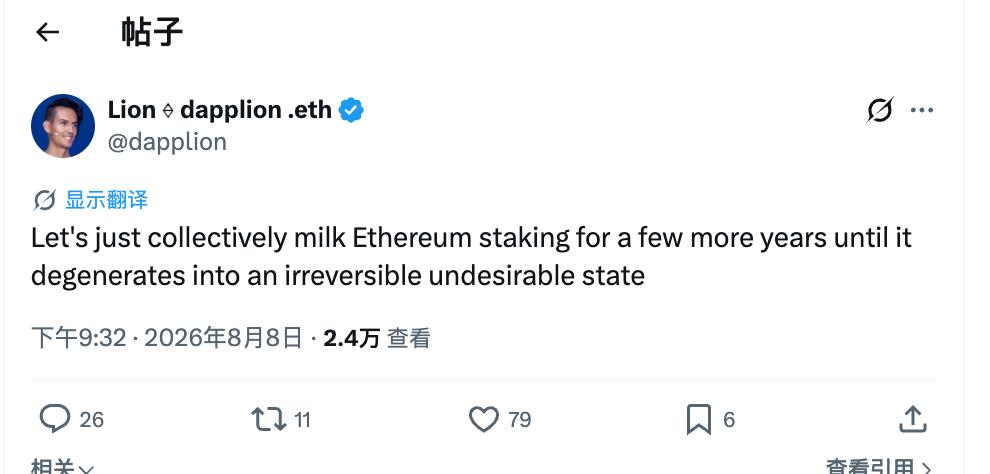
Some supporters of this EIP describe businesses based on Ethereum yields as "extracting" from the network or receiving "systemic subsidies." Such rhetoric ignores the real work being done by teams like Obol, which builds DVT infrastructure, or funding mechanisms like Octant for public goods; they are solving problems, not extracting profits.
Impact on DeFi
The entire Ethereum DeFi ecosystem relies on the base staking yield. A sudden drop in ETH staking yield will directly lower borrowing rates for ETH throughout DeFi. Currently, market participants borrow ETH to stake, lend out ETH for yield, and use ETH as collateral to borrow stablecoins and buy more ETH.
Lowering staking yields will reverse these incentives. Market participants will borrow ETH to sell. They will stop lending out ETH due to the low yields and will switch to using stablecoins as collateral instead of ETH. This will trigger a massive unwinding of staking yield strategies: DeFi treasuries will see outflows, and the total locked value in DeFi will decline, reducing the demand for ETH as well.
Not all DeFi users are yield farmers. DeFi provides access to financial services for users around the globe. Many rely on it for saving, investing, and hedging against local currency inflation. They too will be affected by the decline in yields. A sudden change of this magnitude may have far-reaching consequences. More concerning are the upheavals triggered by this.
Based on Expectations
One reason this EIP has sparked controversy is that it is based on expectations. How the market will reach equilibrium in two years is still unknown, regardless of which curve is chosen.
The new curve will find equilibrium above 0% real yield, allowing self-funded stakers to still be maintained.
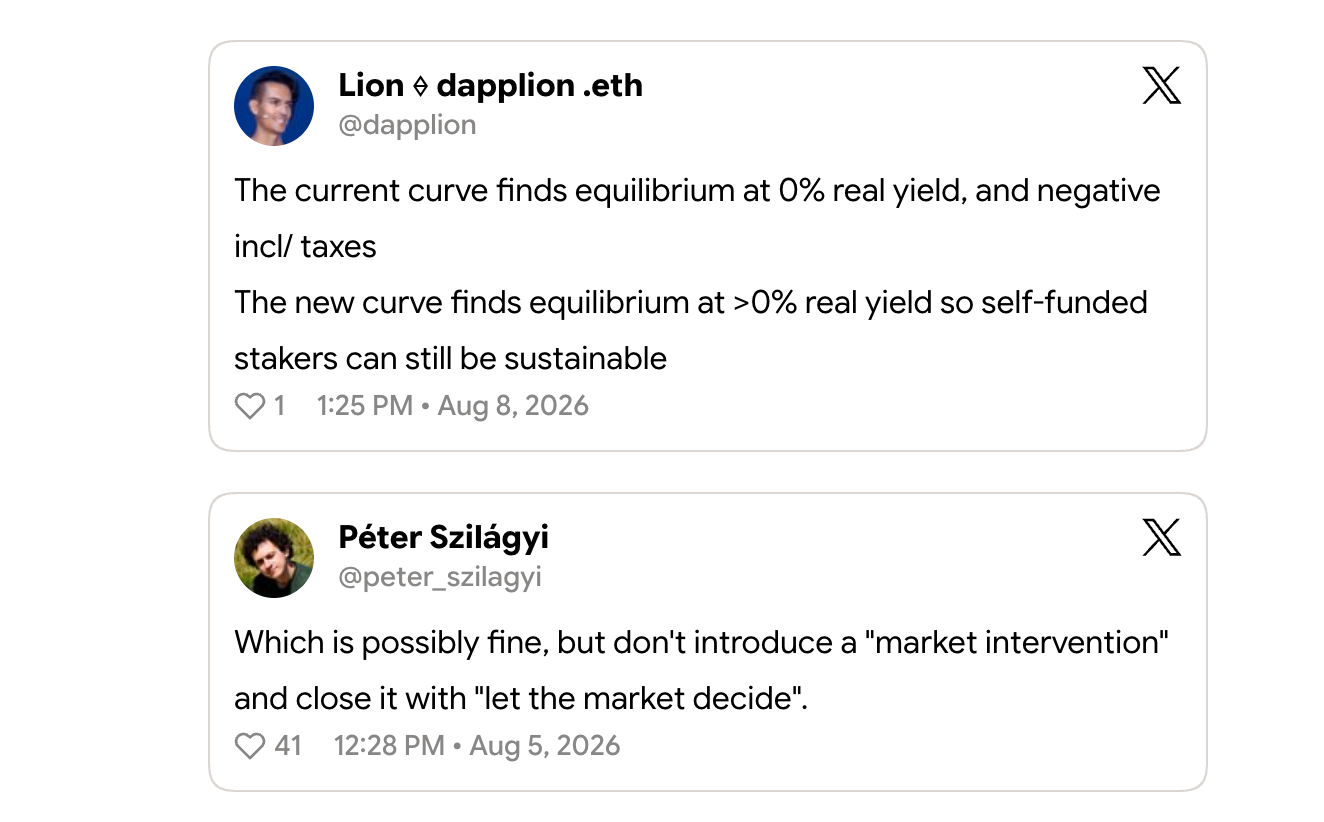
A core argument from supporters is that under the new proposal, the market will find equilibrium above 0%. Analysis from pa7x1 (The Shape of Future Issuance Curve) indicates that under the current curve, independent stakers will first hit negative real yields when 70 million ETH are staked. This expectation is based on cost estimates. Under the new proposal, independent stakers will hit negative real yields with less than 60 million ETH staked. If actual costs are higher than estimated, this critical point could arrive even sooner.
Longer-term Roadmap
I have not seen anyone discuss the relationship between EIP-8363 and the target set of 128,000 validators. The Ethereum roadmap includes changes to reduce the number of validators. A smaller validator set helps reduce the signature, proof, and state load on the consensus layer. The goal of MaxEB (EIP-7251) is to alleviate this burden by merging validators. This long-term series of improvements will help Ethereum move closer to single-slot finality.
The issuance burn effectively sets a cap on the amount of already staked ETH, thereby reducing the number of validators. It is unclear whether reducing the validator set is an indirect goal of the issuance burn proposal. Clarification from researchers on this point would be helpful.
I believe the goal of balancing the staking ratio is a good one.
I think it alleviates but does not solve the issues it claims to address.
I believe the costs outweigh the benefits.
免责声明:本文章仅代表作者个人观点,不代表本平台的立场和观点。本文章仅供信息分享,不构成对任何人的任何投资建议。用户与作者之间的任何争议,与本平台无关。如网页中刊载的文章或图片涉及侵权,请提供相关的权利证明和身份证明发送邮件到support@aicoin.com,本平台相关工作人员将会进行核查。


