This article is jointly produced by PANews and BIT US Stocks. BIT US Stocks offers over 10,000 US main board stocks and ETFs, supporting stablecoin deposits and withdrawals as well as traditional US dollar wire transfers, allowing for complete shareholder rights and dividend voting rights.
BTC Stuck in "Summer Sideways", Market Holds Breath for CPI Data
Bitcoin is still consuming patience in the "summer sideways" trend, with BTC dropping to around $63,000 yesterday, falling over 2% from a previous high of $65,300. Over the past few weeks, the price has been mainly locked in the range of $62,000 to $66,000, with light trading and insufficient directional clarity. Recently, the price movement of BTC has been countered by two forces: one is continued inflow into spot ETFs, while the other includes off-exchange selling from miners and large players like Strategy. Bitfinex analysts believe that ETF buying and corporate reserve activities are offsetting each other.
Traders generally believe that the real short-term catalyst for BTC is not the on-chain narrative but the US CPI, Federal Reserve policy expectations, and regulatory progress such as the "Clarity Act". Jeff Anderson, Managing Director of STS Digital, pointed out that Bitcoin has been sideways for five consecutive weeks, summer liquidity is thin, and market attention has been diverted by AI; more crucially, implied volatility has fallen to the first percentile historically, indicating that the market is waiting for a larger volatility release.
Several traders have highlighted the key support at around $62,000 to $63,000, especially near $62,200, which has been repeatedly defended and is supported by daily and three-day moving average resonance; resistance above is focused on the range of $65,000 to $66,000, with the 50-month exponential moving average near $65,400 regarded as significant resistance, and BTC has only closed above that a few times since June.
On-chain data has released signals of bottoming formation, but reversal has not been confirmed. Doctor Profit analysis points out that the average cost line for BTC held for 3 to 6 months has crossed below the average cost line for 1 to 2 years, a phenomenon that appeared during bear market bottoming phases in 2015, 2019, and 2022, suggesting that chips are shifting from new buyers to long-term holders. However, Glassnode's seller exhaustion indicator has not yet reached historical bottom thresholds, indicating that while selling pressure is weakening, it is not completely exhausted. This type of signal historically does not mean an immediate rebound, often several months of sideways accumulation follow.
The market is holding its breath waiting for the US July CPI data to be announced at 20:30 Beijing time tonight. Analyst Killa expects that market volatility will significantly increase after August 14, with potential one-way fluctuations of 6% to 8%. If the CPI is below expectations, US bond yields and the dollar may retreat, allowing BTC to target $66,000; if the data is hot or if US bond auctions are weak, then caution should be exercised regarding the risk of the price retreating to $60,000 or even lower.
Today's Key Points:
Aptos (APT) unlocked approximately 11.31 million tokens, worth about $6.8 million
Upbit 24-hour trading volume rankings: PROM, DOS, CAP, BTC, XRP
Bitcoin spot ETF: +$4.8862 million
Ethereum spot ETF: -$1.7644 million
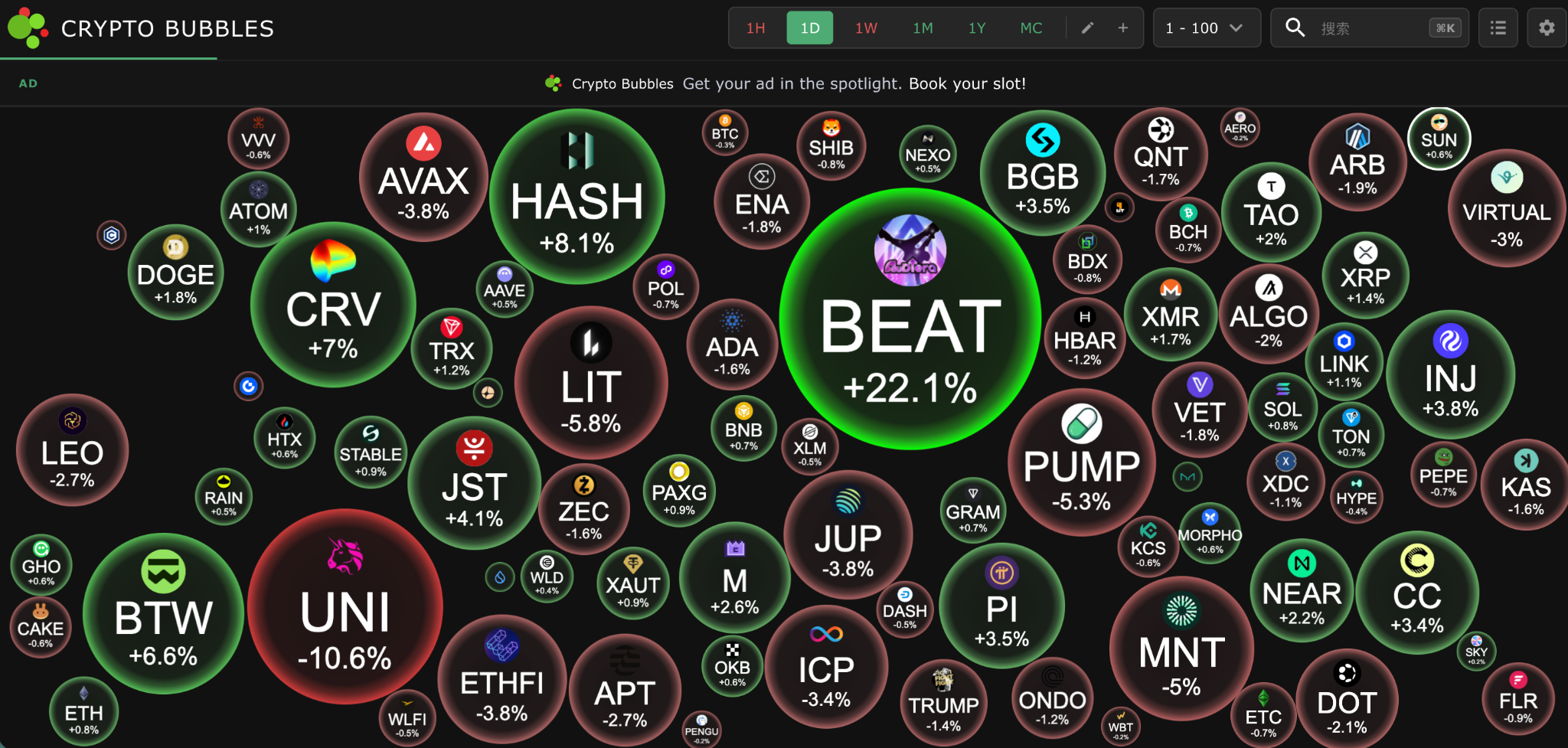
Today's largest gainers among the top 100 cryptocurrencies by market capitalization: BEAT up 22.1%, HASH up 8.1%, CRV up 7%, BTW up 6.6%, JST up 4.2%.
US Stocks Rally in Night Trading, AI Computing Power Takes Center Stage
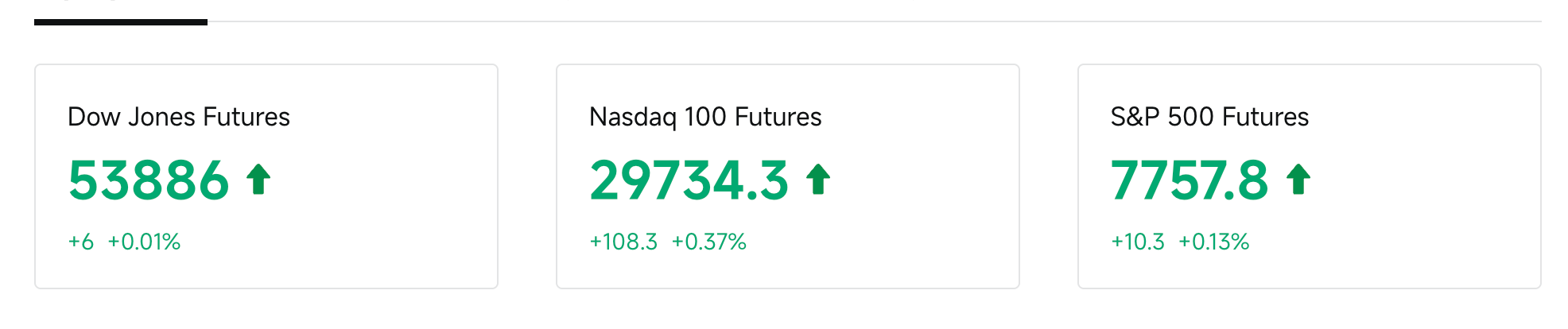
US stock index futures slightly rose before the CPI announcement, as the market remains cautious but not fully retreating ahead of major data. The Dow futures rose 0.01%, Nasdaq 100 futures rose 0.37%, and S&P 500 futures rose 0.13%.
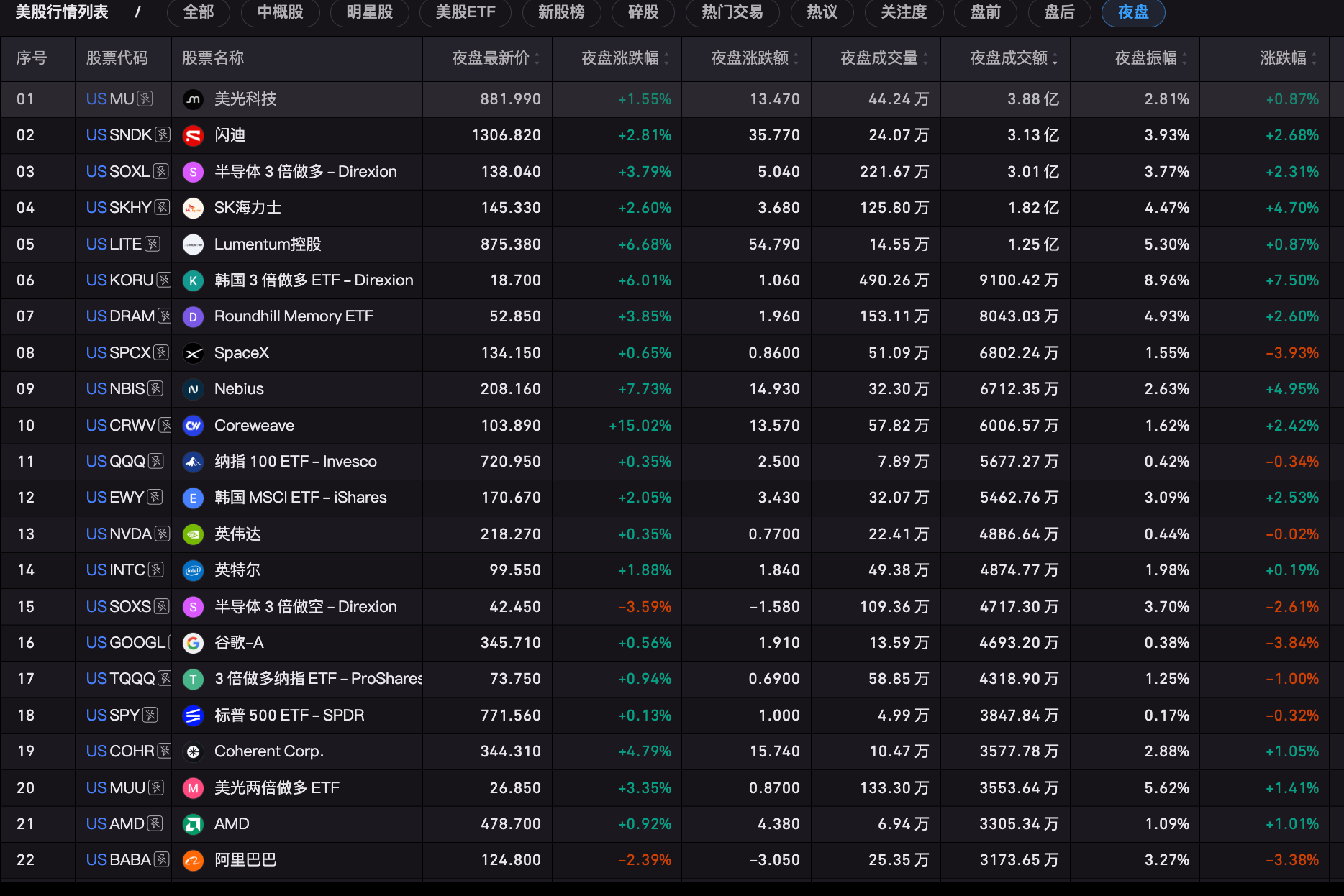
BIT night trading data shows that most US stocks rose before the CPI data release, with Micron, SanDisk, SK Hynix, and storage ETF DRAM increasing by 2% to 4%.
The most notable during night trading was AI computing power stocks, with CoreWeave's stock price soaring over 15%. The company saw Q2 revenue grow by 112% year-on-year to $2.58 billion, with backlogged orders reaching approximately $104 billion; Advanced Micro Devices also rose 9% during night trading, despite Q4 sales slightly missing expectations, gross margins improved significantly, and Q1 sales guidance exceeded market expectations. Nebius, which will release earnings before the market opens, also rose 7.73%.
Optical communications continue to send strong signals, with Lumentum rising 6.68%. Q4 revenue reached $1.01 billion, a year-on-year increase of 109%, non-GAAP EPS rose to $3.23, and the middle of the next fiscal quarter's revenue guidance is set at $1.255 billion. The company stated that pump lasers are “completely sold out” and demand for 1.6T and CPO/NPO is strong. Coherent, which will release earnings after the market closes, rose about 5%.
Tonight before the market opens, Nebius will release its earnings report; as an important player in AI cloud infrastructure, the market will closely watch whether it can sustain the strong momentum of CoreWeave.
BIT US Stocks special invited analyst Jun believes that earnings reports are still the most direct trading clues for US stocks, but the market has a very low tolerance for errors. Sea Limited surged 14.56% due to a 48.1% year-on-year revenue increase and management raising Shopee profit guidance; despite Tencent Music exceeding revenue expectations and EPS being slightly below estimates, it fell 11.92%, indicating that investors prioritize guidance and profit certainty.
Tech Giants Drag Down Indices Last Night, Chip Stocks Strengthen Against the Trend
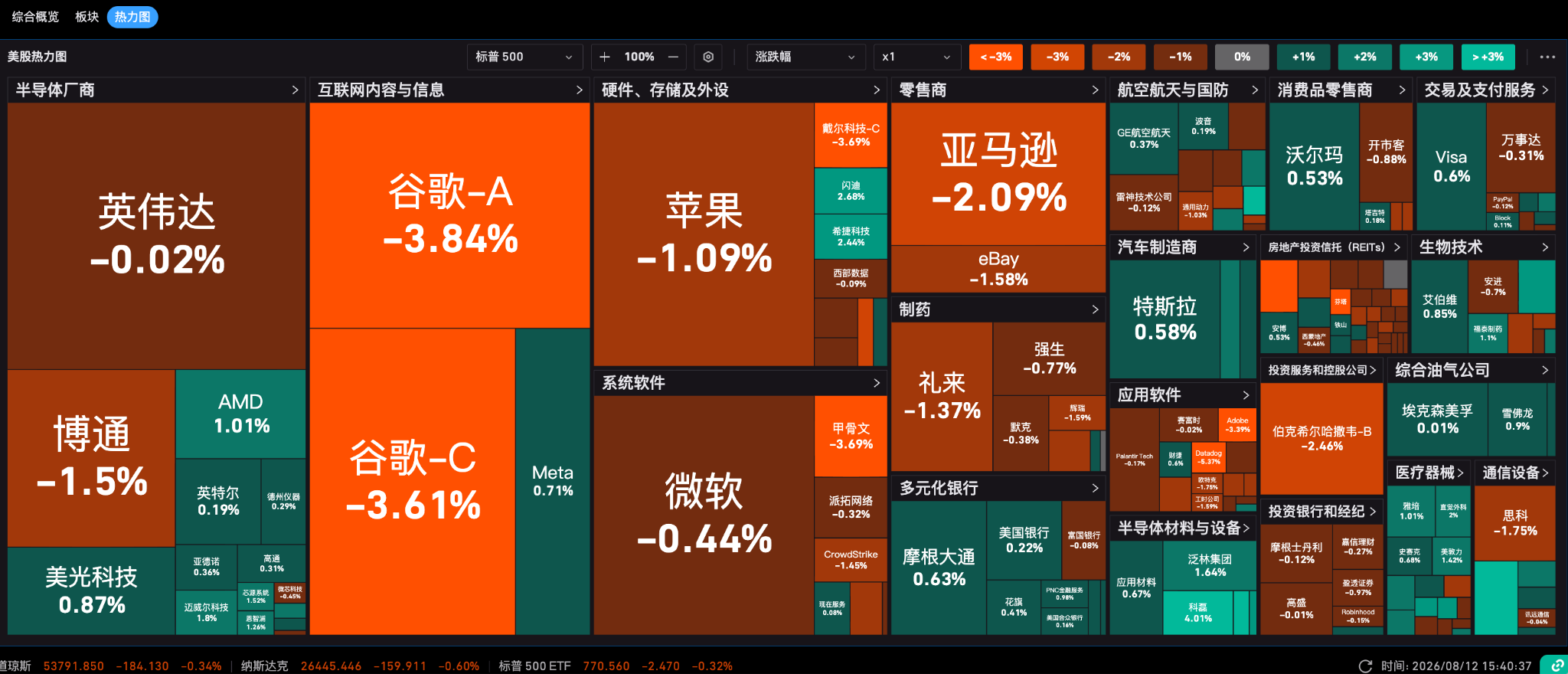
Overnight macro pressures stemmed from three aspects: approaching CPI, tensions in the Strait of Hormuz driving up oil prices, and Federal Reserve officials continuing to sound hawkish. Chicago Fed President Goolsbee stated that the current biggest problem is that prices are rising too quickly; Cleveland Fed President Mester indicated that multiple rate hikes may be needed to bring inflation back to 2%.
Large technology stocks faced widespread pressure, with Google dropping 3.84%, marking the largest single-day drop in nearly six months; Amazon fell 2.09%, Apple dropped 1.09%, Microsoft slid 0.44%, and Nvidia dipped 0.02%. Although Google CEO Pichai mentioned that Gemini has surpassed 1 billion active users, the market still worries about the return on AI investments and capital expenditure pressures.
The chip sector was relatively strong, with the Philadelphia Semiconductor Index rising 0.87%, with 24 of the 30 component stocks rising. Micron rose 0.87%, SK Hynix ADR climbed 4.70%, SanDisk gained 2.68%, and Seagate increased 2.44%. Micron executives stated that AI demand has heightened the need for memory chips, and the supply-demand tension may continue until after 2027.
Alternative asset management stocks benefited from the AI infrastructure financing narrative, with KKR rising 6.88%, Apollo increasing 6.26%, Brookfield up 4.77%, and Blackstone rising 3.89%. Nvidia CEO Jensen Huang clarified the $500 billion AI infrastructure financing plan, stating that Nvidia would support a maximum of 25% in any single project, alleviating market concerns about "circular financing".
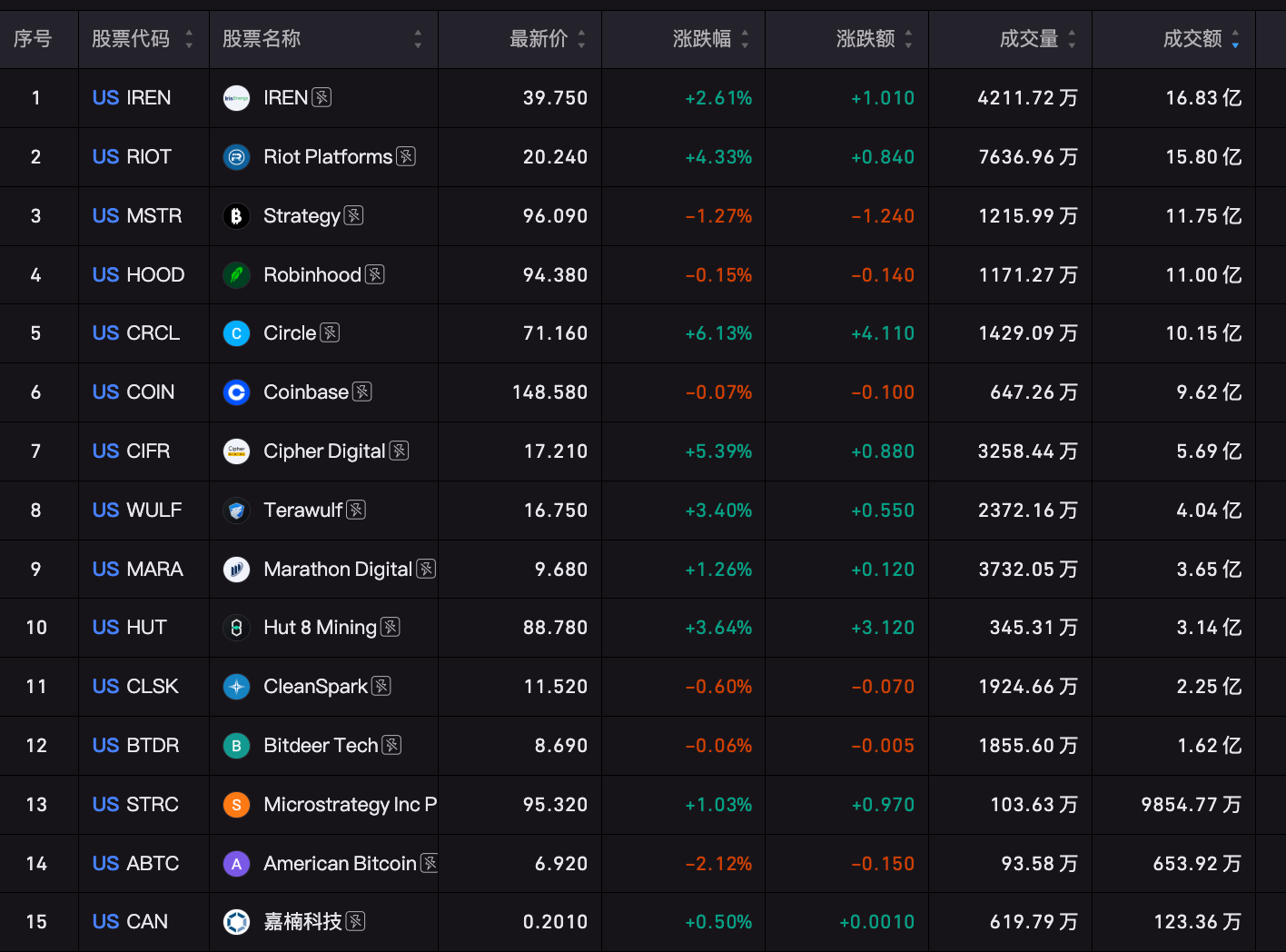
Cryptocurrency concept stocks were generally weak, according to data from BIT US Stocks, with Coinbase down 0.07%, Robinhood down 0.15%, and Strategy down 1.27%, having sold 6,948 BTC this year, although the CEO has indicated plans to resume purchases within the year; Circle continued to recover, rising 6.13%, with Circle's stock price rebounding about 16% to around $71 from a low post-earnings report.
Mining company stocks were generally strong, with the core issue being "AI transformation requires capital": Riot rose 4.33%, planning to provide equity financing for AI data centers through BTC sales, with leasing contracts expected to generate about $9.1 billion in revenue; Bitdeer dropped 0.06%, unlocking up to $1 billion in ATM financing for AI data center construction, with potential dilution of about 30%; MARA rose 1.26%, promoting acquisitions and AI layouts through BTC collateral loans; Cipher Mining climbed 5.39%, TeraWulf rose 3.40%, and Hut 8 increased 3.64%.
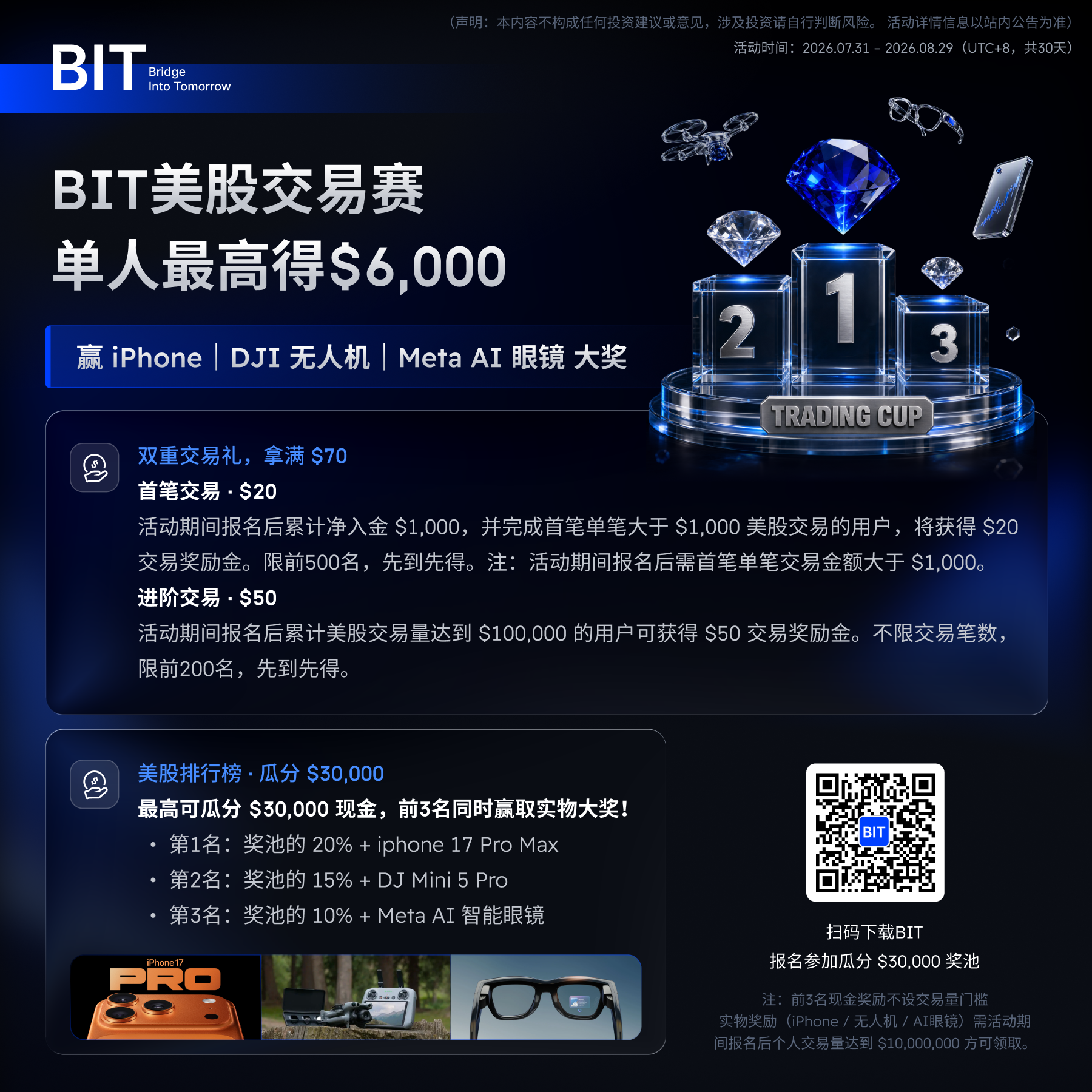
Additionally, the BIT US Stocks trading competition has officially started. Users who complete registration and meet standards during the event can share a cash prize pool of $30,000, with an individual cap of $6,000. The top three by trading volume also have the chance to win physical prizes such as the iPhone 17 Pro Max, DJI drones, or Meta AI smart glasses. The competition continues until August 29 and is limited to BIT US Stocks users who have completed KYC.
Chip Stocks Ignite in Korea, Temasek "Bottom Fishing" Rumors Add Fuel
Asia-Pacific stocks performed strongly on Wednesday, with the Korean market particularly notable. The KOSPI closed up 3.68%, at 6,579.04 points. During the day, the KOSPI's rise briefly expanded significantly, leading the Korean exchange to trigger a temporary halt mechanism, pausing program trades for 5 minutes due to a 5% increase in KOSPI 200 index futures.
The semiconductor giants became the core engine of this rebound. Samsung Electronics rose 6.68%, trading at 255,500 KRW; SK Hynix rose 5.54%, trading at 1,504,000 KRW, with the two chip leaders seeing their intraday increase exceed 8% at one point.
What fueled this round of rebound was the news that Singapore's sovereign wealth fund Temasek plans to invest directly in the Korean stock market for the first time. According to South Korea's "Asian Economy", Temasek has contacted the Korean government regarding investments in Samsung Electronics and SK Hynix and is evaluating the timing for entry. Temasek has classified memory chips as the most undervalued link in the AI value chain and plans to raise AI-related assets to 15% within five years. Investment banking industry insiders interpret this arrangement as demonstrating Temasek's strong confidence in that judgment.
In the Japanese market, the Nikkei 225 index rose 0.83%. Memory chip manufacturer Kioxia rose 3.87%; SoftBank Group increased slightly by 0.66%, with the dollar hovering around 159 against the yen. In addition, Japan's cryptocurrency treasury company Metaplanet fell 5.15%, having transferred 4,176 BTC worth about $265.3 million within the last 7 hours; the company had previously purchased 43,000 BTC at an average price of $96,191, now facing an unrealized loss of 34%, approximately $1.4 billion.
In the A-share and Hong Kong stock market: the Shanghai Composite Index closed up 0.32%, the Shenzhen Component Index rose 1.09%, and the ChiNext Index rose 1.49%, with computing hardware and memory chip sectors leading the gains. The Hang Seng Index opened higher but closed lower, falling 1.1% to 25,652 points, losing the 26,000 mark and the 250-day moving average. Tencent Holdings will release earnings post-market today, with market focus on recovery in gaming, advertising growth, and whether AI investments can translate into margin improvements.
Key Focus Ahead:
August 12 (Wednesday)
Nebius will release earnings before the US stock market opens, as an important player in AI cloud infrastructure, the market will closely watch whether it can continue the strong momentum of CoreWeave.
US EIA, OPEC, IEA monthly reports to be released: The three major energy reports will focus on examining global crude oil supply and demand, inventory, OPEC+ production discipline, and demand outlook. If the reports indicate supply tightening or rising risks in the Strait of Hormuz, oil prices may continue to rise, and inflation expectations will be re-ignited; if demand expectations are revised lower, the momentum for oil price rebounding may be limited.
20:30 US July CPI: The market expects the overall US CPI year-on-year to drop from 3.5% to 3.4%, and core CPI year-on-year to drop from 2.6% to 2.5%; if the data is below expectations, bets on a September rate hike will continue to cool, US bond yields and the dollar may decline, benefiting Nasdaq, gold, long bonds, and high-valuation growth stocks; if CPI is hotter than expected, the market may reprice tightening risks, and US stock valuations, especially AI tech stocks, may come under pressure.
20:00 Tencent Holdings Q2 earnings conference call: The core heavyweight report of Hong Kong stocks this week. The market will focus on the recovery of gaming business, commercialization of video accounts, fintech profit margins, AI capital expenditures, mixed models, red packets, and WeChat AI functionality progress.
August 13 (Thursday)
Cisco, Coherent, Cerebras post-market earnings report: Cisco will validate demand for AI networking devices, Coherent will assess the buoyancy of high-speed optical communication and 800G/1.6T optical modules. If orders, gross margins, and guidance are strong, "multi-optical communication" trades may continue; if they fall short of expectations, the recently surging optical module sector may face profit-taking.
06:00 Google New Product Launch Event: Expected to introduce the Pixel 11 series, Pixel Watch 5, and Pixel Buds Pro, with core highlights being the deep integration of Tensor G6 and the Gemini ecosystem. If the edge AI experience exceeds expectations, it will catalyze AI phones, edge models, sensors, and the Android ecosystem.
20:30 US July PPI: PPI will answer whether corporate costs continue to be transmitted to end consumption. If PPI is hotter than expected, even if CPI is mild, the market may still worry about inflation resurgence; if PPI declines simultaneously, the "declining inflation + easing policy pressure" trade will be further reinforced.
21:00 SanDisk Investor Day: The market will focus on NAND supply and demand, enterprise-grade SSDs, capital expenditures, high-speed flash memory roadmap, and long-term profit margin goals. Given the recent pressure on storage stocks, SanDisk's statements will directly impact Micron, Western Digital, SK Hynix, and sentiment within the A-share storage chain.
JD Group Q2 earnings conference call, SMIC, Hua Hong Semiconductor earnings.
August 14 (Friday)
US SEC 13F quarterly holdings disclosure deadline: The document will disclose the long stock positions of US hedge funds and other institutions as of June 30. The market will closely observe whether large institutions increase allocations to AI, optical communication, power, energy, gold, and financial stocks; note that 13F has about one and a half months of lag and only covers long positions, but is still an important window for judging institutional style shifts.
Applied Materials post-market earnings report: The market will focus on DRAM, advanced packaging, wafer manufacturing equipment demand, and changes in orders from the Chinese region.
Bill Gates visits South Korea and discusses SMR small pile cooperation with SK Group and HD Hyundai: The market will focus on the combination of nuclear energy, small modular reactors, and AI data center power demand. If cooperation details advance, it will strengthen the "AI power infrastructure" trade logic.
免责声明:本文章仅代表作者个人观点,不代表本平台的立场和观点。本文章仅供信息分享,不构成对任何人的任何投资建议。用户与作者之间的任何争议,与本平台无关。如网页中刊载的文章或图片涉及侵权,请提供相关的权利证明和身份证明发送邮件到support@aicoin.com,本平台相关工作人员将会进行核查。


