Authors: Gao Honghao Song Wei
A restarting startup and a product with an ARR of over $300 million.
On the evening of August 11, the phrase "Manus has now become part of Meta" that had been on the Manus website for half a year changed to "Manus is soon to resume independent operation."
It took less than eight months from acquisition to confirmation of the split.
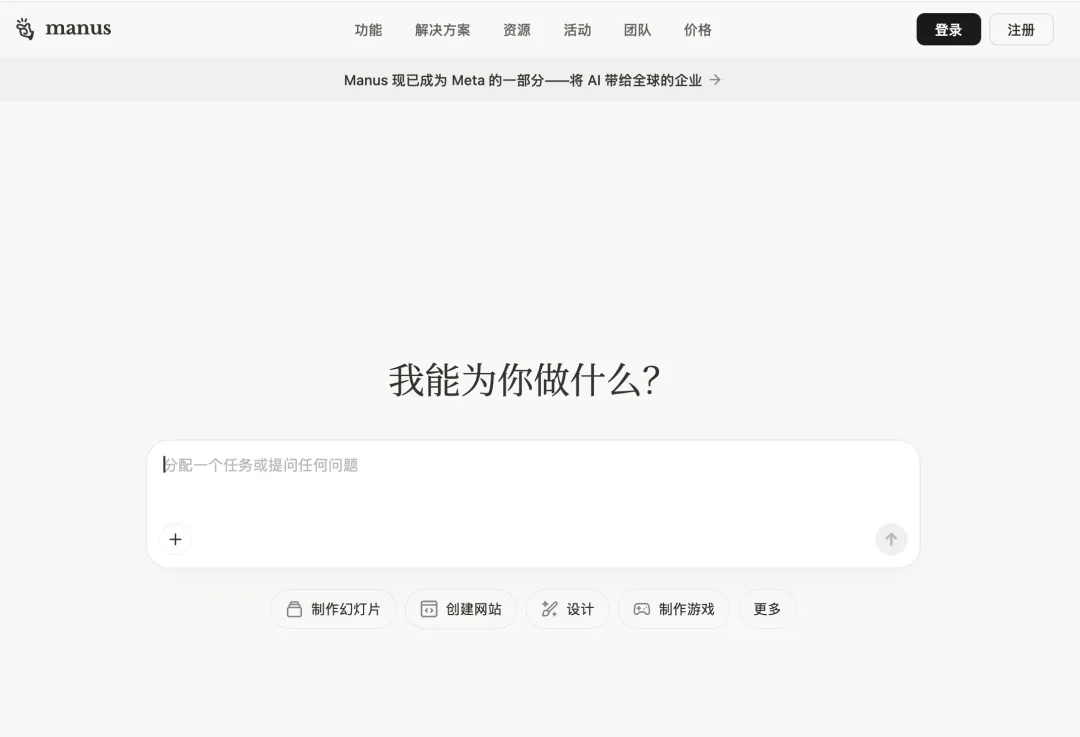
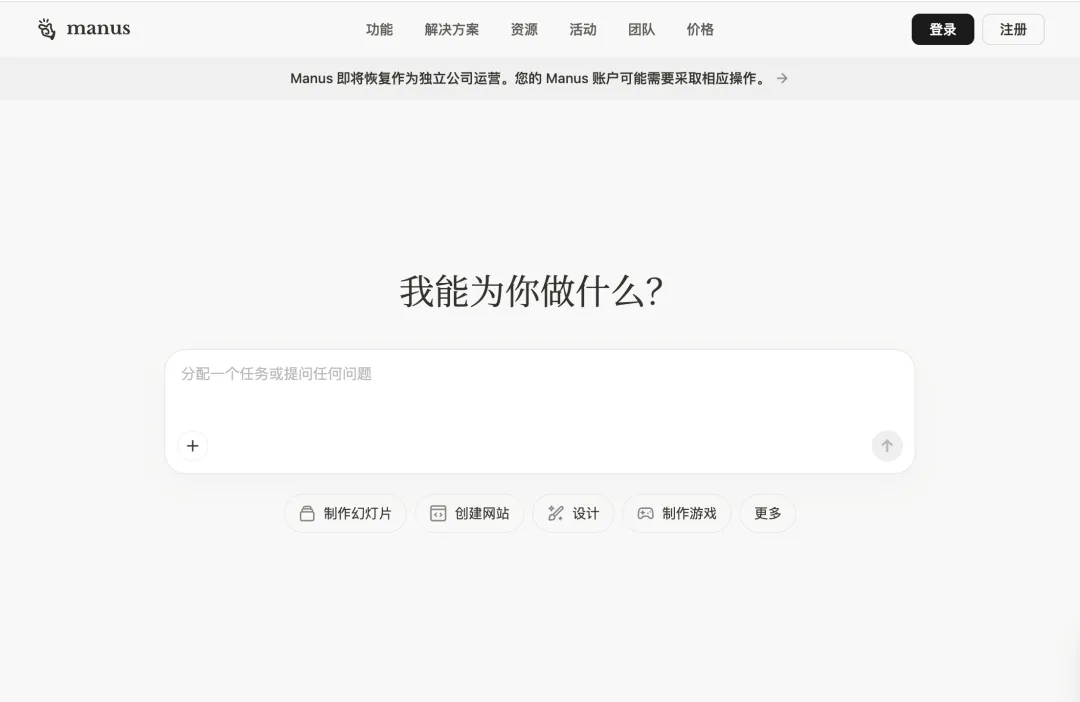
Image: The Manus official website before and after August 11, 2026.
In July 2025, Xiao Hong left Wuhan, where he had lived for a long time, and moved to Singapore with the entire team. On December 29 of the same year, he decided to sell the company to Meta for over $2 billion, taking on the role of Vice President at Meta.
This was the largest acquisition in the field of large model applications at the time, with the transaction taking only about 10 days from contact to signing; it was also the third largest merger and acquisition in Meta's history, following WhatsApp and ScaleAI.
A week after the announcement of the deal, a spokesperson for China's Ministry of Commerce stated at a routine press conference that they would conduct an assessment of the acquisition's consistency with related laws and regulations concerning export control, technology imports and exports, and foreign investment.
The dramatic change sparked enthusiasm for discussion, with far more participants on social networks discussing it than those who had used Manus. "The champagne was popped too early," "20 billion dollars gone in a night" were repeated. Some viewed it as a turning point—the end of Chinese startups exiting through U.S. capital.
During this time, the venture capital firms that once squeezed in through any gap to seek shares cautiously kept their distance. Xiao Hong, Ji Yichao, and Zhang Tao held daily video calls with the team remaining in Singapore to synchronize progress and arrange work.
Despite the turmoil, Manus continued to maintain 1-2 feature updates each week, comparable to the peak at the end of 2025, faster than a year prior. However, there was no significant version change, with the product remaining at 1.6, focusing more on functionality enhancements and adding connectors (integrating with global products like Gmail, Shopify, Slack), and launching a client. A person from Manus said that the development pace remained normal, and version 2.0 had been completed, set to be released after the deal fully ended.
On April 27, the National Development and Reform Commission announced the decision: "A ban on foreign investment in the Manus acquisition project, requiring the parties to withdraw from the acquisition deal." Meta subsequently responded in a statement sent to the media, saying that the deal fully complied with applicable laws and looked forward to a proper resolution of the review. Deal unwind—usually refers to canceling a completed transaction and restoring the status quo as much as possible.
Days later, the actual split between Meta and Manus began. According to media reports, both sides ceased data sharing, and Manus employees could no longer access Meta's internal systems.
By June and July, investment firms keeping their distance began to realize that this was a profitable opportunity. One investor told us that if there was still a funding gap, they would be eager to get involved.
Some sensitive VC and entrepreneurs began taking action, preparing funds to participate in Manus's first round of financing after returning.
This was because, during the three months of turmoil, Manus's income had increased by about five times, rising from $300,000 daily to nearly $1.5 million, at one point surpassing DeepSeek.
During this time, various rumors circulated. In July, there were reports that Tencent would acquire a controlling stake in Manus. Thus, the Manus teams in Beijing and Singapore maintained daily communication to calm emotions and stabilize the team. Throughout months of turmoil, this 150-person company saw no one leave.
Those in Beijing developed a new rhythm of life. Xiao Hong relearned mathematics, studying large models. Zhang Tao took up rock climbing and practiced the Rubik's cube, spending six months reducing his weight from 150 to 120 pounds, ensuring he got seven hours of sleep each night, even lowering his blood pressure.
These months reshaped the trajectory of this startup and helped its founders clarify what they truly wanted.
Back in December 2025, Manus was in the process of financing when Meta representatives expressed a desire to meet the core team to explore potential business collaboration opportunities. After several rounds of communication, during a meeting attended by all core team members, Meta unexpectedly indicated its intent to acquire in front of the group. By this time, several partners and core technical personnel had followed Xiao Hong for many years, having experienced two startups. Selling the company was a necessary explanation and reward for everyone.
After the acquisition ended, on New Year’s Day 2026, Xiao Hong walked along the Singapore coastline, feeling that the winding ten-year journey had finally come to an end and that he would soon be starting at a big company. However, upon reaching this seemingly fulfilling conclusion, he felt a sense of loss.
After the acquisition was clearly set to be withdrawn, the significant reversal and blow perceived by the outside world instead gave these serial entrepreneurs renewed expectations: their entrepreneurial story entered its second season.
According to someone close to Manus, Xiao Hong expressed during a team call that he did not want to be a spectator or reminisce about that era but wanted to continue to be part of the wave and engage in it. Otherwise, he would only become someone writing a memoir about the past.
Manus is a classic technology startup story. Before ChatGPT, Xiao Hong used the earlier released GPT-3 large language model, saw the potential of the technology, and brought Ji Yichao and Zhang Tao in, creating a browser shell for GPT called "Monica."
The browser made it difficult to see the potential for the next super product. A year before the release of Manus, an entrepreneur met one of Xiao Hong's partners and, after discussing the already released Monica, felt the partner had quite a bit of self-doubt.
During the development of Monica, as the large model advanced, this team found a previously advanced product form through trial and error, enabling agents to work fully automatically like humans. By 2024, Cursor, Copilot, and even ChatGPT were still assuming humans would be staring at screens, continually issuing prompts to direct AI tasks. During that time, model inference costs were an order of magnitude higher than now, but Manus was already conducting Wide Research that involved massive token consumption, betting that tokens would become particularly cheap. They were also one of the earliest AI application companies to establish an Evaluation team, creating a closed-loop development cycle.
These forward-looking judgments and investments allowed Manus to maintain its lead and growth for a long time. After its release in 2025, shortly after Manus came out, a major tech firm initiated at least seven similar projects internally, yet none managed to take its users away. During the investigation period, Manus's ARR first surpassed $300 million.
Xiao Hong once summarized his understanding of the entrepreneurial path with the phrase "Trade, Industry, and Technology": first find the market, then establish products and business, and finally delve into the depths of technology. Through Manus, he has now completed the first two steps—creating a product needed by a large number of users and establishing a real business.
Today, Manus's competitors have mastered the most core technologies. Over the past six months, Claude and Codex have fiercely competed, quickly perfecting applications to control computers to complete tasks. The desktop application and the Plan Mode, which Manus launched during this period, were in pursuit of these two Silicon Valley pioneers. Recently, many large domestic companies also view computer work as the next battlefield.
After the transaction completion, Manus will also face a choice: whether to continue to strive for a lead through product insights, or invest in more core technology, such as model training, to confront the most brutal challenges of large model applications.
On the evening of August 11, Manus officially confirmed that it would resume independent operations. The Meta acquisition has entered the substantial unwinding stage, and Manus is soon to restore independence; however, the final repurchase amount and whether the company will return to the Chinese capital system have yet to be formally announced.
That evening, Xiao Hong wrote to the team and investors: "This is my third trip." They initially viewed the new Manus as a restarting startup: the starting point is a team of over 150 people, a group of partners who still stood united after the turmoil, and a product with an ARR of over $300 million. The story of Manus is far from over.
免责声明:本文章仅代表作者个人观点,不代表本平台的立场和观点。本文章仅供信息分享,不构成对任何人的任何投资建议。用户与作者之间的任何争议,与本平台无关。如网页中刊载的文章或图片涉及侵权,请提供相关的权利证明和身份证明发送邮件到support@aicoin.com,本平台相关工作人员将会进行核查。


