Compiled & Edited: Deep Tide TechFlow
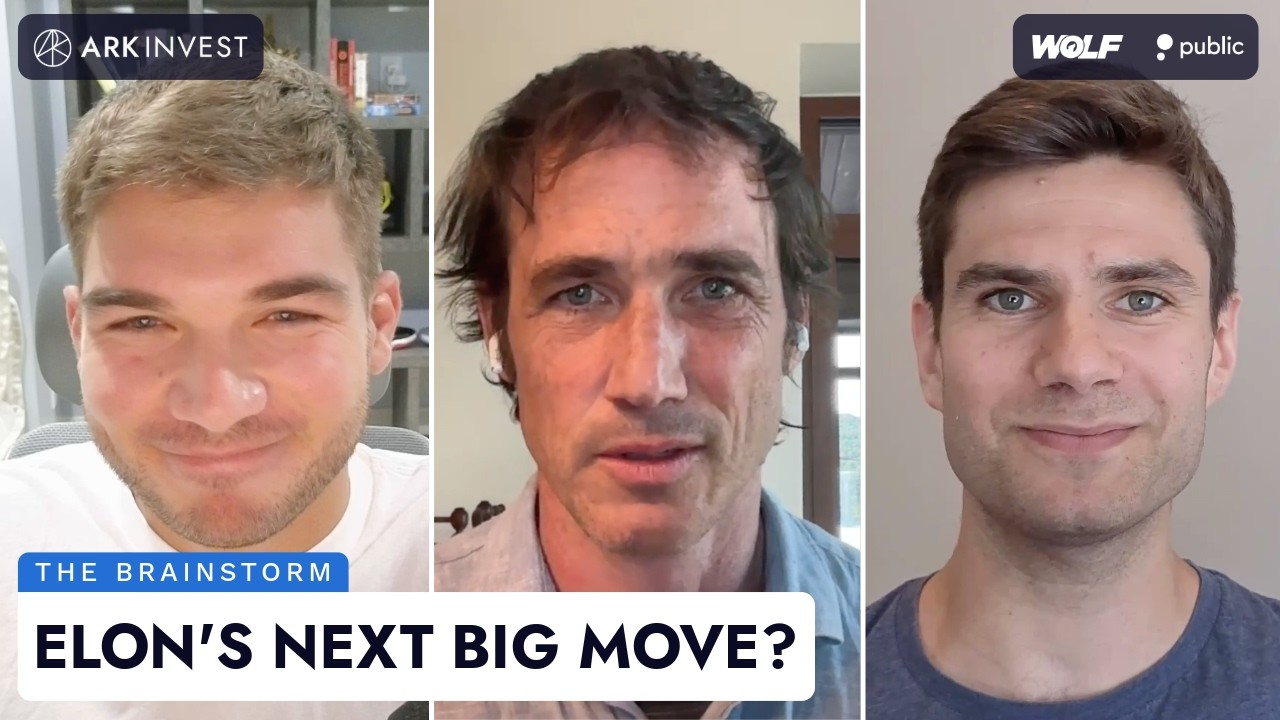
Guests: Brett Winton (Chief Futurist at ARK Invest), Nick Grous (Director of Research for Consumer Internet and Fintech at ARK Invest)
Host: Sam Korus (Director of Research for Autonomous Vehicles and Robotics at ARK Invest)
Podcast Source: The Brainstorm (Produced by ARK Invest)
Original Title: Could China Block A Rumored Tesla-SpaceX Merger? | The Brainstorm 143
Broadcast Date: August 7, 2026
Disclosure: The top two holdings of ARK Invest’s ARKK ETF are Tesla (TSLA, approximately 9.2%) and SpaceX (SPCX, approximately 5.9%), and the ARK Venture Fund also holds shares in OpenAI. The discussion regarding the Tesla-SpaceX merger and frontier model company revenue projections is highly consistent with ARK fund holdings.
Summary of Key Points
Three research directors from ARK Invest discussed two core topics in this episode of The Brainstorm: the Chinese factors in the Tesla-SpaceX merger and the speed of collapse in AI inference costs. Brett Winton believes that the Tesla factory in Shanghai will not be a stumbling block for the SpaceX-Tesla merger because national security review issues can be addressed through asset isolation, and the importance of the Chinese factory to Tesla's future value is declining; Robotaxi will be the source of future economic value. He expects the merger to be announced by the end of the year.
In terms of AI costs, Winton presented a set of data: in the agentic benchmark tests, the annualized decline in AI costs has accelerated from 99% last year to 99.99%. Tasks that were impossible at any cost at the beginning of the year can now be accomplished for 15 cents. Nick Grous took a more cautious view about "who will ultimately win the market," noting that companies like Spotify, Block, and Palantir are building their own model routing layers, seeking the cheapest options between open source and closed source. The three hosts also discussed the societal resistance faced by AI hardware, as well as a counterintuitive judgment: as digital experiences become almost free, physical experiences will instead gain pricing power.
Highlights of Insights
On the Tesla-SpaceX Merger and the Chinese Factor
"I don't think China is a stumbling block because there are ways to isolate Chinese assets." "For Tesla's future value, the Chinese factory is not that important; Robotaxi is the core of future economic value." "Optimus robots are unlikely to be allowed to be sold in China." "Shareholders of both companies would benefit more from the completion of the merger."
On the Collapse of AI Costs
"Tasks that were impossible to accomplish at any cost at the beginning of this year can now be done for 15 cents." "The upper limit of performance is improving, and the lower limit of cost is decreasing; the former may be more important." "Frontier model companies seem to have cracked the code for recursive self-improvement." "By 2030, frontier model companies need to achieve $2 trillion in revenue, but the growth rate must actually decrease by over 50% per year from now on."
On Who Wins the AI Market
"Spotify has built its own development environment, Honk, and also created Chirp for intelligent routing, looking for the cheapest models between open source and closed source." "The market is still focused on coding; the real scaling points are those businesses without strong engineering teams." "You will see 50 winners larger than anything we have ever seen."
On AI Hardware and Social Resistance
"You need to own a smartphone to have a chance in hardware." "If people knew they were being recorded or listened to all the time, the whole social structure would change." "The first hardware product from OpenAI is a small dongle for enterprise developers to interact with Codex Agent."
On Physical Premium
"When anything in the digital world can be manufactured, everything in the physical world becomes relatively scarcer." "Movies suddenly became popular again, while games struggle a bit." "Entertainment is about storytelling; if storytelling becomes controlled by AI, humans will lose interest."
Main Text
Chapter 1 Will China Be a Stumbling Block for the Tesla-SpaceX Merger?
Sam Korus: Brett, Elon said China "is not a problem." What do you think? Will Tesla in China be a landmine for the SpaceX-Tesla merger?
Brett Winton: I can understand why Tesla in China is an uncomfortable piece of the puzzle for any SpaceX-Tesla merger because SpaceX has a large amount of business related to national security, and there are many restrictions on dual-use technology entering China. But I don't see this as a stumbling block because there are likely ways to isolate Chinese assets.
Interestingly, Tesla having its own factory in Shanghai is actually an anomaly in the entire automotive industry, which also indirectly proves Elon’s ability to navigate various political turmoil. To be honest, for Tesla's future value, the Chinese factory is not that important because Robotaxi is the core of future economic value. We do not believe China will be a place that generates significant Robotaxi revenue due to regulatory pressures and local competition, and China itself is already a ride-hailing market with extremely low costs per mile. The Shanghai factory is still exporting to non-European, non-American countries, so it remains important as a manufacturing base. But I believe they can circumvent this issue. Nick, what do you think?
Nick Grous: What I want to say is, who doesn't want this merger? Neither the U.S. nor China wants it. Can you imagine how popular these cars would be in China if Starlink were integrated into them? China definitely doesn't want that. But it would be very attractive for Chinese consumers.
Sam Korus: Can they block Starlink satellites from flying over China?
Brett Winton: No way, it's in space. You can prohibit antennas from being sold in China and keep the service from landing through that route. But Elon has posted: what can you do, shake your fist at the sky? Just like in Tehran, people set up illegal satellite antennas to watch satellite TV; this was even before the low-orbit constellations appeared. SpaceX certainly cannot completely offend the Chinese government and should not actively seek business. However, if someone brings a Starlink into China, I guess they would be happy to collect money.
Sam Korus: Isn’t it largely in the government's hands? The military would say if you want to merge and become a defense contractor, you have to follow these rules, or else you lose all defense contracts.
Nick Grous: I agree with Brett's assessment; this is not an insurmountable obstacle. Having a car factory in China may be harder than solving this issue and isolating part of the business. The Chinese factory was once the cornerstone of Tesla 2.5; everything rested on whether they could expand car production and reduce battery costs. But we are now in Tesla 3.0, which is a transitional phase, and Tesla 3.5 is clearly Robotaxi, and all of that is made in the U.S. The Chinese factory is still important, but it is no longer the driving force of future value.
Brett Winton: Moreover, Optimus robots are unlikely to be allowed to be sold in China. The Chinese government might want to use this to block the merger; they do not want SpaceX to gain cash flow from Tesla Robotaxi. This is a complex negotiation, and fortunately, I am not at the center of the storm. But Elon has shown the ability to navigate these issues in the past. In the face of other challenges to complete this merger, the China issue seems like a small wrinkle.
Chapter 2 Timing of the Merger: Announcement by the End of the Year
Sam Korus: Do you think the merger will be announced by the end of the year?
Brett Winton: If announced, yes. I think the likelihood of announcing by the end of the year is quite high. It may be after the main IPO lockup period ends or after this quarter.
There is a sensitive issue: does SpaceX need to pay a premium for Tesla stock, and how much of a premium is required to win shareholder votes to complete the merger? From the perspective of SpaceX shareholders and Tesla shareholders, both sides benefit more from the completion of the merger. So there must ultimately be a mechanism to merge the two companies while providing fair value to both sets of shareholders.
Nick Grous: I agree. As long as it’s not some lawyer who has never been on an earnings call answering questions and calling it an "announcement," I think it will be announced by the end of the year.
Chapter 3 Collapse of AI Costs: Annualized 99.99%
Sam Korus: Brett, you have done a lot of research in this area. AI costs are decreasing, and there is a lot of discussion around the commoditization of the model layer. What is most important? What should we focus on?
Brett Winton: In this year’s Big Ideas report, we showed that the costs are declining by 99% annually at a given benchmark test performance. That is a 100-fold decrease. And in a more challenging agentic benchmark test, from February of this year to July 31, the annualized decline in costs is 99.99%. This means the rate of decline has accelerated by two orders of magnitude compared to before. We predict that it will continue to decline by around 99.97% in the next year. AI is becoming extremely cheap, and it is becoming cheaper at an incredibly fast rate.
Another angle: not only are costs declining at a given performance level, but the upper limit of performance is also improving. At the beginning of this year, no matter how much you spent, you could not get an AI model to score above 50% on this benchmark. Today, every task can be achieved for 15 cents. The cost reduction is limitless.
The improvement in the upper limit of performance may be more critical than cost reductions at a specific price point because it continually pulls in new tasks. Cost reductions also bring tasks in but are more about machine workloads like "I need to classify 17,000 books" or "I need to annotate these gene derivatives," making them cheap enough to be worth doing.
The net effect is that anything you use AI for today may cost only a thousandth of the price next year if you continue doing the same thing.
What interests me more is that the performance improvement seems to be accelerating. From 99% to 99.99%, it suggests that frontier companies (Grok has also squeezed in) seem to have cracked the code for recursive self-improvement of models. Model releases are being compressed, while performance keeps climbing.
Chapter 4 Who Wins: Frontier Models, Open Source, or Application Layer?
Sam Korus: Nick, the favorite "skeptical face" of the YouTube comment section.
Nick Grous: That’s not skepticism.
Sam Korus: Okay. The model layer has killed SaaS, and now everyone is saying the model itself is the one that will be killed, and the application layer is what matters. What do you think?
Nick Grous: I agree with the numbers Brett presented; they are hard to refute. But I’m more curious about what this means for the market, who ultimately wins, and why.
For me, it is still unclear who will seize the majority of the market. Everyone is very focused on frontier model companies because they make coding incredibly simple, and I believe most AI spending happens here. From the perspective of agentic use cases, this spending primarily comes from developers at tech companies.
I have been wondering where the next market opportunity lies. Do you need frontier models to open that market, or can you accomplish it with open-source models and a routing layer?
Today we received some very interesting data points. Spotify was quite candid on its earnings call; they have built their own development environment, Honk, and also created Chirp for intelligent routing, looking for the cheapest and most effective models between open source and closed source. Robinhood is doing the same thing. Block has its own development environment called Goose. Then Palantir released a nice quarterly report, and Alex Karp directly stated that closed-source models are terrible for the company.
So frontier models are indeed advancing, but I don’t believe this directly points to "they will win in five years." I think they'll take a large portion of the market, but many companies still have opportunities.
Brett Winton: I agree with the latter point. Going back to our GDP forecast, I don’t think people understand how different the world will be in 5 to 7 years. When you say "winner," it's not just one or two winners. There will be 50 winners larger than anything we have ever seen, and people will look back and say: can you believe that Apple and NVIDIA were once just single-digit trillion-dollar companies?
There is indeed a future state where a frontier model company becomes a hundred billion-dollar company. It might be SpaceX, or it might be OpenAI, or it might be both. But there is also another, more decentralized future state.
The companies that are the most vocal are saying they build model routing and use open source. But the meat of the market is still in coding. The direction of market expansion is towards those businesses that do not have strong engineering teams, where there are a lot of knowledge workers. These customers are less likely to switch to open-source weight models because when problems arise, there is no one to turn to. The cost decreases actually give them the incentive to stay put, as they can say: we have this best provider, and existing activities will become cheaper.
OpenAI recently cut the price of Luna (the lightest model) by 80% compared to a month ago. Part of the reason is competitive pressure, but they also released a blog discussing model efficiency improvement. They are saying: we want to bring all businesses in, no matter where you want to be on the efficiency spectrum.
From a personal user experience standpoint, using a clunky model that makes mistakes is very painful. Individual users will continually push for smarter models.
If you look at the ARR of Grok, Gemini, OpenAI, and Anthropic, the second derivative of revenue is increasing. Year-over-year growth is about five times, and the growth rate is accelerating. Recent leaked revenue news from OpenAI also indicates a turning point. To achieve our forecast of $2 trillion in revenue for frontier model companies by 2030, their growth actually needs to start sharply decelerating from now on, with annual growth declining by more than 50%. Currently, there are no visible signs of a slowdown characteristic of traditional diffusion curves; growth rates are still on the rise. This indicates that we are still in a phase of major market expansion.
Chapter 5 AI Hardware and Social Resistance
Nick Grous: I want to return to the topic of voice and hardware. Voice has improved a lot since the first version. If a leading model company released hardware devices, that might be the best way to lock in a large number of consumers. We are at a tipping point. Nick shakes his head, why?
Sam Korus: This is much harder than saying "we release hardware and then lock everyone in." You still need to have a smartphone to have a chance in hardware, especially in wearables. I don’t think consumers or even businesses have the appetite to capture all the context that is valuable to these companies. If people knew they were being recorded or listened to all the time, the entire social structure and culture would change immediately. There would be massive resistance. You might see initial growth after a product launch, but soon it would hit a wall. It took Apple 5 years to subtly persuade society that this is good for society.
Sam Korus: So your judgment is that society will resist, and the next five years will not work due to societal reasons rather than technological ones?
Nick Grous: I don’t know what would turn it around. I really want this functionality, to store all the context of my life. But I find it socially untenable. If it were really done, you would see a barbell effect: restaurants would ask you to put your devices away, society would split into two groups of people.
Brett Winton: Interestingly, movies suddenly became popular again, while games are struggling a bit. This could be at the forefront of that trend. Digital experiences have been compressed to such an extent that being with people feels better. Sporting events, movies, the World Cup, these might be the "anti-AI tracks." When anything in the digital world can be manufactured, everything in the physical world becomes relatively scarcer. Society will start to value this, while online things become commodities.
Nick Grous: The fact that movies became popular again is indeed interesting, especially among the younger generation, who originally couldn’t even sustain attention for two hours. But perhaps it's precisely that: forcing them to concentrate, they feel "wow, how novel, I've never spent two hours watching something." It feels warming.
When Sora came out, I said that generating AI videos alone is not an attractive medium. You can embed it in Instagram or TikTok, inserting an AI video every five or six pieces in an existing stream of artificial content; that can find balance. But making an independent app that says "this is all AI slots," what’s the point? Entertainment is about storytelling. If storytelling becomes controlled by AI, humans will lose interest.
Brett Winton: One last point: OpenAI’s first hardware was actually a small dongle for enterprise software developers, allowing you to quickly converse with Codex Agent and switch tasks. This aligns with the normal progression of technology: first for enterprises, and then consumers come along. Partly because capturing and processing context is still quite costly. Applications on the consumer side exist for paid pro users, but they are not compelling enough for indirect monetization.
Sam Korus: Wait a year, and costs will drop a thousandfold.
Brett Winton: Yes.
免责声明:本文章仅代表作者个人观点,不代表本平台的立场和观点。本文章仅供信息分享,不构成对任何人的任何投资建议。用户与作者之间的任何争议,与本平台无关。如网页中刊载的文章或图片涉及侵权,请提供相关的权利证明和身份证明发送邮件到support@aicoin.com,本平台相关工作人员将会进行核查。


