Author: Pyth Network
Compiler: Deep Tide TechFlow
Deep Tide Introduction: In July, the trading volume of RWA perpetual contracts reached $708.3 billion, a stunning increase of 69.6% month-on-month, hitting a record high; nearly all incremental growth came from memory chips—AI data centers consumed about 70% of global memory production capacity, placing SanDisk, Micron, SK Hynix, and SOXL on the list.
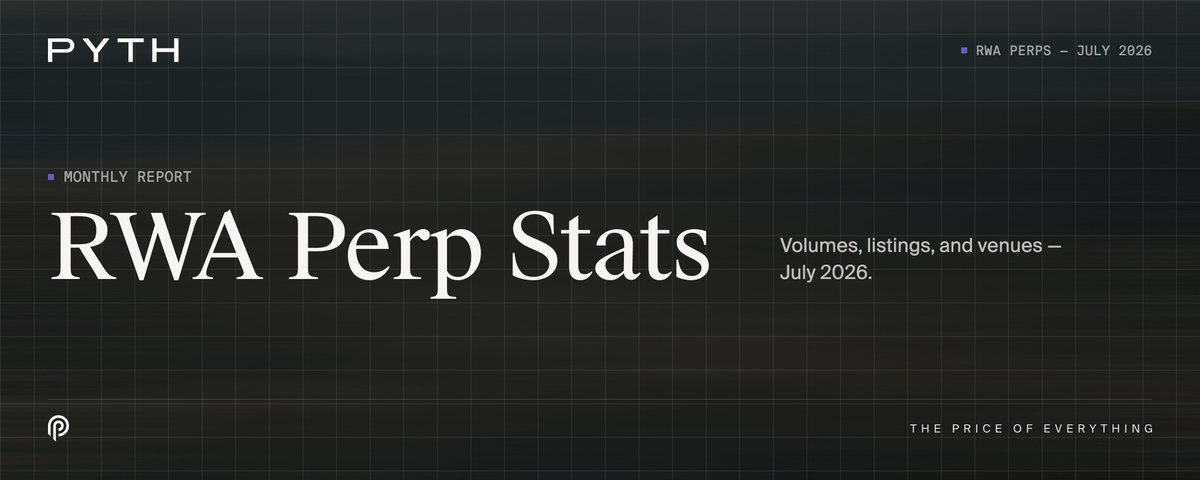
July marked a historic high for RWA trading volume. The volume reached $708.3 billion, growing from $417.6 billion in June, an increase of 69.6%, most of which came from four stocks. In June, gold, silver, and SpaceX led this market; whereas in July, memory chips became the dominant force.
This Month's Most Active Assets
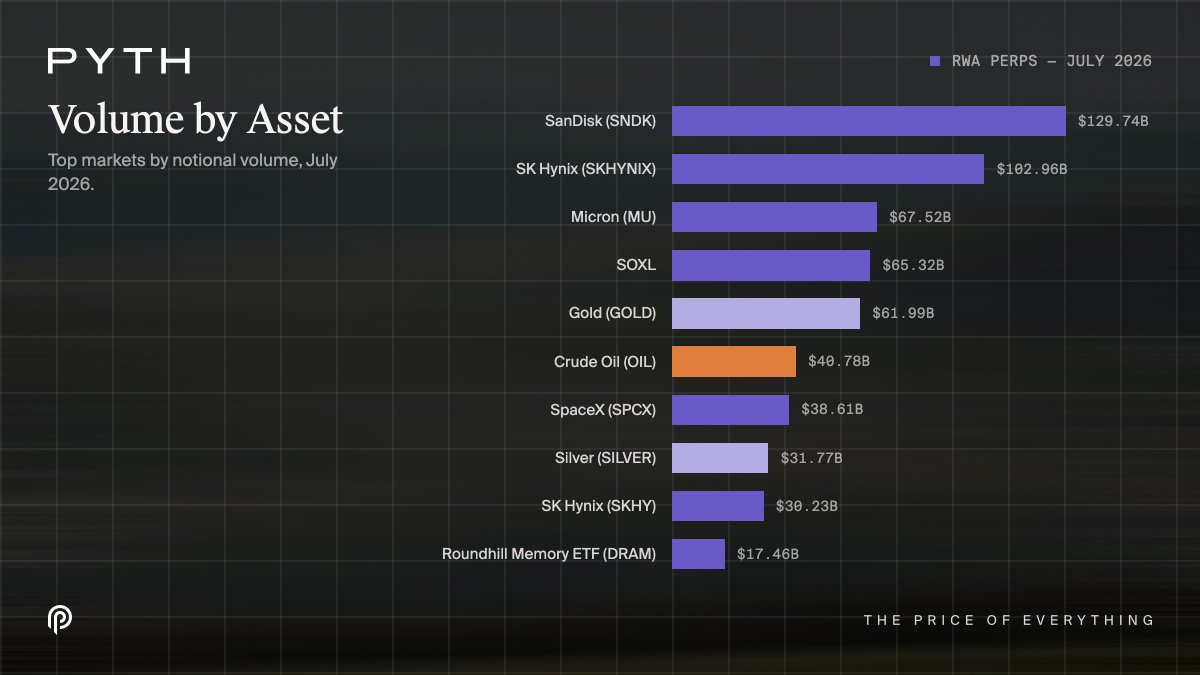
Chart: Assets with the Highest RWA Perpetual Contract Trading Volume in July
Source: RWA Markets
Among the five major assets, four are the same bet. SanDisk, Micron, and SK Hynix all produce memory chips, while SOXL provides a 3x daily leveraged exposure to a basket of semiconductor indices. These four assets contributed approximately 81% of the entire market's incremental growth.
This is supported by a memory market that is in high demand. AI data centers now consume about 70% of global memory chip output, directly driving up prices: memory for ordinary laptops has surged nearly 700% in the past year; the CEO of SK Hynix stated in July that shortages are likely to continue until after 2030. Two IPOs coincidentally occurred in this window.
SK Hynix’s ADR began trading on Nasdaq on July 10, after a $26.51 billion issuance, the largest overseas IPO to date. CXMT listed in Shanghai on July 27, dragging down the whole sector. SanDisk fell nearly 37% within four trading days, rebounding 21.5% one morning on July 30. This is exactly the price trend and volatility the perpetual contract market loves.
Aside from memory, gold stayed steady, growing slightly by 14.6% month-on-month, just managing to maintain a spot among the top five. On the other side, two assets fell out of the top five: SpaceX dropped from first to seventh, and silver dropped from fourth to eighth. SpaceX's June trading volume coincided with its June 12 IPO— that IPO ultimately raised $85.7 billion, the largest in history, and July was just the "month after IPO."
Asset Class Rankings
The trading volume of three stocks more than doubled. SanDisk, SK Hynix, and Micron collectively contributed $215.4 billion of the incremental $247.0 billion in this category.
Commodities grew by 15%, rising from $129.2 billion to $148.1 billion, but its share decreased since other markets grew five times faster. Gold, oil, and silver account for 91% of this category.
Trading Platform Rankings
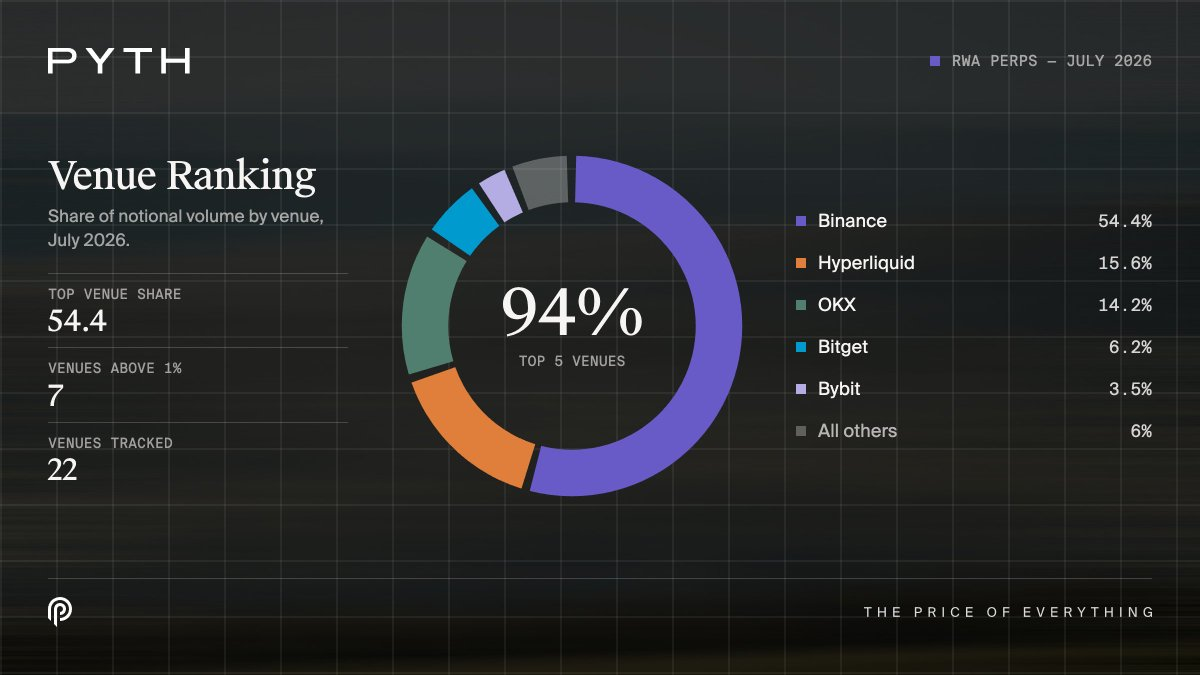
Chart: Trading Volume Share of RWA Perpetual Contracts by Trading Platform
Source: RWA Markets
Binance and Hyperliquid dominated the entire month. Together, they processed 70% of RWA perpetual trading volume, with Binance alone accounting for over 54%, and Hyperliquid firmly in second place. The two are at opposite ends of the asset scale: Binance is a platform for scaling memory trading, with its top five assets matching exactly the ranking order of this category; while Hyperliquid is where new assets first go live, with CXMT launching on Hyperliquid 13 days before its official release.
OKX doubled its trading volume, reaching a market capitalization of $100.7 billion, ranking third and showing the largest growth among all major trading platforms. Subsequent trading platforms saw significant declines in market capitalization, with Bitget at $43.7 billion and Bybit at $100.7 billion.
Growth is widespread, not concentrated among a few. All of the top five platforms grew, and the share drop of Hyperliquid and Bitget is merely due to slower growth compared to others.
Another noteworthy trend appeared in lower-ranked positions: trading volume from exchanges outside the top five nearly doubled, and the number of exchanges achieving a liquidation rate of 1% increased from 5 to 7. New exchanges GM Trade and Variational are both commodity trading platforms, so the metal trading volume that fell out of the rankings ultimately flowed to them.
Trading Volume Split by Market Data Sources
Pyth accounted for 95.2% of trading volume in July, its share being the highest among the fastest-growing markets: SOXL at 99.4% and SanDisk at 99.3%. Gold’s share was the lowest at 87.6%, while four other suppliers also had relatively substantial volumes.
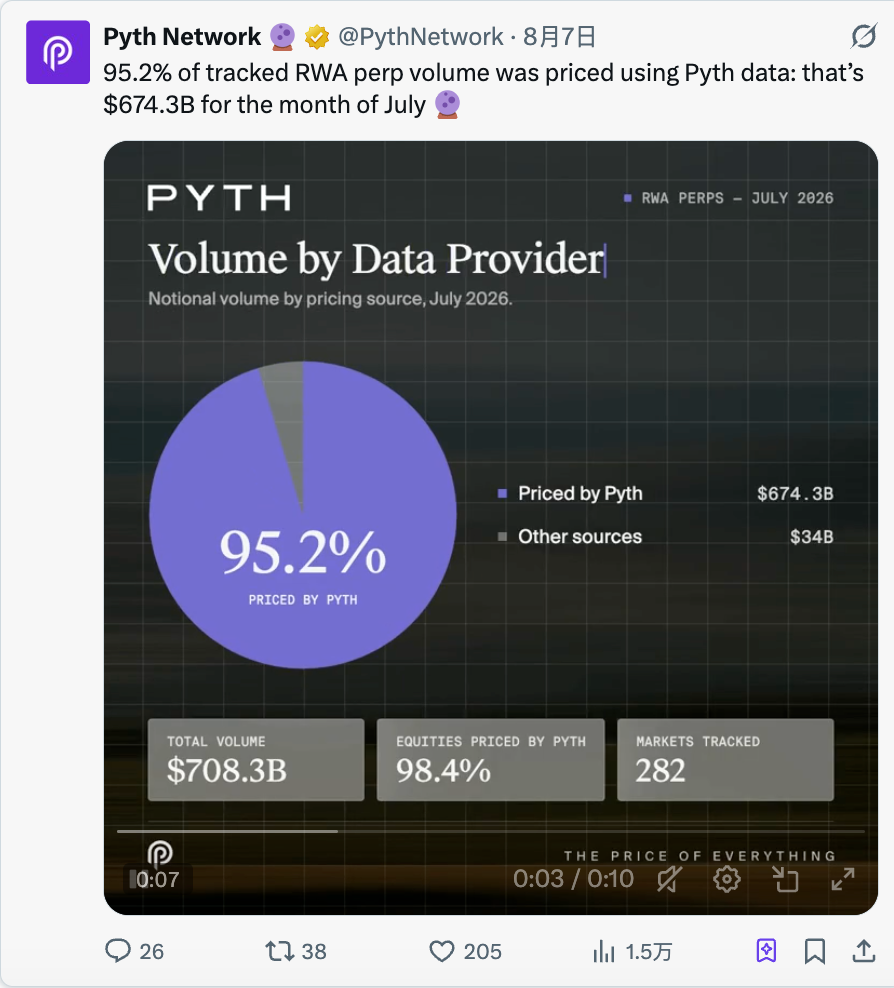
Chart: Trading Volume Shares by Pricing of Different Market Data Sources
Source: RWA Markets
This Month's Highlights: CXMT and Pre-IPO Perpetual
CXMT’s stocks traded in the form of perpetual contracts on the market 13 days before officially opening to public trading.
ChangXin Memory Technologies, a leading DRAM manufacturer in China, entered the market in an exceptionally high-demand year for memory. Its Shanghai debut closed with a surge of 465.8%, pushing its market capitalization above 3.2 trillion yuan, making it the most valuable company listed on mainland exchanges. Daily trading volume exceeded 140 billion yuan, making it the first A-share to surpass daily trading volume of 140 billion yuan.
The dashboard records the phased entry of CXMT into the perpetual universe:
- July 15: Hyperliquid
- July 16: Lighter
- July 26: Aster
- July 27: Bybit
CXMT’s tracked trading volume was approximately $737.3 million, of which $709 million (96% of total trading volume) came from the Hyperliquid platform. The trading volume grew rapidly in the initial online phases, reaching about $107.8 million on July 26 and about $248.9 million on July 27.
Before the listing, the trading platform reflected expectations for the future of a company that had not yet gone public with its stocks. After listing, traders had an external cash stock price as a reference, with Pyth providing pricing data from the start of trading. The contracts also shifted from pure price discovery to common issues such as tracking, funding, basis, and trading channels.
A snapshot of financing conditions on July 30 showed that CXMT’s financing integration still has much work to do. CXMT had a financing yield of 109.95% (annualized) on the Hyperliquid platform, while the financing yield on the Bybit platform was -434.89% (annualized), a difference of 544.84 percentage points between the two platforms. The seven-day average yield on both Hyperliquid and Aster platforms was negative.
The listing was not confined to a single market. CXMT’s debut triggered a global selling spree in memory and a four-day drop in SanDisk's stock price, accounting for a large portion of the record trading volume in July.
免责声明:本文章仅代表作者个人观点,不代表本平台的立场和观点。本文章仅供信息分享,不构成对任何人的任何投资建议。用户与作者之间的任何争议,与本平台无关。如网页中刊载的文章或图片涉及侵权,请提供相关的权利证明和身份证明发送邮件到support@aicoin.com,本平台相关工作人员将会进行核查。


