整理 & 编译:Deep Tide TechFlow
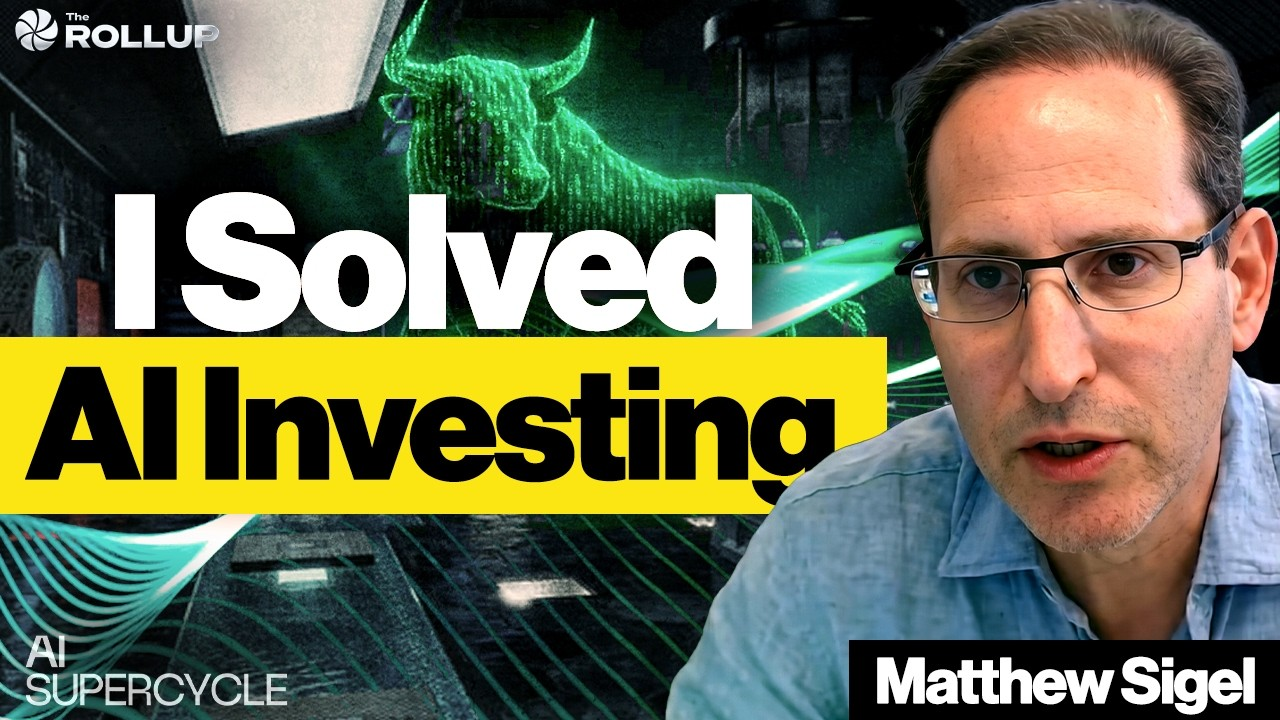
Guest: Matthew Sigel, Head of Digital Asset Research at VanEck, Manager of VanEck Onchain Economy ETF (NODE)
Host: Rob (Robbie Klages) & Andy, The Rollup "AI Super Cycle"
Podcast Source: The Rollup
Original Title: VanEck Research Head: Why This Isn't The AI Bubble Everyone Fears (Here's Why)
Broadcast Date: August 10, 2026
Conflict of Interest Statement: Matthew Sigel is the Head of Digital Asset Research at VanEck and the manager of the NODE fund. His views may align with the positions of funds managed by VanEck.
Summary of Key Points
The VanEck Onchain Economy ETF (NODE) managed by Matthew Sigel has outperformed Bitcoin by nearly 100 percentage points over the past 15 months, primarily due to the early prediction of the shift of Bitcoin mining stocks toward AI data centers. He believes that the market was highly concentrated in the first five months of this year: the companies that spent the most on capital expenditures had the best stock price performance; however, after June, this logic reversed, with software-related assets (including Bitcoin and crypto tokens) being collectively sold off, while capital expenditures themselves became targets for punishment.
Sigel's position can be summarized in two judgments: First, AI infrastructure is not a bubble; it differs from the 19th-century railway bubble because this round of financing comes from long-term leases from the private sector, rather than government land grants and speculative bonds;
Second, the real pressure on the crypto market does not lie in the macro environment, but in institutions' disappointment with mainstream L1s. Since the election, VanEck has reduced its holdings in mainstream L1s like Solana and ETH, focusing instead on enterprise chains like Circle, Stripe, and Robinhood. He believes that if the CLARITY Act can pass and establish an information disclosure system, related tokens might experience a tremendous relief rally, but until then, he will remain cautious.
Highlights of Insights
On the Shift in Market Structure
- "In the first five months of this year, the companies that spent the most did the best, but starting in June, the companies that spent the most were punished the hardest."
- "Bitcoin is software, coincidentally open-source software. When software stocks as a whole are under pressure, Bitcoin and crypto tokens find it hard to remain insulated."
- "I hope the market sees more diversification rather than a single factor determining everything. Only then do we have the chance to extract alpha from individual assets."
On the AI Transformation of Bitcoin Mining Stocks
- "ASICs are not the most valuable assets for miners; electricity and land are."
- "The business model of early miners was continuously diluting shareholders by issuing shares to buy ASICs, with revenue halving every four years, which is like a melting ice block. Now, they can finance through the debt market, eliminating the need to dilute shareholders."
- "CleanSpark needs Bitcoin to rise to $360,000 to return to pure mining mode, as only then is it worthwhile to tear up the already signed AI lease."
On the Comparison Between AI Infrastructure and the Railway Bubble
- "The U.S. once invested 3% of GDP for nearly 20 consecutive years into railroads, while AI has only just hit that level this year, after five years since GPT emerged."
- "The railway bubble was government-led: Congress passed the railroad bill in 1862, granting vast federal lands to railroad companies, but the land ownership transfers only occurred after the entire network was completed; bonds issued by the Treasury were subordinate to private capital."
- "AI factories can immediately train models and perform inference as long as they are connected to the internet, with fiber optics and chips in place. Railroads had to wait until the East and West coasts were connected to be genuinely useful."
- "The four major cloud providers have over $2 trillion in contract backlogs, many of which have prepayments from clients and bring their own GPUs, with terms exceeding five years. No one in 1870 would buy a train ticket for a service that wouldn't start until 1885."
On L1s vs. Enterprise Chains
- "After the election, many tokens doubled, but no truly breakout applications appeared, and no application attracted global capital."
- "Currently, enterprise chains are winning: Circle, Stripe, and Robinhood are involved, even Wells Fargo is building its own custom chain."
- "Banks and other regulated entities do not want to put real money on open-source chains; even if they support, they must support three to five chains simultaneously, which dilutes the winner-takes-all attribute of any single L1."
- "If the CLARITY Act passes and brings a genuine information disclosure system, some tokens could see a huge relief rally. Until then, we remain cautious."
Main Text
Chapter One: The Market Shift from "Chasing Capital Expenditure" to "Punishing Capital Expenditure"
Rob: First, tell us about the current market state you are seeing. There was a period when digital assets didn't react positively to favorable news like DTCC and the CLARITY Act. Now Saylor is selling coins, and the CLARITY Act doesn't seem to be passing, the market isn't rising or falling, looking completely indifferent. At the same time, it seems AI and U.S. stocks are sucking up all the liquidity. Is this what you are observing?
Matthew Sigel: Yes, in the first five months of this year, the market was extremely concentrated, with the companies spending the most having the best stock performance. However, starting June 1, that relationship reversed. Excluding the recent rebound from the Situational Awareness liquidation bottom, it was precisely the companies with the highest capital expenditures that suffered the most during that time.
Bitcoin and crypto tokens are actually classified as "software." Many people are focusing on the relative strengths and weaknesses of semiconductors and software, while Bitcoin is software, and open-source software at that. AI capabilities like Claude and Codex are having substantial impacts on many open-source software projects, but their upgrade cycles aren’t as top-down-driven as Web2 companies. You can’t force users to upgrade. This overall lagging performance of software significantly weighs down Bitcoin and crypto tokens.
Additionally, there’s the psychology of the four-year halving cycle, and the market is quite respectful of this model. I hope in the future the market can show more differentiation and more revenue dispersion, allowing us to find alpha from individual stocks or assets rather than relying solely on betting on a certain factor. I don’t believe it has to be that if AI rises, crypto falls or vice versa; reality is more nuanced than that.
As for my own positions, I still have exposure to the AI infrastructure theme through Bitcoin miners. I am optimistic about Bitcoin hitting a bottom in Q4 and am looking forward to the market rebalancing. However, I tend to wait for favorable volume before making a move; trading frequently in a volatile market isn’t my style.
Chapter Two: Why NODE is Making Big Bets on Miners’ AI Transformation
Rob: So what is your current specific position? I've seen some tickers like MARA, Riot, APLD, WULF, essentially Bitcoin mining stocks transforming into AI data centers. They have built the infrastructure, with electricity and energy capacity, often in remote areas. These are precisely the raw materials needed for AI data centers and can even repurpose existing hardware. How long do you think this trend can continue? Additionally, if so much computing power flows from the Bitcoin network to AI, will it create systemic issues for Bitcoin?
Matthew Sigel: The NODE ETF I manage has been established for 15 months and has outperformed Bitcoin by nearly 100 percentage points. The biggest source of returns comes from the early realization: every megawatt of power controlled by Bitcoin miners was severely undervalued compared to the few data center REITs at that time.
The business model of early miners involved continuously diluting shareholders by issuing stock to purchase ASICs, simply needing to run faster than competitors. But their income halves every four years; it's like a melting ice block—capital-intensive with thin profits. Now we see not just hyperscalers but even the construction leases around these data centers significantly lowering financing costs. These companies can raise funds through the debt market without needing to continue diluting shareholders by issuing stock. Moreover, each new lease is almost always economically better than the last one. Coupled with falling interest rates, this has created substantial value.
Therefore, the market style switch since June has hurt those with high leverage the most, while we have avoided leverage and minimized exposure to highly leveraged companies. When we saw the Situational Awareness fund—whose holdings overlapped significantly with ours—being forcefully liquidated by their prime broker, we chose to go against the market trend and increase our position. Last Thursday, we executed the largest single-day transaction since the fund's inception: withdrawing nearly 10% from low volatility, low beta positions, doubling down on the few miners we are most optimistic about.
We did not see a deterioration in the fundamental capital returns for this hyperscaler investment. In fact, reviewing earnings call transcripts for companies like Amazon, these returns are better than initially expected. Older GPUs that were rented out for $2 per hour now see clients wanting to renew contracts at significantly higher prices once the contracts expire. Thus, we look at the fundamentals, which are still improving.
When the prices hit the lows, some of our most favored companies had stock prices reflecting only the value of existing contracts, completely ignoring the terminal value of data centers, platform value, and potential new leasing pricing. Even if we assume the 10-year yield rises by another 100 basis points, that work has already been done. So at the lows, we saw substantial safety margins.
Regarding the Bitcoin network, I do not believe there are systemic issues. On the contrary, as hash rates decline, the remaining miners earn more. Companies like Bit Deer and MARA that we have increased exposure to still have strong flexibility: they can continue mining or convert facilities to AI. In the future, a certain Bitcoin price may prompt discussions about whether to revert to mining, but we are not advocating that facilities that have switched to AI revert back. We estimate that CleanSpark would need Bitcoin to reach $360,000 for it to be worth tearing up the already signed AI lease. Thus, that flexibility itself is valuable.
Chapter Three: This is Not a Bubble, It is a Cautionary Tale of the 19th Century Railroads
Rob: You mentioned historical comparisons. You wrote an article comparing AI infrastructure to 19th-century railroad construction. Can you quickly explain why this comparison holds?
Matthew Sigel: Many people use the railway bubble to counter my point, saying it was also a capital expenditure cycle that changed the economy, but early capital was largely annihilated. My response is that you can compare both scale and financing structure.
In terms of scale, the U.S. once invested 3% of GDP into railroads for nearly 20 years straight. In contrast, AI has only reached this level for the first time this year, after five years since GPT emerged. Given the current valuations of AI companies, the market is not pricing in that "this round of construction will last twenty years." Most analysts believe it will peak by 2030. This is the first disconnect.
The second is the financing structure. The railway bubble was actually government-led. In 1862, Congress passed the railroad act that granted hundreds of millions of acres of federal land to railroad companies, but the land ownership transfer only occurred after the entire rail network was completed. Additionally, the Treasury issued construction bonds that were subordinated to private capital. The largest railroad companies went overseas to sell bonds, promoting them as safe assets, yet these bonds depended on land grants, even when companies did not own the land. That was the bubble.
Now comparing to AI factories, railroads need to be interconnected to create true utility; their value was limited before the East and West coasts were connected; AI factories can immediately train models and perform inference as long as they are connected to the grid with fiber optics and have chips in place. They do not need to wait for global network synchronization to be completed.
Lastly, an important distinction is the contract backlog. In 1870, no one would buy a train ticket for a service that would not start until 1885, and there was no forward market then; everything was built on speculative land sales. However, today, data centers of the four major cloud providers alone have over $2 trillion in signed contract backlog, half of which is combined from Microsoft and Oracle. Many of these contracts include prepayments from customers and clients bringing their own GPUs, with terms exceeding five years. The computing power generated by these factories has real purchase orders supporting it, and financing is based on these contracts, not government subsidies.
Rob: So the conclusion is, this round is more sustainable.
Matthew Sigel: Yes, more sustainable. It is supported by long-term contracts from the private sector, with years of backlog serving as collateral.
Chapter Four: Mainstream L1s are Losing to Enterprise Chains
Rob: Someone in the live chat mentioned that in 2021 or 2023, you said Solana needed to pause L1 development. If Solana wants you to view it favorably again, what does it need to do? We are also seeing many L1s seeking to reduce inflation and reduce incentives for validators; Ethereum just released a new proposal this morning, and Solana and Near are also doing the same. How important are these inflation adjustments to the conditions of the L1 market?
Matthew Sigel: After the election, when many tokens doubled but actual adoption remained stagnant with no truly breakout applications appearing, we reduced our entire L1 exposure for the firm. What we have seen since then is the rise of enterprise chains. Circle has them, Stripe has them, and Robinhood has them; these are semi-permissioned chains that allow public companies to customize user experiences and extract some economic benefits.
I understand this might not align with the open-source ethos and crypto fundamentalism, but those looking to mass utilize these networks need predictable fee flows. You asked about Solana, but I want to mention ETH first because ETH is an example where transaction fee fluctuations are too significant, making many large institutional participants seek more stable costs. Thus, enterprise chains are capturing significant market share, which is also where we are focusing our investments.
Solana's transaction fee fluctuations aren't as significant, but until recently, you couldn't buy USDC on Solana in New York; just this morning, we saw Wells Fargo researching its own tokenized deposit chain. Banks and regulated entities do not want to put real money on open-source chains; even if they participate, they have to support three to five L1s simultaneously, which dilutes any single chain’s winner-takes-all character. Thus, market share is declining, and the winner-takes-all feature is also weakening, which leads to very low exposure to these tokens.
If the CLARITY Act can pass, even though the odds have dropped to their lowest this year, I believe some tokens could see huge relief rallies. It will establish an information disclosure system that informs us who the actual beneficial owners are without KOLs promoting without disclosing their positions. We will also see how much each lab and foundation holds in tokens. It is precisely the absence of a disclosure system that has led many institutional investors to choose to ignore this space. I hope to see this change, and only then can we seriously reassess many L1s.
Chapter Five: Lowering Inflation is Beneficial, but Details Determine Success
Rob: ETH, Solana, and Near have all proposed lowering validator inflation; if passed, the inflation supply for these L1s could approach zero. How important do you think these measures are for the market?
Matthew Sigel: A few quarters ago, we conducted a study comparing the average inflation rates of mainstream L1s to user growth and fee revenue. There indeed exists an inflation issue in this field. At the beginning of this conversation, we compared software companies and crypto tokens; this year, semiconductors have significantly outperformed software, forcing many software companies to reflect on how quickly they issue new stock; the dilution levels for some companies have noticeably decreased.
Therefore, I think it is appropriate for L1s to explore lowering inflation. However, the details will determine success or failure, and we also need to consider the second-order effects on companies that rely on staking income; for example, Bitmine frequently promotes its staking returns, which could collapse. Overall, it is wise for L1s to rethink inflation six years after their inception.
免责声明:本文章仅代表作者个人观点,不代表本平台的立场和观点。本文章仅供信息分享,不构成对任何人的任何投资建议。用户与作者之间的任何争议,与本平台无关。如网页中刊载的文章或图片涉及侵权,请提供相关的权利证明和身份证明发送邮件到support@aicoin.com,本平台相关工作人员将会进行核查。


