
Author: Wu Rui Rui, elsewhere
OpenAI has Fidji Simo, the only CEO besides Sam Altman; Anthropic has Daniela Amodei, Dario's sister and company president, with all executives reporting to her except for one chief of staff who reports to Dario, and she is accountable to the board.
The two companies that define this era of AI have both entrusted "everything beyond the model" to a woman. This makes us curious: what about on this side of the ocean?
After looking around, we found not only some, but quite a few.
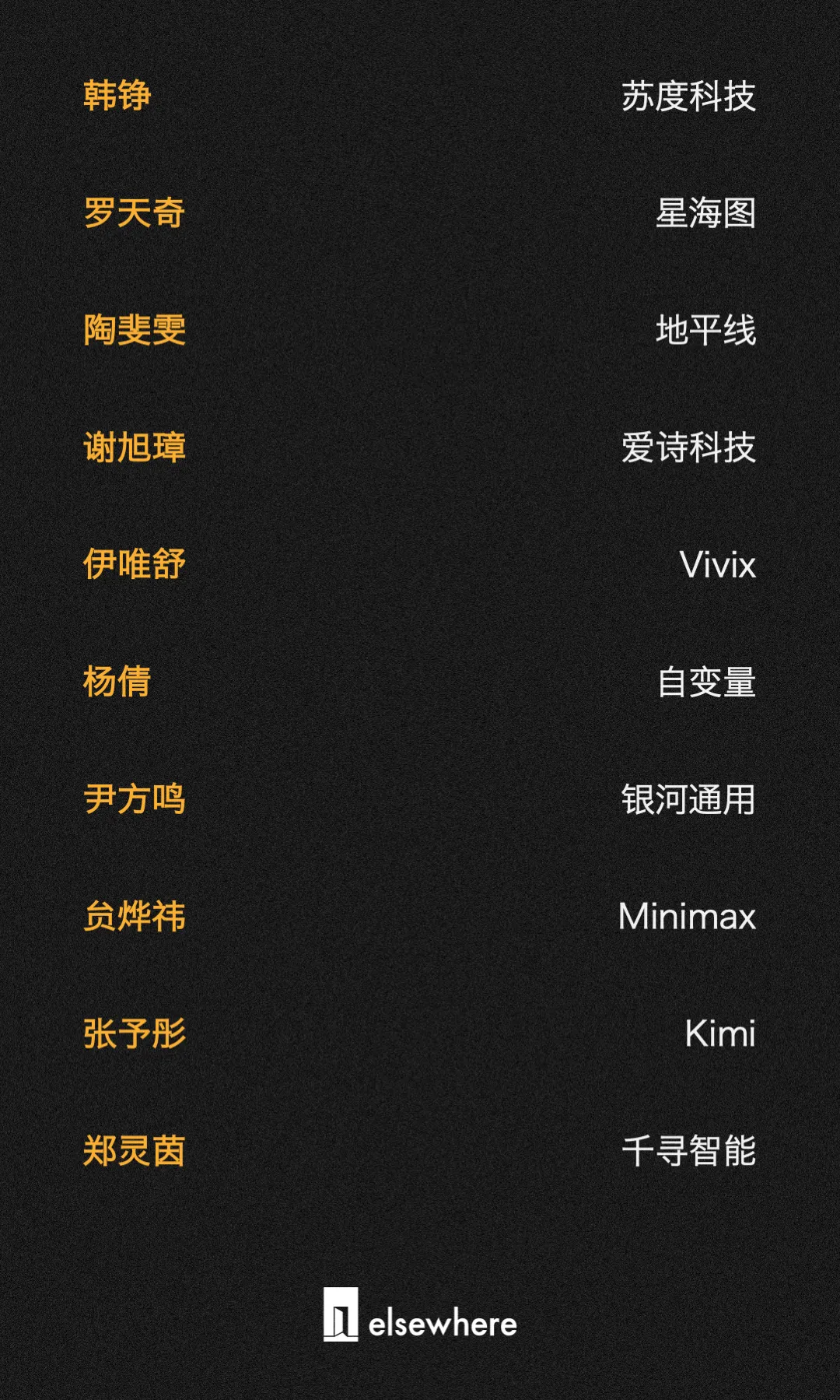
For example, Zhang Yutong for Kimi, Yuan Yeyi for MiniMax, Yi Weishu for Vivix. Their titles vary: some are presidents, others are CEOs or co-founders, but their actual roles are similarly aligned: aside from algorithms and R&D mainly handled by technical founders, most other responsibilities within a company may fall on them.
Except for a few who appear publicly on camera, they mostly remain very low-key. While the spotlight shines on the CEO, the parts that are not illuminated are handled by them: besides financing, human resources, finance, law, government relations, public relations, commercialization, some even participate in product development.
In simple terms, the CEO is responsible for leading the pursuit of AGI, while they are responsible for assembling a company from the people pursuing AGI.
He is somewhere.,She is everywhere.
Unlike the "number two position" in the internet age, such as Jack Ma's Joe Tsai or Pony Ma's Liu Chiping, in AI and embodied intelligence companies, they often are not just traditional CFOs or COOs: they typically oversee not a single function but almost all functions outside of technology.
In some companies, the vast majority of non-technical departments report to them. Frontline employees might rarely see the CEO, but they repeatedly encounter them in final interviews and business reports; externally, unless the CEO must appear, investors, clients, media, and government are likely to see them.
Employees at a modeling company described the presence of a male CEO and female president this way: He is somewhere. She is everywhere.
When they act, some are detail-oriented while others cut through the chaos, but without exception, they hold a multitude of threads in their hands.
These matters are often generically referred to as "things outside the model," as if the model is the main business and the rest are just maintenance tasks for the company. However, how cards are purchased upstream, how financing works, how to achieve C-end growth and B-end sales downstream, ultimately all determine whether a model can continue training and whether a product can reach the next version.
Training the model is undoubtedly the most central process, but the success of the model never solely occurs within the training cluster.
Therefore, they are not completely isolated from technology. In some companies, they attend key meetings in algorithms and R&D departments, deciding together with the CEO where to allocate resources, when to release products, and how long to adhere to a particular technical roadmap.
Having long represented the company in market interactions, they also become more attuned to shifts in market sentiment.
Many employees at modeling companies have told me they pay close attention: how well other companies' models are performing, which benchmarks they are focusing on; if competitors secure funding, our cash reserves are not far behind, and so on. Then, they work with the CEO internally to set direction and push the pace.
Sometimes, they even need to act more like stable, diligent managers than the CEO.
A few months ago, a modeling company's training got stuck. The CEO's pace began to slow, and employees privately asked over and over, “What is the CEO doing?”
Ultimately, a female co-founder confronted the CEO, compelling him to revisit several possible directions. She repeatedly pushed the CEO to face reality: if the model isn't performing well, they won't be able to raise the next round of funding; if they can't raise funds, the company won't have another chance to try again. After several heated discussions, the CEO finally emerged from the stagnation.
This type of relationship is difficult to summarize with a single title. They are not merely subordinates of the founder, nor are they just the ones responsible for cleaning up the mess. Often, they need to trust the founder's technical judgment while also pulling the founder back to the table when they lose their sense of judgment or avoid making decisions.
This also explains why what is most scarce in this role is not a specific skill set, but trust.
How does trust come about?
Trust is not established through a single round of financing.
Regardless of whether they have an investment background, their contributions to the company often begin with financing. But money is never just money. Alibaba's nearly $800 million for Kimi, the financing that enabled MiniMax to join the big model "six little dragons" at the end of 2022, and the swift valuation of $1.32 billion for Vivix all carry strategic significance far beyond the funds themselves.
However, although there are many precedents for “invest and then manage,” the ability to raise funds is clearly just the explicit part of their contributions.
When investors join a company, some remain stuck in the position of "head of financing," while others continuously expand their scope. The former can find money when the company needs it, but the latter gradually become involved in operations, growth, organization, and strategy, ultimately determining what kind of company it should become.
This is certainly influenced by experience and background; more crucially, it relies on the ability to continuously evolve.
Back in the Jinsha River period, Zhang Yutong spent two years at FunPlus as the head of operations. After entering Kimi, her domain did not remain solely within the capital aspect, instead expanding outward from operations and growth. For her now, "becoming less like an investor" must be a very sweet evaluation.
The founder’s trust in them is also formed little by little through this process: first completing one task, then taking on another; being able to understand technical ideals while translating them into budgets, organization, products, and revenue; standing behind the founder while also being willing to step in front of them when necessary.
Conversely, companies that lack such a role often face issues not due to the absence of someone responsible for financing or PR, but because they lack someone who truly brings the organization together.
Whether it is a coincidence, I have seen that some of the tech companies most criticized for organizational management on Xiaohongshu almost have no such roles. Of course, it could simply be a matter of public sentiment being managed.
There are rumors of a company with many talented individuals facing many organizational issues, consistently being poached by peers. The number one position is incompetent and furious, directly confronting competitors: “I want to sue you!”
Another number one position wants to change direction but realizes they can't reclaim the budget and resources approved at the beginning of the year from their subordinates. Business leaders have each become feudal lords, and only at this point do they realize they are not truly a manager.
As for the "star team" that just secured funding, some members immediately looked for financial advisors to prepare for independent financing; many investors have long been accustomed to such occurrences.
A high density of technical talent does not automatically translate into an efficient organization. On the contrary, a group of smart, expensive, and self-driven individuals coming together often requires someone to manage power, resources, and direction.
Concerning organization, unrelated to gender
At this point, it's not hard to understand why so many women occupy this role.
This position often develops from roles in investment, investor relations, and strategy, which already have a substantial number of female practitioners. This primarily reflects a demographic phenomenon in talent supply and career path formation and does not need to be explained with stereotypes like "women are better at communication" or "women are more detail-oriented."
Of course, we have found many excellent male cases in this role as well. For example, Han Zheng, CEO of Sudu Technology, who succeeded in two startups before bringing Su Hao's research into a company as a long-time friend; or Xie Xuzhang's role at Aishi Technology, who, after overseeing rounds of financing internally, gradually moved to the forefront.
What truly deserves attention is not gender, but the changes in organizational structure within tech companies today. Rather than calling them traditional "companies," "commercializable labs" may be a more fitting term.
In the past, CEOs were expected to grasp "people, money, and tasks" hands-on because technology, organization, supply chains, and channels could all determine the rise and fall of a tech company. But in today's tech companies, the greatest victories are first and foremost those of the model or core technology. Technical founders often focus most of their attention on technology, which may not be a bias but rather a legitimate focus.
Viewed from this perspective, the mid-game outcomes of the competition among the "six little dragons" of large models are, to some extent, a victory of the "scientist-type CEO" over "managers who understand technology."
Today, CEOs need to present themselves as technology idols more than ever before. Many employees at modeling companies have told us that their criteria for choosing careers depend on which company is more likely to reach AGI faster.
For these highly sought-after talents, they follow someone who can lead them to achieve grand ideals. Perhaps this is why Sam Altman is so skilled in communication and commercialization yet consistently faces complicated evaluations within Silicon Valley's tech circle.
However, the more technology-obsessed a company is, the more it needs someone to handle everything outside of technology.
Thus, some founders are even willing to cede the CEO position to find their Zhang Yutong. In 2023, a leading figure from a modeling company publicly sent out a hero post to recruit a CEO for themselves. In casual conversations, many investors also mentioned that they had been invited by their portfolios to serve as CEO.
This does not mean that business gives way to technology. On the contrary, it signifies that scientist CEOs realize that as long as the company is still composed of carbon-based life forms, wherever there are people, there exist social ties and rivalries that will not vanish with technological advancement.
Below is a list of notable figures collected by "elsewhere." It is important to note that this is a rather subjective list. Its significance within the company may be perceived differently by the individuals themselves, the CEO, and the employees. Additionally, the list is not sorted by gender and is organized by the first letter of each name.
免责声明:本文章仅代表作者个人观点,不代表本平台的立场和观点。本文章仅供信息分享,不构成对任何人的任何投资建议。用户与作者之间的任何争议,与本平台无关。如网页中刊载的文章或图片涉及侵权,请提供相关的权利证明和身份证明发送邮件到support@aicoin.com,本平台相关工作人员将会进行核查。


