Author:Max Resnick, Chief Economist of Anza
Compiled by: Jiahua, ChainCatcher
I publish this article because SIMD 550 (doubling inflation decline rate) and SIMD 553 (resource fees) are about to enter the voting phase. This article does not specifically critique these two proposals; I have already left comments under the specific proposals on GitHub. The main focus here is the problems these proposals attempt to solve and their relationship to the valuation of L1.
Part One: Establishing Asset Pricing Theory
Before the formal establishment of asset pricing theory, investors had no shortage of methods for company valuation. Some focused on hard assets and liquidation values, while others emphasized profits, dividends, growth, quality of management, or market psychology. There were many metrics available, but what was truly lacking was a rigorous method to explain which metrics determine value and how these metrics should be weighed against each other.
By the late 1920s, just before the Great Depression, this ambiguity had become quite dangerous. Investors could list facts such as profit growth, market expansion, new technologies, and improvements in corporate governance, but these facts were often used to justify market prices rather than to project asset values.
Graham and Dodd (1934) later described that period as one where analysis gave way to "potential and prophecy." Even when data were presented, they would become “pseudo-analysis used to support various illusions of the time.”
Those who frequently scroll through Crypto Twitter should find this scene familiar. Today's discussions surrounding L1 tokens are similarly filled with potential, prophecy, and pseudo-analysis, reminiscent of the late 1920s stock market.
The number of people participating in blockchain development has hit record highs. Transaction activity has reached historic levels. Tokens are set to become currencies, collateral, digital oil, or a bullish option betting on the future financial system.
Some of these claims may be true, and may even indicate that the underlying networks have room for appreciation. However, if it cannot be explained how these factors translate into the surplus of token holders, they cannot constitute a coherent valuation framework.
John Burr Williams was a pioneer in pushing asset pricing towards rigor. In "The Theory of Investment Value," Williams (1938) argued that value is "the present value of future dividends from stock, or the present value of future interest and principal from bonds."
Gordon (1959) later expressed the same view more succinctly: "Like other assets, stock is purchased because it is expected to bring future income."
Equities have value not because a company is impressive, has vibrant operations, holds an important position, or is technically irreplaceable. They are valuable because equities grant shareholders the right to future income.
For L1 tokens, value can be aggregated in two ways. The first is fees burned, which economically equates to buybacks. The second is distributing fees to stakers, which economically equates to issuing dividends.
Staking rewards paid through inflation are different. They are neither revenue generated by the network nor costs incurred by the network. The protocol creates new tokens and distributes them to stakers while diluting non-stakers' holdings.
This mechanism may be necessary for ensuring network security, and it may determine who gradually owns the network over time, but from the perspective of all token holders, it neither creates value nor causes value loss.
A blockchain may process millions of transactions yet create almost no value for token holders, as these surpluses may be taken by users, applications, validators, or other intermediaries. Conversely, a chain with lower activity, if it can convert a larger proportion of economic activity into value for token holders, may, in fact, be more valuable.
However, not all fees have the same value. The R in ARR stands for recurring, meaning sustainable, repeatable income. Dichev, Graham, Harvey, and Rajgopal (2013) pointed out that high-quality profits should be "sustainable and repeatable" in their discussion of profit quality. The same standard applies to L1 fees.
A dollar fee generated by sustained financial activity is different from a dollar fee derived from airdrops, meme coin frenzies, chain liquidations, or temporary network congestion.
Some fees come from users’ continued demand for scarce block space. Others merely represent the exhaust from speculative cycles. Once incentives disappear, volatility declines, or users run out of money, these activities will also dissipate.
The quality of fees depends on sustainability and defensibility.
Are users paying because this chain provides long-term economic utility, or is it simply because some short-term activity happened to occur on this chain? Can the protocol continue to charge these fees without driving users, applications, or order flow elsewhere? Can tokens keep earning these returns, or will this value ultimately be siphoned off by validators, applications, searchers, block builders, users, or other chains in competition?
In the past, crypto investors often held two opposing misconceptions about income quality.
On one hand, they overestimated income quality because a large amount of crypto activity is speculative, reflexive, and episodic.
On the other hand, they also underestimated income quality because they did not fully recognize the strength of L1 network effects. Liquidity, applications, wallets, infrastructure, users, developers, assets, and order flows reinforce each other.
These network effects can sometimes make certain fees harder for competitors to seize than they initially appear. They also indicate that mainstream blockchains like Solana and Ethereum may have stronger pricing power than the market generally believes, allowing them to benefit from increasing transaction fees.
Part Two: Accounting Standards for Revenue, Inflation, and Total Supply
The next step is to clarify a minimal L1 fundamental model capable of deriving valuation multiples.
It may still be premature to call it a "standard model." Currently, there is no widely accepted standard model of L1 valuation. However, the following classification is the form I believe the standard model should take. It is intentionally close to the methods used by stock analysts when valuing companies.
This content needs to be explicitly written out because there has not even been a consensus on the most basic accounting objects.
I have discussed this framework with some of the smartest people I know, but they often disagree on some fundamental issues. Are the validator rewards funded by inflation considered costs? Should foundation expenditures be viewed as operating expenses? Should the unused foundation token share be counted in the token supply? Should MEV paid to validators be counted as protocol income, validator income, or not counted for either?
Some of the confusion may stem from the fact that a correct valuation model can have multiple forms. Accounting classifications are not unique. As long as the corresponding offsets are also adjusted accordingly, one can move an item from one side of the books to the other while keeping the model accurate.
However, this flexibility is also dangerous. Many models are internally consistent, but many are not. The existence of multiple correct methods does not mean there are fewer incorrect methods.
Inflation rewards are the simplest example.
Staking rewards funded by inflation are essentially rewards that token holders pay to stakers through dilution. From the overall perspective of all token holders, the two will offset each other. The protocol did not generate revenue when it minted new tokens, nor did it incur real external costs when distributing these tokens to stakers.
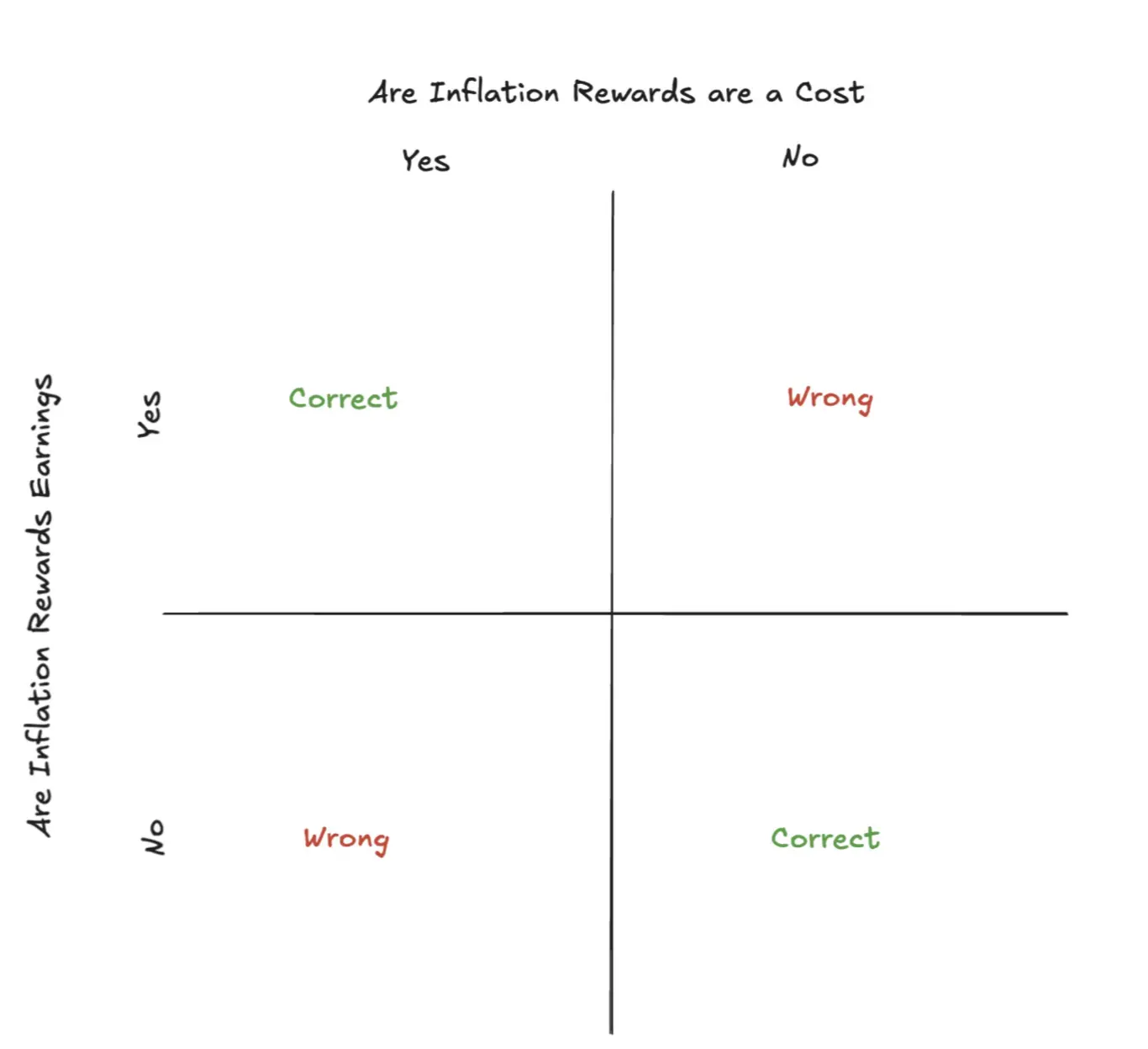
You can build a correct model that considers inflation rewards as a cost, but only if newly issued tokens are counted as a source of value to offset this cost. Otherwise, the model would reach absurd conclusions, such as claiming that Solana has no profitability because it pays out large staking rewards.
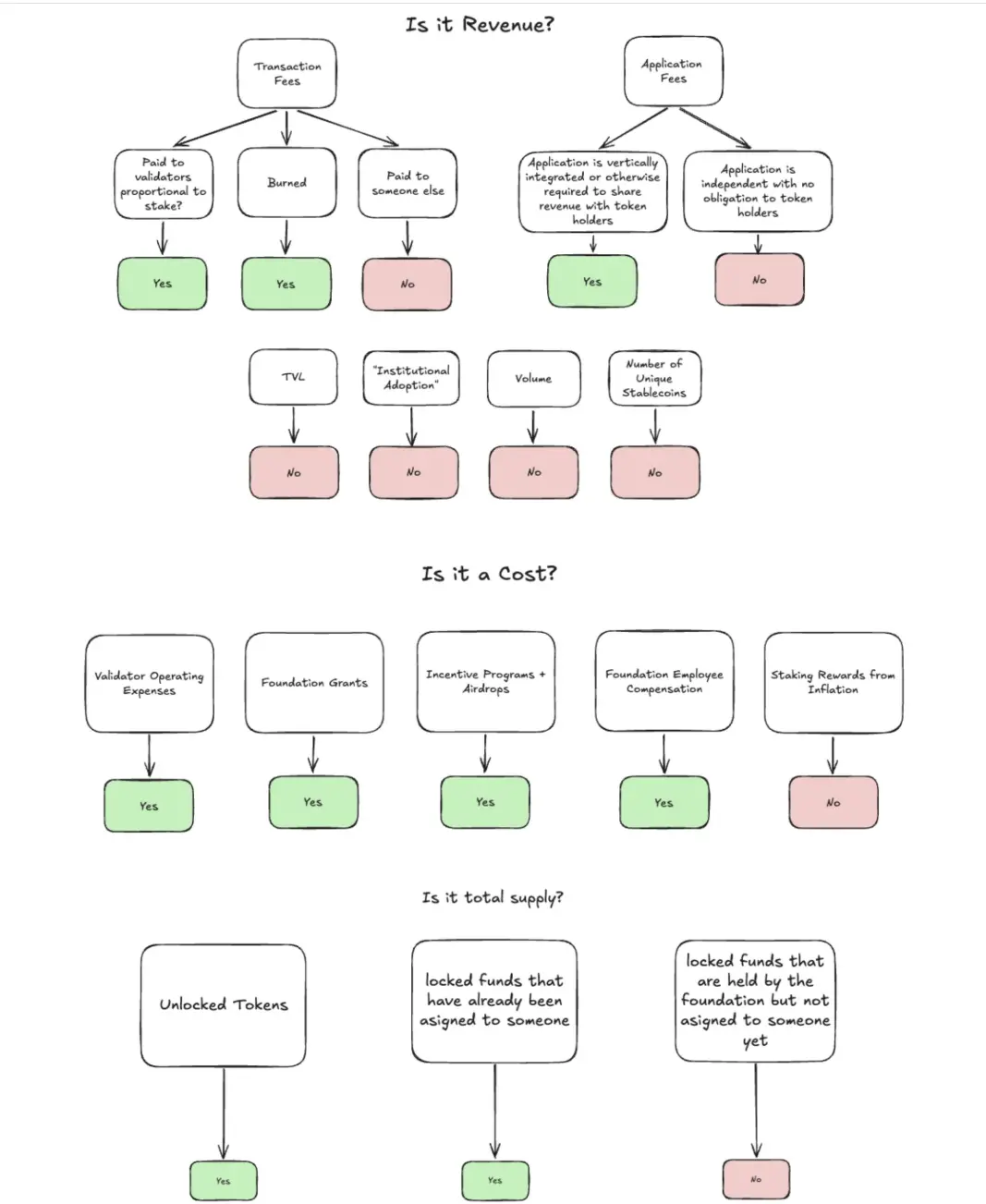
The classification below is the benchmark scheme I propose. It separates three objects: revenue, costs, and total supply.
I believe this set of definitions is the closest to the models that stock analysts are already familiar with, making it easier to understand and reason through.
Other classifications may also be correct, but there must be clear reasons for deviating from this classification. Unique models carry two costs.
The first is that they are harder for others to understand. The second is that people can easily overlook the dependencies between items.
For example, if foundation expenditures are classified as costs, then the unused foundation token share cannot simultaneously be counted in total supply, or it will lead to double counting. If inflation rewards are classified as costs, newly issued tokens must also be treated symmetrically.
Part Three: Supply, Demand, and Price
Recently, several blockchains have explicitly increased fees with the goal of boosting revenue. However, revenue equals price times quantity.
Raising fees will increase the revenue contributed by those transactions that still remain, but it will also cause some transactions to disappear. Therefore, how raising fees ultimately affects revenue is uncertain, largely depending on the price elasticity of transaction demand.
To understand the logic behind these adjustments, I spoke with some decision-makers from these blockchains. They believe that the original fees on these chains were too low, which is why demand is relatively inelastic within this price range.
This claim may apply in specific cases but does not universally hold.
I have previously conducted research utilizing the randomness in EIP-1559 pricing. The analysis revealed that the price elasticity of gas demand is approximately between 0.6 and 0.8. In other words, a 10% increase in price would result in a decrease in demand of 6% to 8%.
Moreover, this data only reflects short-term price fluctuations and does not account for overall impacts from applications migrating off-chain or optimizing programs.
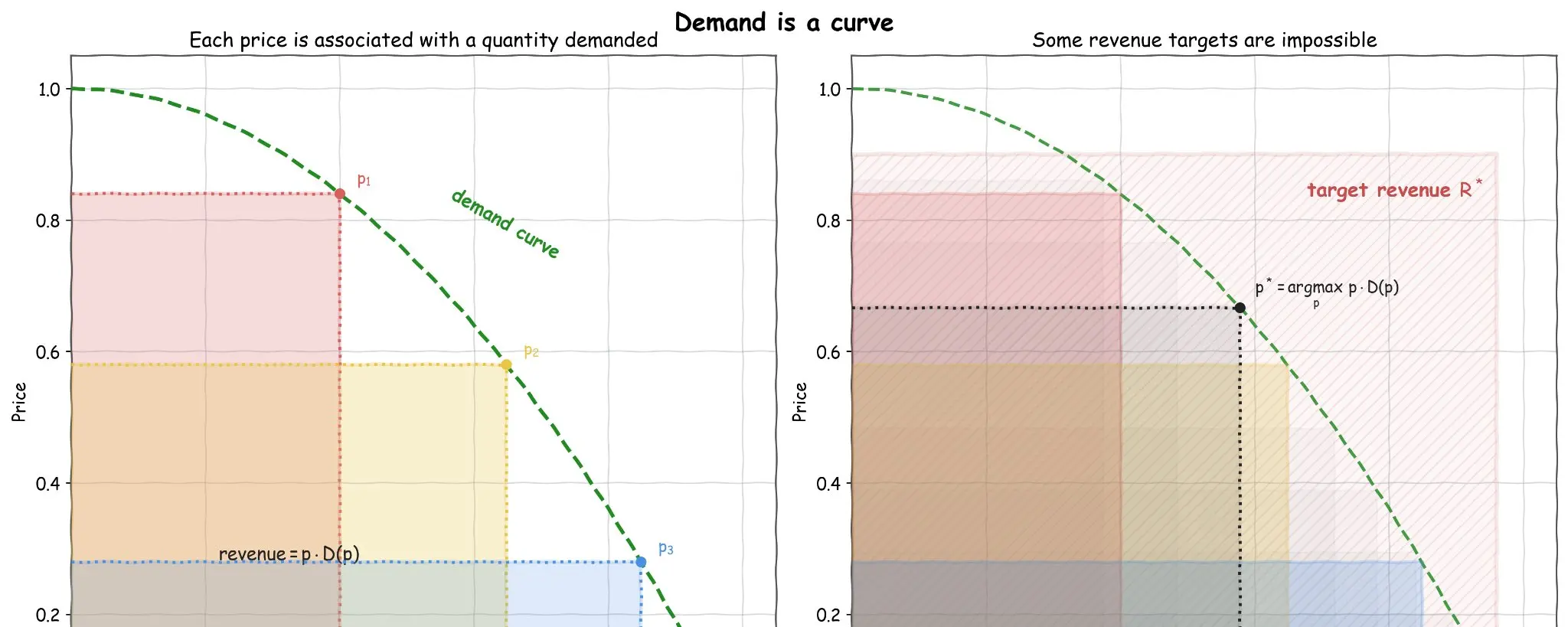
As a result, a uniform fee rate is quite a blunt instrument for revenue generation. Different types of on-chain transactions have varying willingness to pay.
A small wallet transfer, a large stablecoin transfer, and a liquidation may all occupy the same block space, but the total surplus they create and their willingness to pay differ.
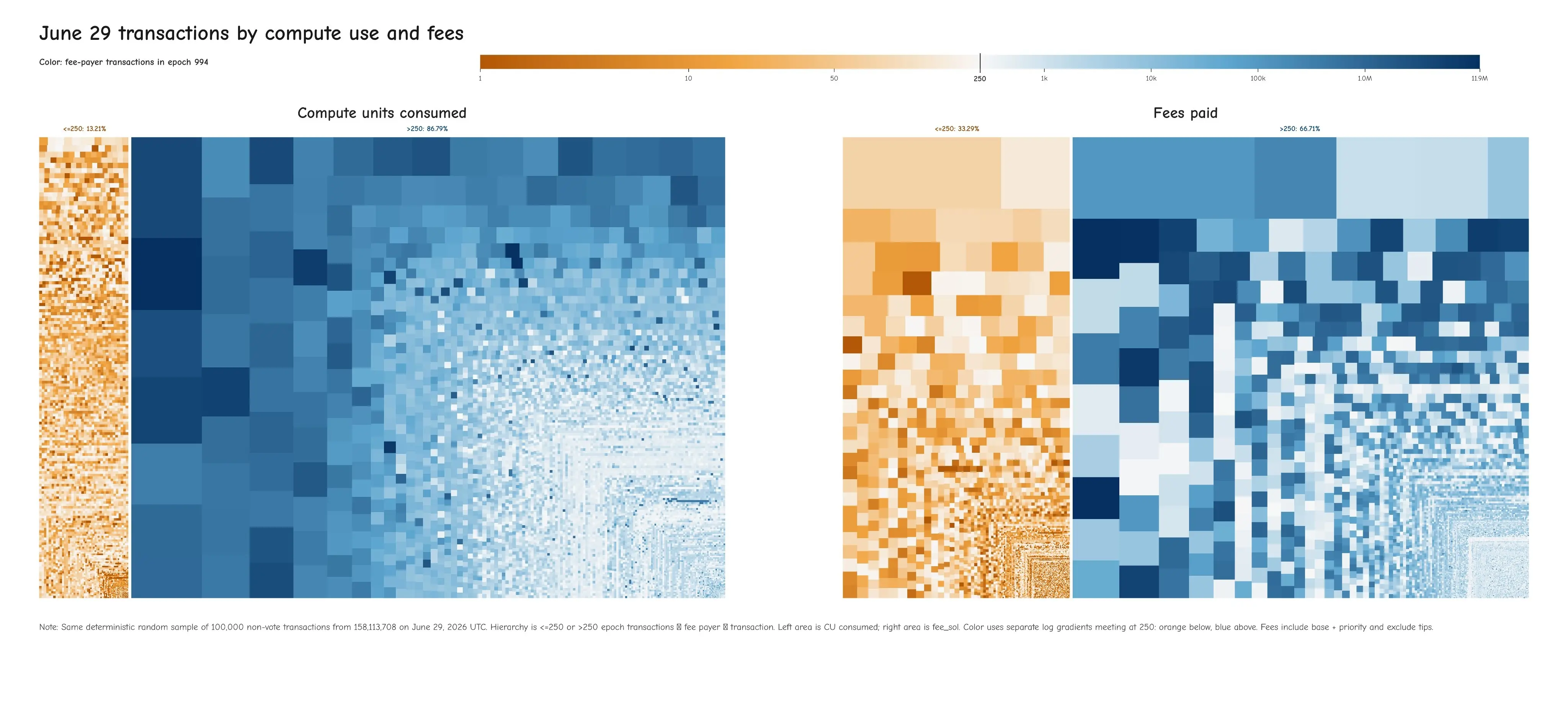
Note: The blue dots represent the same fee payer initiating over 250 transactions during that period, indicating they are more likely to be bots and thus have higher price elasticity. Bots usually have very low margins, so once prices rise, they tend to significantly reduce resource consumption.
The protocol aims to charge higher fees on transactions with stronger willingness to pay. Calculating fees is a step in that direction but is still not thorough enough.
For financial activities, nominal transaction amounts often better reflect willingness to pay than computational loads. This is also why exchanges typically charge fees based on basis points.
Token programs can provide a way to charge based on transaction amounts. By modifying the token program, a small proportional fee can be charged when transferring tokens. This way, even if a high-value transfer uses similar computational resources as a low-value transfer, the high-value transfer would still need to pay more.
免责声明:本文章仅代表作者个人观点,不代表本平台的立场和观点。本文章仅供信息分享,不构成对任何人的任何投资建议。用户与作者之间的任何争议,与本平台无关。如网页中刊载的文章或图片涉及侵权,请提供相关的权利证明和身份证明发送邮件到support@aicoin.com,本平台相关工作人员将会进行核查。


