Author: Jae, PANews
In the first week of August, mainstream targets in the AI industry chain of the U.S. stock market generally gained considerable increases of over 10%. Nvidia's stock price rose for five consecutive days, while Marvell achieved nearly a 20% increase. After experiencing a " Waterloo" in July, AI industry chain concept stocks finally breathed a sigh of relief in the new month, recovering a significant amount of lost ground.
However, this rapid rise cannot be separated from the intense leverage clean-up in late July. At that time, upstream targets in semiconductor and computing power faced significant valuation retrenchments, and the market was once filled with panic over "bubble bursts." Morgan Stanley's chief economist in China, Xing Ziqiang, pointed out in his latest analysis that the recent volatility in the AI sector is not due to deteriorating fundamentals, but rather a phase of "halftime adjustment" caused by crowded trading, large firms retracting financing, and oil price increases boosting interest rate expectations. This view has also become a consensus among major investment banks on Wall Street.
Currently, while targets in the U.S. AI industry chain still show outstanding performance, the fervent emotions surrounding the AI sector are undoubtedly gradually cooling down, and the hottest engine in the global capital market is quietly shifting gears. In the first half of AI investment, capital crowded into computing power chips, chasing the certainty of "selling shovels"; Morgan Stanley's research team believes that the investment focus in the second half may shift along two roads: one focuses on the application end, pursuing real cost reduction, efficiency enhancement, and cash flow realization; the other extends to the physical world, re-evaluating energy, raw materials, and other hard asset bases that AI cannot bypass.
The "Three Mountains" Crushing AI "Shovel Sellers"
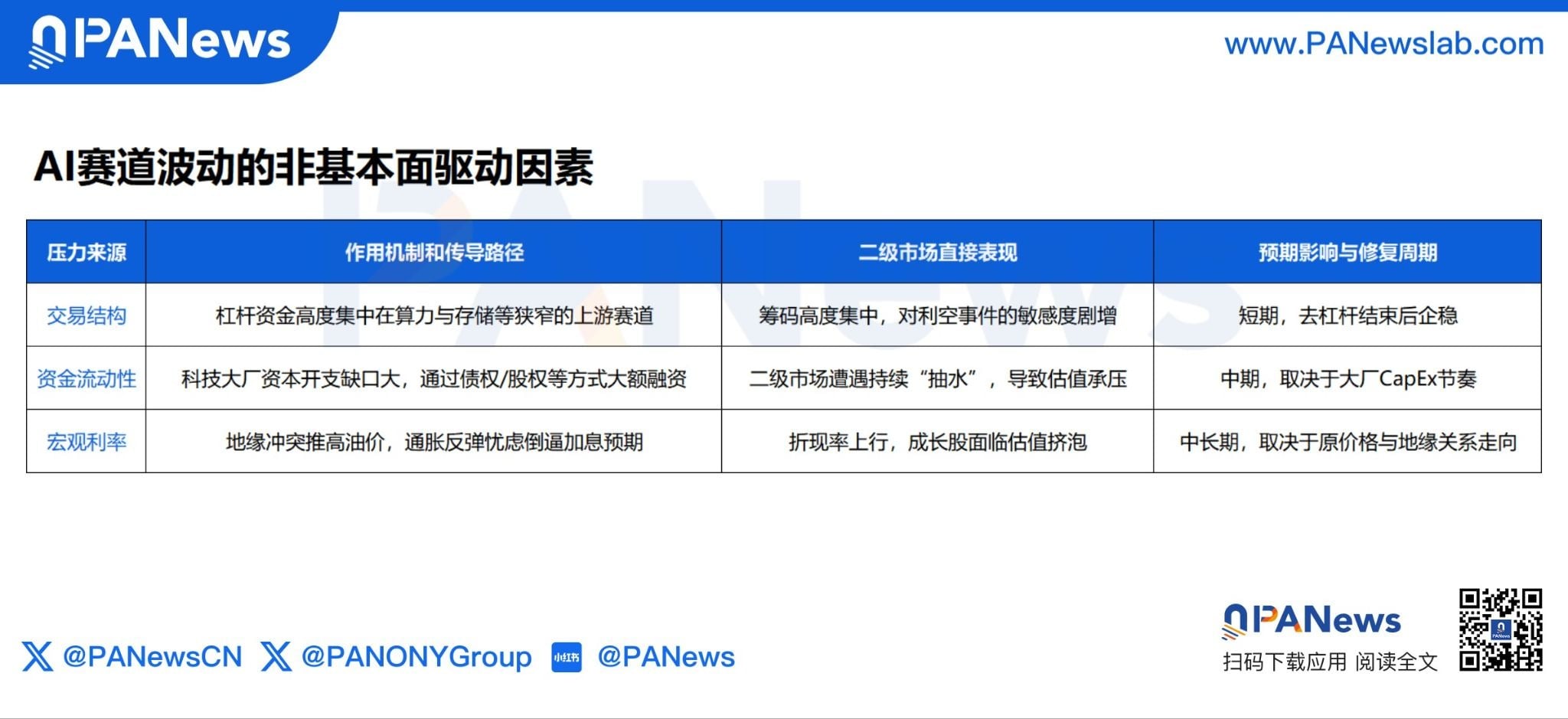
The combination of three forces has collectively pressed the "pause button" on the AI sector.
Crowded Trading: The Fragile Balance Built on High Leverage
The AI market in the first half of the year is a typical example of "crowded trading."
A large amount of leveraged capital and momentum trading funds rushed into upstream sectors such as computing power chips, semiconductors, and storage, leading to a rapid increase in the concentration of chips to historical highs. The crowded chip structure amplified the fragility of the market, resulting in a sell-off-driven deleveraging.
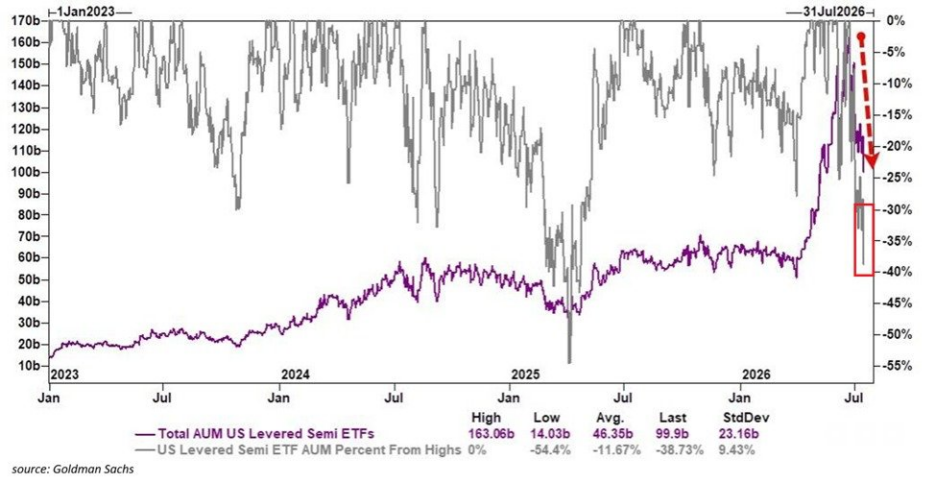
In late July, overly consistent trading expectations encountered a concentrated loosening of chips. According to Goldman Sachs statistics, the assets under management (AUM) of leveraged semiconductor ETFs fell from about $163 billion at its June peak to $100 billion, a decline of nearly 40%, marking the largest drop since April 2025. During the same period, semiconductor ETFs accounted for about 63% of the outflow from all leveraged ETFs in the United States.
However, deleveraging effectively cleared the bubble of pure concept speculation, cooling the overheated emotions in the AI sector.
Capital Retracting: The Liquidity Backlash from Hundreds of Billions of Dollars in Capital Expenditures
The other side of the AI arms race is the sustained consumption of liquidity in the secondary market.
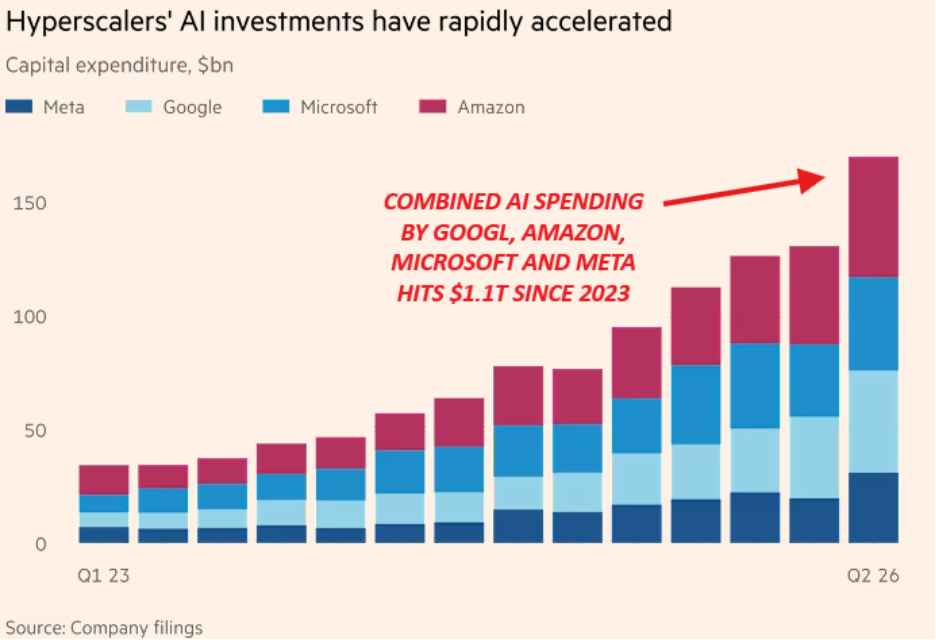
Global hyperscale cloud service providers plan to invest hundreds of billions of dollars in AI infrastructure to seize the computing power high ground, but their cash flows struggle to fully cover such a large capital expenditure gap. Therefore, tech giants frequently engage in large-scale financing through stock issuances and issuing large corporate bonds. According to the Financial Times, the cumulative capital investment of the four major Silicon Valley giants in AI has reached $1.1 trillion as of the second quarter of this year. Morgan Stanley's research team also pointed out that AI-related debt has accounted for more than 15% of the U.S. investment-grade bond market, becoming the largest single debt segment; if downstream monetization does not meet expectations, excessive borrowing may pose a potential threat to corporate credit ratings.
The secondary market is continuously "drained," and a tightening of capital supply naturally puts pressure on valuations. In simple terms, the more aggressive the expansion of computing power, the stronger the siphoning effect on liquidity.
Interest Rate Clouds: Valuation Squeeze from Inflated Inflation
Macroeconomic variables become the last straw that breaks the camel's back of high valuations.
Heightened geopolitical conflicts in the Middle East have pushed up international oil prices, and market fears of persistent inflation have resurged, forcing expectations for interest rate hikes from the Federal Reserve to rise. The upward trend of risk-free interest rates raises the discount rate for future cash flows. For AI targets still in the investment phase, where cash flows have not yet been realized, rising discount rates further suppress their valuations.
Under these threefold pressures, the business of "selling shovels" has suddenly become difficult.
Changing AI Investment Logic: Calculating ROI with One Hand, Securing Hard Assets with the Other
Goldman Sachs and Morgan Stanley point out that foundational model training is transitioning to large-scale reasoning deployment, and merely stacking computing power and competing on parameters is beginning to yield marginal returns. The valuation anchor in the capital market is also shifting towards the ability to realize business models and resource bottlenecks in the physical world.
AI Application End: From Storytelling to Calculating ROI
The second half of AI investment is an elimination match focused on financial realization capabilities.
In the first half, as long as a target was associated with the AI concept, it could enjoy valuation premiums; in the second half, the scale of parameters is no longer the main indicator—return on investment becomes the basis for obtaining high valuations. The market will pay more attention to whether companies can use AI to achieve cost reductions and efficiency improvements, converting them into revenue and cash flow growth.
As reasoning costs continue to decline, application-oriented companies with strong closed-loop ecosystems, exclusive data assets, and high customer stickiness will stand out. For example, companies embedding AI into game development, advertising placement, or digital business processes can significantly reduce unit operating costs, transforming AI technology into an internal efficiency engine and product pricing capability.
As capital aligns more towards ROI, it will force AI vendors to shift from "parameter competition" to "real-world implementation," accelerating AI's transition from the laboratory to real industries. Currently, at the AI application end, except for a few leading players like Palantir (PLTR) that have achieved financial growth, other targets still need subsequent market data to speak for themselves.
HALO Assets: The End of AI is the Physical World
"The end of AI is energy and raw materials," a judgment from Goldman Sachs last month is becoming market consensus.
HALO (Heavy Assets, Low Obsolescence) assets refer to those with high barriers to tangible capital that are not easily replaceable by technology, such as copper mines, power grids, infrastructure equipment, and nuclear resources. This type of physical hard assets that AI "cannot move, dismantle, or create" may be favored by global funds.
Goldman Sachs pointed out in its report "The HALO Effect" that the global market is undergoing a "repricing of scarcity." Over the past decade, the market has favored a "light asset, light, high expansion" software model, but AI has lowered the thresholds for information processing, greatly compressing the valuation and profit margin ceilings for software and IT service companies. In contrast, the reset costs of physical assets have soared due to inflation and the re-regionalization of supply chains.
Simply put, large models iterate on a weekly basis, the barriers for algorithms and software services have been largely leveled, and some light asset SaaS companies dependent on simple code or intermediary services are facing disruptive risks of being replaced by AI agents. Algorithms can be surpassed by open-source models, software can be rewritten by AI agents, but power grids cannot be easily replicated, copper mines cannot be created out of thin air, and nuclear power stations cannot be built overnight.
According to Wall Street's classification standards, the HALO theme covers four main sectors: power and nuclear energy, grids and infrastructure, critical raw materials, and engineering manufacturing, each of which is a physical barrier that AI computing power expansion cannot bypass, and is not lacking in potential targets with high consensus from institutions such as BlackRock and Goldman Sachs.
In the field of power and nuclear energy, independent nuclear power giants represented by Constellation Energy (CEG), Vistra Corp (VST), and NextEra Energy (NEE) are becoming the focus of capital attention. Against the backdrop of limited public grid expansion, they, leveraging their licensing advantages and "behind-the-meter" power supply models, are turning nuclear power plants into primary energy suppliers for data centers, attracting tech giants to sign long-term purchase agreements (PPAs) with guaranteed minimum prices, transforming originally cyclical public utilities into cash flow assets with high certainty.
In the field of grids and infrastructure, the proliferation of high-power GPUs has pushed traditional air cooling to its physical limits, making the transition of data centers to liquid cooling technology an inevitable trend. Vertiv (VRT), relying on its leading position in precision cooling and thermal management technology, will reap the benefits of upgrading cooling for data centers. Eaton (ETN) and Quanta Services (PWR) hold the construction capabilities for distribution equipment, transformers, and high-voltage grids, determining the actual pace of grid expansion. Additionally, the long-cycle projects of upgrading physical grids also build higher competitive barriers for them.
In the field of critical raw materials, Freeport-McMoRan (FCX) holds high-quality super large copper mine resources and mining rights. Whether for power transmission, transformer windings, or internal wiring of data centers, copper is an irreplaceable physical conduction medium. The long development cycle of mines and declining ore quality significantly reduce the supply elasticity of new copper mines, and the long-term widening of the supply-demand gap will continue to enhance the pricing power of copper mine resources.
In the engineering manufacturing field, Caterpillar (CAT) and Deere & Co (DE) possess large physical factories, proprietary engineering technologies, and global supply chain networks, creating physical barriers that are difficult to be replaced by code or algorithms while continuously winning orders amid the infrastructure boom.
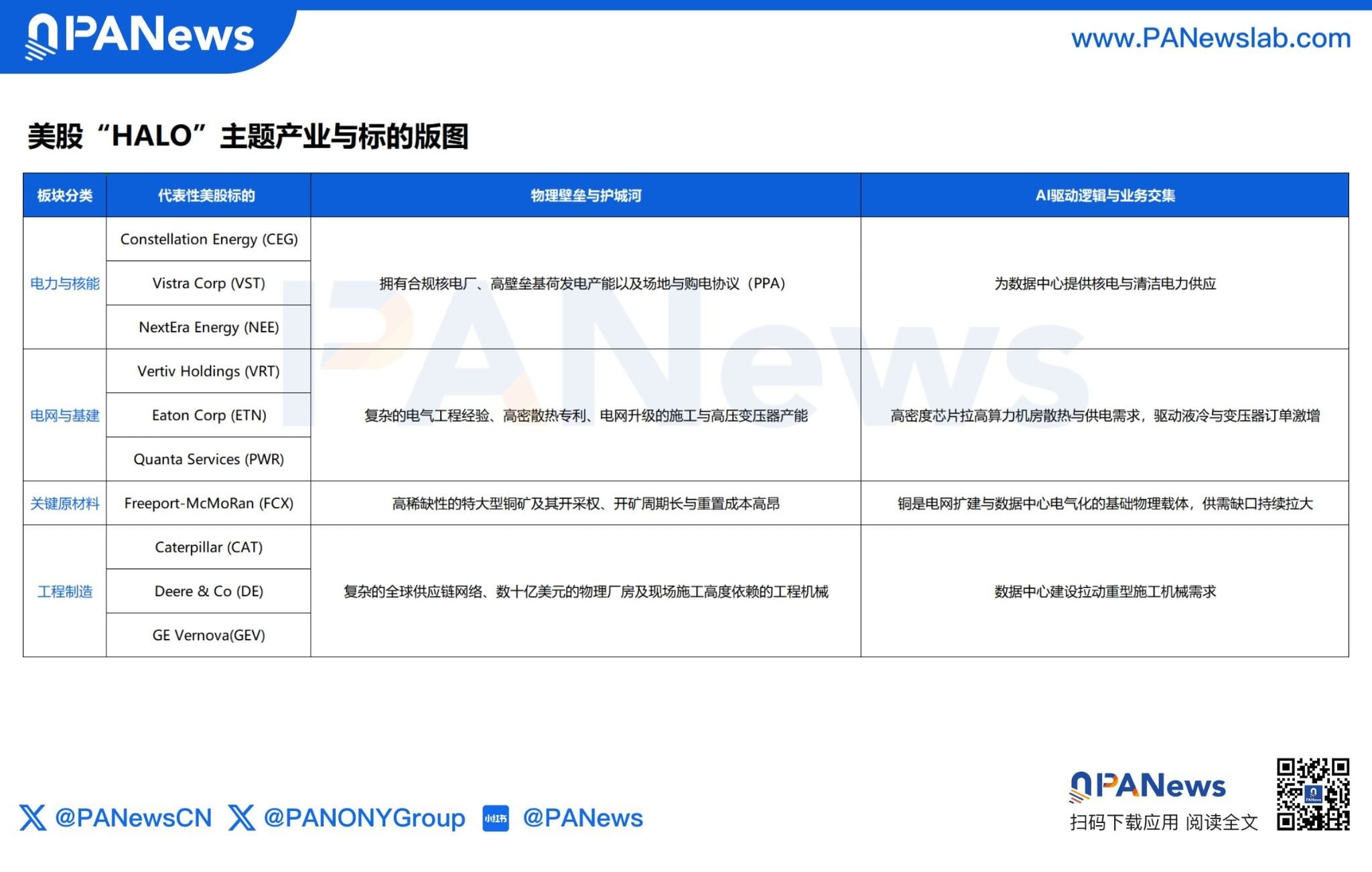
In the second half of AI investment, Eaton's transformers, Caterpillar's giant excavators, Newmont's copper mines, and other assets once deemed "old economy" are suddenly endowed with new strategic value. The repricing of capital towards HALO assets will lay a solid physical foundation for the next stage of larger AI infrastructure demands.
However, HALO asset construction involves long cycles and requires significant financial investment. If the commercialization speed of downstream AI applications does not meet expectations, the preemptively invested energy and computing power infrastructure may also trigger risks of overcapacity and asset obsolescence.
A "halftime adjustment" is a necessary stage for the capital market to move towards rational differentiation; future excessive returns will stretch one hand towards real business scenarios and dig deep into solid hard assets. Only players with both commercialization capabilities and physical moats can maintain their lead in the long run after the "halftime adjustment."
免责声明:本文章仅代表作者个人观点,不代表本平台的立场和观点。本文章仅供信息分享,不构成对任何人的任何投资建议。用户与作者之间的任何争议,与本平台无关。如网页中刊载的文章或图片涉及侵权,请提供相关的权利证明和身份证明发送邮件到support@aicoin.com,本平台相关工作人员将会进行核查。


