Author: Azuma, Odaily Planet Daily
On August 5, Beijing time, before the U.S. stock market opened, stablecoin issuer Circle officially announced its financial report for the second quarter of 2026.
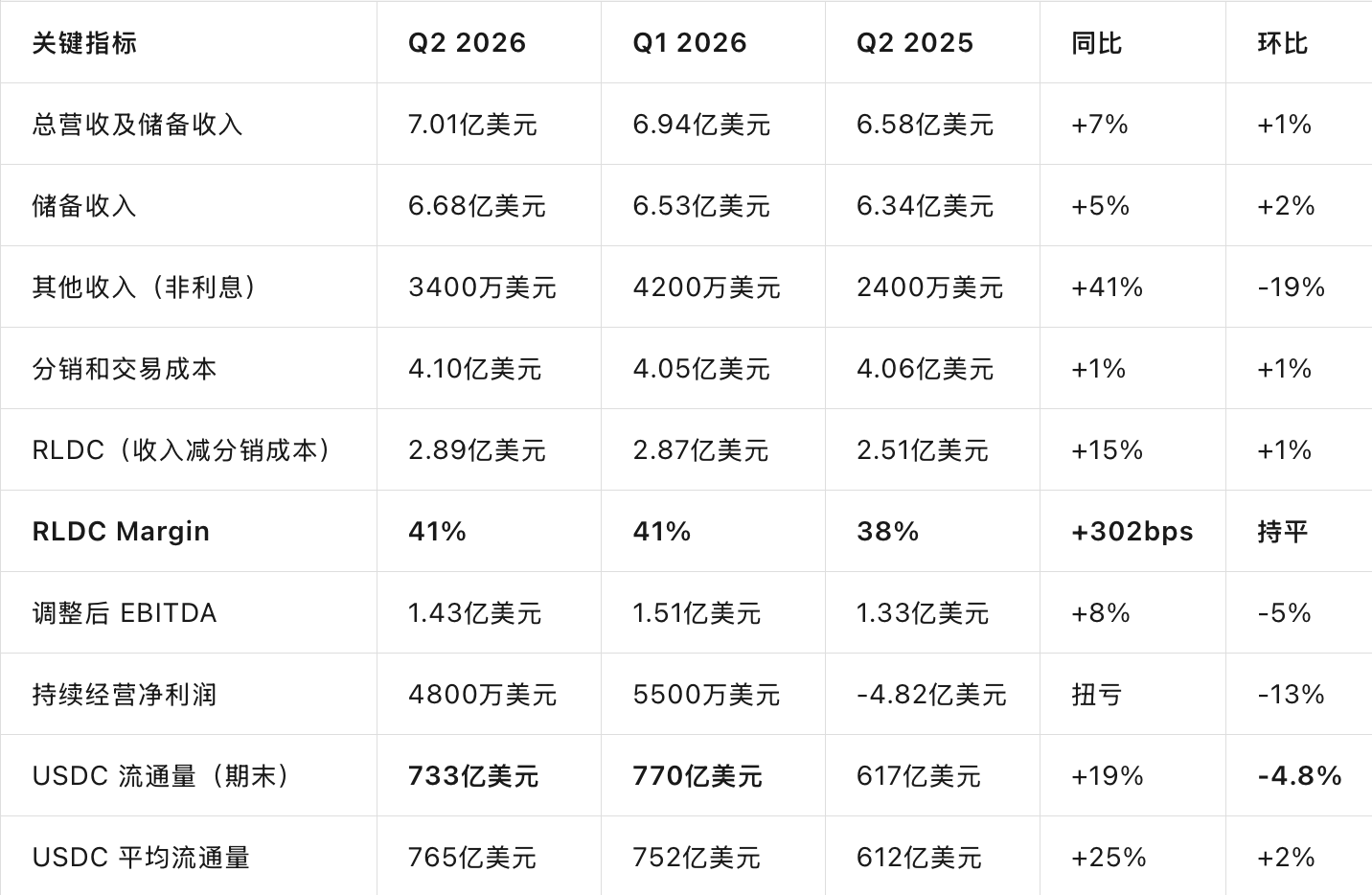
The financial report shows that Circle's total revenue and reserve income for the second quarter was $701 million (below the market expectation of $717 million), a year-on-year increase of 7%; adjusted EBITDA was $143 million, a year-on-year increase of 8%; net profit from continuing operations was $48 million (above the market expectation of $43 million), a year-on-year increase of $530 million.
During the investor conference call following the release of the financial report, Circle's founder and CEO Jeremy Allaire addressed the much-anticipated "Coinbase Distribution Agreement" issue. Allaire stated: "We have renewed our agreement with Coinbase under the existing terms, ensuring that USDC continues to play a central role in Coinbase's entire product ecosystem. At the same time, we look forward to establishing distribution agreements with strategically aligned partners to continue expanding our USDC network."
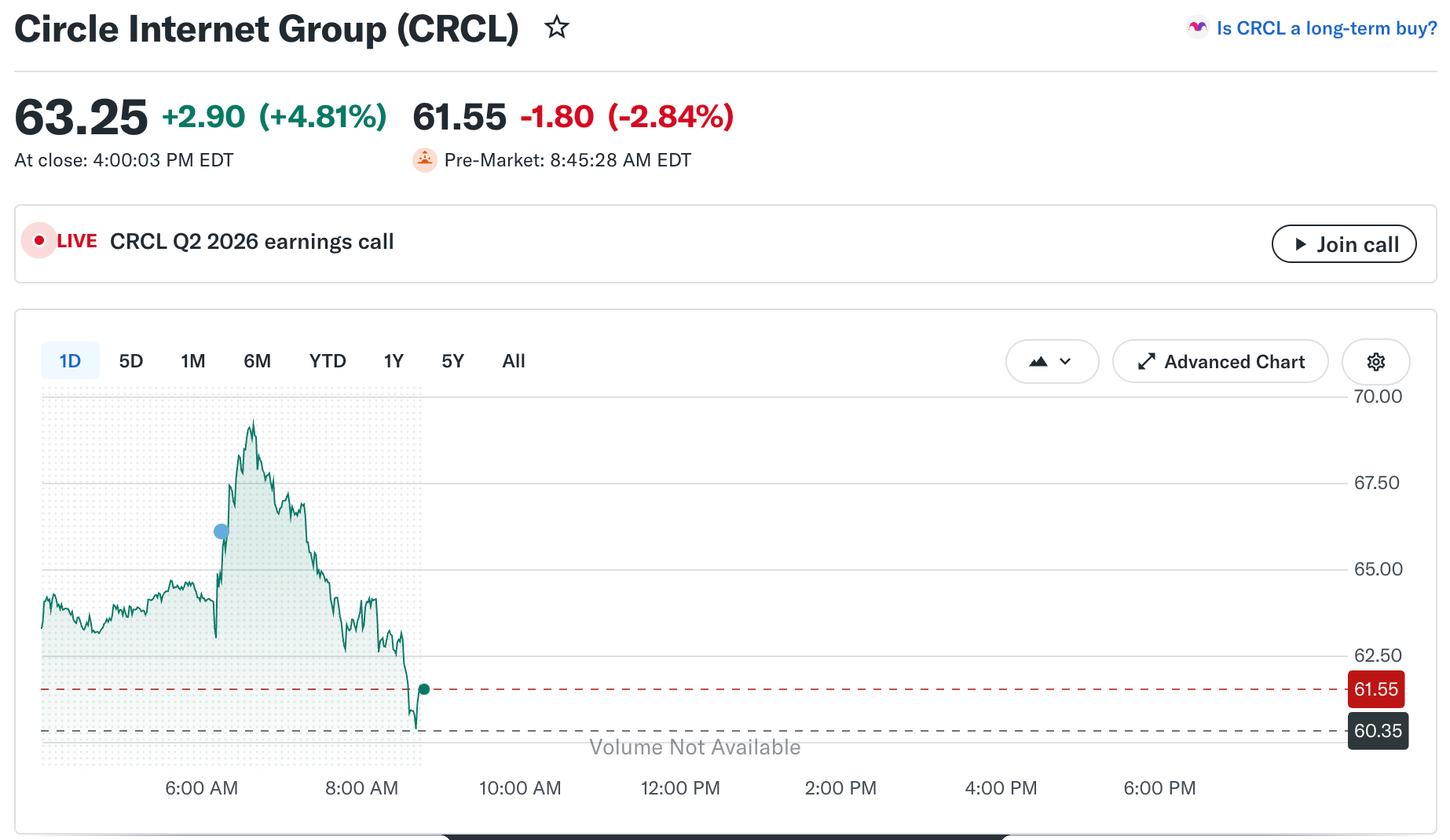
Following the release of the financial report, CRCL briefly surged before the U.S. stock market opened but gradually weakened, reporting at $61.55 as of 20:45, a pre-market decline of 2.84%.
The core data interpretation is as follows:
1. Total revenue missed expectations, but at least reversed the trend
As the financial report shows, Circle's total revenue and reserve income this quarter was $701 million, although it did not match market expectations ($717 million), it reversed the shrinking trend from the previous quarter ($579 million ➡️ $658 million ➡️ $740 million ➡️ $770 million ➡️ $694 million ➡️ $701 million).
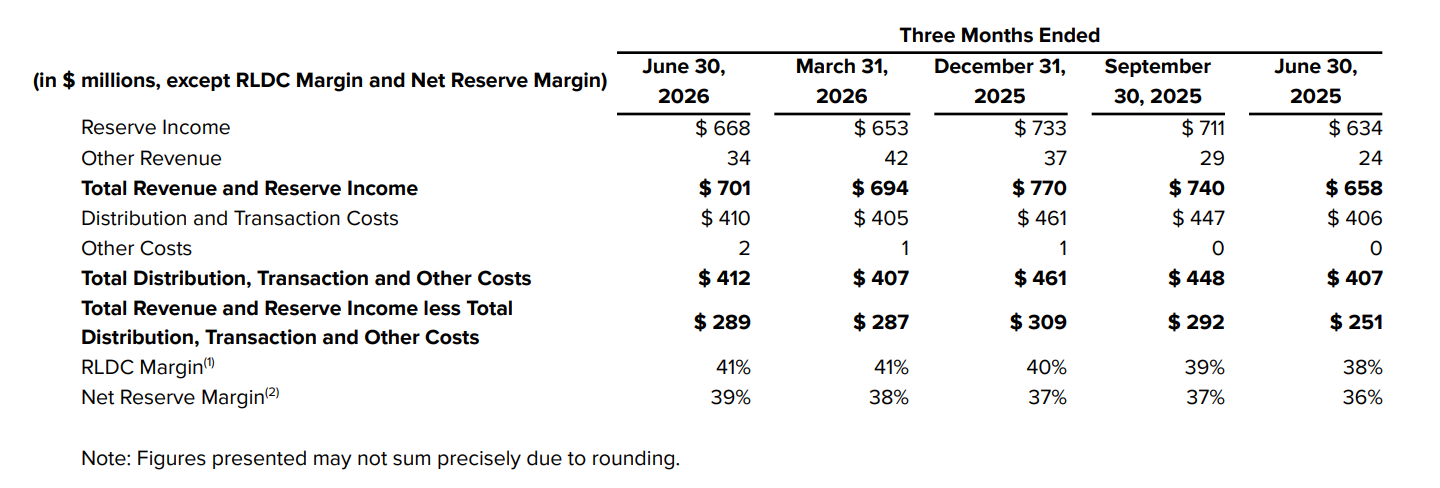
In terms of revenue structure, reserve income remains the absolute main pillar, recording $668 million in the second quarter, a year-on-year increase of 5% and a quarter-on-quarter increase of 2%.
2. USDC average circulation continues to grow but suffered a significant outflow at the quarter-end
The growth of reserve income was mainly attributed to the increase in USDC circulation - in the second quarter, USDC circulation showed a "average growth, quarter-end contraction" trend.
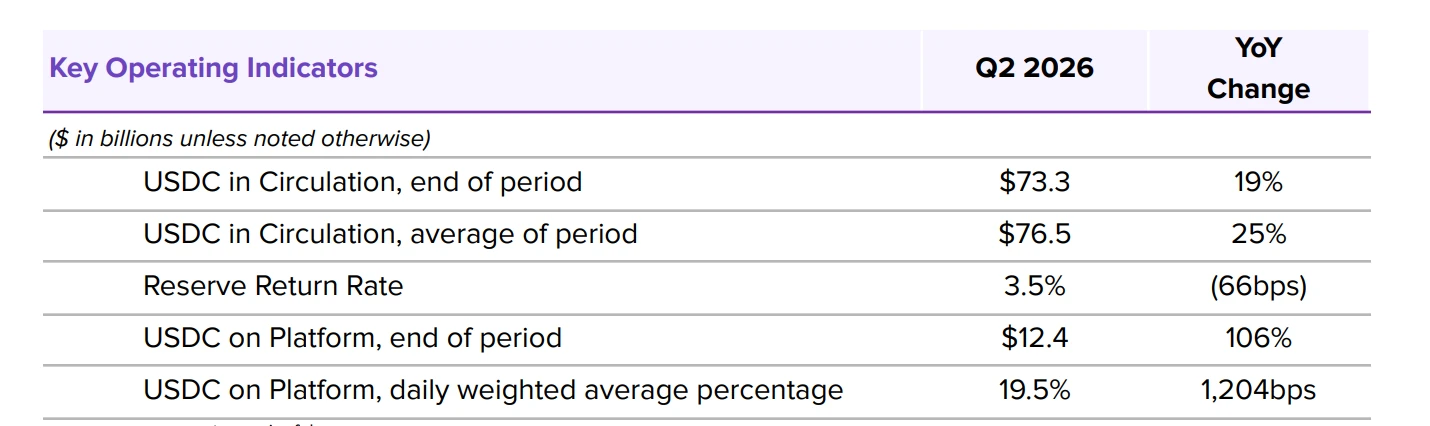
The financial report data shows that the average circulation of USDC for the second quarter was $76.5 billion, a year-on-year increase of 25%, and a quarter-on-quarter increase of about 2% (the previous quarter's average was $75.2 billion); however, the circulation at the end of the quarter was $73.3 billion, which, although a year-on-year increase of 19%, shrank by about 4.8% compared to the end of the previous quarter at $77 billion. This indicates that the outflow of USDC mainly occurred at the quarter-end window; the overall amount is still expanding, but the marginal trend is concerning.
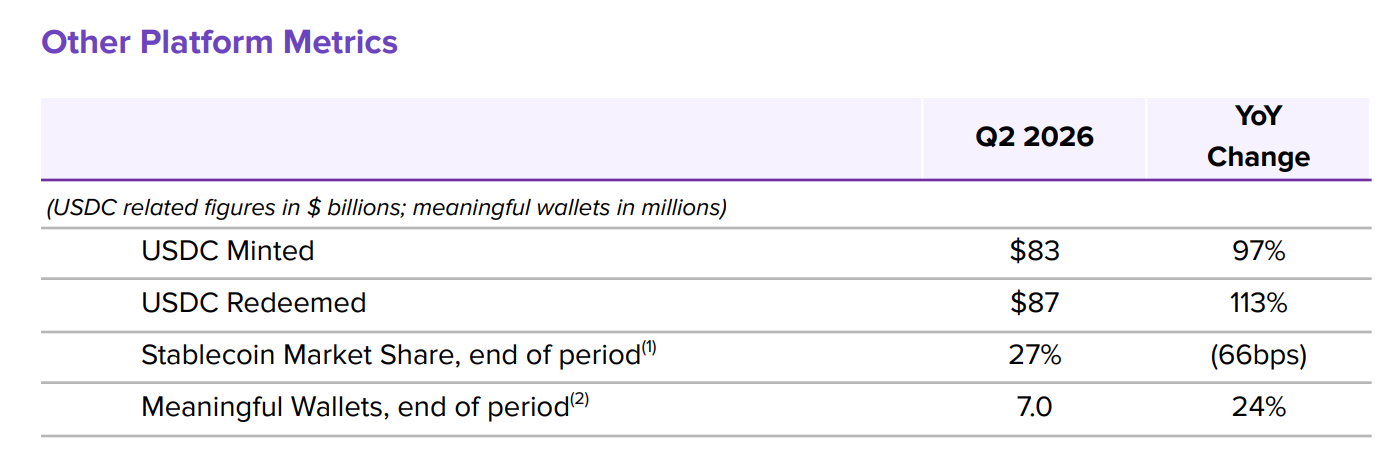
Another concerning indicator is market share. The financial report shows that USDC's market share among dollar stablecoins at the end of this quarter was 27%, a year-on-year decrease of 66 basis points - against the backdrop of shrinking industry supply, USDC failed to capture market share contrary to the trend and instead experienced a slight loss.
3. Other income decreased quarter-on-quarter, but full-year guidance significantly revised upwards
Excluding reserve income, Circle's other revenue this quarter was $34 million, a year-on-year increase of 41%, but down 19% quarter-on-quarter, breaking the previous five consecutive quarters of growth trend ($21 million ➡️ $24 million ➡️ $29 million ➡️ $37 million ➡️ $42 million ➡️ $34 million).
It is worth noting that Circle also significantly raised its guidance for other revenue for the 2026 fiscal year from the previous $150 - $170 million to $310 - $330 million, almost doubling, and specifically explained that this guidance includes confirmed ARC token pre-sale income.
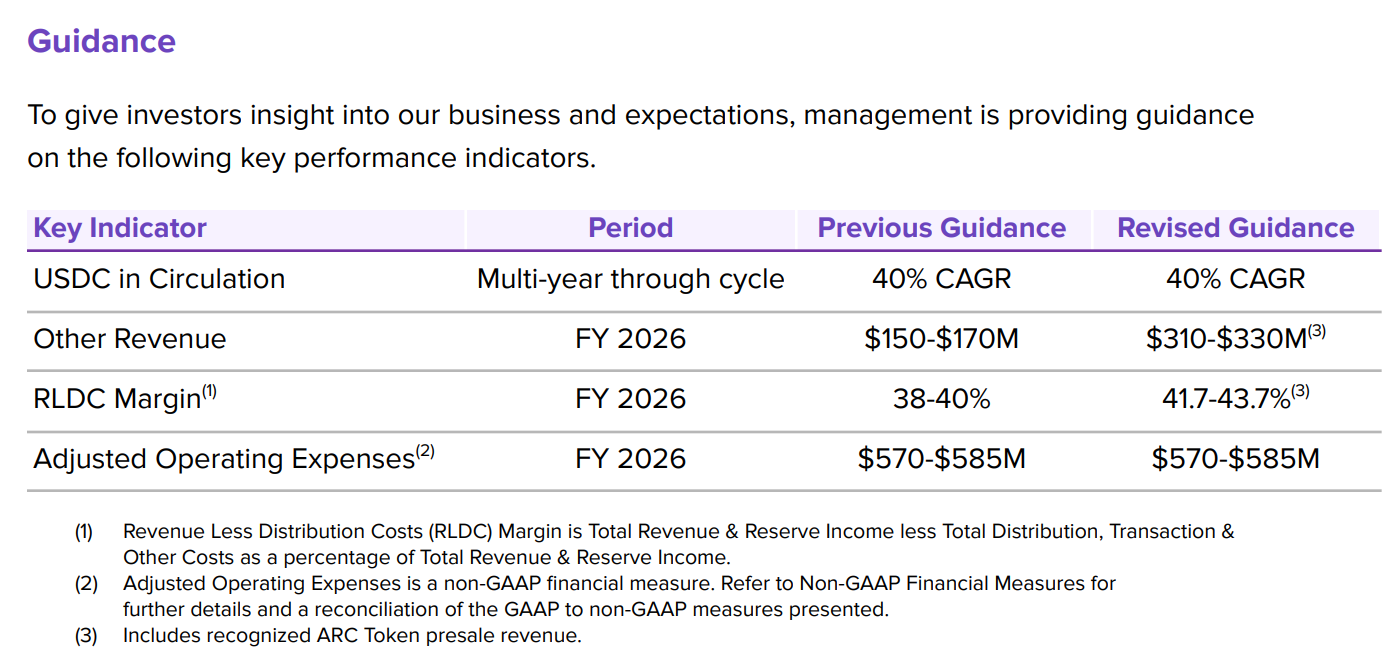
According to explanations from the first quarter financial report conference call, the ARC tokens held by Circle will be recognized at fair value as "other revenue" once they fulfill their pre-sale agreement obligations and will directly enter RLDC and adjusted EBITDA. This means that the other revenue in the coming quarters will be significantly boosted due to the accounting of ARC tokens. However, it should be noted that this portion of revenue is closer to one-time accounting income rather than sustainable subscription or service income; if excluding the impact of ARC, the growth slope of core Other Revenue still needs to be monitored.
4. RLDC Margin remains high, optimization of distribution cost control
RLDC Margin is the most resilient indicator in Circle's financial report this quarter - this data refers to the profit margin after revenue is reduced by distribution costs, reflecting the core business profitability level after deducting distribution costs and is generally regarded as Circle's key profitability indicator.
In the second quarter, Circle's RLDC (revenue minus distribution costs) was $289 million, a year-on-year increase of 15%; RLDC Margin reached 41%, up 3.02 basis points year-on-year, unchanged from the previous quarter, with steady increases over the past five quarters (38% ➡️ 39% ➡️ 40% ➡️ 41% ➡️ 41%). The significance of this data is that despite the headwind environment of year-on-year decline in reserve yields (due to the Federal Reserve lowering the federal funds rate), Circle still maintained its profit margin, with the key behind this being the refined control of distribution costs - distribution and transaction costs in the second quarter were $410 million, only growing 1% year-on-year, far below the 5% growth rate of reserve income year-on-year.
Similar to other income, Circle's management also raised the full-year RLDC Margin guidance from 38–40% to 41.7–43.7%. However, it should be noted that this revision also includes confirmed ARC token pre-sale income, so the profit margin figures for the second half of the year will carry a certain degree of "non-recurring" nature.
5. Distribution remains the largest expense, increased investment in product development
In terms of expenses, distribution and transaction costs continue to be Circle's largest cost item, reaching $410 million in the second quarter, with a year-on-year increase of only 1%, and quarter-on-quarter growth controlled to within 1%.
From the perspective of operating expenses, under GAAP standards, the second quarter was $254 million, a year-on-year decrease of 56%, but this was mainly due to the high stock compensation expense (attributed to the IPO last year of $435 million) resulting in a base effect and lacks much reference significance.
More substantively, adjusted operating expenses for the second quarter were $146 million, a year-on-year increase of 23%, reflecting that Circle is continuously increasing its investment in product development, infrastructure, and AI capabilities. Specifically breaking down, general and administrative expenses increased to $66.3 million, IT infrastructure costs increased to $16.4 million, and depreciation and amortization expenses doubled year-on-year to $29.9 million, in conjunction with management's statements regarding continued investments in product development, infrastructure, and AI capabilities, the growth of related expenses may be highly related to businesses such as Arc, Agent Stack, and CPN.
Business Progress: Platformization Layout Continues to Advance
In addition to financial data, several business progress disclosures made by Circle in the second quarter financial report are also worth noting.
The first is that the Arc network is officially in the countdown to launch. Circle announced that the Arc mainnet will officially launch on September 16, with the first batch of network validators including traditional financial institutions such as BlackRock, DTCC, Galaxy, Visa, Mastercard, and Standard Chartered Bank. Meanwhile, BlackRock's tokenized money market fund BUIDL will be deployed to the Arc network, and DTCC plans to support the tokenization of assets custodied by DTC on Arc.
Compared to previous introductions more focused on technology routes and visions, this disclosure implies that Arc has begun to gain actual involvement from traditional financial institutions. For Circle, Arc's positioning is no longer just a public chain built around USDC but aims to become the underlying infrastructure connecting stablecoins, RWA, and traditional financial institutions.
Another noteworthy business is the Circle Payments Network (CPN). The financial report shows that as of the end of the second quarter, CPN's annualized transaction volume over the past 30 days has increased to $14.7 billion, up about 76% from the $8.3 billion disclosed in the first quarter; the number of connected financial institutions has also increased from 136 to 175, a quarter-on-quarter increase of 29%. Although CPN's direct contribution to revenue is still limited, both the transaction scale and institutional numbers indicate that this payment network is gradually accumulating network effects.
In terms of regulation, Circle also made important breakthroughs this quarter, as the company has officially received approval from the U.S. Office of the Comptroller of the Currency (OCC) to set up Circle National Trust, becoming one of the first stablecoin issuers to obtain a federal trust bank license in the U.S.; meanwhile, its application to set up Circle New York Trust has also been approved by the New York State Department of Financial Services (NYDFS).
For a stablecoin issuer whose core competitiveness is compliance, these two licenses not only further enhance Circle's regulatory status in the U.S. financial system but also provide a more solid institutional foundation for the future development of custody, payment, and institutional finance.
Did the financial report answer Wall Street's valuation disagreement?
Yesterday, we published an article titled “On the Eve of Circle's Financial Report, Wall Street Has Huge Disagreement over CRCL Valuation.” The article mentioned that ahead of this quarter's financial report release, there were clear disagreements on Wall Street regarding Circle's future value.
On August 3, Morgan Stanley (hereafter referred to as "Morgans") downgraded Circle's rating from "Equal Weight" to "Underweight," sharply lowering the target price from $106 to $38; meanwhile, TD Cowen initiated coverage on Circle for the first time and gave a "Buy" rating, setting a target price of $82.
The two institutions provided drastically different rating judgments, reflecting the core disagreement behind how to evaluate Circle's revenue growth expectations - does Circle's long-term value come from USDC? Or from the digital financial infrastructure built around USDC?
From this financial report, it seems that both sides' viewpoints have been somewhat confirmed.
On one hand, several concerns raised by Morgan Stanley still exist - USDC's quarter-end circulation continues to decline, and market share has not increased; the company's revenue still mainly comes from reserve income, although other revenue's full-year guidance has been significantly raised, this new portion mainly comes from confirming ARC token pre-sale income, rather than ongoing growth in payments, APIs, or RWA businesses. This means that Circle's profit model remains highly dependent on the growth status of USDC and the interest rate environment in the short term.
On the other hand, new evidence supporting TD Cowen's bullish logic seems to be increasing as well. The Arc mainnet has been officially scheduled, traditional financial institution participation such as BlackRock and DTCC in the ecosystem, CPN's rapid expansion, and the landing of the federal trust bank license… though these businesses have not yet become revenue pillars, they are continuously enriching Circle's platformization layout.
In summary, the only exact answer we can genuinely find from this financial report seems to be "Circle is moving towards platformization," while whether these layouts can ultimately translate into sustained growth of non-interest income and support the valuation logic of a digital financial infrastructure platform may still need several more quarters for validation.
免责声明:本文章仅代表作者个人观点,不代表本平台的立场和观点。本文章仅供信息分享,不构成对任何人的任何投资建议。用户与作者之间的任何争议,与本平台无关。如网页中刊载的文章或图片涉及侵权,请提供相关的权利证明和身份证明发送邮件到support@aicoin.com,本平台相关工作人员将会进行核查。


