
Author: Nancy, PANews
On August 5, a wave of orange swept through social media, with numerous bloggers showcasing their orange wallet IDs on X. It turned out that "Cyber Lama" Cloudflare launched programmable wallets called Cloudflare Wallets for AI Agents on the evening of August 4, which not only enables Agents to participate autonomously in internet transactions but also promotes the concept of crypto infrastructure to the public.
Meanwhile, Cloudflare opened the registration for the name cloudflare.pay Wallet, which triggered an unexpected rush to register Agent identities.
Programmable Wallets for Agents, Supporting Stablecoin Micro-Payments
Cloudflare's latest blog announced the launch of programmable wallets called Cloudflare Wallets for AI Agents, aimed at assisting AI Agents in completing API purchases, content consumption, and service transactions autonomously.
In fact, as AI Agents gradually transition from auxiliary tools to executing tasks independently, a new problem arises: how should an AI complete payments if it needs to purchase APIs, call data services, or consume digital content?
Currently, most internet services are still designed around human users. AI Agents typically need to register accounts, bind payment methods, apply for API keys, and sometimes even undergo manual verification before they can use services. This process not only increases the access costs but also limits the Agents' ability to autonomously explore, compare, and use different services.
Cloudflare Wallets aims to address the payment, identity, and permission management issues that AI Agents face in the internet era.
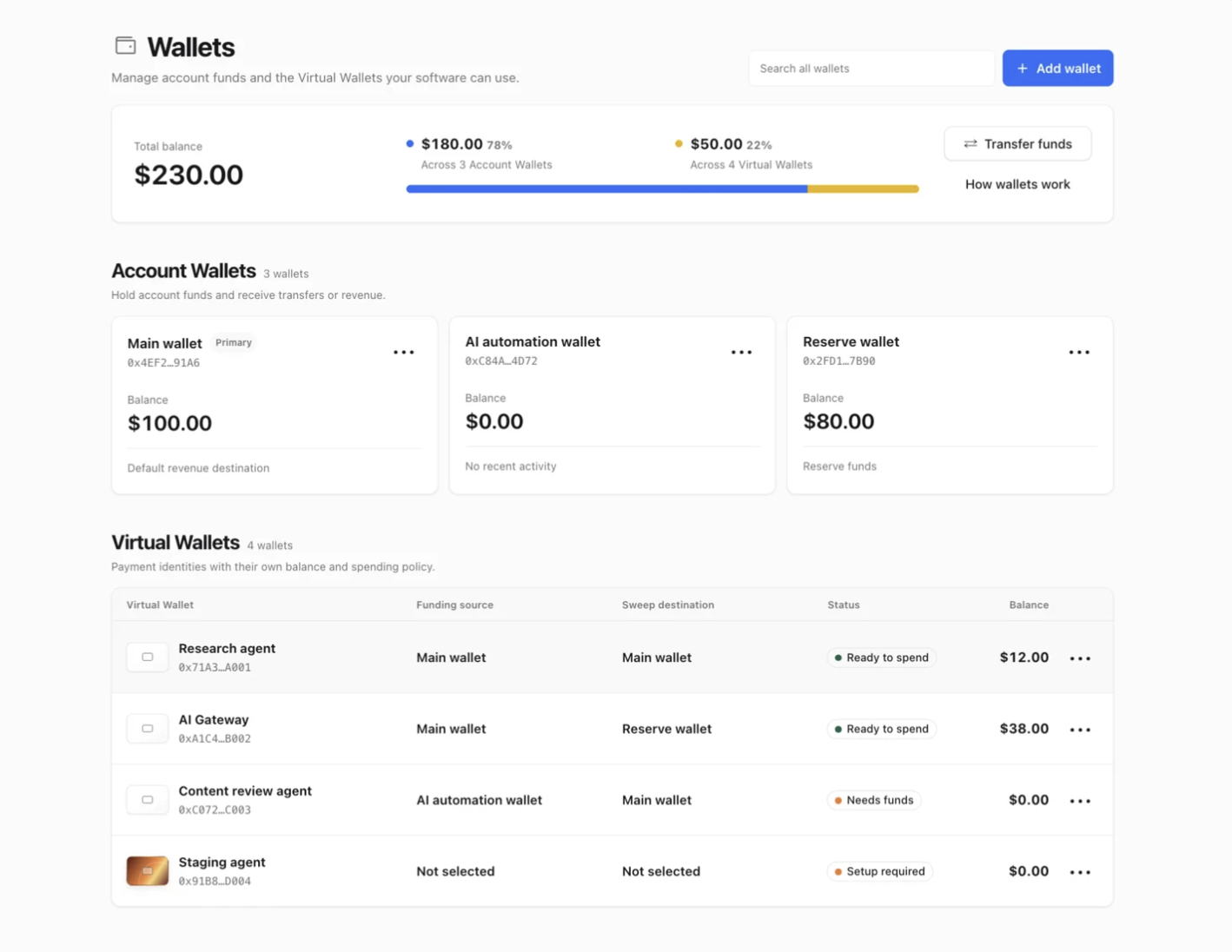
The wallet is mainly divided into account wallets and virtual wallets. The account wallet is primarily aimed at individual or business users for funding, asset management, and authorizing spending limits for AI Agents; the virtual wallet is specifically designed for AI Agents, enabling them to make purchases on behalf of users.
The virtual wallet has garnered significant market attention. To reduce risks associated with automatic payments, users can set spending rules in advance for the virtual wallet, including transaction limits, whitelists, and maximum single payments. This allows users to authorize the Agent to execute tasks autonomously without needing to manually confirm every operation, while controlling the financial risk within an acceptable range.
This design grants the Agent greater freedom while exploring internet services. As spending limits are usually kept within a small range, users can confidently allow Agents to experiment with various APIs and tools without worrying about significant losses from erroneous calls or malicious services.
One of the key technologies supporting Cloudflare Wallets’ micro-payment capabilities is the open-source payment protocol x402 launched by Coinbase. This protocol enables micro-payments between machines via the stablecoin USDC, allowing AI Agents to access and purchase API services directly without registering traditional accounts or binding bank cards, significantly reducing the costs of testing and calling new services. Currently, x402 supports multiple blockchain networks including Base, Polygon, Arbitrum, World, and Solana, with its foundation gaining support from organizations like Visa, Mastercard, American Express, Stripe, Google, AWS, and Cloudflare.
With "IDs" for Agents, an Unexpected Rush for Registrations Occurs
Apart from payment capabilities, Cloudflare also aims to address the identity issues faced by AI Agents on the internet.
In the traditional internet, websites and service providers typically rely on account systems to identify users. However, as AI Agents start to access websites autonomously, call APIs, and even complete transactions, service providers find it difficult to determine whether the entity behind them is a real user, a business organization, or a potential malicious actor.
For example, a company can easily provide genuine users with free trials or promotional services, but when faced with AI Agents lacking stable identities, it often struggles to ascertain whether their needs are authentic. The same user could create numerous Agents, causing service providers to be unable to effectively distinguish between normal requests and bulk abuse.
To solve this problem, Cloudflare launched cloudflare.pay, which acts as an electronic ID for Agents and binds it to the Cloudflare account system, giving Agents a recognizable and traceable digital identity.
However, whether Agents disclose their identities is not a mandatory requirement but is left to user discretion. Additionally, businesses can choose whether to prioritize servicing Agents with verified identities based on their needs.
With the official opening of the wallet name reservation for cloudflare.pay, which operates on a first-come-first-served basis, a wave of ID registrations quickly erupted.
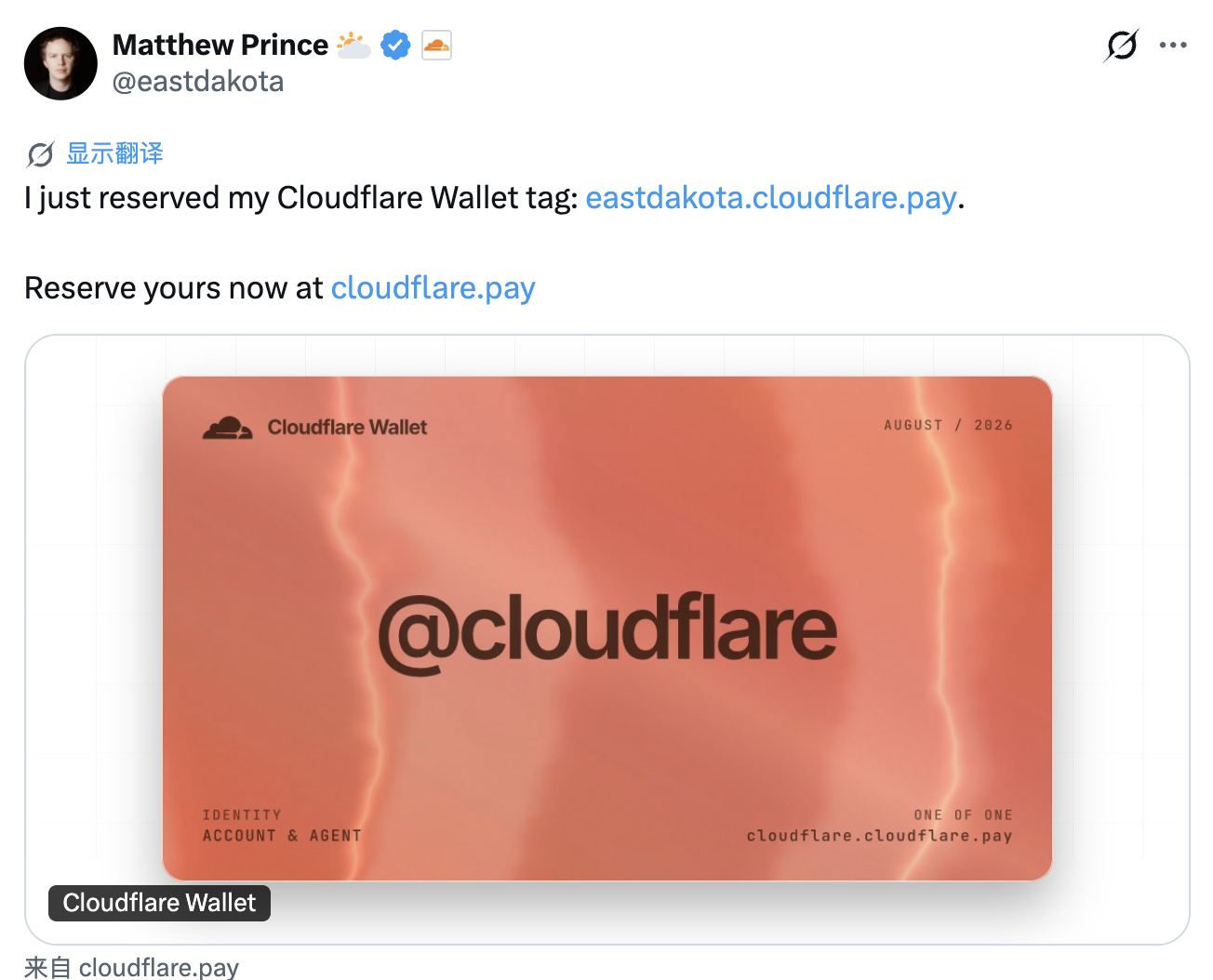
In addition to Cloudflare CEO Matthew Prince publicly sharing his Handle, many users also showcased their registration results on social media. Names related to celebrities, popular brands, and leading AI companies were quickly registered, reminiscent of the buzz around Web3 domain speculation years ago. Some users even set up query websites to help others find unregistered popular Handles.
Years ago, Web3 also sparked a gold rush for on-chain domain registrations, where users rushed to register domains, with many popular names being speculated on for high prices. Now, a similar struggle for identity is replaying in the AI era.
For participants, some wish to lock in identities to prepare for future AI Agent payment scenarios; others adopt an investment mindset, viewing Handles as potentially valuable digital assets.
This rush for Handles not only heightened market attention towards Cloudflare Wallets but also introduced concepts like wallets, stablecoin payments, and on-chain identities—previously mainly existent within the crypto sphere—to a broader audience of regular internet users for the first time.
More importantly, Cloudflare's industry influence provides a more accessible and credible entry point for these crypto-native concepts to enter the mainstream market.
As a global leader in internet infrastructure services, Cloudflare is one of the most widely used CDN (Content Delivery Network) service providers globally. In the past, Cloudflare experienced service outages that rendered many well-known websites and services inaccessible, causing a significant portion of the internet to come to a halt, thereby reflecting its critical position in the market. At the same time, Cloudflare has long accumulated market trust by providing a significant amount of free infrastructure services to developers and ordinary users, making global acceleration and security capabilities that were once only affordable for large enterprises more widespread, earning it the title of "Cyber Lama".
Compared to a crypto-native company, Cloudflare—being a Web2 giant with a vast user base and influential infrastructure—might be more effective in promoting crypto concepts to the public and advancing crypto infrastructure into mainstream internet.
The Wallet is Just the Beginning, Aiming to Build the "Headless Marketplace" in the AI Era
What Cloudflare truly aims to build is not just a wallet, but a "Headless Marketplace" for the AI era.
A so-called headless marketplace refers to a future where transactions no longer rely on traditional web interfaces, manual clicks, and complex registration processes, but are completed autonomously by AI Agents through service discovery, demand matching, price comparison, payment settlement, and resource acquisition.
In this model, AI Agents are no longer just tools executing human commands; they may become proactive participants in the internet. They can search for services based on task requirements, invoke tools, and complete transactions within the scope of the authorization they receive.
This is also the core vision of Cloudflare's commercial ecosystem called Agentic Internet—making payment and transactions a native capability of the internet, rather than relying on manual operations as an additional step.
Previously, Cloudflare has continuously laid out around AI infrastructure, launching products such as Workers AI, Agents SDK, AI Crawl Control, Monetization Gateway, covering various stages like AI inference, Agent development and operation, content access management, and resource monetization. The release of Wallets fills in the crucial payment component needed to construct a headless marketplace.
In the future, AI Agents may no longer just serve as tools executing commands but could also possess identities, budgets, and transactional capabilities like real users, becoming new participants in the internet economy. However, as Cloudflare mentioned, the internet will not shift overnight to an Agent economy, but the layout surrounding identity, payment, and infrastructure may very well be the first step toward realizing a commercial ecosystem for Agents.
免责声明:本文章仅代表作者个人观点,不代表本平台的立场和观点。本文章仅供信息分享,不构成对任何人的任何投资建议。用户与作者之间的任何争议,与本平台无关。如网页中刊载的文章或图片涉及侵权,请提供相关的权利证明和身份证明发送邮件到support@aicoin.com,本平台相关工作人员将会进行核查。


