Key Takeaways
- The National Sheriffs’ Association sent Thune and Schumer a fresh CLARITY Act warning.
- Blockchain Association’s Lindsay Fraser believes the NSA’s position comes from a place of “fundamental misunderstanding.”
- The dispute centers on Section 604, which shields non-custodial software developers.
The National Sheriffs’ Association sent a letter to Senate Majority Leader John Thune and Democratic Leader Chuck Schumer warning that the CLARITY Act, as currently written, would create broad exemptions from registration, know-your-customer, anti-money-laundering, and sanctions-law requirements for certain decentralized-finance participants, potentially allowing illicit actors to exploit platforms and services designed to obscure digital-asset transactions.
It is not the association’s first warning on the subject, as the NSA first raised the same objection in a May 13 letter to the Senate Banking Committee, then joined a four-organization coalition letter in late June that repeated the warning almost verbatim, meaning the August letter is less a new alarm than a third reiteration of the same core complaint as the Senate’s recess deadline closes in.
The sheriffs’ group is not acting alone, joining the National District Attorneys Association, the National Association of Assistant United States Attorneys, and the International Association of Chiefs of Police in warning that the bill’s treatment of DeFi could open gaps traffickers, sanctions evaders, and money launderers would exploit, a coalition whose joint letter dates to late June and whose core argument has been echoed in each NSA letter since.
The specific target of the coalition’s objection is Section 604 of the bill, a provision commonly referred to as the Blockchain Regulatory Certainty Act, which carves out protections for developers who build non-custodial software, wallets, and protocols without ever taking control of user funds.
Law enforcement groups argue that carve-out is written broadly enough to let genuinely custodial or laundering-facilitating operations claim the same shield, weakening Know-Your-Customer and Anti-Money-Laundering standards relative to what traditional financial institutions must follow.
The Blockchain Association has not let the argument go unanswered, sending out a message of clear pushback.
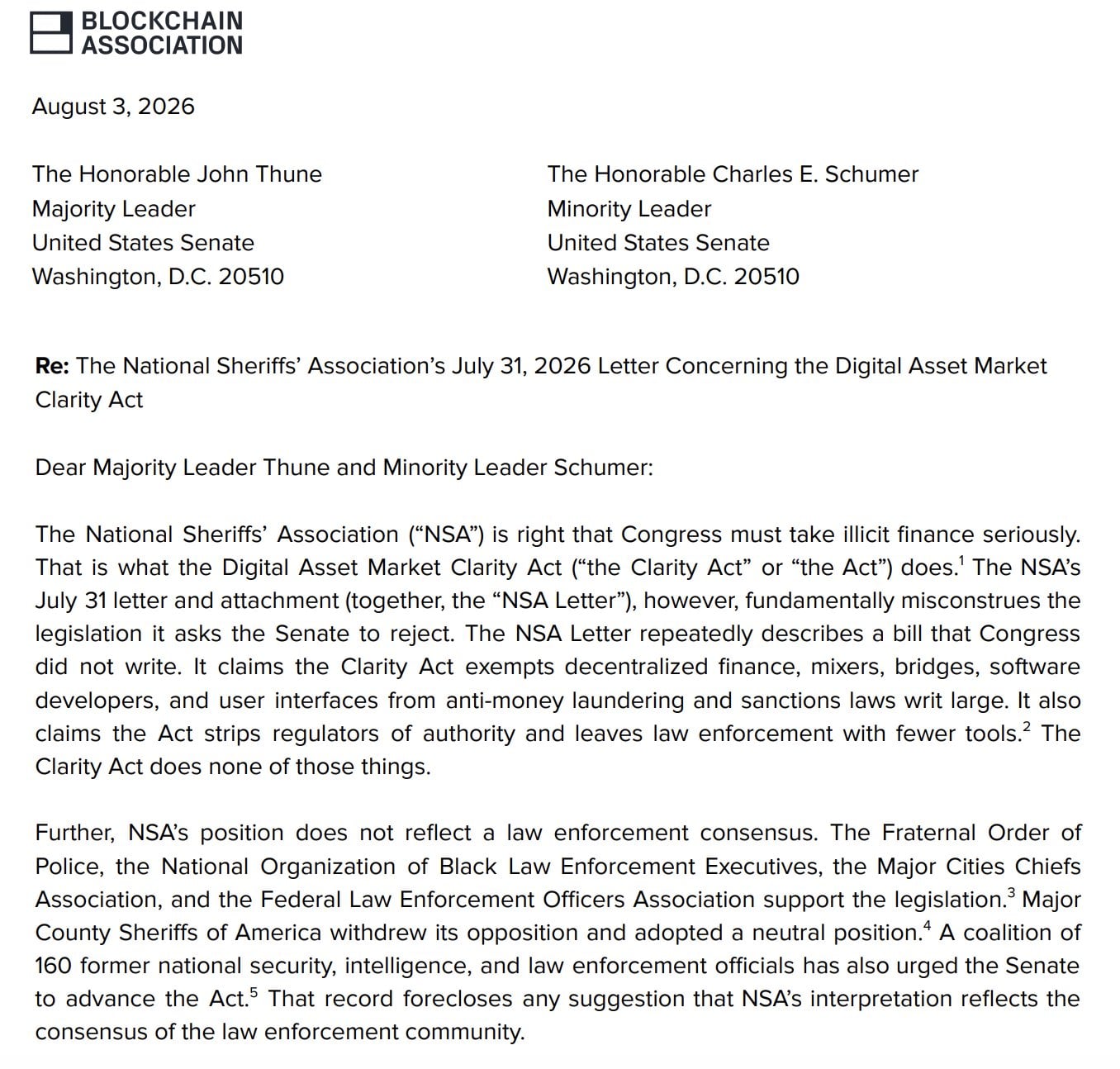
Moreover, when the four-organization coalition first raised the same complaint in June, Lindsay Fraser, the trade group’s chief policy officer, dismissed the reading of Section 604 as a “fundamental misunderstanding” of what the provision actually does, saying:
Section 604 does one narrow thing: it prevents non-custodial software developers from being misclassified as money transmitters when they do not custody assets or control transactions.
She went further in rejecting the idea that the provision creates a loophole for bad actors, stating plainly that it “does not immunize criminals,” “does not limit sanctions enforcement,” and “does not stop prosecutions for money laundering, fraud, or terrorist financing.”
The standoff illustrates why the CLARITY Act’s law enforcement question has become its own subplot inside the broader Senate fight. Unlike the ethics dispute over Trump’s crypto business ties or the stablecoin oversight questions that have separately slowed negotiations, the Section 604 fight pits working law enforcement organizations directly against the industry group lobbying hardest for passage, with both sides claiming to represent public safety.
The law enforcement community itself is far from unified on the provision. The National Organization of Black Law Enforcement Executives formally endorsed the bill on July 1, becoming the first major law enforcement group to back it outright, arguing it preserves longstanding criminal enforcement authorities while adding meaningful new capabilities.
Two days later, on July 3, Major County Sheriffs of America, a separate organization from the National Sheriffs’ Association representing sheriffs’ offices serving 130 million people, shifted from active opposition to neutral on Section 604 specifically, telling the Senate Banking Committee that continued talks had provided additional clarity on how the provision would actually be implemented.
With Thune saying the Senate still expects to hold a floor vote before the August recess and roughly four legislative days left on the clock, this fight over developer liability has become one of the more granular and more consequential.
免责声明:本文章仅代表作者个人观点,不代表本平台的立场和观点。本文章仅供信息分享,不构成对任何人的任何投资建议。用户与作者之间的任何争议,与本平台无关。如网页中刊载的文章或图片涉及侵权,请提供相关的权利证明和身份证明发送邮件到support@aicoin.com,本平台相关工作人员将会进行核查。


