
Author: Dan Koe
Translation: FFIVE, Mooc
“If you need to deliberately remember it, then it is not important; if it is truly important, it will naturally arise when you need it.”
This sentence sounds like some kind of metaphysical chicken soup, yet it is the central proposition put forth by Dan Koe in his article “How to Remember Everything You Read.” Our generation has fallen into a strange anxiety: having saved thousands of articles, installed five or six note-taking apps, and built what seems to be a perfect "second brain," we end up unable to retrieve anything when needed, feeling like we are increasingly “forgetting things.”
The problem has never been about memory; it lies in our fundamentally flawed understanding of “learning.” Below, I will follow Dan Koe's framework and combine cybernetics, output-driven learning, and the current practical applications of AI tools (Obsidian + Claude, Eden, etc.) to reorganize a system that can truly help you “remember” and “apply” what you have learned. The article is lengthy, but each section corresponds to a real pitfall you have encountered in knowledge management.
1. Why “remembering everything” is a false proposition
Let’s dismantle a deeply ingrained concept: Learning ≠ stuffing information into the brain.
Schools have trained us for over a decade with recitation and exams, leading us to mistakenly believe that “being able to repeat word-for-word” is a sign of having learned. However, the real world does not score based on answer sheets — your boss will not promote you just because you can recite a passage from The Economist, and clients won’t sign contracts because you remember a few steps from a marketing book.
Dan Koe's observation is sharp: Most people cannot remember what they have read not because they did not read diligently, but because they treat “remembering” as the endpoint of reading. You desperately want to remember every sentence, fundamentally wanting to appear smart — “Look, I can casually drop knowledge points.” This vanity-driven learning has been off track from the start.
Things that are truly important never need to be memorized rigidly. They will naturally settle into your cognitive structure through repeated use, reflection, and discussion with others. Forgetting most content is a normal mechanism of the brain, not your failure. What you should care about is not “how to remember,” but “which things are worth remembering and what mechanism will allow them to arise when needed.”
2. Viewing learning as a ship: a four-step closed loop from a cybernetics perspective
Dan Koe borrowed from cybernetics — a term derived from ancient Greek meaning “helmsman” — to redefine learning as a feedback regulation system, rather than a one-way input pipeline.
An intelligent learning system operates with the same logic as the thermostat in your home or the pancreas secreting insulin, and involves four steps:
| Step | Cybernetics Term | Corresponding Learning Scenario | Consequences of Omission |
|---|---|---|---|
| 1 | Goal | Your clear understanding of the “state you want to reach” | No direction, all information seems related yet unrelated |
| 2 | Sense | Honest assessment of “where I am now” | Self-deception, believing that saving equals learning |
| 3 | Compare | Understanding “how far the goal is from the current state” | If you cannot detect deviations, you will lack motivation to learn |
| 4 | Act | Taking specific actions to narrow the gap | Staying in wishful thinking, always “preparing to start learning” |
Most people cannot continue learning not because of a lack of willpower, but because they only possess step 2 (blind input), without step 1 (clear goals) to generate “deviation signals.” Without deviation, the brain does not know which information is worth retaining and which can be discarded, leading to an overwhelming influx of information only to be forgotten later.
For an intuitive example: saying “I want to be healthy” as a goal is too vague to trigger any corrective measures—if you drink too much tonight and stay up until three a.m., you won’t feel like you have deviated from anything. But if you set a goal of “completing a half marathon in three months,” then every night you don’t go for a run will produce a clear “deviation signal,” forcing you to adjust. Learning works in the same way.
3. The most effective learning starts with “output,” not input
Having understood the cybernetics framework, here comes the most counterintuitive yet useful principle: Don’t learn first, start working first.
Naval has talked about the concept of “Specific Knowledge”—knowledge that aligns with your nature, provides a competitive advantage, and cannot be replaced. This type of knowledge cannot be acquired through “systematic remedial education,” but can only be obtained through the process of doing things and “pulling it as needed.”
Dan Koe provides a three-stage approach:
- First, have a meaningful goal that belongs to you (not the default paths of “certification/academic advancement/raise” imposed by society). The more specific the goal, the stronger the neural plasticity.
- Directly start a project, instead of first “preparing a lesson.” Want to learn After Effects? Don’t binge on the entire tutorial from start to finish, first set a specific project — for example, “make a 30-second promotional video for a friend's café,” then only learn the skills that will drive this project forward.
- Fill in the gaps as needed. If you get stuck on keyframes, go check the tutorial for keyframes; if you get stuck on color grading, study the color panel. After a few projects, the skills you acquire are cumulative, and each piece is tied to real scenarios, so you won't forget them.
The same goes for learning the guitar: don’t immerse yourself in music theory books first; pick a song you really want to play, learn the first chord and the second chord, and when you get stuck, also learn how to tune and keep rhythm. Once you can really play a few songs, you will naturally be curious about “can I write a melody myself” — learning happens in the pull of wanting to “create,” not from watching slides.
Schools excel at teaching general knowledge but do not teach you how to navigate for yourself. Self-education is not about hoarding knowledge to create the illusion of “I am making progress,” but about filling in the just enough parts for the goals you set for yourself.
4. Why most “second brains” have turned into digital graves
When it comes to knowledge management, one cannot avoid the concept of “Second Brain.” Tiago Forte’s PARA method and CODE process were originally meant to liberate memory, yet in reality, 90% of people have turned it into a high-level collection folder.
Dan Koe himself has experimented with several generations of tools: from Roam Research changing his writing style to creating Kortex, and later evolving into today’s Eden. His conclusion is: The problem lies not in the tools, but in the usage.
Most people fall into three pitfalls:
- The illusion that collecting equals completion: links saved, highlights made, notes taken, and then never opened again. The act of organizing itself brings cheap dopamine, leading you to believe “I am learning.”
- Over-organization compulsions: tagging each note with five or six labels, spending hours adjusting PARA classifications, yet never producing a short essay, project proposal, or sharing based on those notes. The value of a note lies in the work it helps you accomplish, not the note itself.
- Ignoring the design of “retrieval”: almost all tutorials focus on “how to put in,” but nobody teaches you “how to fish it out when needed.” A system that only receives input and does not output is not a knowledge base; it is a digital grave.
Looking back at those who truly produce work — Marcus Aurelius's "Meditations" were originally private notes; Da Vinci left thousands of pages filled with sketches and questions; Mark Twain, Montaigne, and Rick Rubin all have their own note-taking systems. The biggest difference between them and modern “note enthusiasts” is: collecting ideas is meant to turn them into work. Seneca had a brilliant metaphor: collecting pollen from many flowers then turning it into your own honey. In today's terms, it means digesting external materials to create something that belongs to you.
5. Upgrading the “second brain” to the “second subconscious”
Dan Koe提出了一个更精准的说法:我们要建的不是一个静态仓库,而是一个“第二潜意识(Second Subconscious)”。
潜意识的特质是什么?它不是你主动去翻的时候才工作,而是平时就在后台默默关联、在你盯着一个问题发呆时突然“抛”一个联想上来。好的知识系统也该如此——在你创作时,它能主动把相关的材料推到你面前。
方案 A:Obsidian + Claude Code 的自建派
适合愿意折腾、追求数据完全本地化的人。核心思路是让 Claude 充当你的“知识管理员”,而不是你亲自去维护复杂的分类树。
搭建逻辑大致是这样:
- 装好底座:安装 Obsidian(本地 Markdown 笔记,数据完全自己掌控),并配置好 Claude Code 或 Claude Cowork 环境。
- 设定工作目录:把 Obsidian 的 Vault 文件夹设为 Claude 的工作目录,相当于给 AI 一把“只读+按需改写”的钥匙。
- 写两个 Skill(技能指令):
- “保存想法”Skill:当你扔给 Claude 一段灵感、一篇文章链接、一条推文时,让它在 Vault 的
Inbox文件夹里新建一条笔记,自动补上清晰标题和时间戳。 - “处理收件箱”Skill:让 Claude 定期读取
Inbox,补充标签、移动到合适的分类文件夹(Projects / Areas / Resources / Archives),并给相关笔记加上双向链接[[ ]]。
- “保存想法”Skill:当你扔给 Claude 一段灵感、一篇文章链接、一条推文时,让它在 Vault 的
- 日常调用:写作或做项目时,直接对 Claude 说“在我 Vault 里找出所有和 [当前主题] 有关的内容”,AI 会跨整个知识库检索并带回带引用的材料。
进阶一点的仓库结构可以参考这样分层:
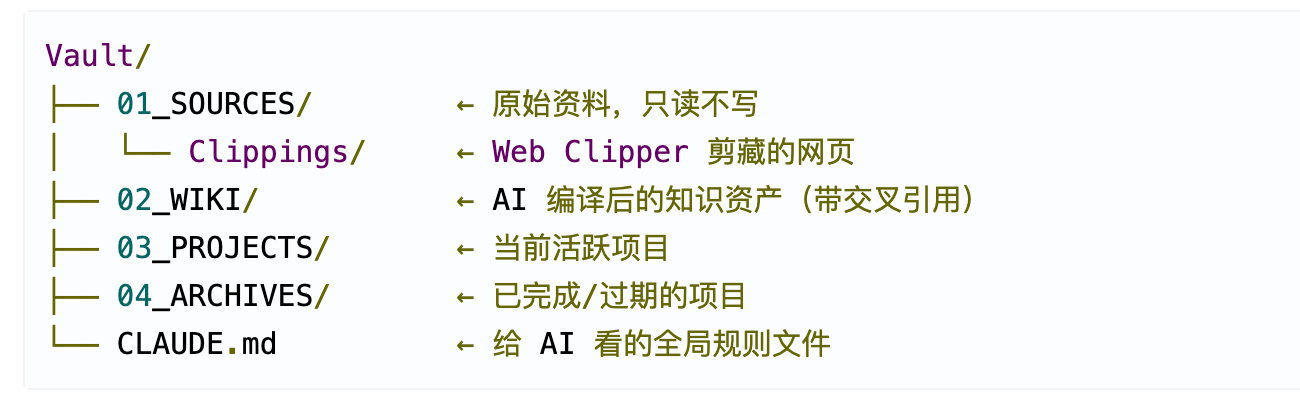
核心原则是源文件只读不写,AI 只动 Wiki 层。CLAUDE.md里写明你的关注领域、仓库结构规则、导入和查询流程——这相当于给 AI 一张地图,让它知道每类信息该往哪归置、引用时用什么格式。
方案 B:Eden 这类“自动分类+语义搜索”工具
如果你不想自己维护向量数据库、embedding API、索引脚本,也不想操心每次增删改后重新嵌入的缓存问题,把底层维护交给工具,自己只管思考和创作,是更划算的选择。
Eden(前身就是 Dan Koe 参与的 Kortex)做的事情和 Obsidian + Claude 类似,但更“无感”:
- 自动采集:Substack 文章、YouTube 视频、X 长文都可以一键存进去,自动转录文本、做高亮。
- 自动嵌入与语义搜索:每条记录被编码成约 1500 个数字的向量,相当于在知识空间里的“GPS 坐标”。哪怕两条笔记没有重合的关键词,只要在语义上接近,系统也能把它们连起来——这是传统关键词搜索做不到的。
- 连接 Readwise:如果你用 Readwise 存书摘,可以同步进 Eden,变成可按语义搜索、可对话、可拖进 Board 做成引用卡片的素材库。
- 异常值内容发现:Eden 会分析创作者表现突出的内容,帮你找值得深入讨论的话题,而不是漫无目的地刷信息流。
MyMind 也是类似思路的代表——你把链接和想法丢进去,它自动分类、打标签、做语义检索,你不必亲自维护流程。
两种方案没有高下之分:
- Obsidian + Claude胜在完全自主、数据不出本地、可高度定制,但需要你写规则、管索引;
- Eden / MyMind胜在零维护、语义关联强、自带创作工作流,但数据和索引在云端(虽然 Eden 承诺不上传私有内容,但架构上你依赖它的服务)。
6. Filtering is more important than collecting: what you should put into the system
No matter what tools you use, one thing must be clear: not everything should be stored.
AI can already produce content in bulk; what has always been scarce is the layer that has been filtered by you and digested by your worldview. Dan Koe's advice is very direct — only collect ideas that you are willing to be shaped by.
The thinkers and creators you continuously follow and revisit will gradually form your lens of worldview. For instance, when Dan Koe thinks about the essence of reality, concepts like history, integration theory, and spiral dynamics naturally emerge because they are his usual frameworks for explaining problems. What you need to accumulate is this kind of “set of ideas” that belongs to you, not just saving today’s trending topics and tomorrow’s new concepts.
Specifically, here’s how to operate:
- Read more from stable, long-term good authors and thinkers, and reduce scrolling through anxiety-inducing information streams. For writers and creators, research may take up 80% of the workload, with the remaining 20% being digesting the researched material into useful expressions for others.
- Turn materials into a part of yourself through writing and public sharing. Just collecting without output leaves those ideas suspended in “others' wisdom”; only through restating them in your own words, reconstructing them based on your experiences, and putting them into real scenarios for feedback can they truly enter your cognitive structure.
- Let projects serve as filters. Knowledge that does not propel your current project cannot be retained, even if learned temporarily. Projects provide you with clear boundaries and milestones, automatically filtering out the noise.
7. The correct role of AI: reducing friction, not speaking for you
Finally, it is essential to clarify the borders of AI in reading and writing — this is currently the most misunderstood area.
Dan Koe’s approach is balanced: do not use AI to express your values and judgments, but you can let it serve as your courses, mentors, and editors.
The balance roughly is:
- Factual content can utilize AI: for example, explaining Greuter’s nine stages of self-development, or outlining the background of a theory; directly letting AI generate or reference existing materials is fine — this is no different than using Google to look something up before writing, and forcing it to rewrite the entire text instead wastes the reader’s time.
- Opinions and organization must be done personally: to make your ideas clear, you must experience some “resistance” — personally refining the structure, organizing arguments, and revising wording leads to a better understanding of what you truly believe. If you hand over this part to AI, what you output won’t reflect your worldview, but rather the statistical average of the model.
- Scenarios to use AI to “remove friction”: ask it for several organizational methods when structure is hard to think of; seek possible directions when unsure how to develop the next section; let it help you quickly delve into research when encountering unfamiliar concepts. The one who ultimately makes judgments and decides what can be published is always you.
The so-called “do not use AI for writing” truly aims to remind you not to let AI express your values. AI does not replace reading; it makes reading even more critical — because answers that can be directly provided by AI are increasingly worthless, the irreplaceable worldview built through deep reading is what others are willing to follow.
8. A practical writing/creation closed loop
If you are ready to start writing (whether for Substack, public accounts, X long-form articles, or YouTube scripts), the process provided by Dan Koe can serve as a starting point:
- Select a “validated + curious” intersecting theme. The term “validated” means this topic has previously garnered real attention — you can save high-engagement social posts or use Eden’s anomaly detection feature to find exceptional content; “curious” refers to questions you want to ponder even without traffic. The overlap of both keeps your desire for expression while being more easily noticed.
- First dump ideas, then build structure. Don’t wait for inspiration while staring at a blank page. Write down as many thoughts related to the theme as possible, flip through your note repository to pull in usable materials, then give them a simple narrative framework (e.g., problem → insight → solution) before fitting the materials into appropriate places.
- Link the first draft. Keep the outline, spontaneous notes, and knowledge base accessible (for instance, let Claude read your Vault, or open Eden’s semantic search), then weave them into a complete article.
- Revise repeatedly until you convey what you truly want to say. If a piece hasn’t captured your values, ideas, and beliefs, keep revising until it does.
9. In conclusion: remember, it is not the endpoint, but a byproduct
Returning to the opening sentence — you do not need to remember everything you have read.
What truly stays with you and helps you make better decisions are never the sentences you force yourself to memorize, but:
- The things you actively learned for a goal that belongs to you;
- The items you repeatedly used in a real project;
- The concepts you digested through writing, sharing, and discussion;
- The materials you placed in your second subconscious, allowing them to spring up naturally when needed.
Tools (Obsidian, Claude, Eden, Readwise…) simply make this process smoother; they cannot build your worldview for you, nor answer “where do I truly want to go.”
First, make the goal specific enough, and start working on a project that belongs to you; then let knowledge find you through the process of doing — whether you remember it or not, it no longer matters, because the important things have already become a part of you.
免责声明:本文章仅代表作者个人观点,不代表本平台的立场和观点。本文章仅供信息分享,不构成对任何人的任何投资建议。用户与作者之间的任何争议,与本平台无关。如网页中刊载的文章或图片涉及侵权,请提供相关的权利证明和身份证明发送邮件到support@aicoin.com,本平台相关工作人员将会进行核查。


