Author: Chloe, ChainCatcher
An unusual order from pre-market trading in the Korean stock market this morning triggered a chain reaction on the blockchain.
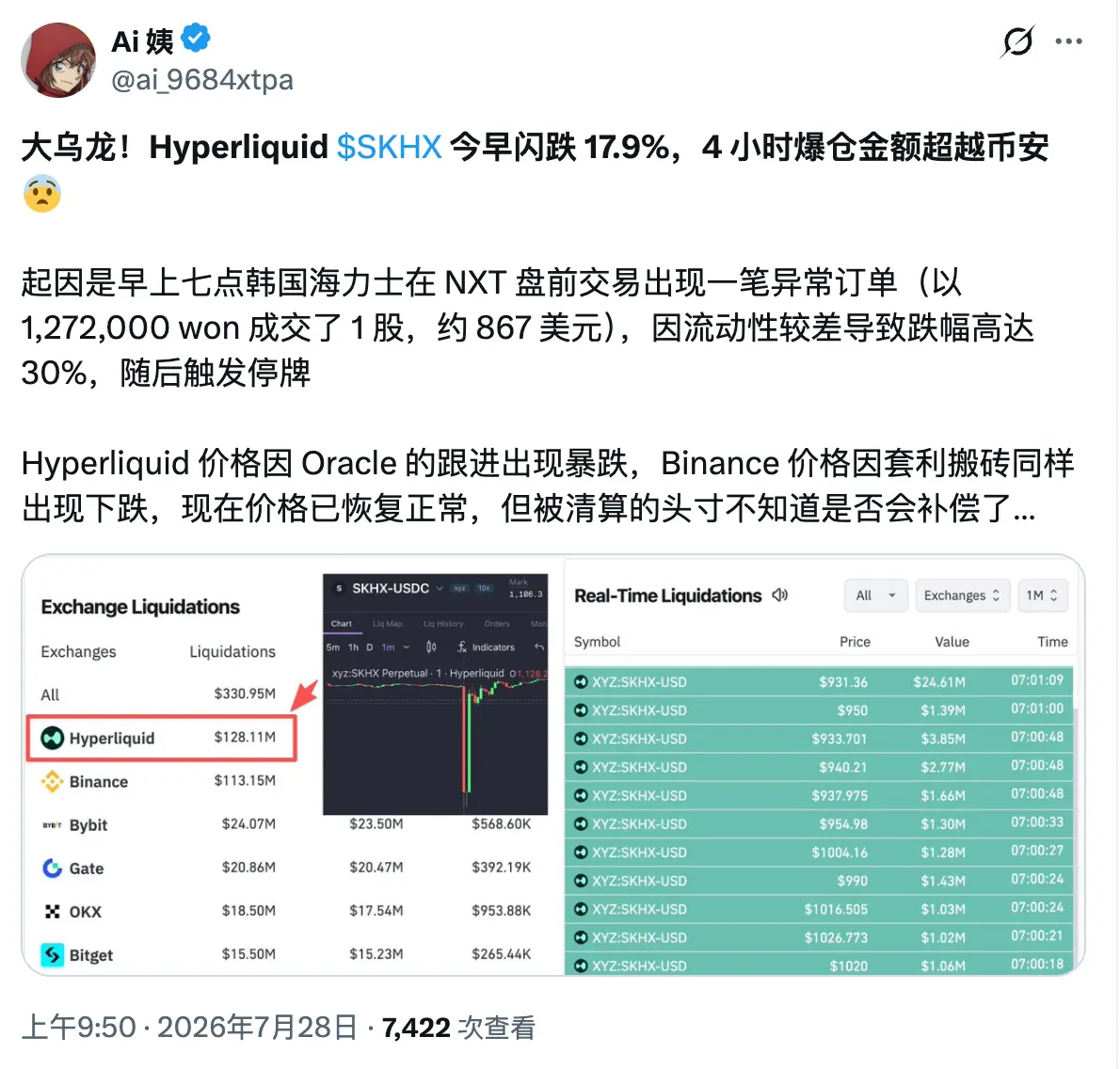
According to on-chain analyst Ai Yi's monitoring, the perpetual contract SKHX tracking SK Hynix on Hyperliquid experienced a sharp drop of 17.9% this morning, resulting in the liquidation amount on Hyperliquid surpassing that of Binance within a short period. The root of this on-chain flash crash lies in an order that executed only one share in the pre-market of Korea's alternative trading system NXT at 8 AM Seoul time.
Transmission Mechanism: Oracle Follow-up, On-chain Long Positions Subjected to Forced Liquidation
According to a report from the Seoul Economic Daily, on July 28th before the market opened, an unusual transaction record appeared on Korea's alternative trading system Nextrade (NXT) during an extremely low liquidity pre-opening period: SK Hynix transacted one share at 1,272,000 Korean won (approximately $867), significantly discounted from the previous trading day's closing price, with a drop of nearly 30%, which immediately triggered the pre-market trading suspension mechanism.
Industry consensus suggests that this may have been a mistaken order by an investor, compounded by insufficient liquidity during the pre-market auction phase. Due to limited order book depth at the time, the abnormal trade of just one share instantly drove the price down to extremely low levels. Even though trading was subsequently suspended, the abnormal quote had already transmitted to the on-chain contract market via the oracle during this brief period of price distortion.
The SKHX perpetual contract on the Hyperliquid platform is a stock-like perpetual contract deployed by Trade.xyz through the HIP-3 framework, settled in USDC, supporting up to ten times leverage, and tracking the price of SK Hynix's common stock (000660.KS) listed in Seoul, converted to USD, instead of the Nasdaq ADR quotation.
It can be said that the contract's pricing relies entirely on real-time stock price data returned by external oracles. As soon as this unusually low transaction price occurred in NXT's pre-market, the oracle promptly adjusted the mark price downwards, directly triggering the forced liquidation process for on-chain long positions.
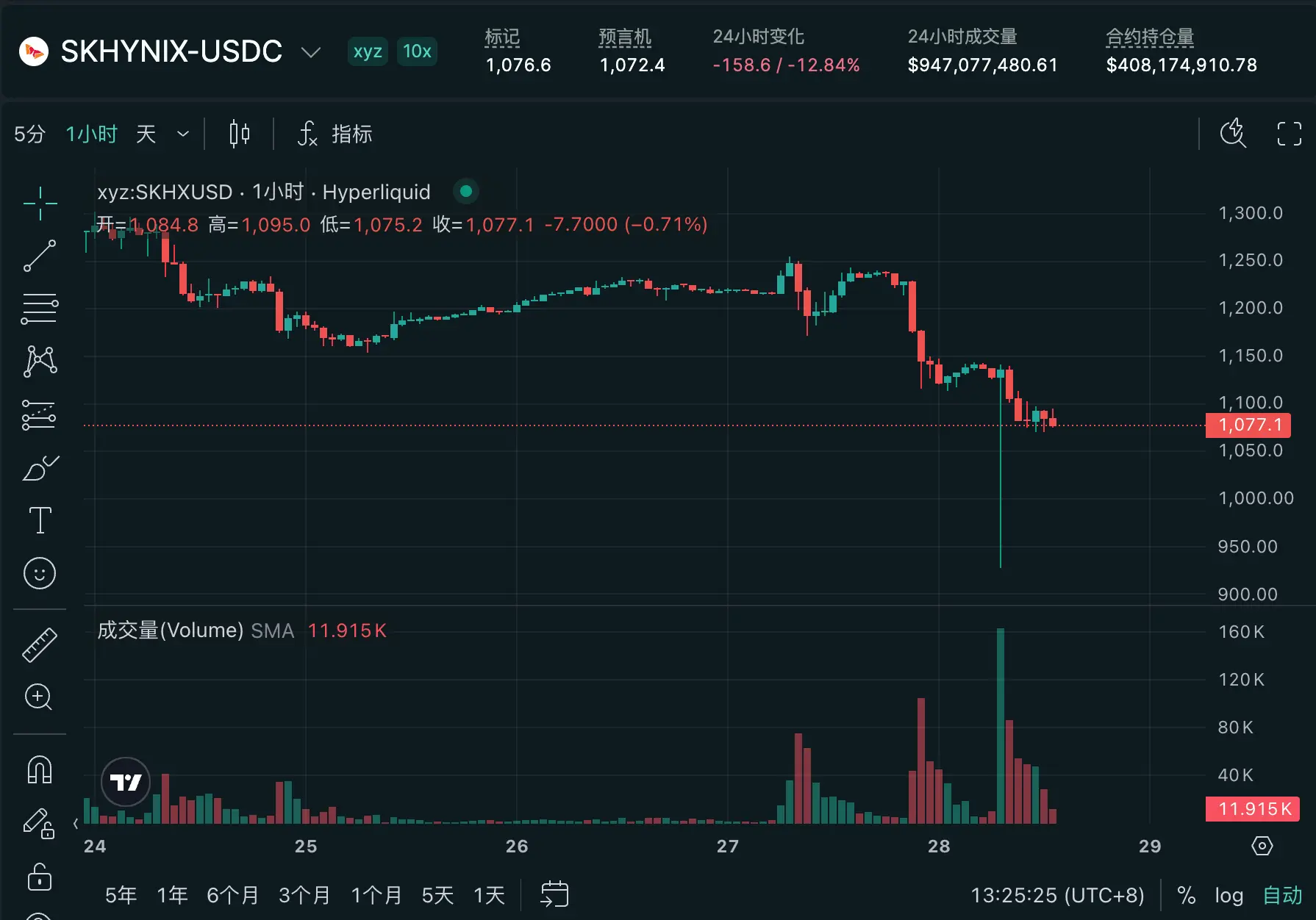
From the K-line chart, it is clear that this morning, SKHX had a long lower shadow, dipping to about $927 at its lowest, before quickly bouncing back to around $1,080 within a few minutes, during which some high-leverage positions were already forcibly liquidated.
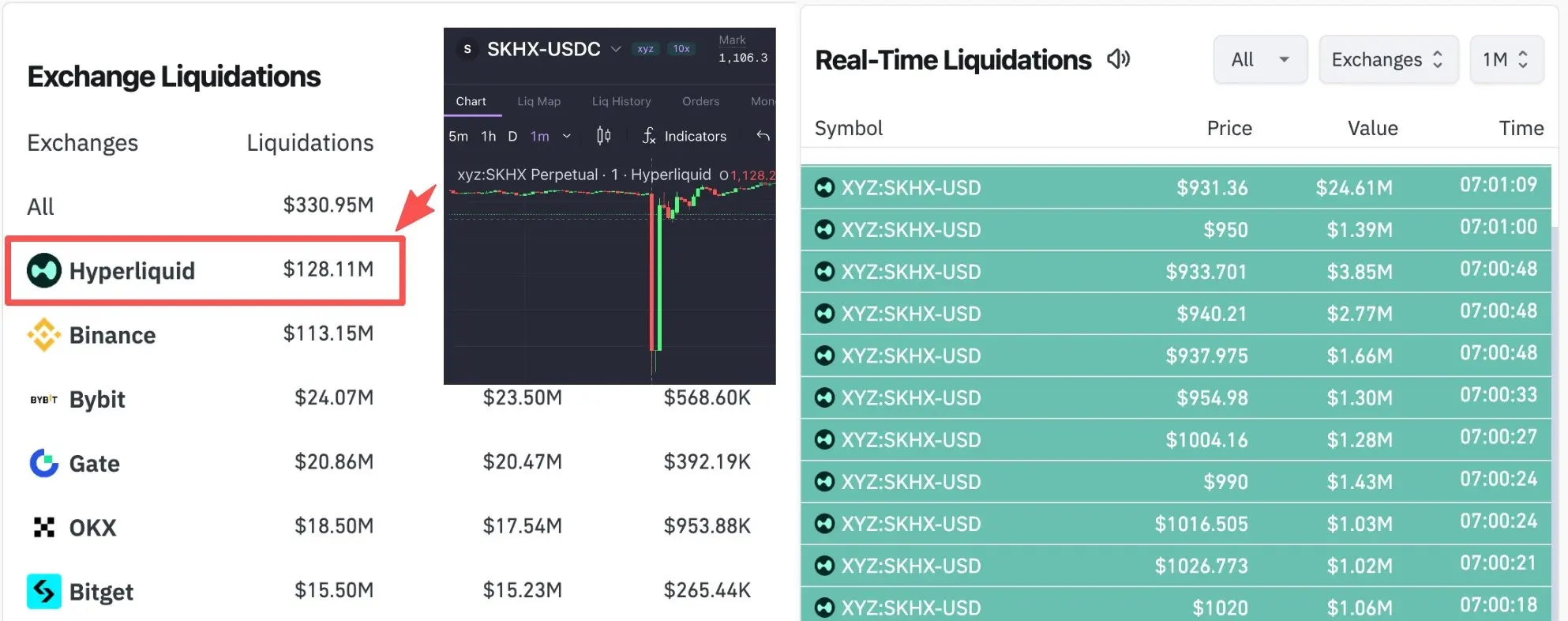
According to derivative market monitoring data, within four hours of the incident, the overall liquidation amount across the Hyperliquid platform was approximately $128.11 million, exceeding Binance's $113.15 million during the same period, ranking first among the exchanges included in that data platform's statistics; the total liquidation amount across exchanges was about $330.95 million. However, this data reflects the overall exchange-level liquidations and cannot all be attributed to the liquidation caused by the SKHX single contract.
Real-time liquidation details indicate that between 7:00 and 7:01, multiple forced liquidations at the million-dollar level occurred for XYZ:SKHX-USD within less than a minute, with a single nominal value ranging from approximately $1.02 million to $24.61 million.
Additionally, the price of the SKHX contracts on Binance also fell temporarily. On-chain analysis suggests that the sudden widening of the price gap between Hyperliquid and Binance triggered cross-platform arbitrage: traders likely bought at the lower price on Hyperliquid while selling or shorting on Binance, causing the downward trend to transmit to Binance, after which the prices on both platforms returned to normal ranges.
Sharp Drop Below IPO Price, SK Hynix ADR Plummets
The root of today's on-chain storm stems from the downward trend in SK Hynix's stock price in recent weeks, coupled with a significant crash in the Korean stock market today.
SK Hynix completed its pricing on July 9, listing its ADR at $149 on the US stock market, raising approximately $26.5 billion, setting a historical record for foreign companies going public in the US, surpassing Alibaba's fundraising in 2014. The stock opened at $170 on the first day, closing at $168, a rise of nearly 13%, and the market capitalization briefly exceeded $1.2 trillion.
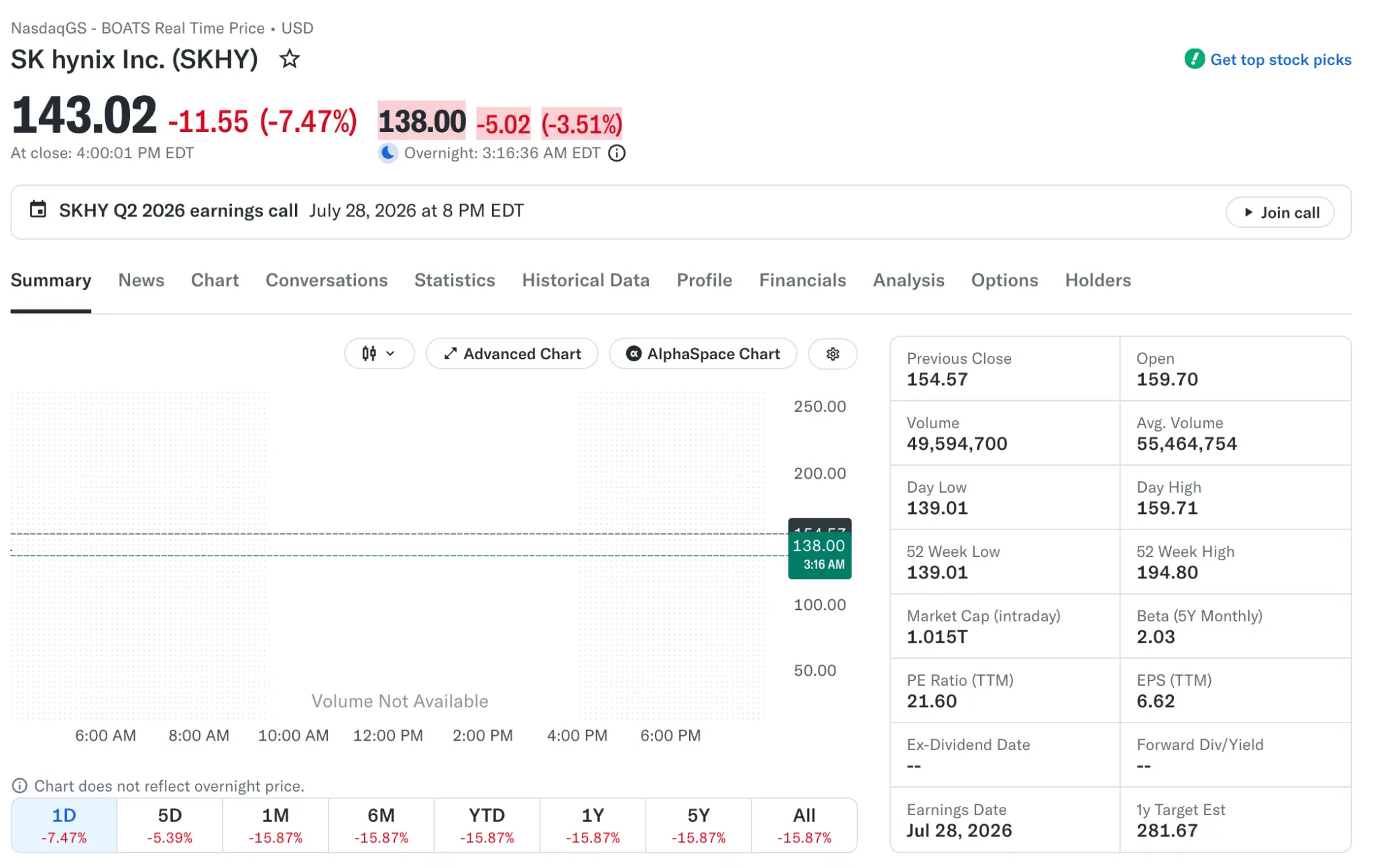
However, it took only 17 days for it to fall below the issue price. On July 27, SK Hynix's ADR fell to a low of $139.01 during intraday trading, closing at $143.02, officially breaching the $149 issue price, making it one of the first large IPOs this year to break below its issue price.
Furthermore, the company is expected to release its second-quarter financial report on July 29, which is projected to set a record for the strongest single-quarter profit ever. According to consensus estimates from Korean brokerages, operating profit is expected to reach 64.1 trillion Korean won, with an operating margin as high as 77%, and quarterly profits may even surpass the historical record for the entire year of 2025. However, despite the impressive financial report, the market remains skeptical.
Andy Wong, head of multi-asset at Pictet Asset Management, bluntly stated that the core debate in the market is: "Has the memory sector taken too much profit away from the AI industry?" He revealed that his fund has been reducing its holdings in SK Hynix in recent weeks, and what the market wants to know is whether any factors can reverse the ongoing impression of SK Hynix extracting excessive profits from the supply chain.
Today (July 28), the situation in the Korean stock market became even more severe after opening. The KOSPI index quickly triggered a program trading suspension mechanism (Sidecar) following the opening, pausing program trading sell orders for five minutes; subsequently, the decline expanded to 8%, officially triggering a circuit breaker, resulting in a comprehensive trading suspension for 20 minutes. SK Hynix fell by more than 11% at one point, and Samsung Electronics' decline also exceeded 9%. This marks the 22nd time this year that KOSPI has triggered the sell-side program trading suspension (Sidecar), and counting both buy and sell sides, it is the 42nd time this year.
Two macro factors triggered this sharp decline. First, overnight US stock chip sectors experienced a comprehensive drop, with the Philadelphia Semiconductor Index plummeting over 2%, Nvidia dropping nearly 5%, surrendering the title of the world's largest market cap to Apple, as market doubts surrounding Nvidia's "cycle financing model" reignited. Second, the competitive threat from China has sharply increased.
On July 27, China's DRAM manufacturer Changxin Technology (CXMT) saw its share price soar over 465% on its first day on the Sci-Tech Innovation Board, topping A-share market capitalization; at the same time, there were reports that Chinese companies have started mass production of DUV lithography equipment with government support, significantly escalating concerns about the global memory competition landscape, leading to accelerated capital withdrawal from the Korean semiconductor sector.
Macroeconomic Turbulence, On-chain Stocks Bear Additional Risks
In this context, the multiple risks inherent in on-chain perpetual contracts are further highlighted. First, the volatility risk of the underlying asset itself: SK Hynix, whether in Seoul or Nasdaq, is undergoing a phase of significant fluctuation, coexisting with the surge in AI chip demand and the competitive threats from China, with valuation being recalibrated almost weekly.
Secondly, there is the cross-market price differential risk. SKHX tracks the common stock price in Seoul rather than the Nasdaq ADR. Currently, the conversion price difference between the two markets exceeds twenty percentage points, with today's decline in Seoul continuing while the ADR has not yet opened, further amplifying the volatility of on-chain contracts due to time zone discrepancies.
Finally, there is the clearing risk associated with oracle switching; the pricing of these contracts relies entirely on external data sources. If an anomaly occurs in the data source, whether due to erroneous trades or potential subsequent oracle mechanism switching, the instantaneous shift in mark prices could trigger forced liquidations before traders can react.
On-chain stocks provide users without overseas brokerage accounts a 24-hour, continuous trading tool, but the trade-off is the need to bear several overlaying risks simultaneously.
免责声明:本文章仅代表作者个人观点,不代表本平台的立场和观点。本文章仅供信息分享,不构成对任何人的任何投资建议。用户与作者之间的任何争议,与本平台无关。如网页中刊载的文章或图片涉及侵权,请提供相关的权利证明和身份证明发送邮件到support@aicoin.com,本平台相关工作人员将会进行核查。


