368 active digital banks, two-thirds of which do not have formal banking licenses.
Written by: Francesco Andreoli, Head of Developer Relations at Consensys
Translated by: Chopper, Foresight News
Everyone is focused on rounds of financing, yet no one notices the deaths occurring. Thus, I recorded both.
Half a year ago, I began tracking digital banks (Neobanks). I realized that no one could clearly say how many are still operating. Even analysts selling reports for $4,000, venture capitalists funding such projects, and competing founders could not provide an accurate answer.
As of July 2026, there are 368 verified digital banks that are still operating normally. I continuously track each institution based on public data from neobankbeat.
However, the number that truly reshaped my understanding of this industry is not 368. It is the names I had to remove during the compilation of the list.
368 Active Digital Banks
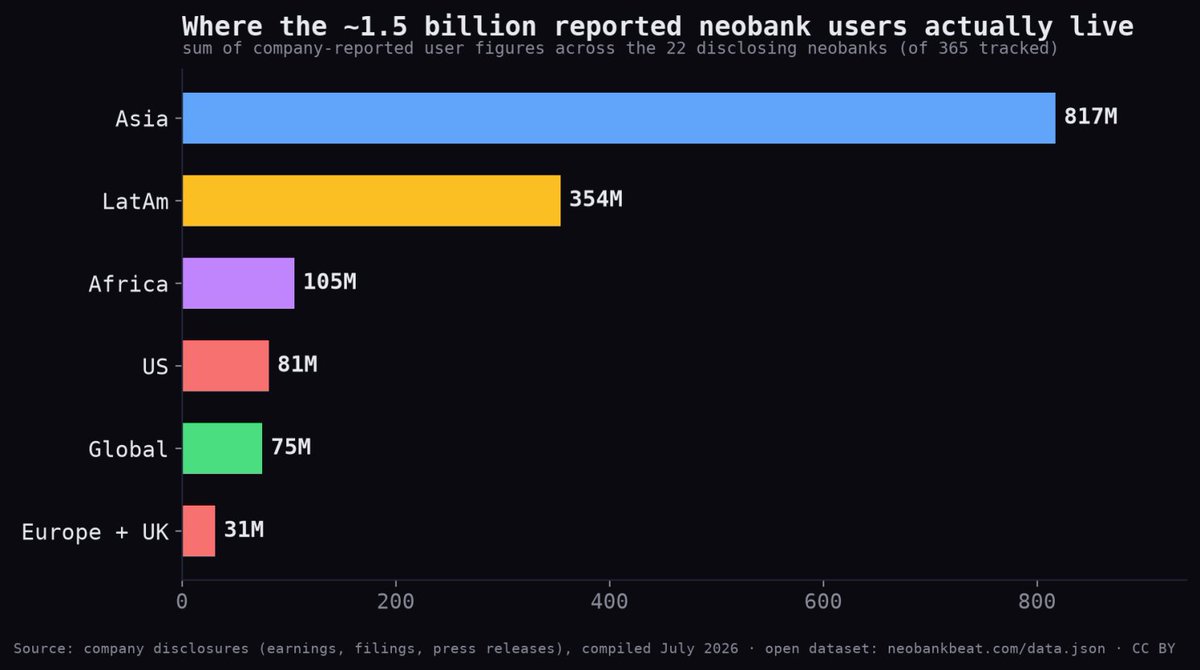
First, the undeniable rise of the industry. Summing up the self-disclosed data from various companies in the database, the digital banks we track serve approximately 1.46 billion users. This is not predictive data or target market extrapolation, but rather the actual customer sizes reported by various institutions.
The geographical distribution of users would subvert the preconceived notions of readers from Western fintech media: 817 million users are located in Asia. The user base of WeBank alone exceeds 400 million, surpassing the total number of users of all digital banks in the U.S. and Europe combined. Nubank has 131 million more customers than all digital banks in the U.S. combined. European benchmark company Revolut has over 50 million users, which is certainly impressive, but pales in comparison to the Asian market.
The focus of industry innovation has also shifted. Among digital banks established after 2020 that are still alive today, 30% belong to native Web3 self-hosted applications, which do not hold user funds. In contrast, this proportion was only 4% for similar institutions established in the 2010s. No matter how you view cryptocurrency, builders have made their choice through action.
Thus, the rise of digital banks is real. The 368 institutions can be divided into three distinctly different waves of development: 254 traditional challenger banks, 58 fiat and crypto hybrid platforms, and 56 native Web3 platforms; supported by 106 infrastructure service providers and backed by 219 investment institutions. The complete ecological context is clearly visible.
Next is the truth that will not appear in any financing pitch deck.
Out of the 368 institutions, only 127 hold full banking licenses.
Yes, among the platforms labeled as "banks" in app stores, two-thirds do not possess banking qualifications. They rely on partnering licensed banks, electronic money licenses, or lesser-known issuing institutions for operational permissions. The vast majority of customers cannot even distinguish the boundaries.
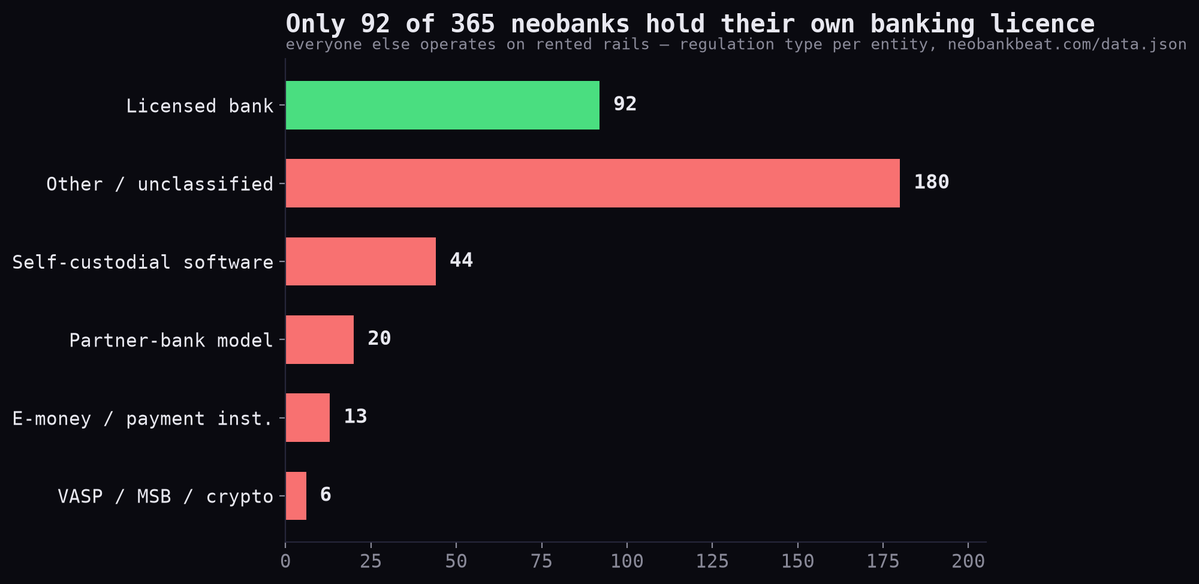
This is by no means an insignificant technical detail; it is a core structural risk of the entire industry, and it has already led to several incidents:
- 2018 WaveCrest: Visa terminated its partnership, leading to the shutdown of dozens of cryptocurrency card projects overnight;
- 2020 Wirecard: A €1.9 billion funding gap caused numerous European digital banking services reliant on it to freeze;
- 2024 Synapse: A bank-as-a-service (BaaS) provider went bankrupt, and ordinary users in the U.S. realized that the so-called "FDIC insurance" is not what they imagined because the underlying system recording fund ownership had problems;
- 2026 Ready: History repeats itself, only with a new batch of players.
When a formal bank goes bankrupt, deposit insurance will pay out to depositors. Once the infrastructure on which digital banks rely collapses, customers can only wait in line for bankruptcy liquidation.
The demise of this industry is always quiet, and that is precisely what deserves vigilance.
At the beginning of compiling this database, I did not expect: the removal operation on the list has never stopped.
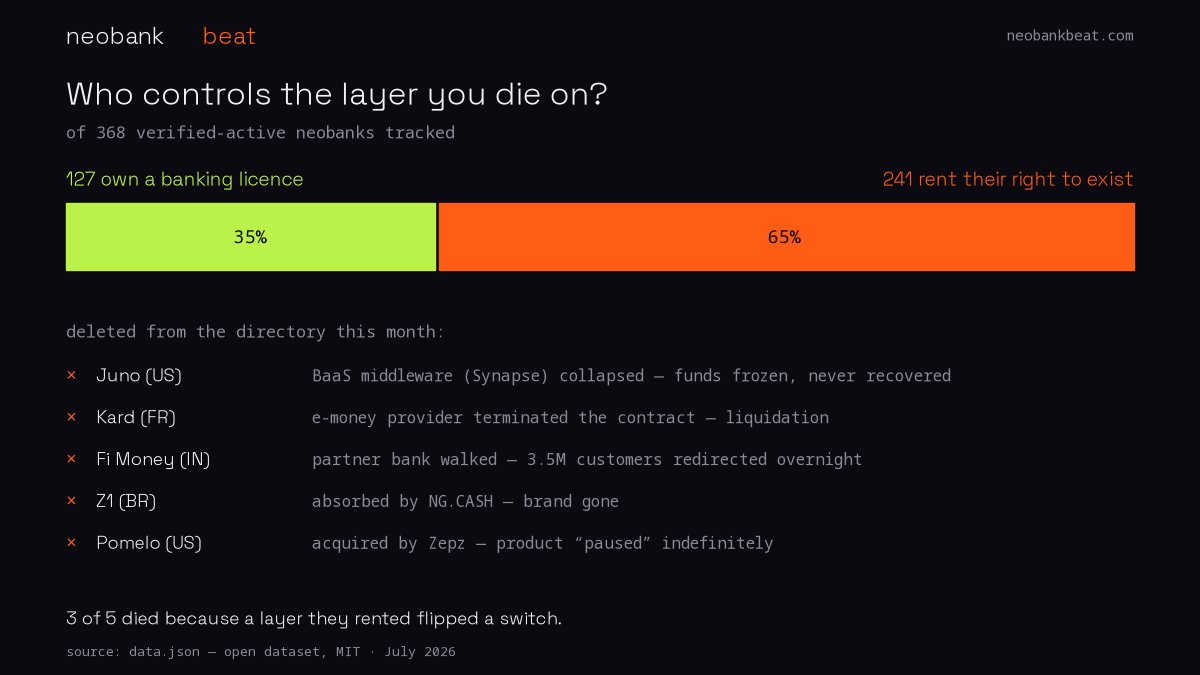
Just this month, five institutions were removed from the list: liquidated, acquired, or quietly transformed. There were no press releases, no retrospectives. Digital banks do not collapse dramatically like FTX. The app simply stops updating, customer service no longer responds; one day, the official website domain redirects to a partner's webpage, and hundreds of thousands of customers either migrate their funds or lose them altogether.
No media have written obituaries for the digital banks that have vanished. Fintech media are keen to report new projects launching and financing news, with advertising revenue and industry resources concentrated on this. Failed companies always remain hidden from view. Thus, a new generation of founders continues to fall into the same traps, believing they are the first to discover the problems.
This is precisely why we place equal importance on the birth of new institutions and the exit of institutions. Data from failure cases is far more valuable than financing news. Press releases do not teach lessons.
"Can artificial intelligence solve profitability issues"? Is it really so?
Almost all digital banks' financing PPTs now mention artificial intelligence. We verified each of the 368 platforms, cross-referencing regulatory disclosures, filing documents, and actual deployed products, rather than merely referencing marketing materials.
Only 67 platforms have achieved large-scale deployment, accounting for 18%. The remaining 300 or so are either still in the pilot phase, merely "exploring research and development," or directly claim ownership of technology by borrowing models from partners.
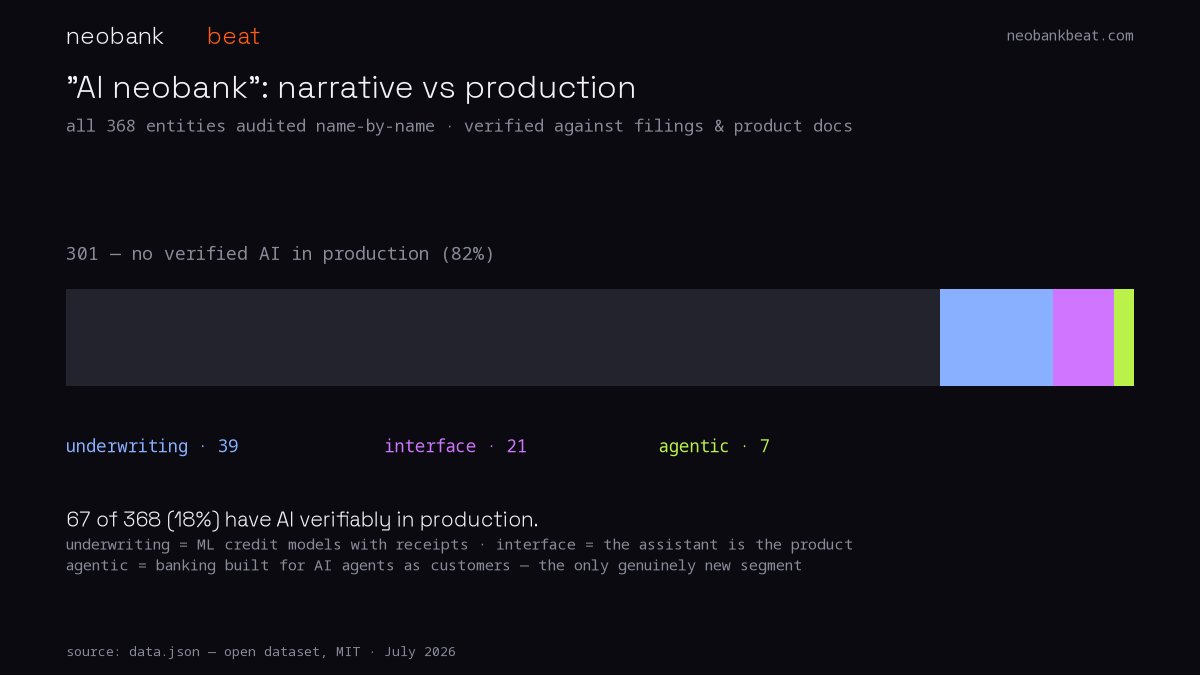
Who are the real players successfully implementing AI digital banking? The answer is unexpected. The early AI application leaders in the industry are mostly not well-known large companies, but credit institutions from emerging markets such as Nigeria, the Philippines, Mexico, and Bangladesh. These regions have incomplete credit systems and rely on models to provide credit to populations lacking credit history, which is not just a product highlight, but a foundation for business survival. While Western markets discuss AI banks, the Global South markets have already achieved large-scale deployment, with survival needs driving innovation.
The Truth Revealed by the Ecological Landscape
Looking at the ecological infrastructure, 106 service providers support 368 consumer-facing brands. In this layer of the system, a few partner banks, BaaS platforms, and card processing service providers simultaneously bear dozens of upper-layer brands. The highly concentrated nature, which consumers are hardly aware of, is a source of hidden risks for the next Synapse-style crisis.
This is the real face of the industry in 2026. The industry is experiencing transformational growth, with 1.5 billion people using banking services through their phones, many of whom are accessing financial services for the first time; however, the entire system is built on an underlying service provider landscape that the public knows almost nothing about. Two-thirds of the platforms will struggle to survive if upstream partners encounter a crisis.
Finally, I offer three predictions while accepting that they may be proven wrong:
- The licensing gap will close from both ends. Strong unlicensed platforms will acquire or apply for banking licenses; weak platforms will gradually exit the market by 2027, and players in the middle ground will disappear.
- The first AI credit model failure will occur in the next credit cycle. Of the 67 large-scale deployed models, the vast majority have yet to experience complete economic downturn pressures. Some teams are about to encounter risk scenarios not covered in their AI training data.
- The next generation of financial service clients will no longer be natural persons. Financial underlying channels aimed at AI smart agents, smart agents independently managing wallets, autonomously issuing cards, machine-to-machine payments—currently, only 7 companies are laying out such frameworks. The current landscape resembles the Web3 track of 2021: there are few participants, the model is niche, but it possesses long-term structural opportunities.
免责声明:本文章仅代表作者个人观点,不代表本平台的立场和观点。本文章仅供信息分享,不构成对任何人的任何投资建议。用户与作者之间的任何争议,与本平台无关。如网页中刊载的文章或图片涉及侵权,请提供相关的权利证明和身份证明发送邮件到support@aicoin.com,本平台相关工作人员将会进行核查。


