Cryptocurrency companies are no longer attempting to replace Wall Street but are instead charging Wall Street institutions for technical service fees.
Written by: Prathik Desai
Translation by: Luffy, Foresight News
Last year, the scale of securities trading settlements handled by an institution reached $47 trillion, a number exceeding 35 times the total global GDP. This month, this institution — the Depository Trust & Clearing Corporation (DTCC) — officially adopted blockchain technology to process related transactions.
The most important upgrade in the global financial industry today centers around infrastructure iteration. Clearinghouses are not the only players entering the field; cross-border messaging collaboration agencies that connect over 10,000 banks globally, and card payment networks covering 200 million merchants, are all reconstructing the underlying system for asset circulation, with blockchain becoming a core component of this upgrade.
Traditional industries, which have long shunned the cryptocurrency space, are now accelerating the adoption of cryptocurrency asset underlying channels.
This article will analyze why traditional finance is embracing cryptocurrency infrastructure as a backend, as well as the role cryptocurrency companies play in this industry transformation.
High Cost Dilemma
The Microsoft stock you purchase today on the New York Stock Exchange nominally requires a full trading day to complete the legal transfer of ownership. At the root of this issue is that this equity circulation infrastructure was born in the era of paper stock certificates. It took humanity over 60 years to achieve the dematerialization of stocks and accelerate the securities trading process, but the funding and asset settlement phases still use the underlying structures designed during the paper era.
This cannot be simply seen as a convenience issue. The delays in asset and fund transfers continuously incur tangible capital costs.
Taking cross-border bank payments as an example: Most global banks need to pre-allocate funds in different countries and currencies to ensure normal clearance for cross-timezone payments. Banks rely on local deposits and central bank reserves to complete cross-border settlements without waiting for real-time fund transfers during local business hours.
Even the margins paid by securities traders cannot generate any returns while idle. The clearing system stops operating on Friday evenings and resumes only on Mondays; even if market participants continue trading over the weekend, the rules do not change. This mechanism was not intentionally designed to create inconvenience when it was established, but today, everyone is paying "hidden taxes" for outdated infrastructure, while more efficient and lower-cost alternatives have emerged.
Major exchanges are responding by extending trading hours. The London Stock Exchange has just announced the launch of the LSE 24 trading segment, which will achieve 23.5 hours of continuous trading from Monday to Friday starting in the first half of 2027. The Chicago Mercantile Exchange (CME) launched round-the-clock cryptocurrency futures in May. Nasdaq also plans to offer a daily 23-hour trading service later this year.
While the trading hours continue to expand, trading clearance remains delayed. Capital continues to be occupied, further burdening traders.
The hidden costs of this outdated system are enormous, accounting for over one-fifth of global GDP.
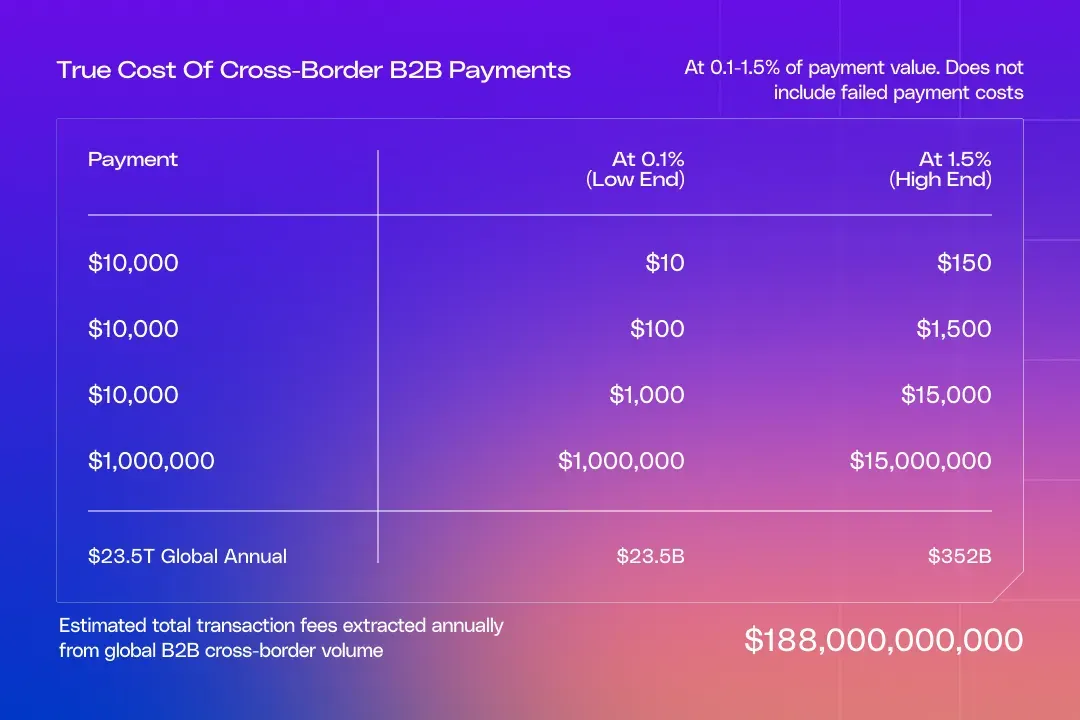
The total amount of cross-border payments by global enterprises exceeded $30 trillion last year, generating transaction costs of over $120 billion annually.
The operators of traditional financial infrastructure are finally beginning to confront this cost issue. In July 2026, the industry took a significant step forward, attempting to replace outdated systems with cryptocurrency asset underlying channels.
Infrastructure Replacement
On July 15, DTCC, the backbone of the U.S. financial market, completed its first batch of live trading with tokenized securities. The trading targets include the stock of publicly listed companies, U.S. Treasury bonds, and corresponding tokenized assets of ETFs.
In DTCC's first round of on-chain trading, JPMorgan tokenized one of the most liquid ETFs globally — the Invesco QQQ Trust — and submitted it as collateral to the CME. More than 30 institutions, including Goldman Sachs, BlackRock, Vanguard, and the New York Stock Exchange, participated in this test. These tokens completed repurchase transactions, asset pledges, securities lending, and clearance margin transfers in a production environment.
Only a few months remain until DTCC plans to officially launch its tokenization service in October 2026.
This infrastructure upgrade intuitively demonstrates how an efficient system can create significant economic benefits for capital markets. By May 2024, the U.S. stock market settlement cycle will be shortened from T+2 to T+1. Compressing it by just one day reduces the required margin size for clearing participants by $3 billion, a decrease of 23%; the margin size drops from an average of $12.8 billion over the last three months of T+2 to $9.8 billion.
Shortening the settlement cycle by one day in a single country's stock market can release $3 billion in idle margin. If the cross-border settlements of stocks, U.S. Treasuries, repos, and foreign exchange can be completed in a matter of minutes, breaking through weekend time constraints, the released capital value will grow exponentially.
This is precisely the value that blockchain can standardize and realize. Stablecoin transfers can be completed in seconds, with fees of only a few cents, operating year-round. Tokenized securities can change ownership in real-time and act as collateral simultaneously without waiting for the Monday market opening.
This is the core reason why traditional infrastructure operators are willing to adopt cryptocurrency underlying channels as a backend. If they cling to the old system, competitors can capture customer resources with lower costs and faster speed.
Cryptocurrency infrastructure eliminates idle fund windows, helping customers' capital operate more efficiently. Securities that cannot be used as collateral today because they will settle tomorrow can be pledged and lent in mere minutes. Whether collateral can flow freely determines whether capital generates intermittent utility or continuously creates earnings.
Just nine days before DTCC's testing, the cross-border messaging system SWIFT, connecting over 11,500 financial institutions globally, announced that 17 banks from six continents (including Citigroup, HSBC, UBS, Standard Chartered, and MUFG) will soon pilot tokenized deposits on a new shared ledger.
Tokenized deposits belong to the bank's currency and are not subject to business hour constraints. Blockchain supports the normal flow of funds overnight and on weekends, with asset rights still belonging to licensed banks. For institutions worried about the lack of FDIC insurance for stablecoins issued by banks, this is an ideal alternative. Tokenized deposits offer the convenience of stablecoins while operating within the existing regulatory framework.
Even card organizations like Visa are starting to lay out cryptocurrency infrastructure.
On July 16, Visa's crypto lab head Cuy Sheffield announced the launch of a new platform that allows banks to issue, circulate, and redeem stablecoins within existing cash management systems. The platform shields customers from complex technical details such as private keys, gas fees, and underlying public chains.
The biggest allure for traditional financial giants embracing cryptocurrency infrastructure as a backend lies in their ability to leverage their vast distribution networks to transfer time and cost advantages to end customers. The Visa network already covers approximately 15,000 financial institutions and over 200 million merchants.
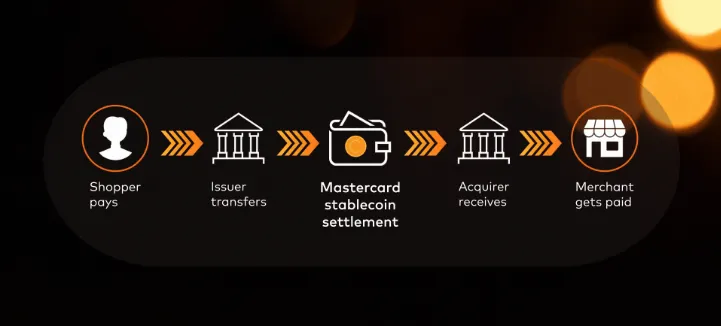
Visa's competitor Mastercard is continuously expanding its offerings based on early pilots and small-scale rollouts, providing collaborating banks with expanded stablecoin settlement options and supporting six regulated stablecoins: USDC issued by Circle, PYUSD, USDG, USDP, Ripple's RLUSD, and SoFi's SoFiUSD. These stablecoins will support multiple mainstream public chains, including Arbitrum, Base, Canton, Ethereum, Polygon, Solana, Tempo, and XRPL.
Large-scale use cases have already emerged within banks, proving that this infrastructure has commercial capacity. JPMorgan's Kinexys has handled over $40 trillion in transaction volume, with an average daily transfer size exceeding $7 billion, continuously operating even during holidays when traditional financial markets are closed.
Practitioners who still hold a skeptical attitude toward cryptocurrency infrastructure can refer to the blockchain deployment case of money market funds. BlackRock's tokenized Treasury bond fund BUIDL manages approximately $2.5 billion and has already been accepted as margin collateral by major derivatives trading venues; Standard Chartered has partnered with the cryptocurrency trading platform OKX to build this operational framework.
This is the real value of cryptocurrency infrastructure as a backend; assets serve as margin while still earning Treasury bond yields.
If anyone asks why the industry needs to adopt cryptocurrency asset channels, the above is the most powerful answer.
The most important mission of any financial innovation is to make the flow, value appreciation, and storage of funds more efficient.
Many mature cryptocurrency companies have found new industry positioning based on such innovations.
From Confrontation to Cooperation: Cryptocurrency Companies Transforming into Service Providers
Many supporters of original cryptocurrency concepts once envisioned a complete replacement of traditional financial institutions by the cryptocurrency industry. The reality is starkly different; cryptocurrency companies are transforming into the infrastructure builders that traditional finance needs.
Multiple cryptocurrency companies collaborated to facilitate the DTCC's on-chain transaction in July. Chainlink was responsible for connecting various networks; Digital Asset’s Canton network supported the flow of U.S. Treasury bond tokens; Fireblocks and BitGo provided custodial services; Circle and Ondo designed supporting service plans for the entire working group.
These companies spent a decade building a parallel financial system and are now assisting traditional financial institutions in creating lower-cost, faster asset circulation infrastructure. Their profit model has completely changed: they are no longer trying to replace Wall Street but are charging Wall Street institutions for technical service fees.
This type of collaborative layout is spreading globally. On July 16, Ondo Finance, the world’s largest stock token issuer, announced a partnership with Japan's SBI Group to promote the tokenization of Japanese stocks. Tokenized equity will connect to the SBI ecosystem and complete settlements using the yen stablecoin JPYSC issued by SBI.
SBI manages assets worth over $250 billion. The cost of developing tokenization technology from scratch would be extremely high. Companies choose to directly procure mature blockchain technology and pay service providers technology fees. Currently, Ondo holds over 70% of the equity token issuance market share and has established distribution cooperation with Deutsche Börse’s Mignex Bank in Europe. Securitize is also playing the role of a technology service provider, supporting BlackRock's BUIDL fund issuance.
Future Direction of the Industry
The revolution in the logistics industry can serve as a reference. In 1956, truck driver Malcom McLean invented the standard shipping container. The cost of loading and unloading goods dropped from $5.86 per ton to $0.16, and global trade was restructured around the shipping container. Ironically, shipping companies saw little dividend from this. The shipping container ultimately became a standardized commodity, and the shipping industry fell into price wars; the true beneficiaries were those businesses that restructured their models around low-cost, stable shipping. The biggest winner from container innovation was retail giant Walmart, not logistics giant Maersk.
The fintech sector may replicate a similar script.
For containers to reshape the logistics industry, supporting modifications to docks, cranes, freight chassis, and customs systems were necessary. Similarly, for tokenization to become mainstream, systems for custody, compliance, and cross-chain interoperability must be built simultaneously. As the banking settlement layer gradually moves toward standardization, value will converge in the supporting ecosystem, which is exactly where Chainlink, Fireblocks, and Digital Asset are targeting.
The tokens themselves and the underlying public chains will struggle to capture significant value; earnings will concentrate in two major directions.
The first category comprises platform institutions that access cryptocurrency underlying channels. DTCC, SWIFT, and Visa will charge service fees for tokenized settlements, token deposits, and stablecoin businesses, with the model remaining consistent with traditional systems. However, greater value lies elsewhere, as some institutions are reconstructing capital management systems around round-the-clock atomic settlements, facilitating intra-day fund scheduling and enhancing collateral utilization efficiency, to provide the market with uninterrupted operational funds. The BUIDL fund is a typical example, where assets serve as margin while continuously earning Treasury bond interest.
After 15 years, the cryptocurrency industry has built a parallel financial system with superior performance. Visionary cryptocurrency builders should stop duplicating similar end financial products. The greater victory in the cryptocurrency space lies in becoming the infrastructure behind the scenes, reducing the costs and increasing the speed of capital circulation.
免责声明:本文章仅代表作者个人观点,不代表本平台的立场和观点。本文章仅供信息分享,不构成对任何人的任何投资建议。用户与作者之间的任何争议,与本平台无关。如网页中刊载的文章或图片涉及侵权,请提供相关的权利证明和身份证明发送邮件到support@aicoin.com,本平台相关工作人员将会进行核查。


