Translation & Compilation: Deep Tide TechFlow
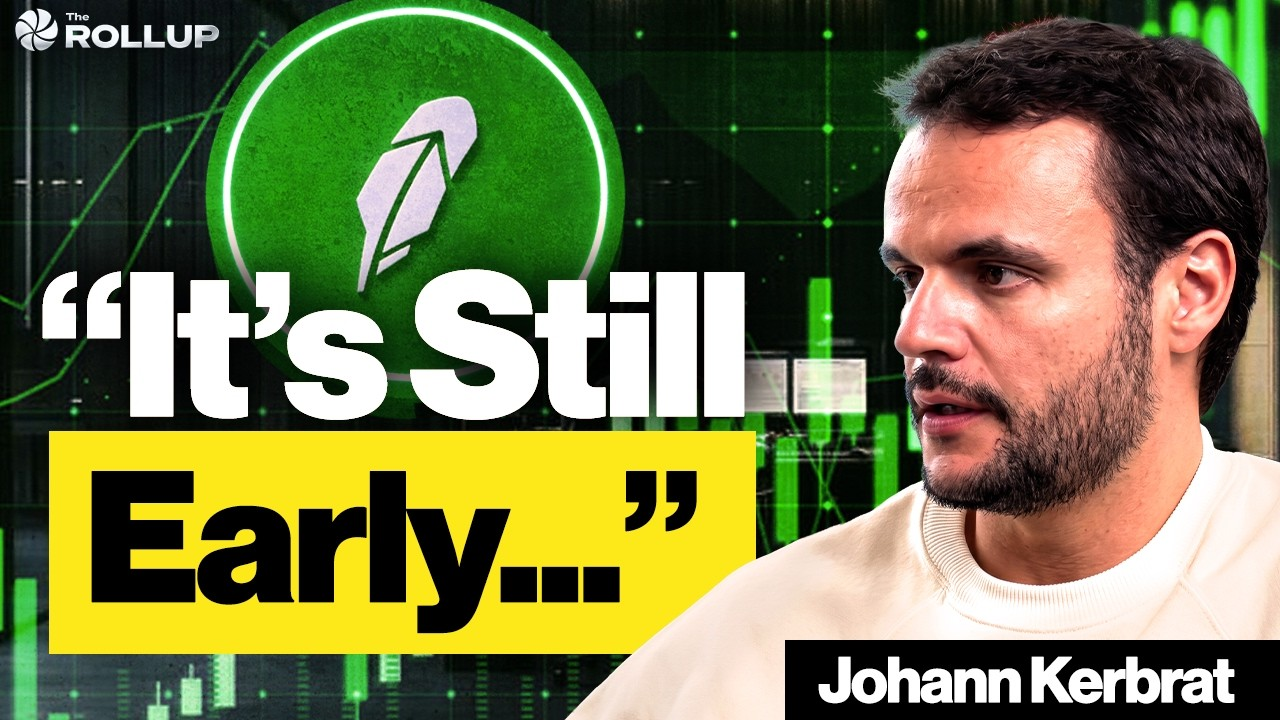
Guest: Johann Kerbrat, Senior Vice President of Robinhood and General Manager of Crypto and International Business
Podcast Source: TheRollup
Original Title: Johann Kerbrat: Inside Robinhood's Crypto Strategy (Full Explanation)
Release Date: 2026-07-24
Conflict of Interest Statement
Johann Kerbrat is an executive at Robinhood, responsible for the entire product line of the crypto business (including Robinhood Chain, tokenized stocks, staking services, perpetual contracts), and his compensation and stock incentives are directly tied to the $HOOD stock price. All discussions regarding Robinhood Chain in this episode pertain to the business he directly oversees. The title uses "insider perspective" rather than "analysis," reflecting this conflict of interest.
Summary
Three weeks after the launch of the Robinhood Chain mainnet, weekly DEX trading volume surpassed $3 billion, with over 105 million transactions and a TVL exceeding $300 million. Johann Kerbrat explains the strategic logic of the chain for the first time on the podcast: why they chose a "barbell" layout (parallel meme tokens + real-world assets), why they used the Arbitrum tech stack instead of building their own L1, and how they plan to gradually move Robinhood's 27 million deposit accounts onto the chain. He emphasizes that the competitive focus is on "growing the pie" rather than competing with Base for market share and reveals that tokenized stocks have covered over 120 countries and 90+ assets, with plans to expand into international stocks and the private market in the future.
Key Quotes
"Our philosophy is to make the chain permissionless and open to everything. Whether it's meme or RWA, many products will be welcomed. We are deeply integrating with the chain."
"Robinhood has 27 million deposit accounts. For these users, DeFi is still too complex and requires too much technical knowledge. We are thinking about how to bring good DeFi products over, while making it user-friendly and easy to use, without needing to create wallets or manage private keys."
"I believe competition ultimately benefits customers. When we launched crypto trading, we significantly reduced fees. It's still too early on the chain to discuss market share."
"We have only been live for three weeks. If you are considering bringing tens of millions of users onto the chain, providing more utility, and delivering things that people actually use (not just temporary fluctuations), then you're thinking about a long-term revenue source."
"We do not want to see all of Robinhood's trading activity move to the chain next year. That would be a bit of a dream. But if we can find things that traditional methods cannot achieve, like international stocks and 24/7 trading, the chain can become the solution."
1. Three Weeks of Data: $3 Billion Weekly Trading Volume is Just the Beginning
The host opens by throwing out a set of numbers: After the launch of the Robinhood Chain mainnet, weekly DEX trading volume reached $3 billion, surpassing 50 million transactions, over 1 million addresses, and a TVL exceeding $300 million.
Kerbrat's response was direct: these numbers have already been surpassed. He stated that by that morning, the transaction count had already exceeded 105 million. He described the team's state as "very excited," with the core point being that this number reflects the market's strong demand for on-chain products.
He particularly emphasized that the ecosystem was ready to welcome developers from day one, rather than building it first and waiting for people to come. This differs from the path taken by many L2s that initially operated empty and gradually attracted users.
2. "Barbell" Strategy: Why Meme and RWA Run Parallel
The host mentioned an interesting phenomenon: Robinhood CEO Vlad Tenev described the on-chain ecosystem as having a "barbell" structure, with one end being meme tokens and the other end being real-world assets (RWA), saying "you have two wolves inside you."
Kerbrat explained the internal thinking. The chain was defined as permissionless from day one, open to all types of applications. Meme tokens bring market makers and DeFi users, while RWA serves users globally who cannot conveniently purchase U.S. stocks and ETFs. The two are not in contradiction but pull in different groups.
He also mentioned several integrated products that have already launched: Robinhood Earn (earning stablecoin yields through on-chain protocols within the main app) and tokenized stocks (tradable in over 120 countries through Robinhood Wallet).
The host pressed for the differences between this and traditional financial products. Kerbrat listed issues with the traditional system: wire transfers can only be processed between 9:30 and 4:00, commission-free brokers only operate during market hours on weekdays, and options and futures contracts can expire. The on-chain versions are superior solutions from a product perspective.
3. How to Move 27 Million Accounts to the Chain: The Fusion of DeFi and CeFi
Kerbrat threw out a key number: Robinhood has 27 million deposit accounts. Most of these users have not been exposed to DeFi, as DeFi is still complex and requires a significant amount of technical knowledge.
His solution is "the best of both worlds": using DeFi's underlying technology to provide high yields while using Robinhood's front end to provide a simple UX/UI and security protection. Robinhood Earn is an example, allowing users to earn on-chain yields directly in the main app without needing to create wallets or manage private keys.
He defined this trend as "the fusion of CeFi and DeFi": centralized platforms leveraging blockchain technology to create better products while maintaining user-friendly experiences.
Regarding the technical implementation of tokenized stocks, Kerbrat revealed the "just-in-time tokenization" mechanism. Traditional DEXs require liquidity pools to be set up in advance, while Robinhood, being a broker and holding these stocks, can quickly move stocks on-chain when users need to trade. The underlying structure uses a combination of prop AMM, standard AMM, RFQ, and classic pools to ensure good prices at all times.
Currently, there are over 90 stock tokens on-chain, but he believes this is just the beginning, with plans to expand into international stocks, private markets, and more asset classes in the future.
4. Why Choose Arbitrum: The Logic of Not Building an L1
The host asked a technical architecture question: why use Arbitrum's tech stack instead of building their own chain.
Kerbrat's answer was pragmatic. Robinhood wants to focus on what it does best: delivering excellent UX/UI and financial products rather than rebuilding something that already exists. Achieving Ethereum-level security and decentralization takes a long time and involves numerous decisions (from the transition from PoW to PoS to collaboration with multiple foundations). Directly utilizing Ethereum's security and liquidity from the EVM ecosystem is a more reasonable choice.
Reasons for choosing Arbitrum as the L2 tech stack include: Stylus (which allows smart contracts to be written in any programming language), extremely fast block times (financial products require high speed), and low gas fees (even during periods of high trading volume). He also mentioned that when on-chain activity surged last week, they proactively lowered gas fees to ensure user experiences were not impacted.
Regarding the Ethereum "rent" controversy (Robinhood Chain earned over $1 million in revenue but only paid 1-2% to Ethereum), Kerbrat believes this is an inherent mechanism setting by Ethereum, and it is neither fair nor unfair. His perspective is long-term: if Robinhood can bring tens of millions of users onto the chain and create real use cases, this will ultimately become a long-term revenue source for the Ethereum ecosystem.
5. Competition with Base: Growing the Pie Rather Than Fighting for Share
The host mentioned the "manufactured competition" between Robinhood Chain and Coinbase Base on social media. Base recently admitted to a failed social experiment and shifted to other directions, while Robinhood is exploring the possibility of on-chain social trading.
Kerbrat's attitude towards competition is clear: competition benefits customers. When Robinhood launched crypto trading, they dramatically cut fees, ultimately benefiting users. But it's too early to discuss market share now; Robinhood Chain has only been around for three weeks, while Base has been running for a year or two.
He made a comparison with a number: currently, only a tiny fraction of the global population holds tokenized assets. His goal is to grow the pie, allowing more people globally to own assets rather than competing for shares in an already small plate. Regarding Base's social experiment, he commented, "It's normal to try new things; sometimes they fail, sometimes they succeed."
Robinhood focuses on financial products: Earn, spot trading, perpetual contracts. These are the areas where they excel and can bring value.
6. Logic of Choosing DeFi Partners
The host listed Robinhood Chain's announced partners at launch: Morpho (lending vault), Lighter (perpetual contracts), 0x (aggregation and quoting API), Chainlink (oracles), LayerZero (cross-chain).
Kerbrat explained the three criteria for selecting partners. First, Robinhood is a publicly traded company holding multiple licenses globally; partners must understand and comply with regulatory requirements. Second, the ability to create a unique experience. For example, in collaboration with Morpho, it's far more than just connecting via API; it involves customized stable rates, insurance mechanisms, and dedicated UX, which requires extensive discussion and joint development. Third, the need to differentiate from competitors.
Regarding the timeline for perpetual contracts to enter the main U.S. app, Kerbrat indicated they are still waiting for regulatory clarity. Even if the CLARITY Act passes, perpetual contracts remain a complicated issue. Currently, users can experience perpetual contract trading through Robinhood Wallet and Lighter's partnership. He also revealed that Bitstamp (the European exchange acquired by Robinhood) is already expanding into perpetual contracts, from crypto to commodities and ETF contracts.
7. From Broker to Super App: The Investment Logic of $HOOD
The last topic returned to the investment perspective. The host asked: What does holding $HOOD stock mean now?
Kerbrat outlined Robinhood's "super app" vision: stocks, options, futures, prediction markets, crypto, credit cards (just launched a platinum card that day), banking services, AI agent trading (with MCP already available). The core is to create one app that meets all financial needs of users at various stages of their lives.
He particularly mentioned the lack of financial education: young people do not learn financial knowledge in school, but by the time they graduate high school, they need to start considering retirement planning. Robinhood wants to make efforts in financial education; IRA accounts are one example.
From a business model perspective, currently, each business line achieves nine-digit (over one hundred million) revenue, with diversified income sources, no longer just a purely trading platform. Concerning the revenue from the chain itself, Kerbrat candidly stated that they are currently prioritizing adoption over pure revenue. The setting of gas fees is a balancing act: too low will lead to abuse by junk trades and bots, and too high will hinder adoption. They are currently in a stage of "optimizing for adoption" rather than "optimizing for revenue."
免责声明:本文章仅代表作者个人观点,不代表本平台的立场和观点。本文章仅供信息分享,不构成对任何人的任何投资建议。用户与作者之间的任何争议,与本平台无关。如网页中刊载的文章或图片涉及侵权,请提供相关的权利证明和身份证明发送邮件到support@aicoin.com,本平台相关工作人员将会进行核查。


