Source: "What Bitcoin Did"
Compiled by: Felix, PANews
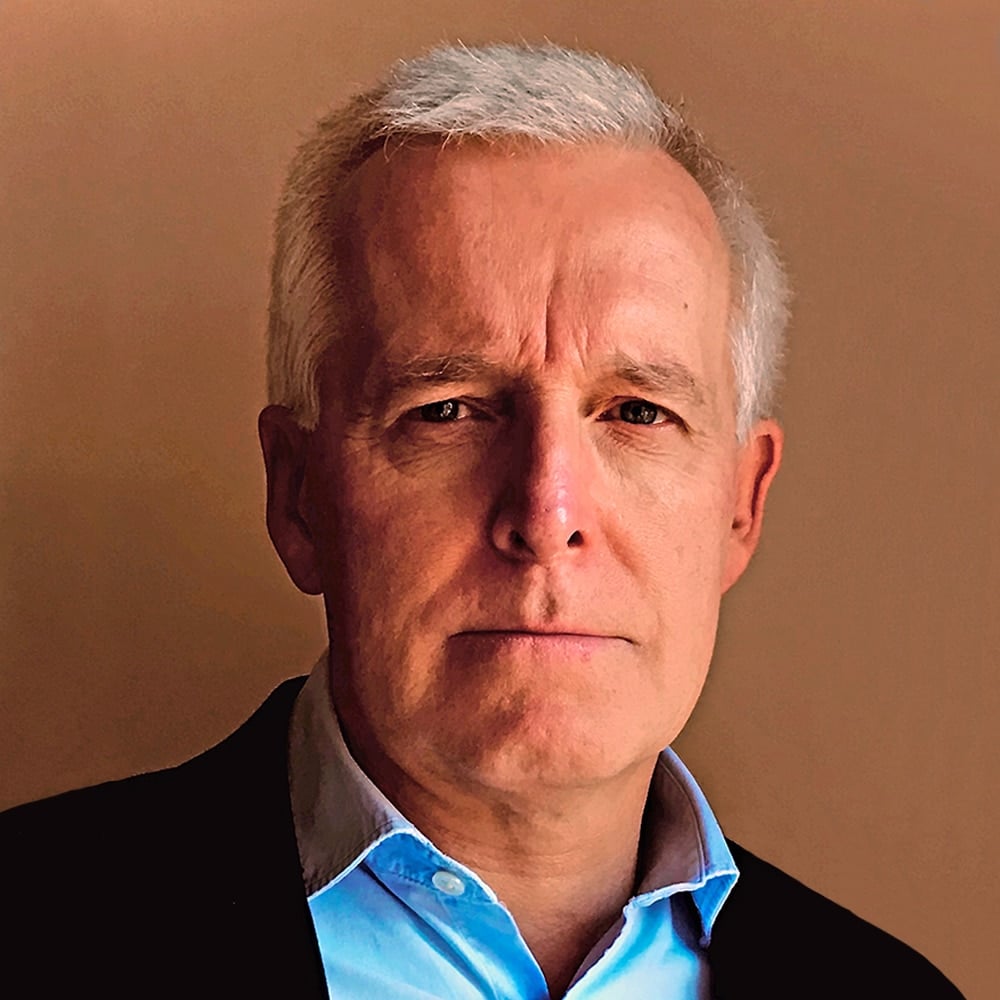
Founder of CrossBorder Capital and "King of Liquidity" Michael Howell guest-starred on the "What Bitcoin Did" program to discuss the global liquidity cycle and its impact on assets such as Bitcoin and gold. Michael pointed out that the modern financial system is essentially a debt refinancing mechanism, and liquidity fluctuations directly govern the rise and fall of the market. He believes that the current liquidity growth has peaked and begun to decline, which explains why liquidity-sensitive assets like Bitcoin are performing poorly. Although the market may face risks from tightening liquidity in the short term, in the long run, holding assets that can counteract currency depreciation remains key to addressing systemic risks.

Host:Why are you so concerned about liquidity? What does liquidity mean to you in the economy?
Michael: That's a good question. In short, capital drives the market, it's that simple. Broadly speaking, the flow of funds into financial markets initiates the entire cycle or investment cycle. The economy is downstream from the market, and geopolitics is downstream from the economy. That's our order of thinking. But what we really want to understand is whether there is money flowing into or out of the market, effectively changing the trading dynamics. You need to conceptualize that there are roughly two large pools of capital in the global economy: one in financial markets, and the other exists almost independently in the real economy. Many people confuse these two, thinking they are the same, but they are fundamentally different. All existing funds must be somewhere, either in the financial sector or in the real economy. Generally speaking, as investors, we prefer funds in the financial or asset economy rather than in the real economy, because if funds are in the real economy, they are merely propelling economic activity; however, if they are in financial or asset economy, they will push up asset prices, which is what we are really concerned about.
Host:You said "the economy is downstream from the market," what does that mean? Many people might think what happens at the economic level is what drives the market; are you flipping that relationship around?
Michael: It is indeed flipped. There is a feedback effect where the real economy can also impact the financial market. But the first stage is the creation of capital. Capital is generated in the financial system first, maintained by the financial system, and then spills over into the real economy, which is the main transmission mechanism. We often hear the saying "the stock market can predict the real economy," but that's not prediction; it's more because the stock market reflects the surge or reduction of funds impacting the financial sector, which then creates a reverberation effect that affects the real economy. Traditional economics textbooks have it completely backward. Although I have a Ph.D. in economics, much of my economic knowledge comes from market practice. The academic view of the world is highly distorted and not helpful. To understand the market, you just need to understand capital flows; many of the best investors are not economists, but rely on experience and common sense.
Host:How has your economic perspective changed? Have you shifted towards a more Austrian school view?
Michael: I don't know if it qualifies as an Austrian school view. I think both sets of theories have flaws. Our starting point is that you must understand the process of capital creation within the financial market or the global economy. Capital is fungible; it tends to flow to the places with the highest returns or the most appealing investment and purchasing opportunities. There is a tendency in the money creation process, and there is also a very clear cycle. Understanding where we are in the cycle and what drives that cycle is very important. Neither Keynesian economics nor Austrian economics explains the cycle very well; they only explain the state of imbalance during a crisis, without really grasping that what you often see in the market is a fairly regular cycle.
The problem is understanding why these cycles occur and why policymakers respond as they do to certain events. What we are currently seeing is yet another example of a typical liquidity cycle in the market. This cycle began to erupt in the second half of 2022, and has likely peaked in terms of liquidity injection and started to decline. But there is still momentum in the system, asset prices are still rising, but the prices of liquidity-sensitive assets have encountered difficulties. Bitcoin is clearly a prominent example; it may be the most liquidity-sensitive asset on Earth. Then there is gold, which is also very sensitive to liquidity and is currently experiencing a rather difficult period. These characteristics indicate that liquidity is losing momentum.
Host: Macro strategist Luke Groman once referred to Bitcoin as "the last effective smoke detector of liquidity." Before talking about where we currently are in the cycle, can you explain what drives these cycles? When liquidity ebbs and flows, where does the money go and come from?
Michael: The answer is actually quite complex, but I will try to explain it in a more direct way: The main driver is the central banks. Although there are other factors, let's assume it's the central banks for now. Central banks will start loosening policy. What prompts them to loosen policy? It could be external shocks (like the emergency arising from the COVID-19 pandemic) or a financial crisis; their response is basically to intervene and inject liquidity into the market. The primary reason for this is not to stimulate economic activity; what they really want to do is save the financial system and banks. Because ultimately, a financial crisis is essentially a debt refinancing crisis. We have far too much debt right now. Economics textbooks are misleading; they often depict financial markets as mechanisms for raising new capital, i.e., companies raising new funds in capital markets for new capital expenditures (like plants or equipment). This rarely happens in reality, except for the short-lived surge possibly caused by the current AI boom; Western economies have not had that much capital expenditure over the past 10 to 15 years. Most of the capital expenditures in the global economy are done in China, and that is a state-led investment model. What are Western capital markets doing most of the time? They are refinancing existing debt, extending debt maturities.
Given that we are sitting on a massive debt pile of $350 to $400 trillion, with an average maturity of only about 5 years, this means you need to refinance $7 to $7.5 trillion of debt every year, which is an astonishing amount. To do this, you need a capacity in the financial sector and institutions that can provide balance sheets. If this mechanism breaks, you will face a financial crisis. In a credit-based modern capitalist system, you can never allow debt to default because debt serves as collateral for new loans. Currently, about 70% to 80% of loans are based on collateral. You need some kind of asset to borrow against, and ironically, this asset is often old debt (like U.S. Treasury bonds). Therefore, you can never allow those debts to default; you must provide liquidity so that the debt refinancing process can continue. This is the fundamental response of central banks to all financial crises; providing liquidity is their ultimate duty. Although they verbally claim this is to control inflation or improve employment, the real purpose is to ensure that debt refinancing can continue.
During the COVID pandemic or the global financial crisis, funds drove the asset markets up. Liquidity is fungible; once it facilitates debt extensions, it spills over into risk assets, corporate bonds, stocks, and so forth, beginning to broadly push up the asset markets. This is what we refer to as a "bubble." Bitcoin and gold are good barometers for this phenomenon, as they are clearly favored during times of plentiful liquidity. Eventually, liquidity spills over into the real economy because the wealth effect drives people to consume more, triggering further investments, and the real economy gains momentum. As the real economy gains momentum, it will need more liquidity, and it will start to siphon off liquidity from the financial sector. You will notice a paradox: a strong real economy is rarely accompanied by a strong financial market, while a strong financial market is often related to a weak real economy. Moreover, if a robust economy leads to heightened inflation, central banks will initiate monetary tightening, which will trigger larger cycles and cause debt refinancing problems; at that point, they will have to intervene again to release liquidity, and thus the cycle continues.
Host:As we get trapped in a debt spiral with exponential debt growth, will the peaks and troughs of these cycles become higher or lower, or will the cycles shorten due to out-of-control debt?
Michael: First of all, what we are seeing is that debt is growing exponentially, as the debt-to-GDP ratio of most economies now exceeds 100%. Once interest payments reach a considerable scale, debt starts a vicious cycle of compound growth. For the government to curb debt growth, it must restore a fiscal surplus, but that is practically impossible. The welfare system in the West needs thorough reform, or it will lead to national bankruptcy. Since debt is growing exponentially, you also need liquidity to grow exponentially, but liquidity usually grows cyclically, which is why financial crises occur. However, saying that financial crises will get larger and more frequent is not always the case. Not every subsequent crisis is larger, but their frequency is indeed quite stable. On average, our liquidity cycle has a frequency of about 5 to 6 years. The reason lies in the fact that the average maturity of debt in the global economy is also about 5 to 6 years, so essentially this is a debt refinancing cycle. By the way, this stands in stark contrast to the oft-cited "Bitcoin 4-year cycle." I don't believe in a 4-year cycle for Bitcoin; I think it is this 5 to 6-year liquidity cycle that dominates Bitcoin and gold. As for whether the next crisis will be larger than in 2008, I'm not sure; it depends on the speed of response from policymakers.
Host:In October last year, Bitcoin peaked, coinciding with what you mentioned as the peak of the liquidity cycle. Where are we positioned in the cycle now, and what will happen next?
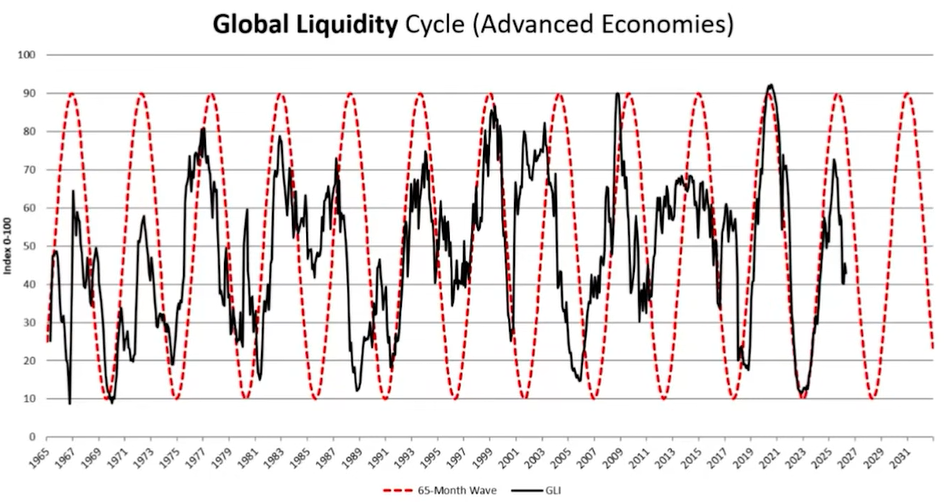
Michael: The chart below shows the global liquidity cycle, with the black line representing the rate of change of liquidity through financial markets. The data we use goes back to 1965, covering about 90 economies globally, with approximately 30 different data series observed for each country. Above this black line is a sine wave, estimated using Fourier analysis in 2000 (25 years ago), and we have not changed it since. The U.S. cycle research foundation asked for our data last year for their study, and they reached the same conclusion: the cycle is 65 months, which is quite standard. As you can see, the cycle peaked at the end of Q3 last year, after hitting a low in September 2022. This upward trend in liquidity triggered a "bubble." The bad news is that this cycle may hit bottom around sometime in 2027 (possibly in the second half of 2027).
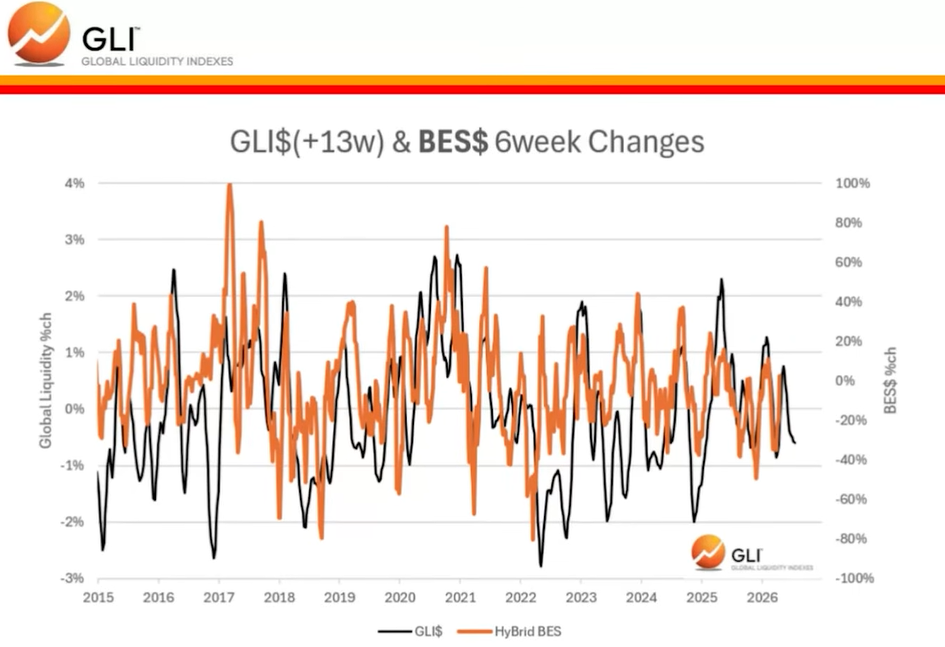
Another chart shows the six-week rate of change in global liquidity and its correlation with a basket of cryptocurrencies (60% Bitcoin, 30% Ethereum, 10% Solana). We advanced the liquidity data by 13 weeks, and the correlation during this period exceeds 0.55. The latest data shows the lagging state of cryptocurrency prices, which aligns perfectly with the fact of liquidity slowing down.
Host:Is gold's performance similar to this?
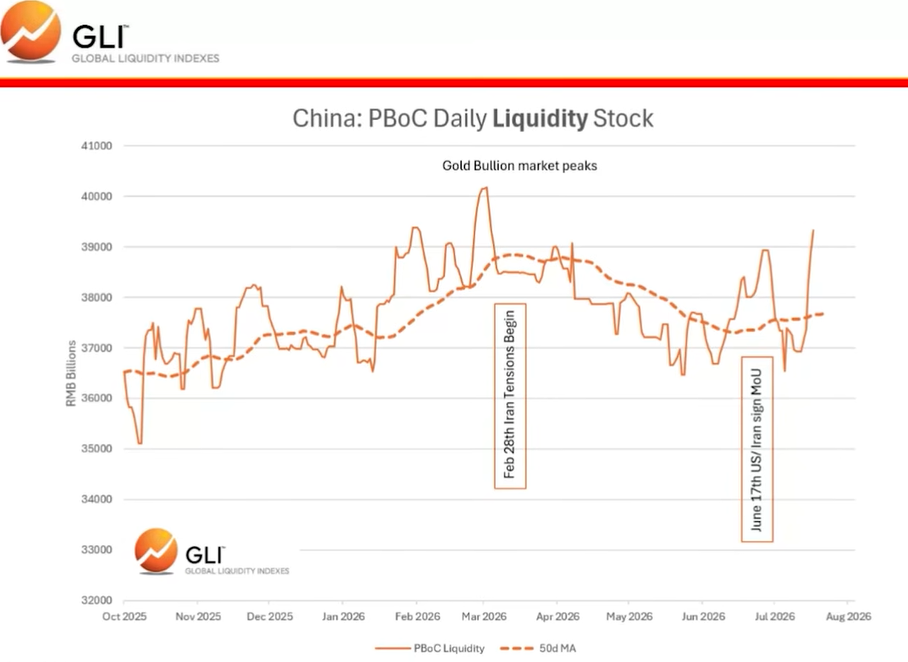
Michael: Yes, but with different dynamics. Because buying cryptocurrency is illegal in China, the People's Bank of China (PBOC), which drives liquidity, does not have a direct impact on cryptocurrencies. However, China has a significant influence on gold prices. The chart shows that changes in PBOC liquidity typically affect gold prices approximately 2 to 2.5 months later. Recently, gold has shown signs of weakness.
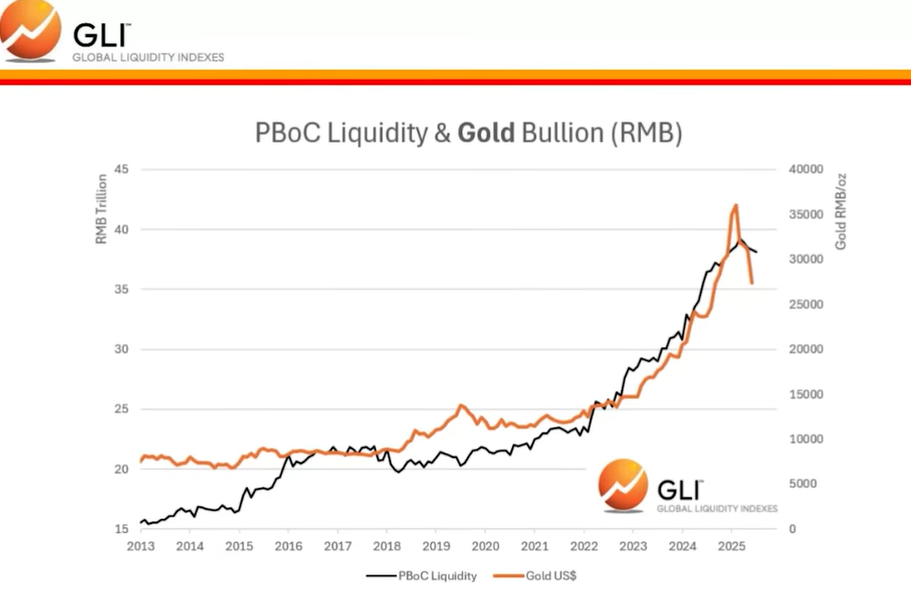
Many believe that the "big devaluation trade" drove the rise in gold over the past year, but we think that major devaluation has not truly occurred in the West. In the future, the West must monetize its exponentially exploding debt, which will lead to massive inflation, but currently, only China is truly doing this. Because of capital controls in China, excess liquidity cannot easily flow out, and Chinese residents can only buy gold to hedge against inflation. The reason China prohibits the purchase of cryptocurrencies is that it would create a shortcut for capital flight. If you zoom in on the chart, you will find that almost simultaneously with the escalation of tensions with Iran, China significantly reduced liquidity injections to slow down the economy and reduce oil imports. But as the U.S.-Iran memorandum was torn up, it seems that China has restarted liquidity injections. This may explain why gold prices might stabilize in the coming weeks if they continue injecting liquidity.
Host:When liquidity peaked and began to fall at the end of last year, Bitcoin plummeted. Will Bitcoin react sharply to the decline in liquidity? Will Bitcoin continue to fall, or will it stabilize while waiting for liquidity to return?
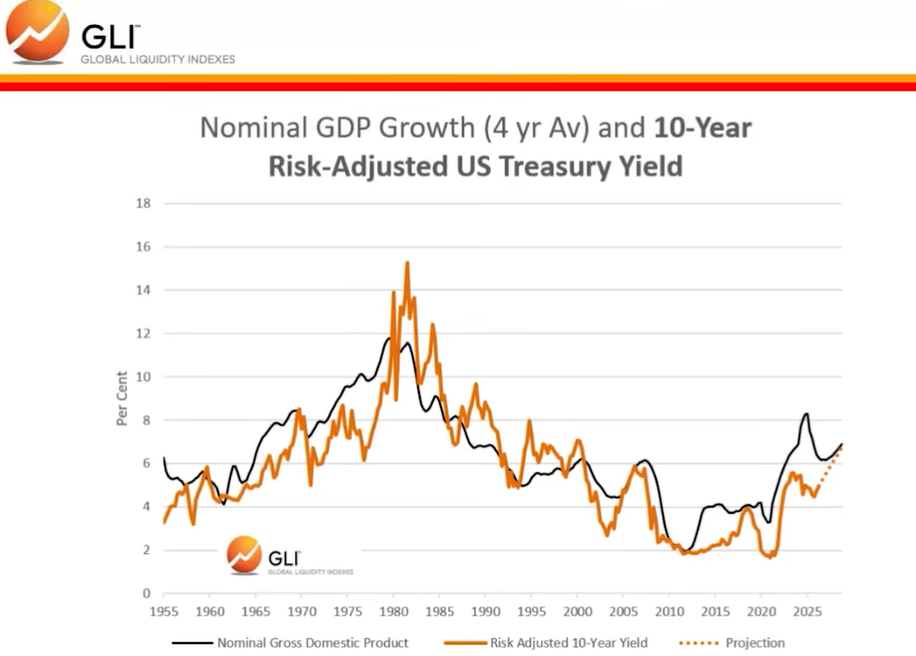
Michael: Let’s put it this way: if you are optimistic about Bitcoin in the long run (we are bullish as well), you must understand that the cycle does not respect trends. Even if Bitcoin surges significantly in the next few years, its price may still be lower than it is now by the end of this year. This is the risk we need to understand. Aside from the gold market and the China effect, the U.S. market is brewing major problems. Two of the most important indicators in the world economy, oil prices and U.S. Treasury yields, have been pushed down to far below normal levels, greatly propelling economic growth. Strong economic growth is not necessarily good for financial markets because funds are all in the real economy. The chart shows the correlation between U.S. nominal GDP growth and risk-adjusted U.S. 10-year bond yields. Currently, U.S. Treasury yields are far below where they should be, and there is significant upward pressure. It's like pressing down on an inflated beach ball underwater. The U.S. Treasury and the Federal Reserve are trying hard to suppress yields to lower interest expenses, and they are intervening heavily in the repo market. This brings two issues: first, when you suddenly let go, the ball will surge up (just like when Japan ended yield curve control, causing 10-year Treasury yields to jump 200 basis points, which is rare in the world). Second, if you squeeze one end of the balloon, the other end will bulge. They are squeezing the long-term market, which causes pressure in the short-term market (like the yield on 2-year Treasury bonds), reflecting the real expectations of the private sector for future interest rates.
Host:My friend Jeff Ross often says this proves it's the market and not the Federal Reserve that determines interest rates; do you see it that way?
Michael: I completely agree. It is always the long end of the market that determines the short end; the Federal Reserve can only influence for a very short time.
Host:Kevin Warsh is in a tough position right now; he has been brought in to lower interest rates and form an inflation working group, even suggesting he could accept 3% inflation. What will he do?
Michael: I believe he cannot implement loose monetary policy because the U.S. economy is already growing very fast. A few weeks ago, the annualized rate of M2 money supply growth soared to nearly 10%, and the Philadelphia Fed's data also showed a significant leap in activity and high inflationary pressure, consistent with nominal GDP reaching 9%-10%. Attempting loose monetary policy in this situation is simply crazy. The strength of the dollar actually tells us they are moving toward a more tightening direction. The negative spread between SOFR rates (Note: Secured Overnight Financing Rate, a benchmark for overnight borrowing costs, using U.S. Treasury securities as collateral) and U.S. 2-year Treasury bonds, similar to 2021-2022, signals that tightening mechanisms are imminent—last time tightening led to a 25% drop in the S&P index and a 75% drop in Bitcoin.
Host:Do you think this is why Kevin Warsh wants to establish a special inflation working group, as he indicates he cares more about the number to the left of the decimal point (i.e., allowing inflation to reach 3%); is he trying to manipulate the narrative?
Michael: He is obviously leaving himself some room for maneuver. The last time the Federal Reserve reached its 2% inflation target was about 63 or 64 months ago. They dare not admit that underlying inflation is actually much higher; otherwise, inflation expectations will become entrenched. But I think these little tactics policymakers are playing actually indicate they know they must raise interest rates; they are just trying to extend the process as long as possible. But if they do not tighten early, they will have to do more aggressive tightening later.
Host:If they really "let go of the beach ball," how will a financial crisis unfold?
Michael: We use the "debt liquidity ratio" to gauge crises. The core function of financial markets is to refinance debt. When this ratio is too high, the financial market lacks sufficient liquidity to extend debt, triggering a crisis. All past financial crises occurred when this ratio was extremely high. Conversely, if there is an excess of liquidity, it will trigger asset bubbles, which is the "bubble" we just experienced. The way policymakers respond to crises is by injecting liquidity; this is why you should hold assets like Bitcoin and gold as a hedge against monetary inflation in the long term. Additionally, during the COVID pandemic, interest rates were lowered to zero or even negative, leading many to refinance their debts, creating a massive debt maturity wall. From 2025 onwards, the amount of existing debt needing refinancing will continuously increase, not counting new borrowings for defense spending and the like. Once dislocated, issues will arise in the repo collateral market; either bond term premiums will collapse, or credit spreads will widen, and funds will massively shift towards safe assets. This is why I do not recommend aggressively buying now. Do not try to catch falling knives; wait for the situation to stabilize, and in the medium term, Bitcoin and gold will rebound strongly.
Host:So will we face a financial crisis every six years?
Michael: It does show this pattern. We stated during the global financial crisis that the future world would be dominated by quantitative easing (QE). Don't just think about QE1; there will be a series of QE processes like QE2, QE3, QE4, etc., because central banks must regularly inject liquidity into the financial system, which itself cannot withstand the immense pressure of debt refinancing. The notion that the Federal Reserve's balance sheet will drastically shrink is merely a dream.
Host:How can they escape the debt predicament? Is it only through inflation?
Michael: They have no choice but to create inflation because they cannot allow Treasury bonds, which serve as collateral, to default; otherwise, it will destroy the credit system. Major devaluation has not truly happened in the West, whereas China is already doing so. Western governments may introduce measures to keep funds domestically, preventing them from flowing into monetary inflation-hedging instruments. The West faces a future debt issue.
Host:Do you think they have a chance to escape debt through economic growth (like AI catalysts)?
Michael: There is no opportunity whatsoever. Economic growth ultimately depends on structural demographics like young labor forces, and we do not have those conditions now.
Host:What actionable advice do you have for the listeners? Should they still buy gold and Bitcoin?
Michael: Yes, in addition, it is essential to pay attention to the jurisdiction of investments and achieve diversification as much as possible. We must be realistic; the world has changed, and the West is bankrupt. For example, the reason the Prime Minister of the UK changes every two years is fundamentally that there is no money to implement any agendas; this may also be the case across Europe. Facing leftist policies or the government forcibly requiring pensions to buy bonds, gold and Bitcoin are clearly quality international assets that can be held.
Related Articles: Macro master Raoul Pal in dialogue with Wall Street strategists: Computing power, energy, and the Agent economy
免责声明:本文章仅代表作者个人观点,不代表本平台的立场和观点。本文章仅供信息分享,不构成对任何人的任何投资建议。用户与作者之间的任何争议,与本平台无关。如网页中刊载的文章或图片涉及侵权,请提供相关的权利证明和身份证明发送邮件到support@aicoin.com,本平台相关工作人员将会进行核查。


