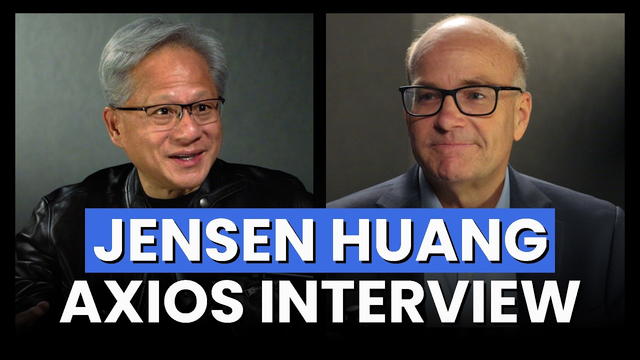
Organization & Compilation: Deep Tide TechFlow
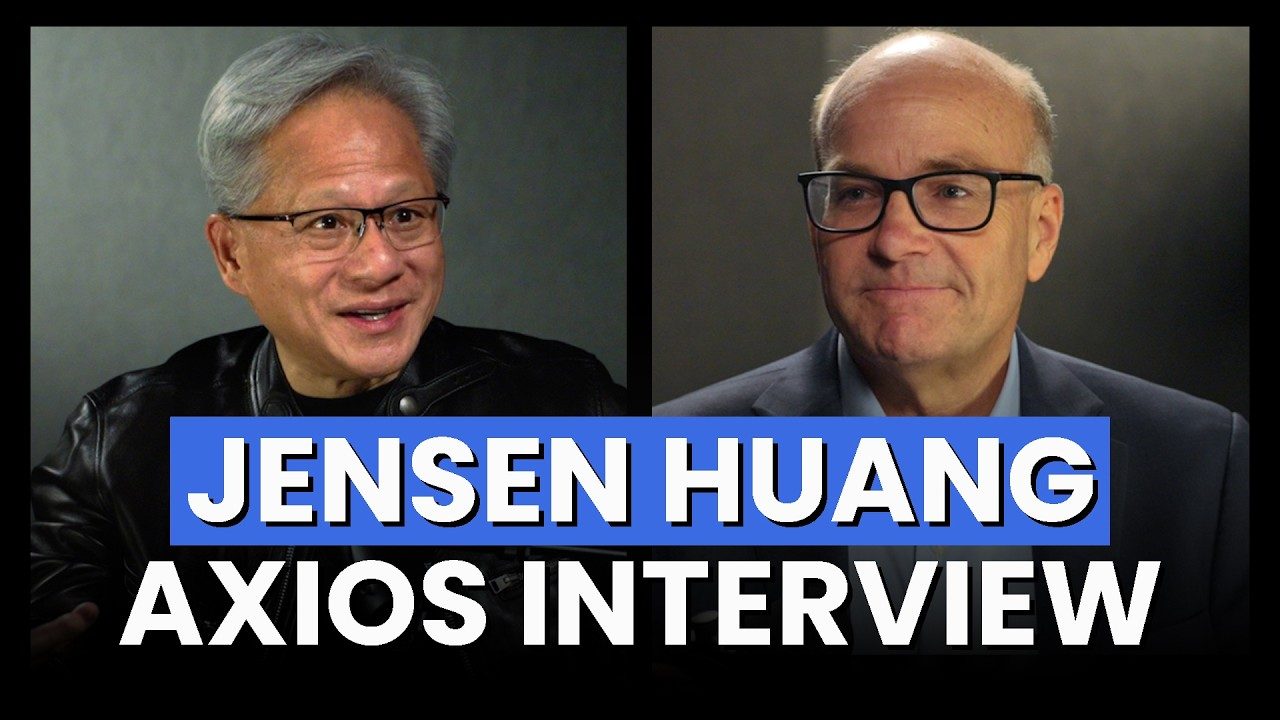
Program: Axios Behind the Curtain
Guest: Jensen Huang, Co-founder and CEO of NVIDIA
Duration: 70 minutes
Recording Location: NVIDIA Factory in Fort Worth, Texas
Disclosure Statement: Jensen Huang is the CEO and co-founder of NVIDIA, holding approximately 3.5% of the company's shares, with a personal wealth of approximately 181 billion dollars. This episode discusses topics such as the expansion of the AI industry, chip demand, and government regulation in China, which are directly related to his personal financial interests. His stance clearly favors promoting the expansion of the AI industry and reducing regulations.
Summary
The CEO of the world's most valuable company takes his seat in the newly constructed Texas factory and addresses nearly every hot debate in the AI industry. Jensen Huang speaks plainly: Wall Street’s panic over Chinese AI models is a misunderstanding, the AI doomsday theory is "nonsense," the chip industry needs to expand 5 to 10 times in the next decade, and a bubble is unlikely to appear within five years. He also publicly states that Anthropic’s Mythos model should be open to everyone, and that OpenAI and Anthropic will be "the most successful IPOs in human history." When discussing Trump, he asserts that the president has an excellent memory and can recall chip models like H20, H200, Blackwell, and Rubin, with the only concern being that the government might be misled by "sci-fi narratives" and over-regulate.
Key Quotes
"The market misunderstood the impact of DeepSeek, and then it misunderstood Kimi. Great models lead to more usage, and more usage means selling more Nvidia computers and building more data centers. The starting point is: good models lead to good applications, and good applications lead to growth."
"Saying AI will destroy humanity is complete nonsense. Saying AI will eliminate half of American jobs is complete nonsense. All facts and evidence point in the opposite direction."
"China has more AI researchers than all other places combined. China will become extraordinary in this field; it's a foregone conclusion. Want to stop China? That's a foolish idea, and it's simply not feasible."
"The semiconductor industry needs to expand 5 to 10 times. Everything is in short supply today: chips are short, memory is short, land, electricity, and construction workers are all in short supply. This shortage is actually a good thing; it gives us time to build infrastructure."
"OpenAI and Anthropic will become the most successful IPOs in human history. How can a company worth a trillion dollars emerge just a few years after its founding? Because AI is useful, and because useful AI can make money."
1. The Shockwave of Chinese AI: Wall Street Misunderstood Again
Host Mike Allen opens with the most sensitive topic: FT reports that China is considering tightening export controls on AI models and semiconductors. The Chinese model Kimi caused NVIDIA’s stock to plummet, with chip stocks dropping 18% in a month. What exactly did Wall Street get wrong?
Jensen Huang’s response is straightforward. He states that the market got it wrong when DeepSeek came out, and now it’s happening again. "Good models lead to more usage, and more usage means selling more Nvidia computers. We need to build more data centers and provide more services; technology will penetrate into more industries." He repeatedly emphasizes this logical chain: good models bring good applications; good applications bring growth, and growth needs more computing power.
When asked whether models like Kimi should be banned, his answer is equally direct: "Of course they should be used; that's smart." He explains that once you download a model, you can fine-tune, enhance, and add safeguards; the model runs in a so-called "harness," which in turn is in a "sandbox," making it safe, with privacy protection, security controls, and access controls. He compares this to operating systems: Linux is open-source, and millions of people around the world review, test, and reinforce it, so we can trust it. Open-source AI models work in the same way.
He also points out a commonly overlooked point: open models and closed models are not opposing forces. "The people most likely to upgrade to good models like Anthropic or OpenAI are those who are already using AI." Free models reduce the barrier to trying AI; once users get hands-on experience, they will naturally seek better services, at which point they'll pay closed model providers. Thus, the more open models there are, the greater the opportunity for closed models.
When asked about NVIDIA's sales in China, Huang gives an unexpected answer: "Our sales in China today are approximately zero." He says he has informed investors not to expect any revenue from China; if the Chinese government and market welcome them back, it would be a "great honor," but until then, consider the sales as zero.
2. Where AI Doomsayers Go Wrong
This is the most charged segment of the entire conversation. The host asks: Are some of your tech peers overstating the risks of AI?
Huang's response is unreserved. "It’s okay to warn others; it’s better to bring solutions along, but fabricating facts is absolutely unacceptable." He then names several popular AI panic narratives: "Saying AI will end humanity is complete nonsense. Saying AI will eliminate half of American jobs is complete nonsense. All facts and evidence point in the opposite direction."
He provides several specific cases to support his argument. The number of radiologists has increased by about 20% because AI has automated scan analysis, allowing doctors to see more patients, while there are too many people needing care, which necessitates more radiologists. The number of legal assistants has increased by about 10%, and the logic is the same. Manufacturing jobs have grown by about 50% over the past few years because AI data centers need to be built and chips need to be produced.
"Intuition and common sense tell you that AI will improve productivity, and increased productivity will create opportunities. Throughout history, technology has made society more efficient, creating more jobs rather than fewer. If it weren’t true, the U.S. should only have a hundred thousand jobs right now."
He also directed his criticism at AI leaders. "Doomsayers spend too much time theorizing sci-fi endings, perhaps to seem clever." When pressed whether he was referring to the CEOs of certain AI companies, he did not deny it but instead said: "If you want to alert the world to the astonishing capabilities of this technology, that objective has already been achieved. We should focus on how to make technology safe; that’s the responsibility of technology leaders."
The host mentions that Asia's attitude towards AI is markedly different from that of the U.S., with Huang being surrounded by fans in Asia wanting autographs. His explanation is intriguing: "Perhaps because doomsayers spend too much time fabricating sci-fi endings." In Asia, people embrace AI as a tool and opportunity rather than fear it as a threat.
3. The Chip Industry Needs to Expand 5 to 10 Times; A Bubble Is Unlikely Within Five Years
The host poses a sharp question: every industrial revolution goes through bubble phases; where are the bubble risks for this generation?
Huang’s answer is cautious yet clear. "A bubble will come one day, but not today. We are at the very beginning of construction." He offers a time frame: unlikely within five years; the situation will depend between five and ten years. The reason lies in the comprehensive constraints on the supply side. "The industry can build faster now, but chips are insufficient, memory is insufficient, land, electricity, and construction workers are all in short supply. We are restricted in every direction and in every aspect."
This constraint is, in fact, a good thing, he argues. "This constraint has held the system back and given us ample time to build infrastructure." Demand is very strong, but the ability to transform that demand into productive supercomputers has been delayed due to all these physical limitations. This has pushed the point of oversupply further into the future.
More critically, he assesses the overall scale of the semiconductor industry. "I believe the semiconductor industry needs to expand 5 to 10 times." What about the time scale? "In the next decade." This means today’s chip industry is still far too small and insufficient to support the construction demands of AI infrastructure.
He explains why this time is different from previous semiconductor cycles. "This time is different because it is not demand-driven, not seasonal, not consumer-driven. This is driven by industrial infrastructure." Just as the world needs energy, the internet, highways, and railroads, it now requires AI as an intelligent infrastructure layer, built on top of all existing infrastructure. This layer needs chips.
Regarding the risk of customers going into debt to purchase NVIDIA products, he claims he is not very worried. "These companies are outstanding; they generate substantial cash." He specifically mentions the launch of the AI profit flywheel: AI is useful, so AI can generate profit. Coding agents are extremely profitable; they do useful work in high-paying jobs, and many companies are willing to pay hundreds of millions each year to enhance their coding capabilities. "This flywheel has already started."
4. Token Economics: The Smarter AI Becomes, The More Valuable It Is
This is the most technically deep part of the entire conversation. The host asks: What makes you confident that tokens will become increasingly profitable?
Huang’s explanation is vivid. "Tokens are a type of embedding. They embed knowledge and intelligence. This number is not static, unlike pi. The intelligence encoded by this number will become smarter over time." As intelligence gets smarter, it becomes more useful; the more useful it is, the more valuable it becomes, and the more valuable it is, the more people are willing to pay.
He compares the AI industry to the past software industry. In the past, the software industry was "light capital," so software companies had very high gross margins. But in the AI era, the software industry will become more "capital-intensive" because producing modern software requires machines like the supercomputer in front of him to generate intelligence. Every industry will become more capital-intensive, but the payoff will be incredible intelligence, productivity, and growth.
"We are laying the foundation and building infrastructure; this is the largest industrial infrastructure project in human history."
Regarding doubts about whether AI has peaked, he answers, "It’s impossible to have peaked because AI’s penetration into society and industry is just beginning." He also mentions that in just the past six months, $300 billion has been invested in venture capital and startups in the U.S., creating new jobs and new companies.
5. Trump, Regulation, and Government Shareholding
Huang's assessment of Trump is unexpectedly specific. "He is smart and remembers everything. My goodness, he really understands numbers." He points out that Trump is the only president who can remember chip models like H20, H200, Blackwell, and even knows the next generation product is called Rubin.
He recounts his first meeting with Trump: "He said he wanted to restore American manufacturing capabilities, to re-industrialize America, to create secure and resilient supply chains, and to bring semiconductor manufacturing back to the U.S." He notes that the Fort Worth factory where they sat for the interview is a direct result of that conversation.
When asked what mistakes the government should avoid, Huang rarely shows anxiety. "I worry about over-regulation and over-correction." He mentions that some companies want the government to help create favorable regulations for them. "I believe we should compete openly." He dismisses the idea likening the AI race to a hundred-meter sprint as "nonsense": "Whoever reaches the finish line first will win forever? That’s nonsense. The ultimate victory lies in whether society uses the technology, which has nothing to do with who invented it. We didn’t invent electricity; we didn’t invent manufacturing, but America applied them faster and with more enthusiasm, thus becoming today’s America."
When the host follows up: If Trump called for NVIDIA's shares, what would you say? Huang's answer is clever: "Not necessary. The U.S. already has a stake in NVIDIA. We paid $10 billion in taxes last year, and we will pay more this year. We create significant jobs and taxes. And don’t forget, most Americans are invested in the stock market; when the stock market rises, everyone benefits."
Regarding whether Anthropic’s Mythos model should be open to all (currently only available to specific institutions), Huang's attitude is very clear: "Of course it should be open to everyone." He says it’s Anthropic’s responsibility to ensure the technology is secure, just like any software, to quickly fix vulnerabilities once discovered. He mentions the Mythos jailbreak incident, saying, "Everything is fine; you and I are still chatting here."
On the issue of open model companies distilling closed models for resale, his stance is relatively balanced: "It depends on the terms of service. If the service provider is not satisfied, they should contact that company. We have many traditional legal means to address it." But he emphasizes that AI learning from other sources is a fundamental characteristic of intelligence. "AI must learn from something. Primitive AI also captured all existing knowledge on the internet. Now the content generated by AI surpasses human output, and in a few years, 99% of the content on the internet will be AI-generated. You are effectively distilling the intelligence of other AIs continuously."
6. The Robot ChatGPT Moment and the Trillion Agent Era
The host asks: When will the robot’s ChatGPT moment arrive?
Huang gives an unexpected answer: "The robot’s ChatGPT moment has already arrived." He explains that the ChatGPT moment isn't when AI becomes useful. When ChatGPT emerged in 2022, it merely made people feel "interesting, surprising." The truly useful applications waited four years. Robots are currently at that "interesting, surprising" phase. You can tell a robot "put the apple in the drawer," and it will reason out the task sequence, including opening the drawer first and then placing the apple inside. "When you first see a mechanical robot truly doing this, it opens up your imagination for the future of robots."
As for when it becomes useful, he provides a time frame of "three to four years" and adds, "I wouldn’t be surprised."
Regarding the Agent era, he paints a stunning picture. Today, a billion people use computers, but most of the time, the computers are idle. In the future, everyone will be assisted by a plethora of Agents, utilizing computers around the clock. "We will have 100 billion, even trillions of Agents running constantly. Smart Agents, less intelligent Agents, specialized Agents, super Agents, all running around the clock. Thus, the number of computers we need will dramatically increase."
7. The CEO's Craftsmanship and Philosophy of Pain
The conversation finally turns back to Jensen Huang personally. The host mentions that he founded NVIDIA at 30, and now the company's market value is $5 trillion with only 50,000 employees; he speculates there may only be 75,000 in ten years, "as small as possible."
Huang defines the CEO's role as "strategic." "Strategy is achieving future vision as efficiently as possible with limited resources." He says he has been doing this job since he was 30 and is probably the longest-serving CEO in tech history. "This is my craft; this is my skill."
Regarding the theory that "pain and honing are the great keys," he corrects it by saying it’s not about a specific painful event but rather a continuous state. "No great athlete becomes great by chance. It requires a lot of practice when no one is watching, a lot of failures, a lot of pain and honing." He states that this honing enhances craftsmanship, shapes character, and builds confidence and resilience. "Just like athletes say, in the highest pressure and tension, time seems to slow down. I feel the same. This comes from practice, from doing the same thing over and over again."
When asked what he would tell his nine-year-old self coming to America, his answer is a passionate praise of the United States: "America is the greatest country in the world, period. Even though we have challenges and differences, it is precisely those challenges and differences that make us great. Through open dialogue, through a vibrant system that allows freedom, free speech, free innovation, free entrepreneurship, and free cooperation." He concludes, "This country was built by immigrants, and the future will also need remarkable immigrants."
Regarding his habit of not wearing a watch, his explanation is very Huang Huang: "Because now is the most important time. I refuse to let a schedule manage my life; I refuse to let a watch manage my life. If I’m late, someone will tell me. Until then, I am a hundred percent here."
Notes
- Conflicts of Interest: Jensen Huang holds approximately 3.5% of NVIDIA shares (approximately 860 million shares), with a personal wealth of about $181 billion (Bloomberg data as of June 2026). This content discusses topics related to the expansion of the AI industry, increased chip demand, and reduced regulation, all of which are directly related to his personal financial interests. His argument that "good models lead to more chip demand" essentially states that Chinese AI models are beneficial to NVIDIA, which readers should judge for themselves.
- About China sales = "approximately zero": Jensen Huang claims NVIDIA's sales in China is "approximately zero." According to public financial reports, U.S. export restrictions have indeed severely limited NVIDIA's high-end chip sales in China, but "zero" reflects Huang's wording; the actual figures should be confirmed by financial reports.
- About AI job creation data: The increases of 20% for radiologists, 10% for legal assistants, and 50% for the manufacturing sector are quotes from Huang during the conversation and not cited with sources in the dialogue. Readers may verify independently.
免责声明:本文章仅代表作者个人观点,不代表本平台的立场和观点。本文章仅供信息分享,不构成对任何人的任何投资建议。用户与作者之间的任何争议,与本平台无关。如网页中刊载的文章或图片涉及侵权,请提供相关的权利证明和身份证明发送邮件到support@aicoin.com,本平台相关工作人员将会进行核查。


