

This article is jointly produced by PANews and BIT US Stocks. BIT US Stocks offers more than 10,000 US main board stocks and ETFs, supports stablecoin deposits and withdrawals as well as traditional US dollar wire transfer, and provides complete shareholder rights and dividend voting rights.
BTC oscillates around 65,000, moving averages, liquidity, and options point to a critical watershed
The cryptocurrency market continued to be under pressure last night, with BTC briefly dropping below $65,000. The current market is in a game of multiple key technical positions: $64,000 is a strong short-term support, $65,600 is the line of conversion between bulls and bears, $68,000 is the breakthrough point, while $73,000 is the heavy pressure zone of the 200-day EMA (Exponential Moving Average).
Short-term traders are currently most concerned about whether $64,000 can be held. If it can be maintained, it indicates that the recent decline is just normal washing out, and Bitcoin has a chance to rebound and challenge the highs of $67,000 or even $68,000; but if the daily closing unfortunately falls below this, the originally oscillating upward momentum will be completely destroyed, and prices are likely to slide down to $63,000, or even $61,000 and $57,000 to seek new support.
From a larger time frame, the pressure from moving averages remains heavy. Merlijn The Trader reminds that although BTC has reclaimed the 50-day EMA, the key 200-day EMA remains above about $73,000 and is trending downward. Only standing above this position would signal a trend reversal. Rekt Capital also pointed out that BTC is currently blocked by the 50-month EMA (about $65,600), and mid- to long-term pressure has not been relieved.
Another long-term indicator that several traders are paying attention to is the 200-week EMA area (about $68,000). AlΞx Wacy pointed out that BTC regained the 200-week moving average during the rebound in July, and a similar trend occurred in 2022, which was followed by a 38% decline in August. He believes it may not necessarily drop as much this time, but a similar structure means the market should not be overly optimistic. Merlijn The Trader emphasized that reclaiming the 200-week EMA at $68,000 is a prerequisite for the resumption of the market. If the monthly closing falls below $50,000, the long-term bullish logic will be invalidated. Ted also mentioned that when BTC is below the 200-week EMA, it is often an accumulation area for long-term funds. According to the four-year cycle, it is reasonable for Bitcoin to bottom in the fourth quarter; however, he also reminded that similar to how ETFs pushed BTC to a new high before the halving, if regulatory bills like the Clarity Act are passed, it may also change the cycle rhythm.
Regarding liquidity and options, Greeks.live data shows that today there are 19,000 BTC options expiring, with the maximum pain point at $64,500, an estimated nominal value of about $1.2 billion. CryptoReviewing pointed out that since the liquidations cluster above $65,000 to $69,000 is about twice as high as below, the price still has a high probability of rebounding to capture liquidity.
BIT Research believes that the current key for BTC is not just about whether $64,000 can be held, but whether US Treasury yields continue to approach 5%. The US federal debt is approaching $40 trillion, and large-scale debt needs to be refinanced in a high-interest-rate environment. Overseas holders such as Japan and China may continue to adjust their Treasury bond allocations; if the 10-year Treasury yield continues to rise, stocks, especially technology stocks, will be under pressure, but gold and Bitcoin may regain funding attention as "sovereign debt hedging assets."
BIT Research further points out that the deviation between Bitcoin and the growth trend of US debt has now expanded to nearly the level during the bear market of 2022. If the stock market continues to be under pressure, and gold and Bitcoin continue to break through the recent descending trend line, cross-asset rotation may shift from stocks to gold and BTC, forming a new round of allocation logic.
BitMEX closure, HYPE faces institutional unlocking and selling wave, Robinhood CEO account hacked
In terms of altcoins, the closure of BitMEX has become the biggest impact. BitMEX announced that it will cease operations on September 23, and the platform token BMEX once plummeted over 95%. This veteran exchange, which once defined perpetual contracts, now has a market share of only about 0.08%, basically squeezed out of the main battlefield by leading platforms.
HYPE has also faced noticeable pressure, dropping over 20% since the high in June, with institutions like Multicoin, Selini, and Galaxy lining up to unlock nearly $150 million of HYPE, which at one point fell to around $58. Although Multicoin managing partner Tushar Jain denied that the unlocking is for sale, the market will still closely monitor the flow of funds after unlocking on July 28.
On Robinhood Chain, the false meme coin VLAD became a short-term farce. After Robinhood CEO Vlad Tenev's X account was hacked, hackers promoted VLAD, causing the coin to surge 391,670% from its low, peaking at a market cap of $10.5 million. However, after the official confirmation that the account was hacked, the price fell 71% within a minute.
Key points for today:
Worldcoin plans to decrease unlocking rate by 43% starting July 24
SoSoValue (SOSO) will unlock approximately 23.46 million tokens worth about $6.9 million on July 24
Plasma (XPL) will unlock approximately 88.89 million tokens worth about $7.3 million on July 25
Humanity (H) will unlock approximately 266 million tokens worth about $18.53 million on July 25
Upbit 24-hour trading volume ranking: XRP, BTC, RE, ETH, LA
Bitcoin spot ETF: -$225 million, ending a 7-day streak of net inflows
Ethereum spot ETF: +$26.3199 million, continuing a 5-day net inflow
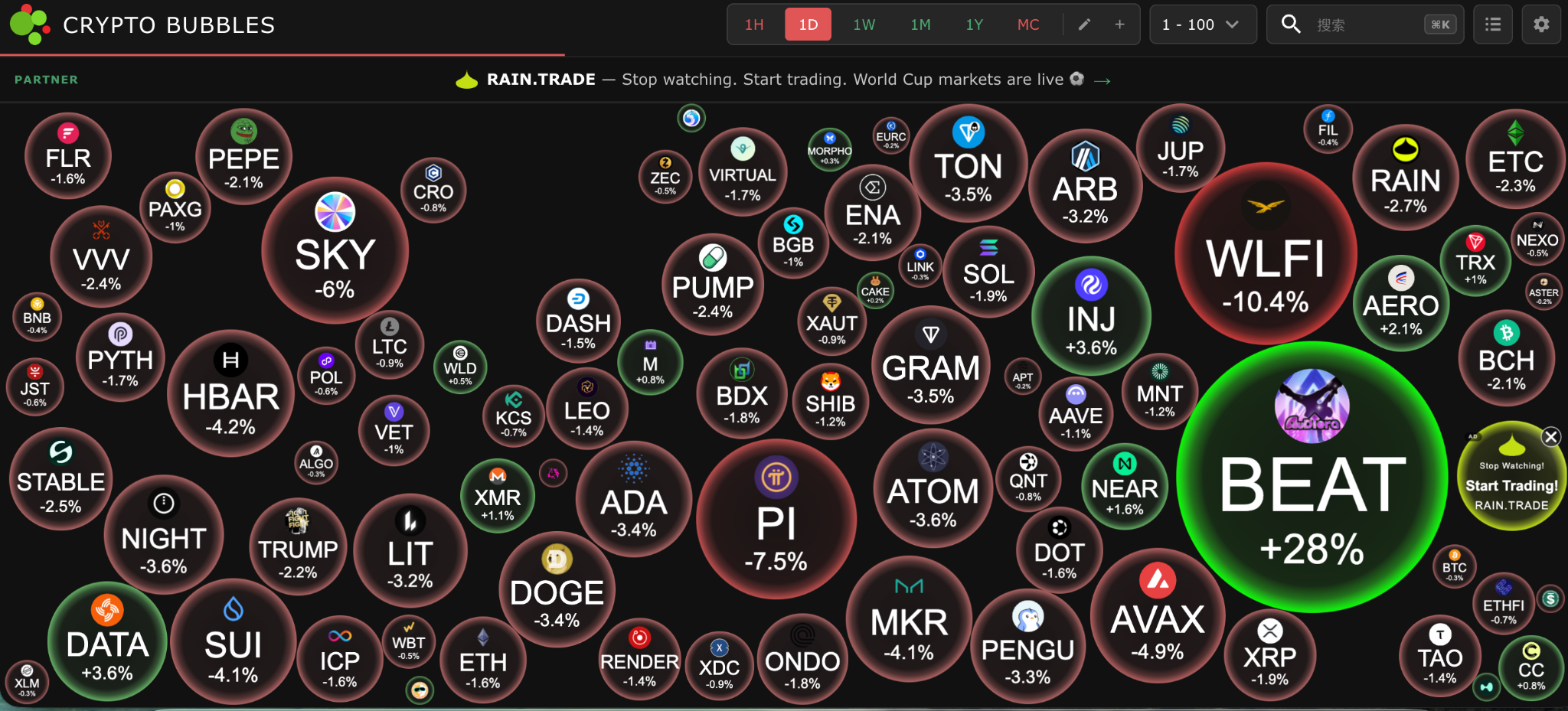
Today’s top gainers among the top 100 cryptocurrencies by market capitalization: BEAT up 28%, INJ up 3.8%, DATA up 3.6%, AERO up 2.1%, NEAR up 2%.
US stocks night session storage retreat, Tesla and Google that plummeted last night rebounded slightly

The futures prices of the three major US stock indexes diverged, with Nasdaq 100 futures down 0.19%, Dow futures up 0.32%, and S&P 500 futures up 0.07%.
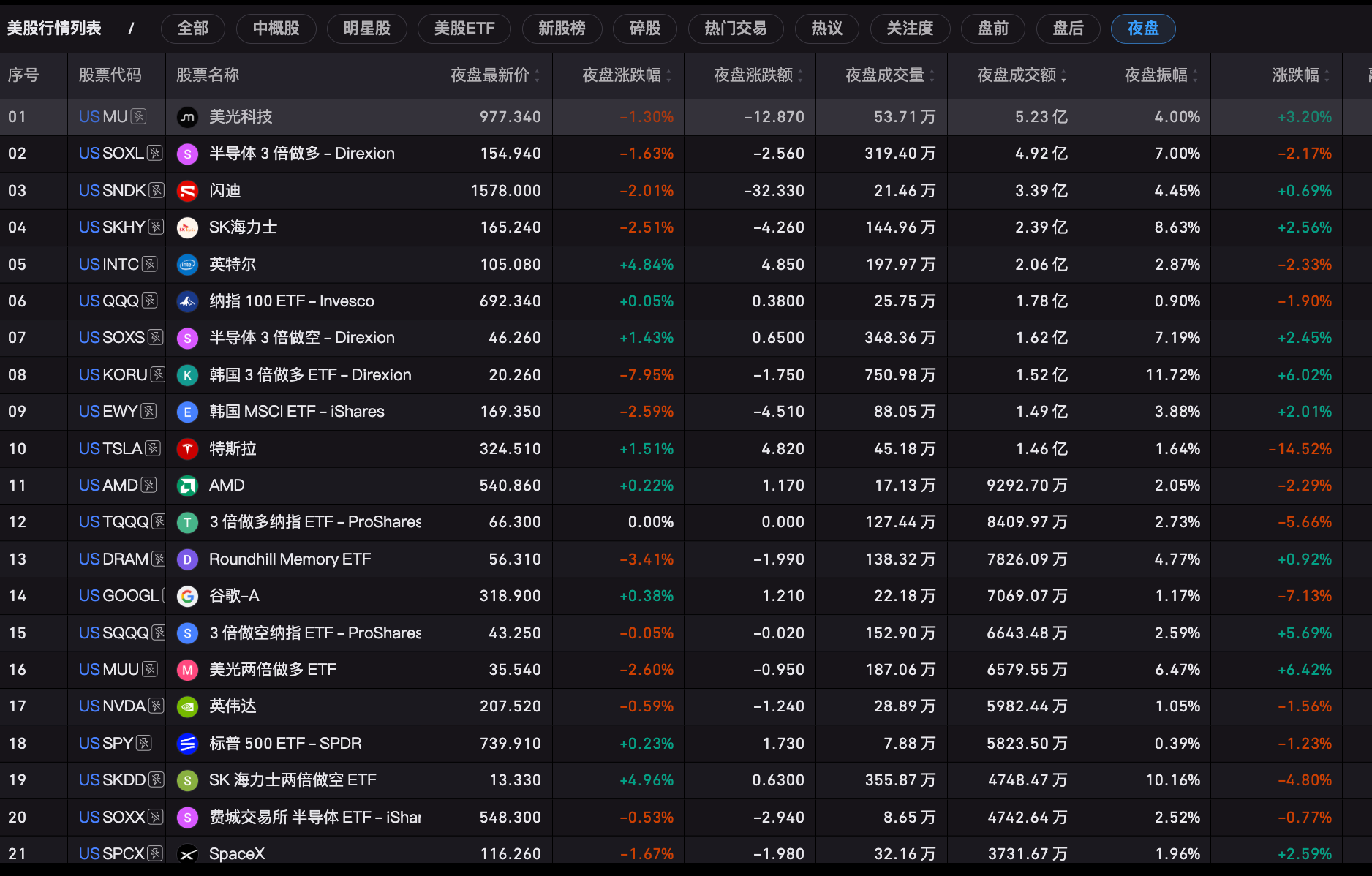
BIT night session data shows that in the night trading of US stocks, the storage sector began to decline again, with Micron down 1.3%, Seagate down 2.01%, Hynix down 2.51%, and DRAM down 3.41%. Tesla and Google rose slightly by 1.51% and 0.38% in night trading after last night's sharp decline.
Intel rose more than 13% post-market, increasing 4.84% in night trading: The company's Q2 revenue rose 25% year-on-year to $16.13 billion, significantly exceeding market expectations, with data center and AI business revenue increasing by about 59%, and the third-quarter guidance also better than expected. CEO Pat Gelsinger stated that AI is driving global computing demand to unprecedented levels.
Oracle rose about 2% in night trading: The company won a software service contract from the US Department of Defense worth up to about $6.99 billion over 10 years. The contract covers the use of software in military branches, the Coast Guard, and the intelligence community's local data centers, briefly easing market worries about OCI cloud growth and AI capital expenditure returns.
Emark Technologies surged nearly 12% in night trading, due to the company reaching a multi-year strategic partnership with Nvidia. The market is still willing to give a premium to AI hardware supply chains after the technology stocks' decline, but is more inclined to buy companies that “sell shovels” rather than giants whose cash flows are being consumed by the AI arms race.
US stocks were dragged down by seven giants but AI still in play
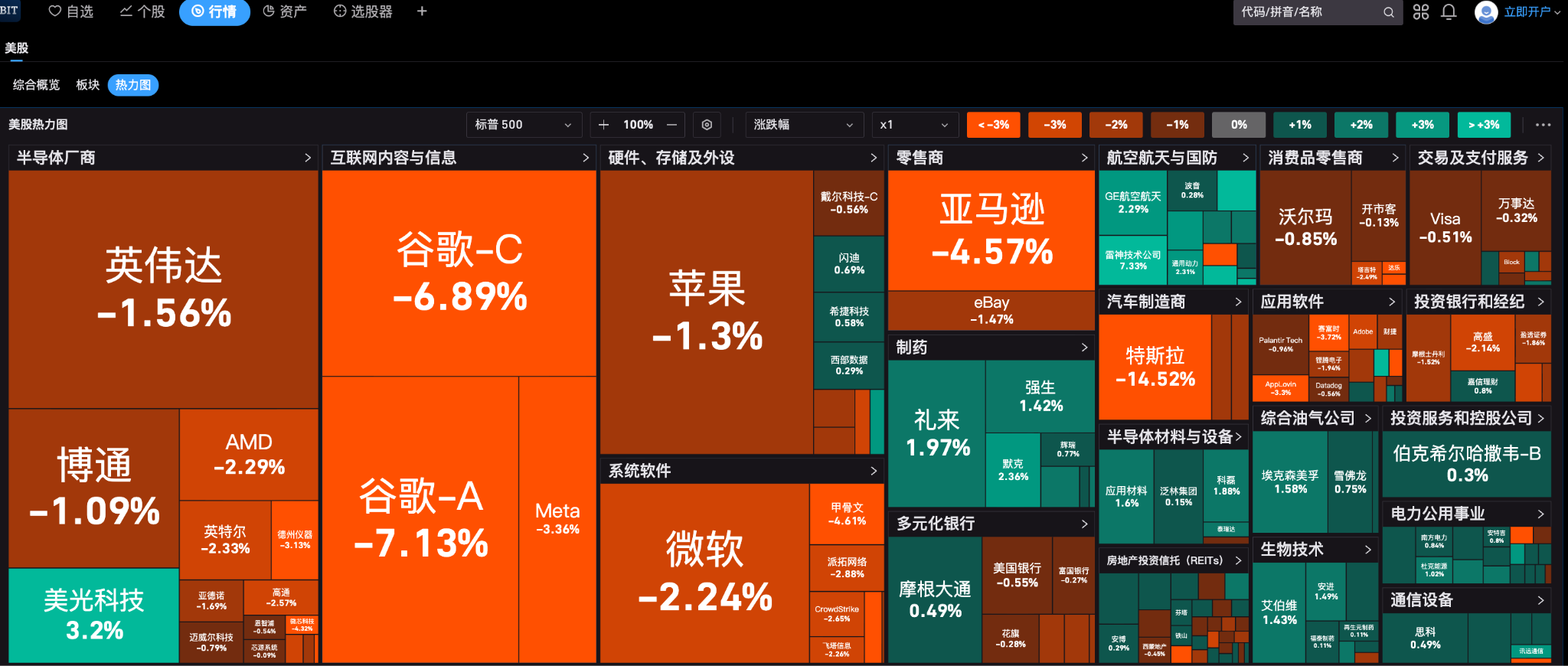
US stocks faced their largest single-day drop in nearly a month on Thursday, with the Dow down 0.97%, the S&P 500 down 1.21%, and the Nasdaq plunging 2.15%. The market capitalization of the “seven giants” in technology evaporated nearly $800 billion overnight, with Tesla plummeting 14.52% due to disappointing earnings and governance uncertainties, while Google dropped 7.13% as its free cash flow turned negative due to AI infrastructure investments. Other companies like Amazon, Meta, Microsoft, and Apple also generally closed lower.
BIT US stock invite analyst Jun believes that the core of the current tech stock sell-off lies in the market's re-evaluation of the AI “burning cash” model: the massive capital expenditures are “sacrificing” the giants' free cash flow, which not only directly weakens their capacity to repurchase stocks that support share prices but also raises concerns about future financing through share issuance. Meanwhile, the market has seen significant divergence, with the storage chip sector (like Micron, SK Hynix, and SanDisk) rising against the trend due to benefiting from capital expenditure orders from cloud providers; defense stocks have become a safe haven, with Lockheed Martin soaring 10.54% due to better-than-expected earnings and backlog of orders.
Why are chip stocks rising instead? The reason is simple: the money that the giants are burning ends up as orders for chip companies.
Google, Tesla, and Amazon spend money to build AI data centers, needing to buy GPUs, storage, servers, and network equipment. Therefore, for companies like Micron and SK Hynix, the higher the capital expenditure from cloud vendors, the better the short-term orders.
However, BIT also reminds that this relationship may not be healthy. If Google and Tesla are pressured by shareholders to cut capital expenditures in the future, the good times for chip companies may suddenly cool.
On the macro front, Brent crude futures once broke $100 per barrel, and WTI was above $90, as inflation expectations reignited. The number of Americans filing for unemployment benefits fell to 187,000, the lowest since 1969, showing a strong labor market that further suppresses the expectation for interest rate cuts by the Federal Reserve. In addition, US Treasury yields have also risen, with the 10-year Treasury yield climbing to 4.70%, and the market fears that if it approaches 5.0%, it will put more severe pressure on tech stock valuations.
BIT reminds that the risk signals for US stocks are now very obvious: negative free cash flow, rising VIX volatility, and oil prices exceeding $100. The combination of these three signals is not friendly to risky assets.
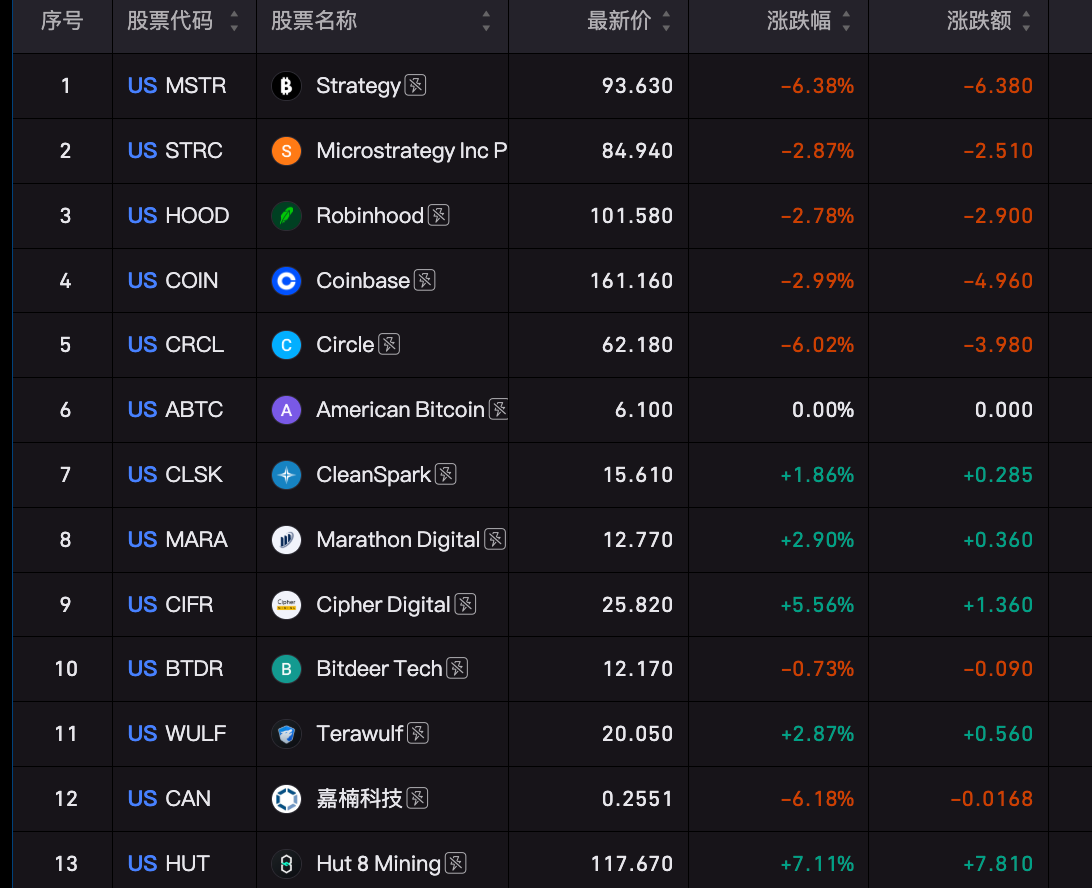
In terms of crypto concept stocks, according to BIT US Stocks data, an overall decline is observed, with Circle down 6.02%, Strategy down 6.38%, and Korea Future Assets increasing its holdings of MSTR stocks by about 25,573 shares. However, the market also noticed that some Bitcoin treasury companies are selling coins to relieve cash flow, even abandoning their BTC reserve strategies. Coinbase fell 2.99%, previously downgraded by Citigroup from a target price of $400 to $235, indicating that institutions are more cautious about trading volume, regulations, and earnings elasticity. Robinhood fell 2.78%, as the CEO account hack and the false meme coin event came under scrutiny.
In the mining sector, Canaan Creative fell 6.18%, Cipher rose 5.56%, Hut 8 rose 7.11%, and MARA rose 2.9%, having sold about 15,133 BTC to repurchase bonds and improve its balance sheet.
Oil prices, chips, and regulation all hit hard, with Korea leading the drop, and Japan held back by the yen and external demand
Affected by the chain reaction of the overnight drop in US tech stocks, escalating Middle East tensions, and oil prices breaking $100 per barrel, the Asia-Pacific stock markets experienced heavy losses today. The Korea KOSPI index closed down 5.73%, and the Nikkei 225 index closed down 2.73%.
As a semiconductor industry stronghold, the Korean stock market was particularly hard hit. Key stocks Samsung Electronics and SK Hynix closed down 7.59% and 8.33%, respectively. After the overnight decline in US tech stocks, Asian investors chose to reduce their positions first, especially before the weekend, as many funds were unwilling to continue bearing risks.
Shawn Oh, head of Korean cash stocks at NH Investment & Securities, stated that due to the ongoing tensions in the Middle East, local funds reduced their holdings of tech stocks and lowered their risks ahead of the weekend, amplifying the downward risk.
Roy Lim, a stock trading officer at Samsung Securities, also mentioned that some Asian hedge funds are selling Samsung and SK Hynix to prepare for increasing holdings in Yangtze Memory Technologies, which will be listed on July 27.Korea also faces regulatory pressures, as the Financial Services Commission of Korea announced that the minimum cash margin requirement for single stock leverage ETFs and ETNs has increased from 10 million KRW to 30 million KRW, and it must be in cash, not using stocks, ETFs, or bonds as collateral. The new regulations will take effect on July 31. This means that retail investors wanting to leverage buy single stock leveraged products like Samsung, SK Hynix, Tesla, or Nvidia face higher thresholds. The market worries this will reduce the enthusiasm for leverage funds for popular tech stocks.
SK Group is also affected by a non-operational event, as a Korean court ruled that SK Group Chairman Chey Tae-won must pay his ex-wife 944 billion KRW, about $643 million in divorce property settlement. If it ultimately takes effect, this could become one of the largest divorce cases in South Korean history. The market is watching whether this money will be paid in cash or stocks in the future.
The Japanese market is also struggling, with the Nikkei 225 down 2.73%, primarily influenced by three factors: rising oil prices, weakening yen, and cooling technology stock sentiments. The yen is nearing 164 against the dollar, close to a 40-year low. Normally, yen depreciation benefits Japanese export companies, but this time it’s different, as oil prices are also surging. The increase in Japan's energy import costs raises concerns about imported inflation, and the Japanese government may even intervene in the exchange rate.
Morgan Stanley has also cast a shadow on Asian storage stocks, with its head of technology research for Asia and Europe, Shawn Kim, stating that the storage industry boom driven by AI may be approaching a turning point, and memory contract prices are expected to peak in the fourth quarter. Although HBM remains in high demand, ordinary DRAM and high-end storage are differentiating, and the market is reluctant to continue giving the entire sector high valuations.
The A-shares and Hong Kong stocks showed local activity:
The Hong Kong brain-computer interface sector strengthened. Brain Motion Aurora-B rose over 10%, with Nanjing Panda Electronics, Lens Technology, and Microneuroscience also rising. On the news front, a Chinese research team released a new brain signal acquisition device, achieving synchronous brain signal acquisition for thousands of people across regions.
Short-selling Tesla products surged, with the South China Double-Short Tesla rising over 15%, mainly due to Tesla's US stock plummeting 14.52%, along with earnings showing below-expectation profits and negative free cash flow.
The People's Bank of China continues to inject liquidity, conducting a 500 billion 1-year MLF operation, injecting 100 billion more than the maturing scale, marking the third consecutive month of increased operations. In simple terms, this is maintaining stable funding domestically amid a global rise in interest rates and a strong dollar.
免责声明:本文章仅代表作者个人观点,不代表本平台的立场和观点。本文章仅供信息分享,不构成对任何人的任何投资建议。用户与作者之间的任何争议,与本平台无关。如网页中刊载的文章或图片涉及侵权,请提供相关的权利证明和身份证明发送邮件到support@aicoin.com,本平台相关工作人员将会进行核查。


