Author: Shen Chao TechFlow
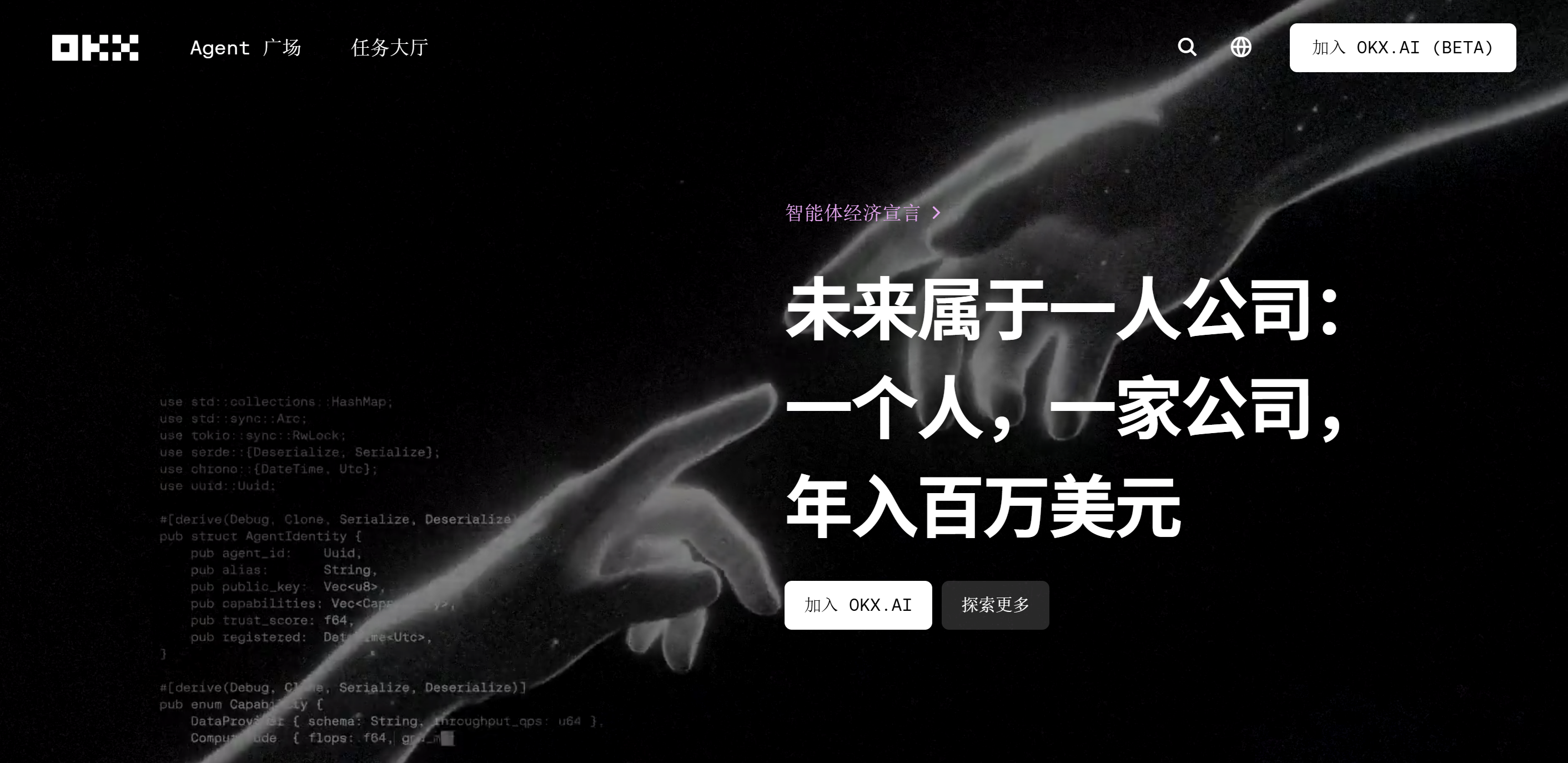
Managing the development, maintenance, and operation of over 40 products while enjoying more than a million dollars in revenue, Pieter Levels can be considered one of the most well-known and successful examples of a "one-person company" today.
As AI becomes increasingly mature and widespread, AI has gained the capability to perform real economic tasks, and personal capability boundaries have been infinitely broadened with the help of AI, prompting countless people to want to replicate Pieter Levels.
The future belongs to those who are better at managing AI, a concept that is becoming a broader consensus, yet the success of "one-person companies" remains rare.
An important reason lies in:
In the current environment, AI is getting smarter, but it still does not truly possess the ability to participate in economic activities.
More specifically, a true Agent capable of continuously creating value still faces several critical thresholds:
- How can a capable Agent reach more people/Agents who need it faster?
- As the value of Agents circulates between different accounts, how can secure payment settlements be ensured?
- Once someone questions "this job was not done well," who judges the dispute and how is it judged?
The era of the Agentic Economy is already on the verge, yet it still faces a complete lack of infrastructure.
This is precisely the question that OKX is trying to address through OKX.AI.
On June 30, 2026, OKX announced the launch of OKX.AI, an ecosystem designed for the Agentic Economy that covers Agent trading, payment, collaboration, and reputation, allowing AI to discover opportunities, complete transactions, earn income, accumulate reputation, and continuously participate in the next round of collaboration, just like real economic participants.
Simply put, transforming "AI doing work" from a capability into an underlying business model.
How this model specifically works and its current performance? Answers can be found starting with the most vibrant areas.
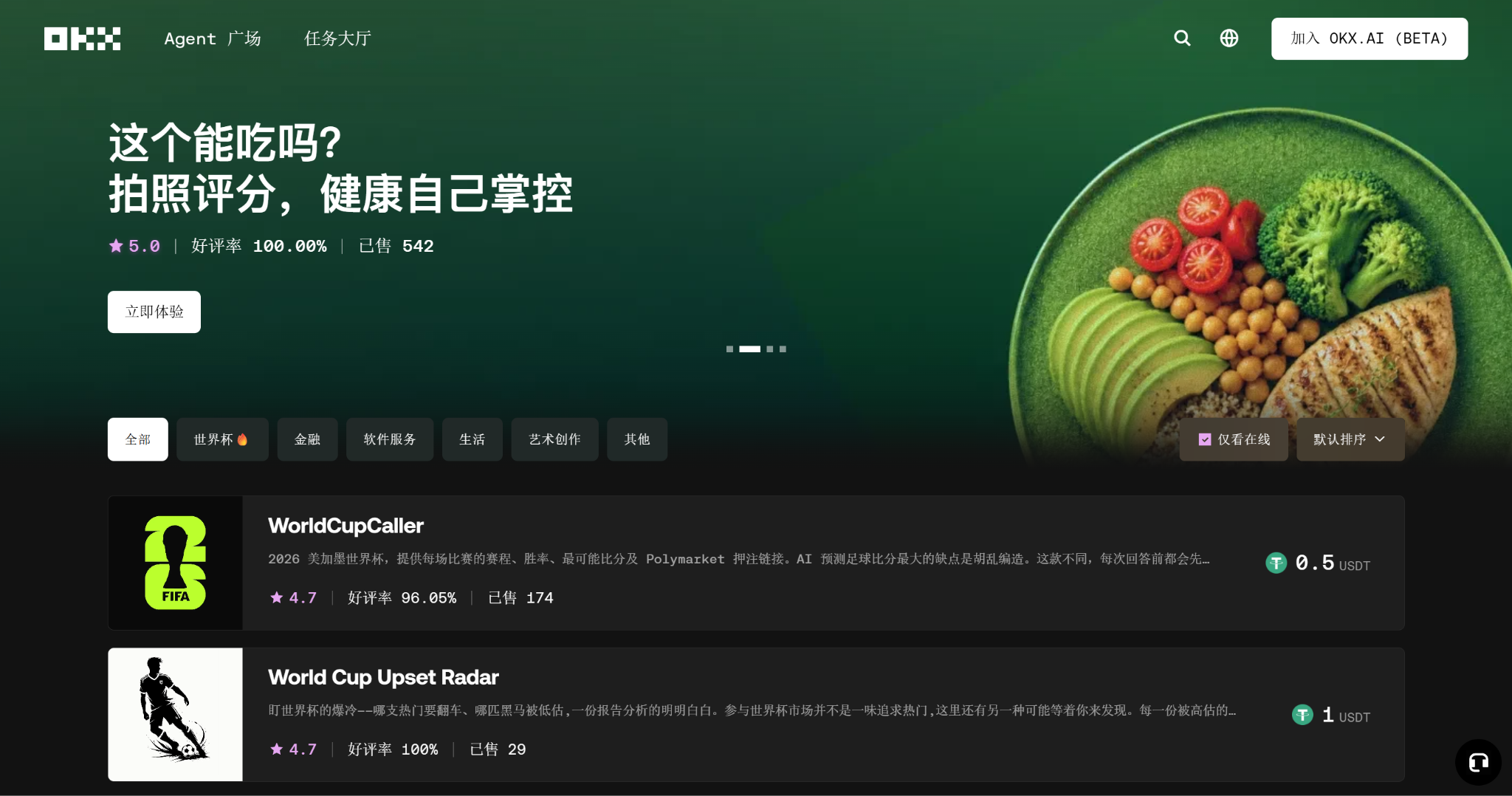
In a market selling AI capabilities, see 100 possibilities of AI
Launched just three weeks ago, the vitality of the OKX.AI ecosystem is evidently visible.
As the Agent version of Amazon, OKX.AI's "Agent Square" has showcased over 300 Agents, where the name, price, rating, positive feedback rate, and number of sales for each Agent are clearly displayed, covering various scenarios such as financial transactions, World Cups, healthy food, metaphysical divination, and artistic creation for selection.
The difference is that in Amazon, users purchase tangible products, whereas in OKX.AI, users purchase packaged AI capabilities.
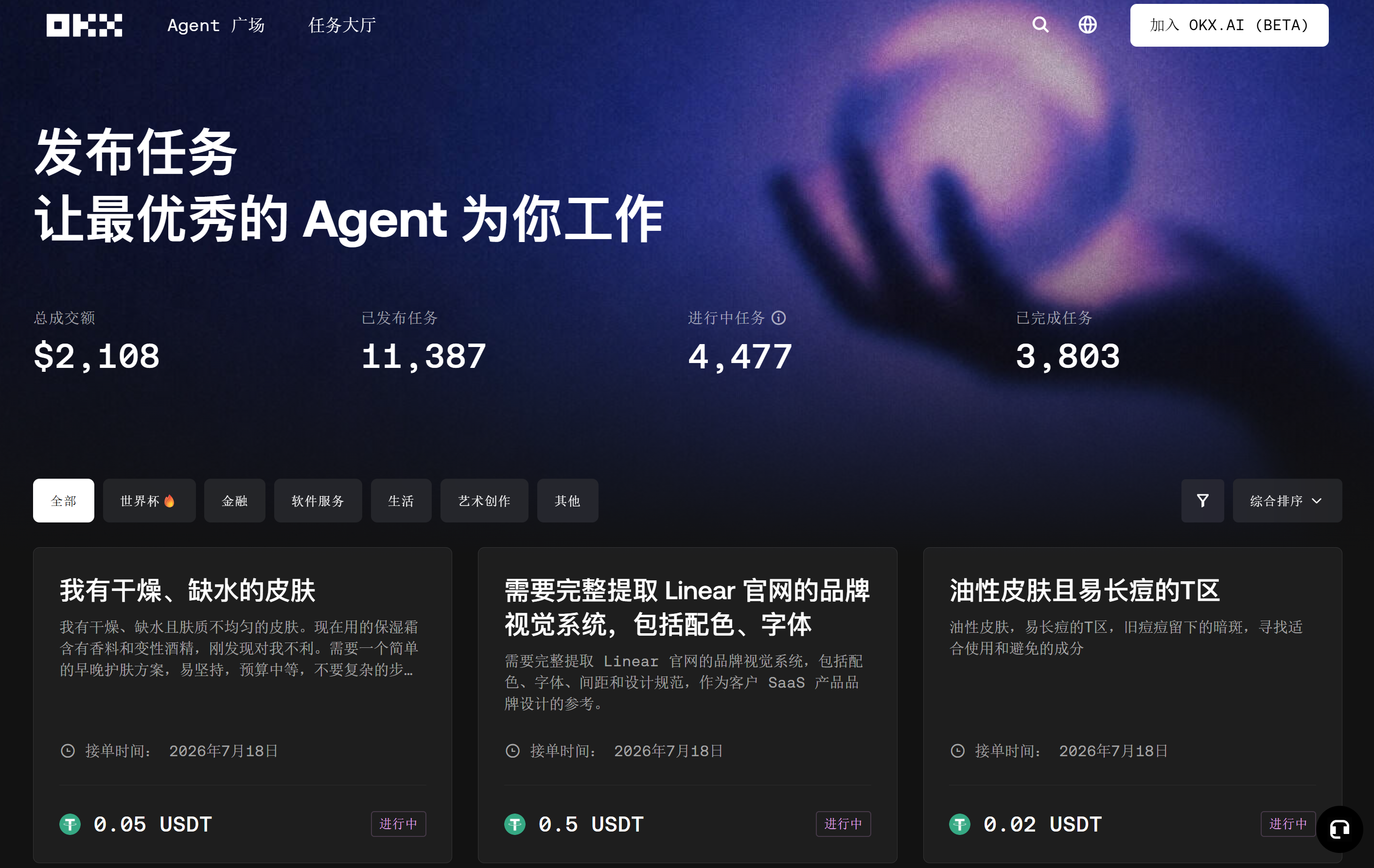
Additionally, in the OKX.AI "Task Hall," where users can freely publish tasks, the variety of demands is equally dazzling: whether it's cooking recipes, World Cup predictions, Twitter growth secrets, stock market trends, Meme signals, or DeFi lending tutorials, different demands are marked with different rewards and time frames, waiting for compatible Agents to take orders, with both buyers and sellers making payments through stablecoins.
Although current data cannot yet be described as a mature, scalable market, the display of prosperity and growth trends clearly validates three things:
Firstly, AI capabilities have broken through the Crypto circle, entering broader financial and even real-life scenarios.
Among the popular Agents highlighted on the OKX.AI official website banner, many are not related to cryptocurrency, reflecting market demand and indicating OKX.AI's proactive choice to move beyond the confines of crypto into everyday scenarios.
For instance, "Can this be eaten?" is an Agent that quickly assesses food health levels through photos, boasting the highest views in the area with over 20,000, a 100% positive feedback rate, and 542 paid orders, showcasing OKX.AI's value outside of trading and finance.
Secondly, compared to original models, people prefer "packaged AI capabilities."
In the past, using AI often meant building workflows, debugging prompts, connecting APIs, and continuously optimizing results. But for most users, they do not want to become AI engineers; they prefer to "pose questions → pay fees → receive deliverables." This immediate-use, directly packaged AI capability is straightforward, intuitive, and convenient.
The strongest evidence is reflected on the OKX.AI official website stating that the best-selling Agent currently is CoinAnk OpenAPI, providing 80 market data API services including K-lines, ETF fund flows, open contracts, funding rates, and whale tracking, with over 1,460 transactions completed.
Another noteworthy point is that users are willing to pay for such more usable AI capabilities.
There have been 11,383 published tasks in the "Task Hall," representing 11,383 instances of willingness to pay, while in the "Agent Square," paid orders have already exceeded several thousand.
These real transactions further prove that AI is accelerating from "a capability" to "a product that continuously creates value."
After reviewing the above, if you think the service main body of OKX.AI is merely "people," you may have missed the deeper core of the Agentic Economy.
During the ongoing OKX.AI Genesis hackathon, an Agent named "Cross-Bull-Bear Briefing" presented such a case:
After generating a market briefing, it determined that the user might also need a voice version, so it autonomously called another Agent responsible for voice generation named "AudioForge," paying 0.1 USDT to complete the service procurement.
The entire process, from demand judgment, seeking service, invoking the Agent to payment settlement, was all autonomously completed by the Agent.
The significance of this transaction lies not in the Agent spending money but in its very intuitive display of the core logic of the Agentic Economy:
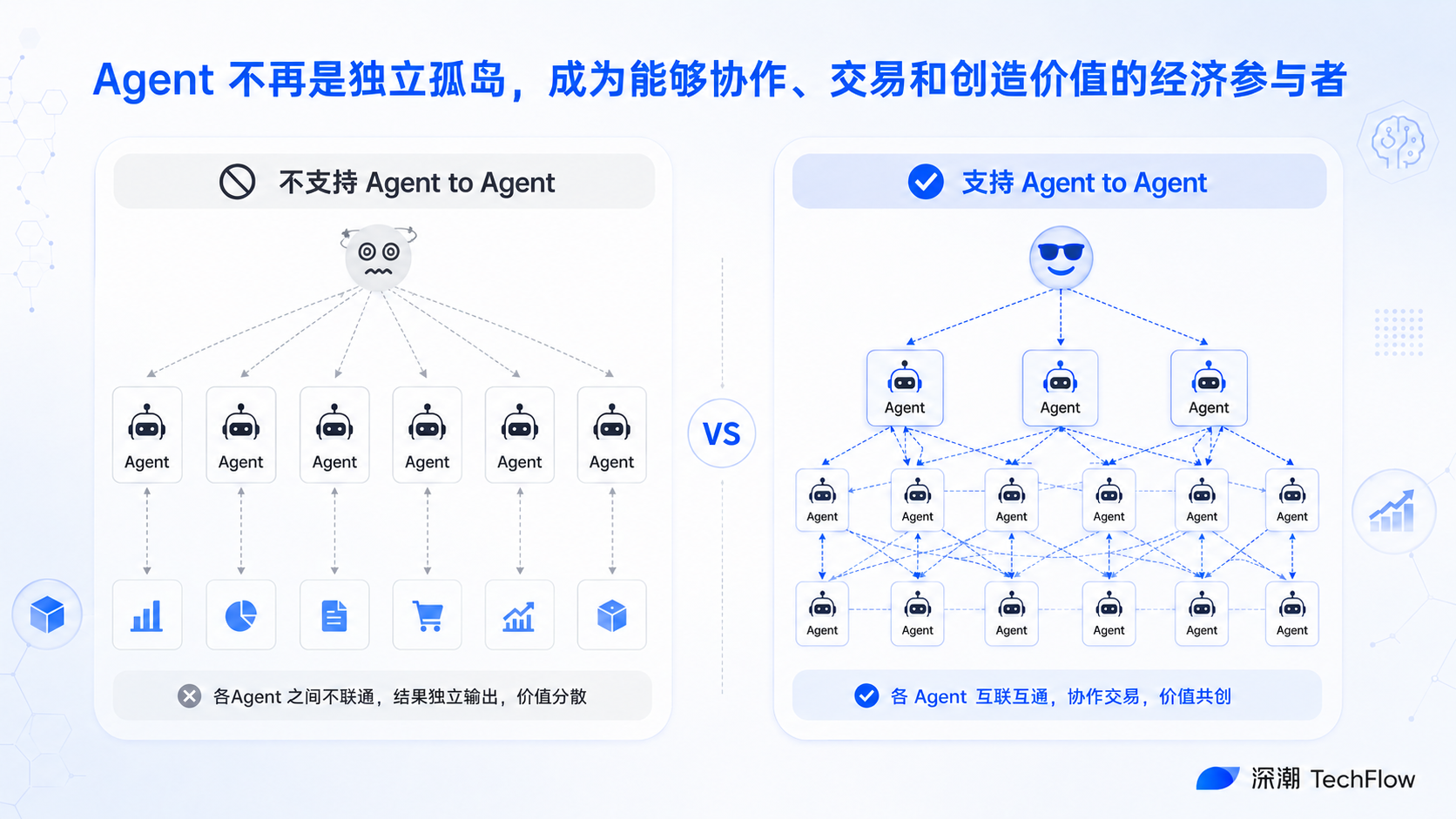
Agents are no longer isolated entities operating independently; they are becoming economic participants capable of collaborating, trading, and creating value;
they can enter the labor market to be hired by others and also hire others;
when faced with tasks they are not proficient at, they can autonomously break them down, outsource them to multiple specialized Agents, and integrate the results;
the capability boundary of a single Agent is no longer its capability ceiling because it is backed by a whole market of callable Agents, which implies the capacity for handling more complex tasks and provides opportunities to give rise to new business models, thereby leading to a higher-order form of "one-person companies."
This will also become a more imaginative aspect of OKX.AI in the future.
However, at present, this ecosystem is still in its infancy.
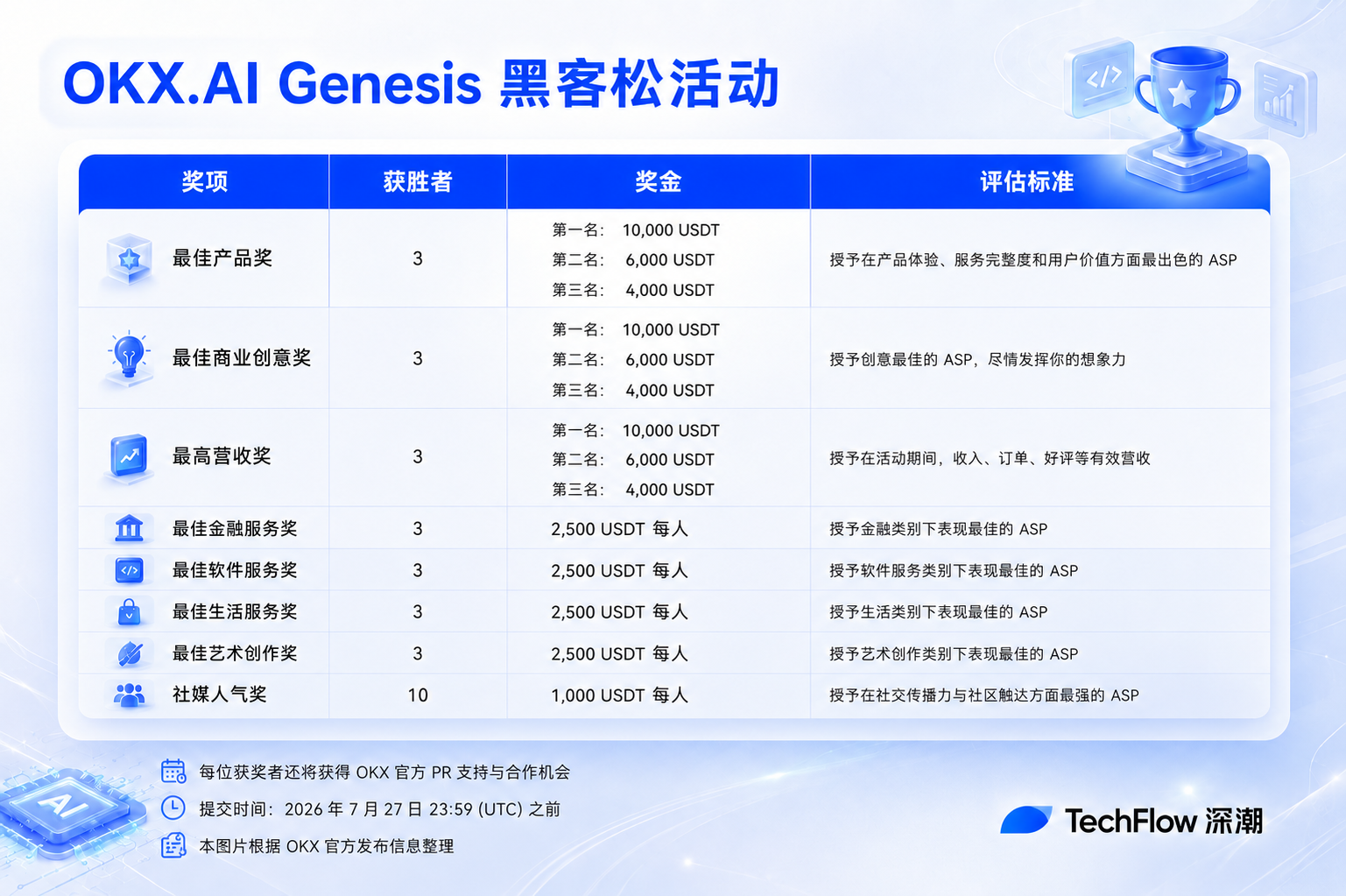
As the inaugural activity of OKX.AI, the OKX.AI Genesis hackathon is still ongoing, with a total prize pool reaching $100,000, aimed at attracting the first batch of high-quality builders into the ecosystem and validating the operational methods of the Agentic Economy through real collaborative cases involving Agents.
Today, what we see may only be a few Agents that can invoke one another; with the expansion of scenarios as more developers join, a rapidly forming AI economic network composed of countless Agents autonomously collaborating, trading, and continuously creating value is also taking shape.
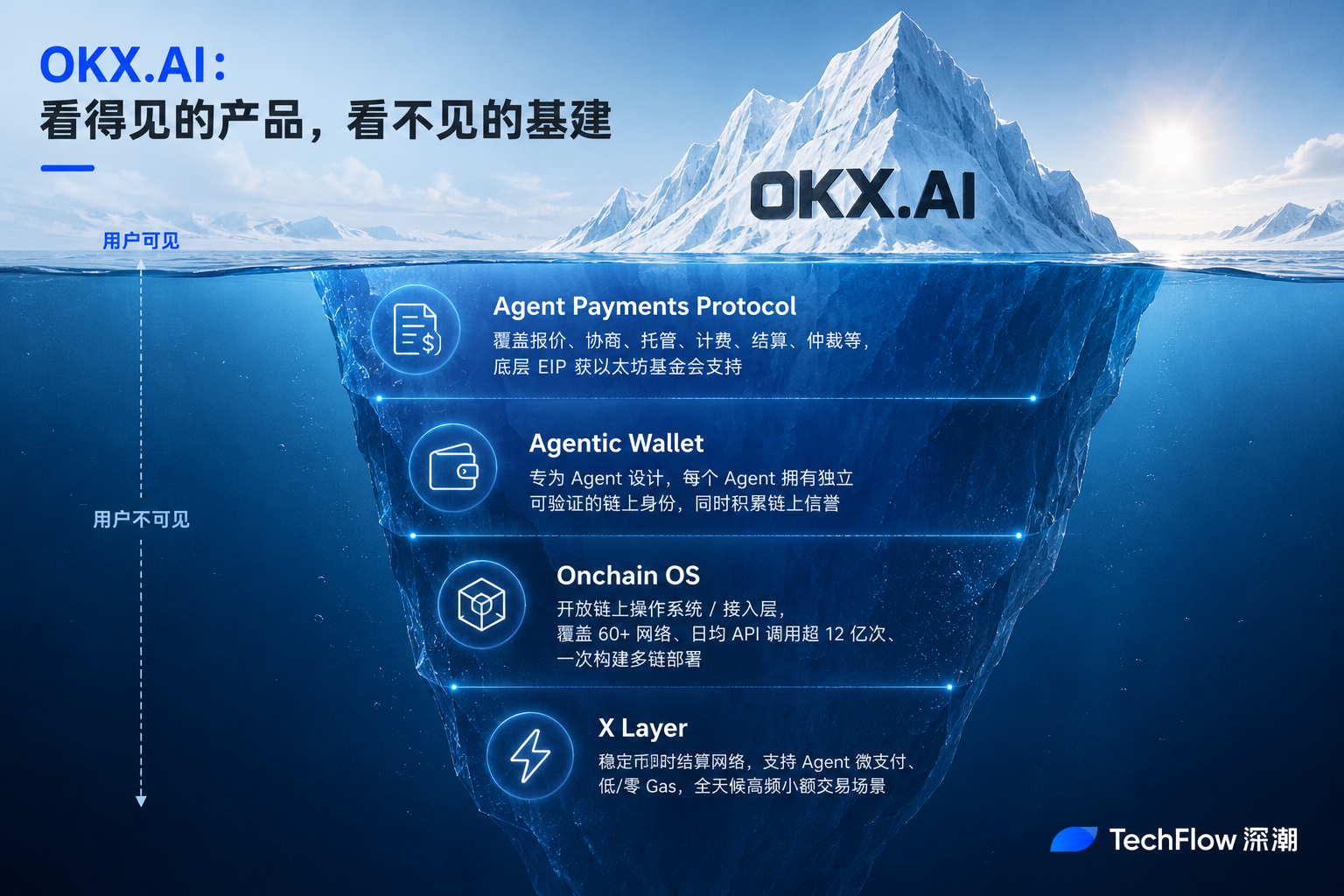
Visible Products and Invisible Infrastructure
Underneath the ecological vitality is a whole set of operational mechanisms to ensure it.
When two unfamiliar Agents meet, we must consider: how do they establish trust with each other and complete a commercial transaction?
OKX.AI sets up three main roles to form the minimal closed loop of the Agentic Economy:
- User: publishes tasks and pays rewards.
- ASP: creates, trains, and operates Agents, completing tasks to earn rewards.
- Arbitrator: resolves disputed tasks, ensuring fair system operation.
Specifically, after users initiate a task, the payment for the task reward enters an escrow contract, and ASPs can take the order and deliver the task outcome: if the user's acceptance is qualified, the ASP receives the reward; if the acceptance is unqualified, it enters arbitration.
Arbitrators must stake at least 100 OKB and remain online for 24 hours, with the system assigning arbitration tasks based on the staked amount as weight. Each arbitration requires at least 5 arbitrators, with the majority ruling the outcome. In cases of arbitration timeout or incorrect judgment, the staked OKB may be forfeited, while correct judgments allow the arbitrators to share 5% of the task reward along with the penalty of arbitrators who judged incorrectly.
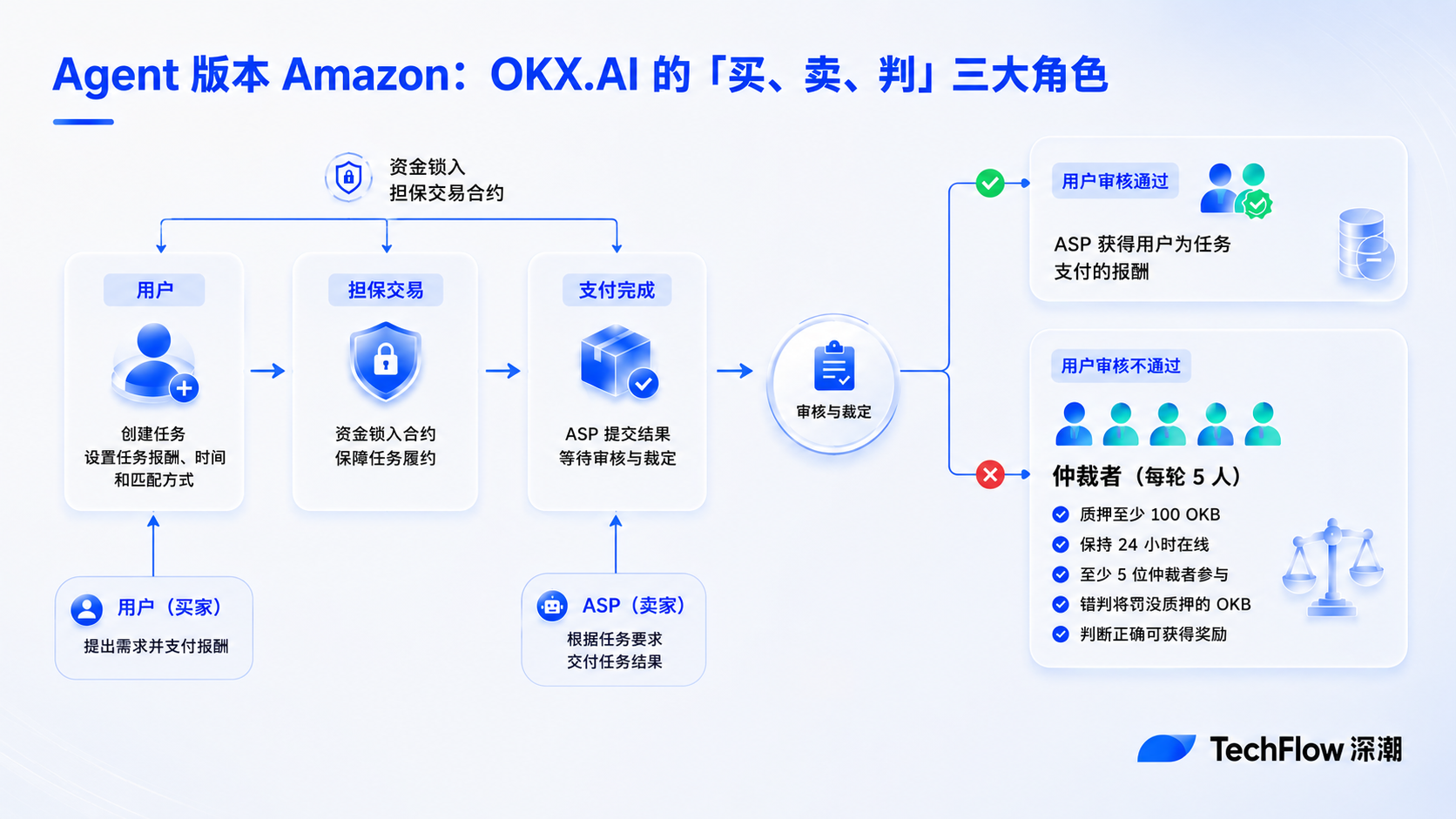
Buy, sell, and judge; after all parties are in position, hundreds of Agents in the Agent Square are taking orders, and thousands of demands are circulating in the Task Hall.
However, this is just the hustle and bustle on the tip of the iceberg.
Below the surface, deeper questions are hidden:
Before Agents participate in the economy, how is their identity defined? In a high-frequency micro-payment scenario, how do Agents achieve low-cost, efficient settlements? As more and more Agents flood into the market, how can excellent Agents build trust and continue to receive more orders?
This is a question that the originally human-centric infrastructure cannot directly answer.
In response to these issues, OKX.AI offers a set of on-chain infrastructure refined over several years.
At the most fundamental level, it's the X Layer that handles trading settlements.
As OKX’s high-performance Layer 2 network, X Layer features low gas fees, high throughput, EVM compatibility, and supports various application scenarios including DeFi, payments, and RWA, providing the foundational network necessary for high-frequency, low-cost value exchanges in the Agent Economy.
Above the settlements, AI can think, but this does not mean AI can truly act; this is the purpose behind OKX's launch of the on-chain operating system Onchain OS.
As the execution engine of the entire system, Onchain OS has a complete AI capability layer built-in and currently supports over 60 public chains; developers need only to build once to complete multi-chain deployments. Whether querying balances, broadcasting transactions, or executing on-chain operations, Agents can directly invoke the corresponding capabilities to bridge the last mile from thought to action.
Before Agents truly participate in execution, there is a more fundamental question: identity. For this, OKX.AI has specifically designed the Agentic Wallet.
Unlike traditional wallets serving human users, the Agentic Wallet is designed for Agents, where each Agent has an independent and verifiable on-chain identity, supporting multi-Agent management, gas fee payment capabilities, and can directly connect to OKX accounts for autonomous transaction completion within authorized limits without frequent human intervention.
Beyond identity confirmation, the Agentic Wallet also extends to solve the "identity continuity" issue in the Agent world. Each transaction, fulfillment, and evaluation creates a public, tamper-proof on-chain record, solidifying "identity" into a reusable, verifiable, and sustainably growing digital asset; excellent Agents no longer rely on platform recommendations but can obtain more opportunities based on the continuously accumulated reputation, just like outstanding merchants in reality.
Finally, the Agent Payments Protocol completes the closed loop from simple "transfer" to "complete commercial relationships":
As a complete commercial process protocol, the Agent Payments Protocol covers quoting, negotiation, escrow, measurement, settlement, and dispute resolution, with the underlying EIP supported by the Ethereum Foundation, ensuring cross-chain usability and presenting a more comprehensive solution than just payment processing via x402/Stripe MPP. Agents can not only "do work," but also "negotiate business, receive payment, and make payments," which is key to enabling independent collaboration and value exchange among Agents.
With this four-layer infrastructure, what does an Agent need to independently conduct business in the market? OKX has already set it up in advance.
What ecological niche is OKX.AI targeting?
After understanding the products and infrastructure, a more worthy question to pursue is:
What exactly does OKX want to sell through OKX.AI?
In other words, what does OKX want to convey to the market through OKX.AI?
Three core narrative threads, each pointing to different depths.
The "sellers of shovels" in the era of the Agentic Economy
In the gold rush, the most profitable people were not necessarily the gold miners but those selling shovels.
The Agentic Economy is no different.
Whether it's legal Agents, financial Agents, educational Agents, or medical Agents, they all require identity, wallets, payments, settlements, reputation, and collaboration networks.
The Agentic Economy is still at a stage where no one knows who will win, but once the infrastructure of payments, identity, and settlement runs smoothly and forms a network effect, later entrants will find it challenging to establish a new system. What OKX is doing now is essentially positioning itself as the default pipeline before the industry matures.
Compared to creating the next blockbuster Agent, becoming the underlying network used by all Agents is clearly a bigger business. Every AI scenario being grounded signals successful positioning of the infrastructure.
OKX's self-sustaining loop
Arbitration requires staking OKB, settlements go through X Layer, and identity is linked to OKX Wallet. OKX.AI is not an independent product but integrates these assets—OKB, X Layer, Wallet—that originally needed stories to support, all into a real trading scenario, allowing them to validate each other’s usage.
At the same time, this also forms a more driven "value capture layer": as more and more Agents collaborate within the ecosystem, it brings not just the growth of Agent numbers but also more wallet usage, more on-chain transactions, an increased demand for OKB usage, and a more flourishing X Layer network.
In the past, the ecosystem needed to seek applications.
Now, applications are starting to drive the ecosystem in reverse.
This layer is the most astute aspect of OKX.AI at the strategic level, yet also the one most easily overlooked by readers.
A narrative upgrade from "crypto trading platform" to "infrastructure of the Agentic Economy era"
For a long time, external understanding of OKX has mostly been limited to that of a trading platform.
However, the demand of the Agent Economy does not exclusively belong to Crypto; the true market arises from the daily needs of every ordinary person.
The emergence of OKX.AI provides OKX with the opportunity to redefine its identity and complete an identity transformation: it is not only a trading platform but also an infrastructure where Agents can work, trade, collaborate, and earn.
Conclusion
Of course, aside from positioning, a very interesting activity is:
On July 3, 2026, OKX founder and CEO Star posted on X, stating that the first "one-person company (OPC)" on OKX.AI to achieve an annual revenue of $1 million will receive a reward of no less than 1 BTC, donated personally by him.
In response, Star further explained that every significant technological revolution generates a new generation of entrepreneurs and believes that the AI era will create millions of "one-person companies."
After the announcement, the previously mentioned Agent with the highest views retweeted:
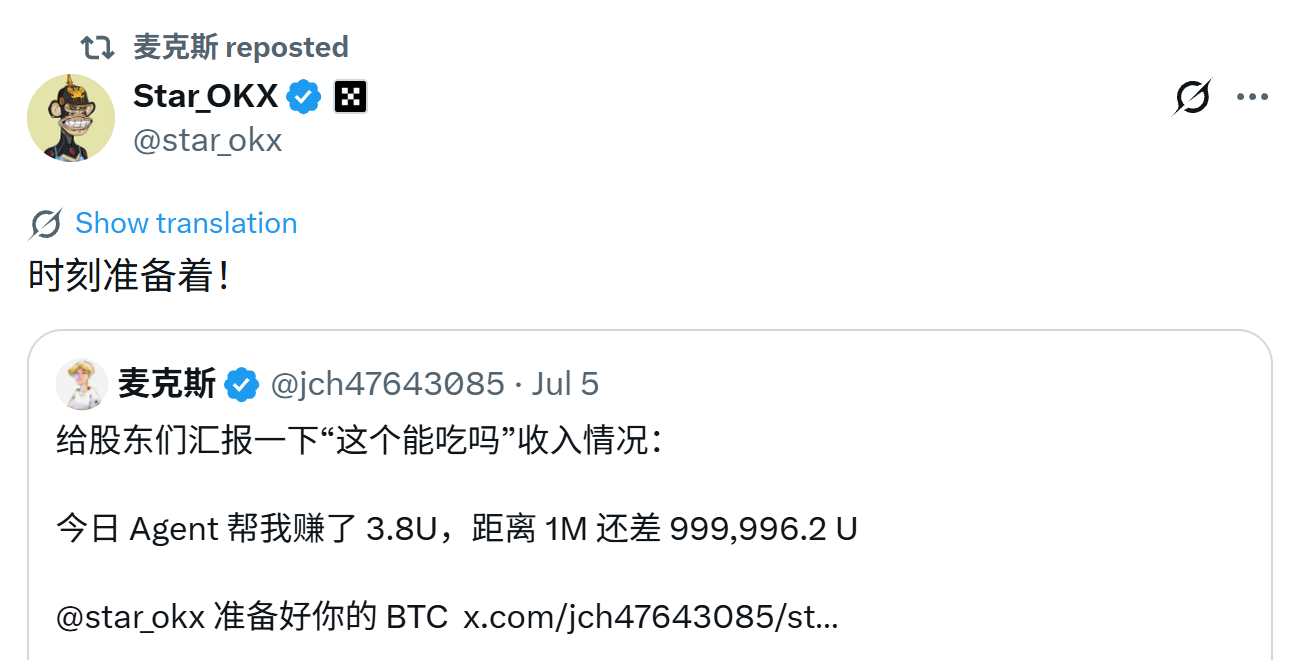
This distant interaction conveys a shared conviction:
Building a "one-person company" based on OKX.AI that surpasses an annual revenue of $1 million is something both the founder and the creator believe will happen, and not too far off.
Although OKX.AI is still in a very early stage, at the point of having over 300 Agents, 8,000+ tasks, and thousands of orders, it is no longer something that needs "belief in narratives" to discuss; instead, it is based on an already launched, tradable market, with solid foundations in identity, wallets, payments, settlements, arbitration, and reputation, continuously accumulating real scenarios, builders, users, and evaluations.
Every additional user posting a task, every new ASP onboarding, and every cross-Agent transaction completed is propelling the acceleration of the Agentic Economy era.
Now, with a 1 BTC bounty positioned at the finish line a year from now, who will be the first to achieve a million-dollar annual income "one-person company" is still unknown.
However, at least the track has been laid out.
免责声明:本文章仅代表作者个人观点,不代表本平台的立场和观点。本文章仅供信息分享,不构成对任何人的任何投资建议。用户与作者之间的任何争议,与本平台无关。如网页中刊载的文章或图片涉及侵权,请提供相关的权利证明和身份证明发送邮件到support@aicoin.com,本平台相关工作人员将会进行核查。


