Author: Byron Gilliam
Translation: Shen Chao TechFlow
Shen Chao Editorial: As global exchanges rush to 24x7 trading, we may have forgotten one fact: In 2008, Morgan Stanley survived precisely because the market closed on weekends. Nights and weekends act as the "emergency brakes" of the financial system, giving a gasping market a breathing window — but tokenized stocks and blockchain are tearing down this barrier.
Before the Columbus Day long weekend in 2008, Morgan Stanley seemed poised to become the next domino to fall in the financial crisis.
The bank started that week with $130 billion in cash, which management believed was enough to weather the storm.
However, hedge funds that had previously taken down Bear Stearns, Lehman Brothers, and Merrill Lynch began to withdraw from Morgan Stanley as well — pulling out $65 billion in a single day.
This was a bank run, and it seemed the only way to stop it was for a big investor to inject equity capital.
"If we hadn’t made this deal, it would have been over," CEO John Mack later said, "we couldn’t have continued to operate."
Fortunately, Mack had already negotiated a deal.
Two weeks prior, Japan's Mitsubishi UFJ Financial Group (MUFG) — the second-largest bank in the world, with $1 trillion in customer deposits — agreed to buy a 21% stake in Morgan Stanley for $9 billion.
Unfortunately, the deal had not yet been completed.
Market sentiment grew increasingly skeptical that it would ever be completed. The deal valued Morgan Stanley at $25.25 per share, but investors seemed unconvinced: the closing price on the day it was announced was only $14.22.
Nine days later, it dropped below $10.
This was a major problem.
The lower the stock price fell, the less likely the deal would be completed. The less likely it was to complete, the further the stock price fell.
Worse yet: the lower the stock price fell, the more clients withdrew their funds. More... you get the cycle.
Morgan Stanley allowed its stock price to dictate its fate, while it continued to decline day after day.
"We just need to hold on until the weekend," Morgan Stanley's business development head Charles Smith later said.
The Weekend as a Circuit Breaker
The weekend was a circuit breaker — a two-day window that allowed Morgan Stanley to complete the deal with MUFG without worrying about the stock price.
On Saturday, MUFG affirmed its commitment to invest but needed to renegotiate. By Sunday, a new deal was reached, with MUFG primarily obtaining preferred shares rather than common stock.
Only the payment issue remained.
The announced renegotiated deal could not prevent the death spiral that would be reignited as soon as trading resumed on Monday morning. To restore confidence in Morgan Stanley, the deal had to be completed.
"We knew that if the money couldn't be delivered," MUFG Chairman Nobuyuki Hirano recalled, "the market would sell off Morgan Stanley shares, possibly down to zero."
MUFG was ready to pay, but there was a problem: the Federal Reserve was closed for the Columbus Day holiday, and the stock market was also closed.
Morgan Stanley needed to receive the funds before trading resumed on Monday morning, but the Fedwire payment system handling such a massive transfer wouldn't reopen until Tuesday.
In a state of market panic, Tuesday might be too late; the $9 billion would be worthless by then. Morgan Stanley might have already lost multiples of that amount due to withdrawals.
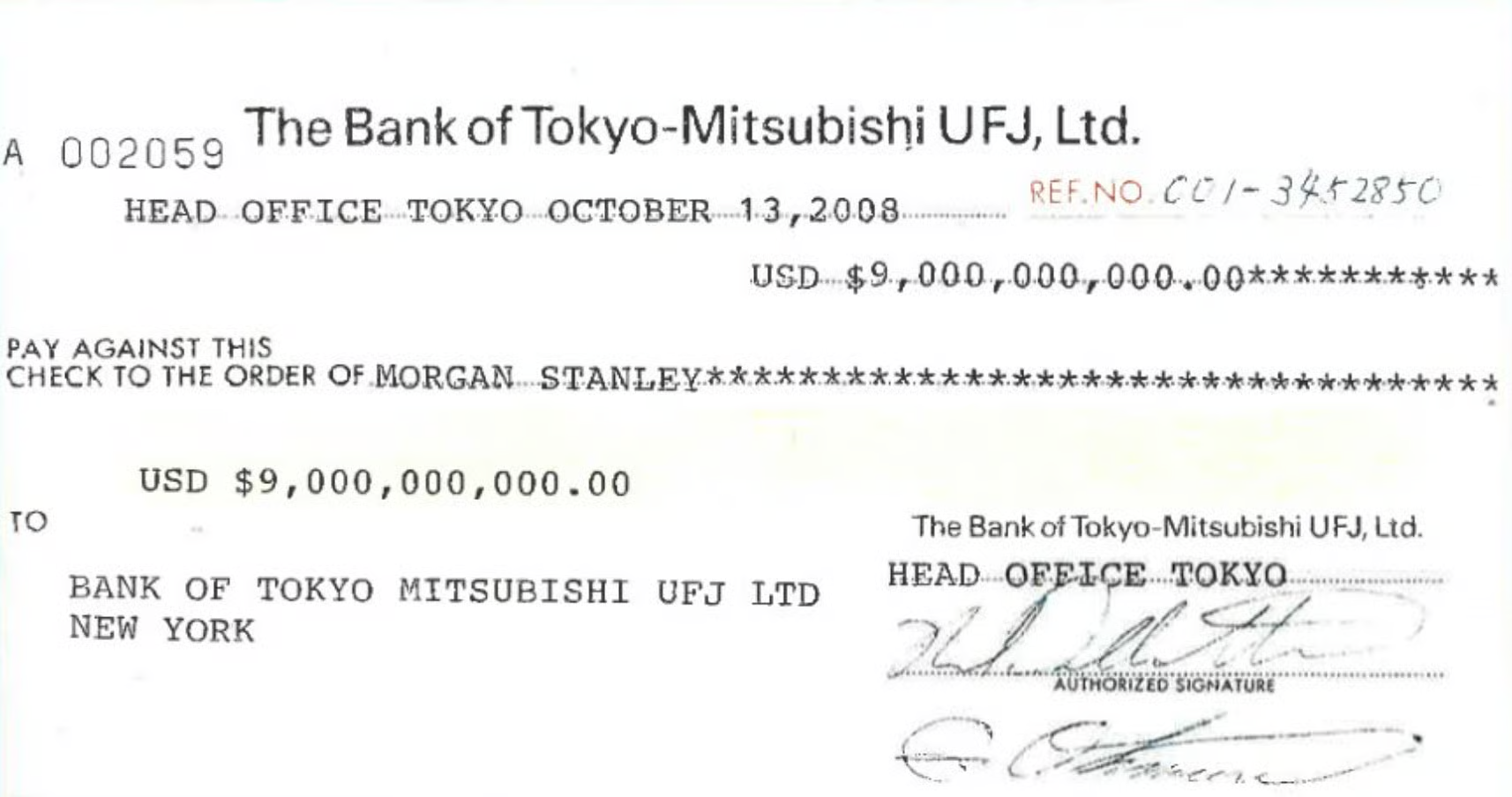
So there was only one solution: MUFG had to write a check.
Morgan Stanley Vice Chairman Rob Kindler proposed this on Sunday, and MUFG agreed. On Monday at 7:30 AM, Kindler waited in a conference room at Wachtell Lipton law firm to receive a physical check.
"He looked terrible," Aaron Sorkin wrote in "Too Big to Fail," "he hadn’t slept in at least a day."
Kindler thought the check would be delivered by a messenger, so he didn’t bother to shave and didn’t change out of the khaki pants and flip-flops he wore after canceling his vacation in Cape Cod.
As a result, the check was delivered by a team of sharply dressed MUFG executives. There was also a film crew.
Kindler hurriedly borrowed a suit jacket from a lawyer, but that lawyer's shoulders were narrower than Kindler's. The back of the jacket ripped.
"I assure you, I am the Vice Chairman of Morgan Stanley," the visibly exhausted Kindler told his Japanese saviors.
Despite his appearance, MUFG handed over the check — just in time for Morgan Stanley to announce it to the world before the stock resumed trading.
The stock price jumped 70% that day.
The bank run ended, thanks to the weekend circuit breaker — but it may not exist for long.
The Lifesaving Pause Button
If the S&P 500 drops 7%, trading is paused for at least 15 minutes. If it drops 20%, it is paused until the next day.
These market-wide circuit breakers were established after the Black Monday crash in 1987 to interrupt panic selling before it becomes self-reinforcing.
Exchanges also have the discretion to pause trading in individual stocks for major news pending release or just for order imbalances — anything that investors might need additional time to consider.
Companies also release earnings reports before or after trading for the same reason. Berkshire Hathaway even releases its reports on Friday nights, allowing investors the entire weekend to digest the information.
This is also the time when regulatory bodies most often attempt to prevent bank runs. Continental Illinois Bank, Barings Bank, and Bear Stearns were all saved over the weekend.
The Federal Deposit Insurance Corporation almost always closes failed banks after Friday's market close, allowing enough time for restructuring under new ownership without affecting depositors' ability to withdraw funds.
Nights and weekends serve as the natural circuit breakers for the entire financial system.
But perhaps not for much longer.
Yesterday, the London Stock Exchange became the latest major exchange to announce plans to transition to 24-hour trading five days a week. The NYSE, Nasdaq, and CBOE are also planning similar moves.
How far off is 24x7 trading?
Exchanges are expanding trading hours to fend off competitive threats from tokenized stocks, which trade on blockchains that never close.
Nasdaq claims this will "broaden investor access, expand opportunities for wealth accumulation, and redefine how markets operate."
I'm sure that's true. But at what cost?
Morgan Stanley is now a $340 billion bank — employing 83,000 people — because the market paused long enough for someone to rescue it.
MUFG still holds a 24% stake.
免责声明:本文章仅代表作者个人观点,不代表本平台的立场和观点。本文章仅供信息分享,不构成对任何人的任何投资建议。用户与作者之间的任何争议,与本平台无关。如网页中刊载的文章或图片涉及侵权,请提供相关的权利证明和身份证明发送邮件到support@aicoin.com,本平台相关工作人员将会进行核查。


