Author: Jae, PANews
While the global technology sector is focused on the semiconductor giant Nvidia's multi-billion, even multi-hundred-billion dollar GPU deals, a recent disclosure from the UK's Companies House revealed its largest bet in the digital finance sector to date.
The document shows that Nvidia's venture capital division, NVentures, holds 141,834 shares in the European digital bank Revolut, with a position valued at nearly $196 million.
This investment in a digital bank not only demonstrates Nvidia's multi-sector strategy beyond semiconductors but also brings NVentures, previously hidden in its shadow, into the public limelight. Since its establishment in 2021, NVentures has been weaving a vast capital network across cutting-edge technology sectors with a strategy distinct from traditional corporate venture capital (CVC).
“Dual-Pillar” Capital Structure: Industrial Investment Strengthens Computing Power Dominance, NVentures Positions at Technology Frontier
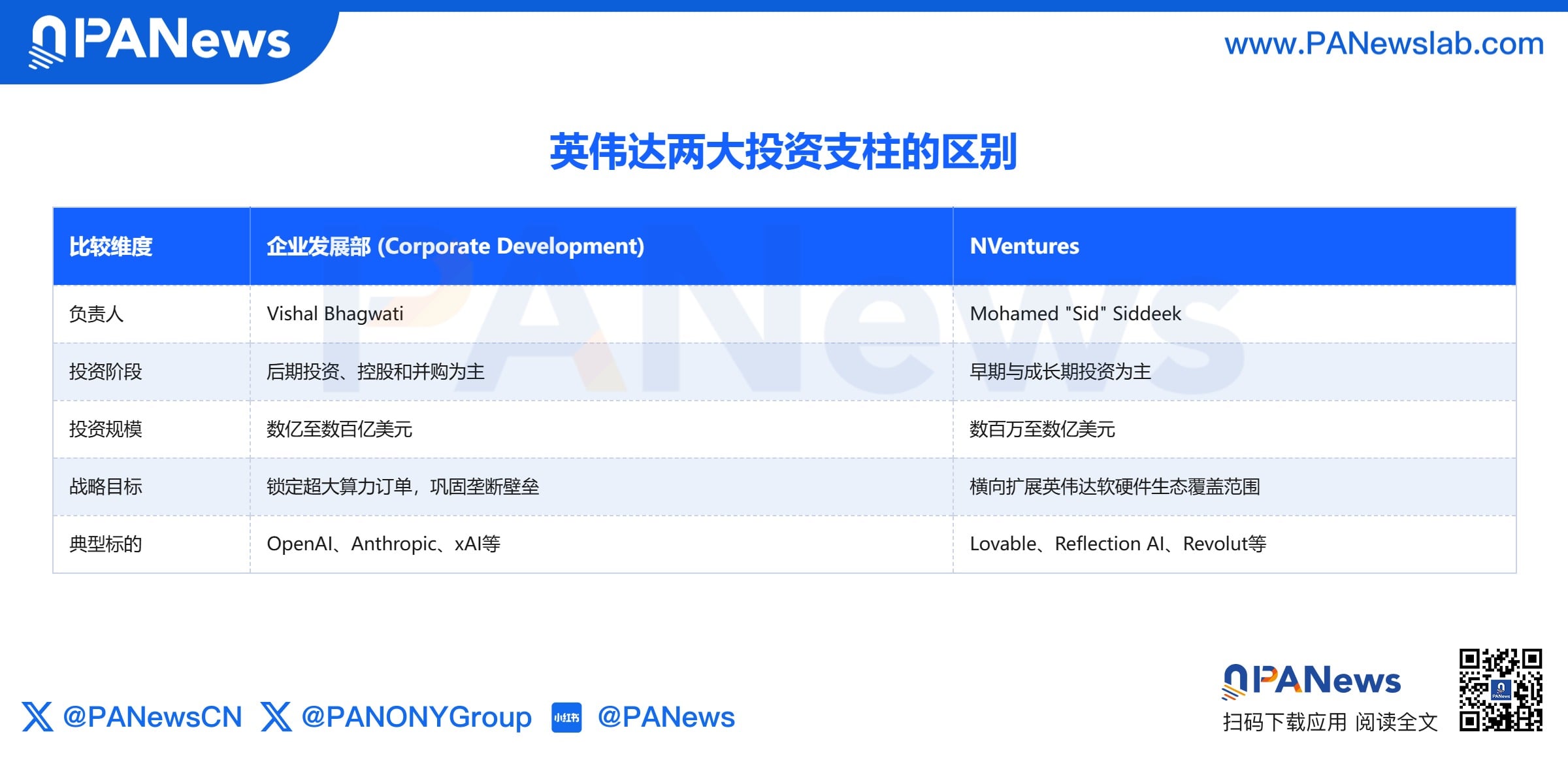
In Silicon Valley's capital narrative, outsiders often lump all of Nvidia's external investments under the intent of the parent company. However, what is not widely known is that Nvidia has already established a clearly defined and highly complementary “dual-pillar investment system”: the Corporate Development department and the venture capital division NVentures stand parallel, together forming Nvidia's capital landscape.
The Corporate Development department focuses on massive equity investments and industrial mergers and acquisitions worth billions, even tens of billions of dollars, led by Vishal Bhagwati. According to CNBC, in just the first four months of this year, investments led by this department exceeded $40 billion. Representative examples include a $30 billion framework investment in OpenAI, a $10 billion injection into Anthropic, and a $2 billion equity investment in Musk's xAI, each significant enough to shake the industry.
The primary goal of the Corporate Development department is to deeply bind cornerstone model companies with cloud service giants, secure future GPU procurement agreements, and strengthen Nvidia's long-term fundamentals. Its essence is to “build walls,” using tens of billions of dollars to fortify Nvidia's computing power dominance and solidify its leading position.
In contrast, NVentures distinguishes itself as a strategic venture capital division, focusing on discovering early to growth stage targets in the hard tech arena. NVentures is steered by Nvidia’s Vice President and head of venture capital, Mohamed Siddeek, whose career has witnessed Nvidia's growth: as early as the late 1990s at Morgan Stanley, he personally accompanied Jensen Huang in completing Nvidia's IPO roadshow; afterward, he led TMT (Technology, Media, Telecommunications) and digital health venture capital operations at top investment firms like the Emirati sovereign wealth fund Mubadala and the SoftBank Vision Fund.
Under Siddeek’s leadership, NVentures' active performance is rivaling top-tier venture capital in Silicon Valley.
As of mid-2026, NVentures has cumulatively invested in 96 startups, among which 20 have become unicorns; in just the past 12 months, it completed 43 new investments, with transaction volume surging over 900% year-on-year. Its individual investment sizes mostly range from millions to hundreds of millions of dollars, with over 85% of its deals made through co-investing.
NVentures does not pursue controlling stakes, focusing instead on “connections,” extending Nvidia's reach into cutting-edge technology territories where the semiconductor industry has yet to arrive, positioning itself lightly as a “rule-maker” in vertical industries.
NVentures Expands into Five Major Tracks, Broadening Computing Power Ecosystem
Siddeek has publicly stated that the investment boundaries of NVentures “essentially cover any area that Nvidia's software and hardware can reach.” Translated, it means: wherever computing power is needed in the future, Nvidia's flag must be planted in advance.
AI Infrastructure: Reinforcing the Invisible Walls of CUDA
Strengthening the technological barriers of the CUDA ecosystem is NVentures' most fundamental and vital mission. The AI automation code review tool CodeRabbit has not only received investment from NVentures but has also been promoted throughout Nvidia. It deeply integrates Nvidia's Nemotron open model, significantly enhancing the efficiency of enterprise-level code reviews, becoming a typical example of the CUDA ecosystem's implementation.
In addition, the retrieval-augmented generation (RAG) middleware developed by Contextual AI assists enterprises in achieving localized RAG deployment of proprietary data while ensuring data security. From the video generation platform Synthesia and AI music platform Suno to multimodal world model developer Runway, and the AI inference infrastructure startup Tensormesh, which it co-invested in this May, NVentures is reshaping the computing power ecosystem for creativity and inference from the ground up.
Robotics and Embodied Intelligence: Closing the Loop in AI's Physical World
With investments in embodied intelligence companies like Skild AI, Bedrock Robotics, and Flexion Robotics, Nvidia's ambitions in the robotics field have long surpassed mere hardware sales.
Take Skild AI, for example; its developing general robot base model, trained through physical simulation, allows robots to manipulate different hardware and adapt to complex environments without targeted customization. Nvidia provides computing power and foundational simulation development platforms like Isaac and Omniverse. This means Nvidia starts defining the “brain” of robots from the development stage, presenting an investment style that resembles “gene implantation.” By the time these robots are mass-produced, they have been tamed by Nvidia.
Combining autonomous trucking with Waabi and logistics automation company Outrider, Nvidia is attempting to infiltrate its software ecosystem in advance while hardware standards in robotics have yet to be established.
Healthcare and Digital Biology: The Highest Proportion Heavy Investment Track
Digital biology is the sector with the most investments from NVentures, accounting for more than one-fifth. Nvidia considers “AI + Biology” as the “next transistor-level computing revolution” after semiconductors, becoming the most crucial high-value computing scenario beyond large model training.
For example, Abridge focuses on voice AI entry for medical clinics, freeing doctors from the cumbersome case documentation; Basecamp Research is using Nvidia's BioNeMo platform to develop EDEN biological large models for genetic engineering; by investing in drug development companies like Generate Biomedicines, Nvidia is gradually “coding” life sciences, thus opening a new high-value computing market that diverges from traditional large model training.
If future drug development no longer relies on test tubes but rather simulates calculations through GPUs, then Nvidia will cut a significant slice of the global pharmaceutical R&D budget.
Frontier Computing and Quantum Technology: Positioning as a Power Nexus in Post-Silicon Era
A hybrid architecture of classical and quantum computing is becoming the evolutionary direction of the next generation of supercomputing. NVentures' moves in the quantum field carry a strong defensive attribute: French quantum computing startup Alice & Bob and Silicon Valley quantum computing pioneer PsiQuantum are both included in its investments.
Though quantum computing cannot replace traditional silicon-based chips in the short term, it has already shown potential in specific ultra-large-scale scientific computing scenarios. By investing in quantum computing firms, Nvidia is promoting the research and development of hybrid architecture between classical GPU computing power and quantum control systems, aimed at ensuring that: even as we enter a non-silicon computing era in the future, Nvidia will still occupy a central position in computing power scheduling.
Green Energy and Power Grid Scheduling: Breaking the Physical Ceiling of Computing Power Expansion
To this day, the constraining factors of global data centers have fundamentally transformed: power supply has replaced hardware capacity and land resources, becoming the ultimate bottleneck for computing power expansion.
In this context, NVentures has invested in energy coordination management platforms like Emerald AI. Emerald AI can aid Nvidia's "AI factories" in accessing the existing power grid more safely and quickly and flexibly manage local energy storage and backup generators during peak electricity usage, turning high-energy-consuming computing clusters into "flexible assets" friendly to the power grid. Furthermore, combined with bets on fusion research company Commonwealth Fusion and battery recycling and energy storage giant Redwood Materials, Nvidia is personally building an energy barrier for its unfulfilled empire of computing power.
The recent $196 million investment in Revolut signifies that NVentures is officially extending its reach into the fintech sector. As a digital bank with tens of millions of users and vast amounts of data, Revolut is not only a potential client for Nvidia; its large user base and data resources will also serve as a foothold for Nvidia's exploration of the financial sector. Nvidia's bet on Revolut through NVentures is essentially a strategic deployment for the "AI + digital finance" application scenario.
The Enclosure of Nvidia's “All-in-One”: Not Just Money, But a “Lockdown”
What makes NVentures most attractive to invested companies is not its money but the “empowerment premium” it provides.
While ordinary VCs wait to exit after providing money, NVentures brings in the “Nvidia all-in-one”: connecting top engineering teams, priority integration rights for development platforms, and even opening global distribution channels. The CEO of CodeRabbit has publicly stated that Nvidia's engineers helped them embed the Nemotron model into their product, which was then promoted company-wide, directly earning them a stamp of approval from Fortune 500 level.
All empowerment is deeply tied to Nvidia's CUDA software ecosystem. Whether using Nemotron or BioNeMo, whether simulating robots on Isaac or constructing digital twins based on Omniverse, the underlying computing architecture is invariably locked within Nvidia's technical system.
With NVentures' reach covering the supply and demand sides of the industry chain, many companies are accustomed to building their technology stack within the Nvidia ecosystem from inception. If in the future AMD or Google and other competitors offer better cost performance, they will face exorbitant migration costs and ecological disconnection risks.
Although for invested companies, NVentures' funding is a ticket to enter the world's largest AI ecosystem, the other side of the coin is that binding to Nvidia also means a high dependence on a single supplier. It can be said that NVentures has effectively welded them firmly onto Nvidia's war machine with a single check, becoming “ecological nodes” dispersed across various vertical industries.
In the long run, this could not only weaken the market's drive to explore alternative computing power solutions but also reinforce a monopolistic market landscape.
Nvidia is no longer just the “shovel seller” of the AI era. From the latest investment in Revolut to the capital landscape across cutting-edge technology industries, NVentures' growth trajectory reflects Nvidia's continuous expansion and is also a key driver for Nvidia to transform its technical advantages into industrial control power.
In the future, at every critical inflection point of new industries, NVentures may well be present. And Nvidia's shadowy tentacles are rewriting the power map of the global technology sector with capital as ink.
免责声明:本文章仅代表作者个人观点,不代表本平台的立场和观点。本文章仅供信息分享,不构成对任何人的任何投资建议。用户与作者之间的任何争议,与本平台无关。如网页中刊载的文章或图片涉及侵权,请提供相关的权利证明和身份证明发送邮件到support@aicoin.com,本平台相关工作人员将会进行核查。


