Author: Alan, Denise | Biteye Content Team
In the era of the AI arms race, the first day after the release of a foundational model is often also the time when evaluations are most prone to distortion.
Highlight demos appear frequently, benchmark rankings are shared repeatedly, topics that the model excels at are amplified, while failure cases have yet to surface. However, for ordinary users and developers who are genuinely prepared to integrate the model into workflows, a leading position on the leaderboard does not equate to stable delivery in everyday tasks.
A week after release turns out to be a more appropriate observation point.
Successes begin to be validated repeatedly by different users, while issues such as white screens, rework, resource consumption, missed commands, and tool compatibility start to emerge in posts and comment sections. Kimi K3 is currently at this stage.
Kimi K3 was released on July 16, 2026. The official definition describes it as a long-range agent model with 2.8T parameters, native support for visual input, and a contextual window of 1 million tokens. About three days after its release, user requests approached the cluster capacity limit, leading Kimi to temporarily suspend personal subscriptions for new users, prioritizing computing power for existing members.
To better reflect K3's actual position among global developers, we systematically organized feedback from developers, AI KOLs, and independent media publicly available from July 16 to 21. 👇
1. Summary of Practical Implementations Online: What Fun Features Does Kimi K3 Offer?
The existing open testing can be roughly divided into five categories: visual interaction and game prototypes, full-stack development and existing codebases, hardware and software system integration, agent workflows, and code security.
1. Visual Interaction and Game Prototypes
This is the most densely populated category of K3's open cases, and it is also the part where ordinary users can most easily perceive differences. Testers not only examined whether the pages looked good but also checked camera movements, physical rules, game states, mobile adaptations, and multiple modifications.
Toxic AI: 7 original tasks divided to test visuals, logic, and debugging
Toxic AI designed 7 original tasks covering interactive applications, a 3D floating island portfolio, demand conflict identification, race condition bug debugging, long-range pricing investigations, minimalist visual design, and billiard physics reasoning.
Among them, the 3D floating island directly reused the same prompt tested in four versions of GPT-5.6, making it more comparable than each model showcasing its highlighted demos separately. The task required the use of React and Three.js, achieving four segments of scrolling camera movements, hovering lights, click progression, bloom effects, volumetric clouds, particles, and dynamic skies.

In the first round of operation, K3 experienced a white screen, but after fixes in the second round, it successfully launched. The main body, waterfall, cloud layers, camera transitions, and mobile effects were basically realized, but the tasks took nearly an hour, and there were still layout issues on mobile.
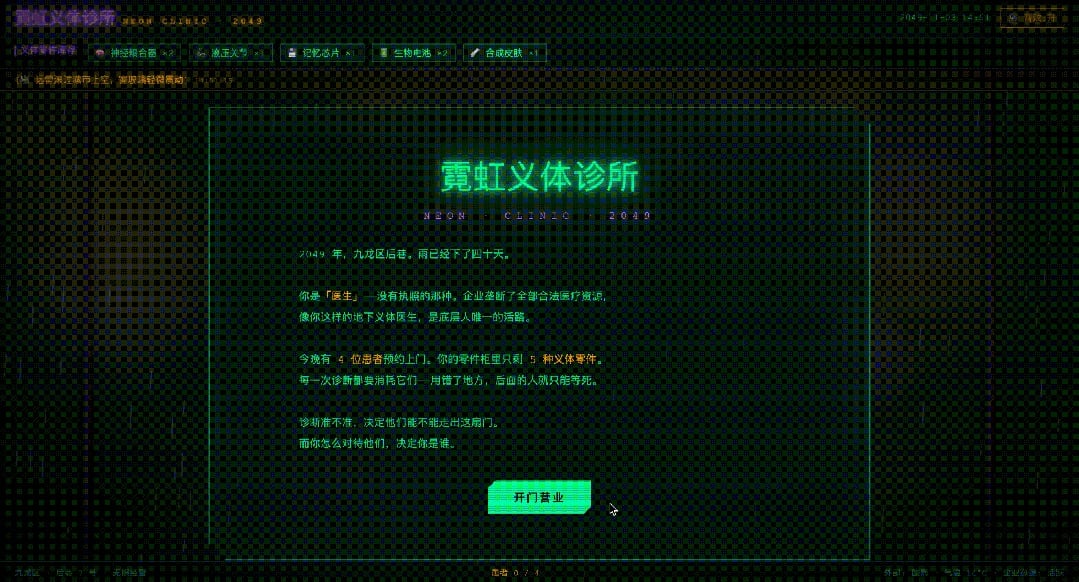
Another project titled "Cyberpunk Underground Clinic" required generating three patients, hidden storylines, inventory of cybernetic parts, and at least three endings. The testing team actually navigated all branches, confirming that all three endings could be reached, and exhausting inventory would change the available diagnosis options. This project measured not only visual generation but also state management, branching logic, and playability acceptance.
Source: https://mp.weixin.qq.com/s/Qe7RfIr2z9-Qlm6Xd1pE1A?scene=1
Aditya: Single prompt to create an MMORPG style prototype, then compare with Opus 4.8
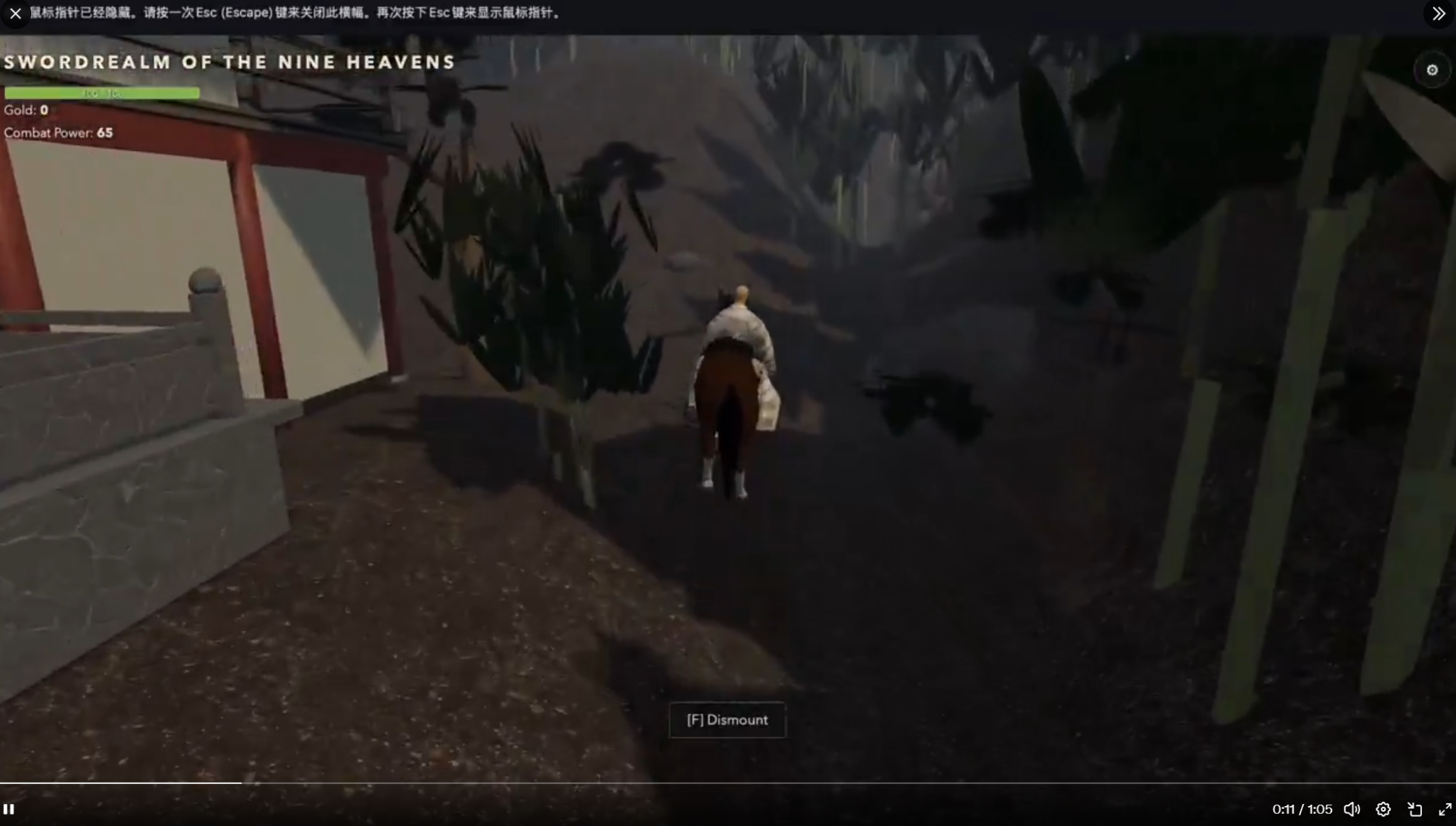
Aditya's first task was to generate a playable MMORPG style prototype using a single prompt. Public records show the task took about 55 minutes, costing $9.37, and the final product included horse riding, parkour on rooftops, combat, and an explorable open world.
The second task involved integrating K3 and Opus 4.8 APIs in the same cursor environment, using the same prompt to generate a Crossy Road clone. The prompt clearly required voxel or low polygon style, procedural roads and rivers, moving vehicles, floating rafts, train warnings, collisions and Game Over, increasing difficulty, scoring, restarts, camera follow, 60FPS, and modular code.
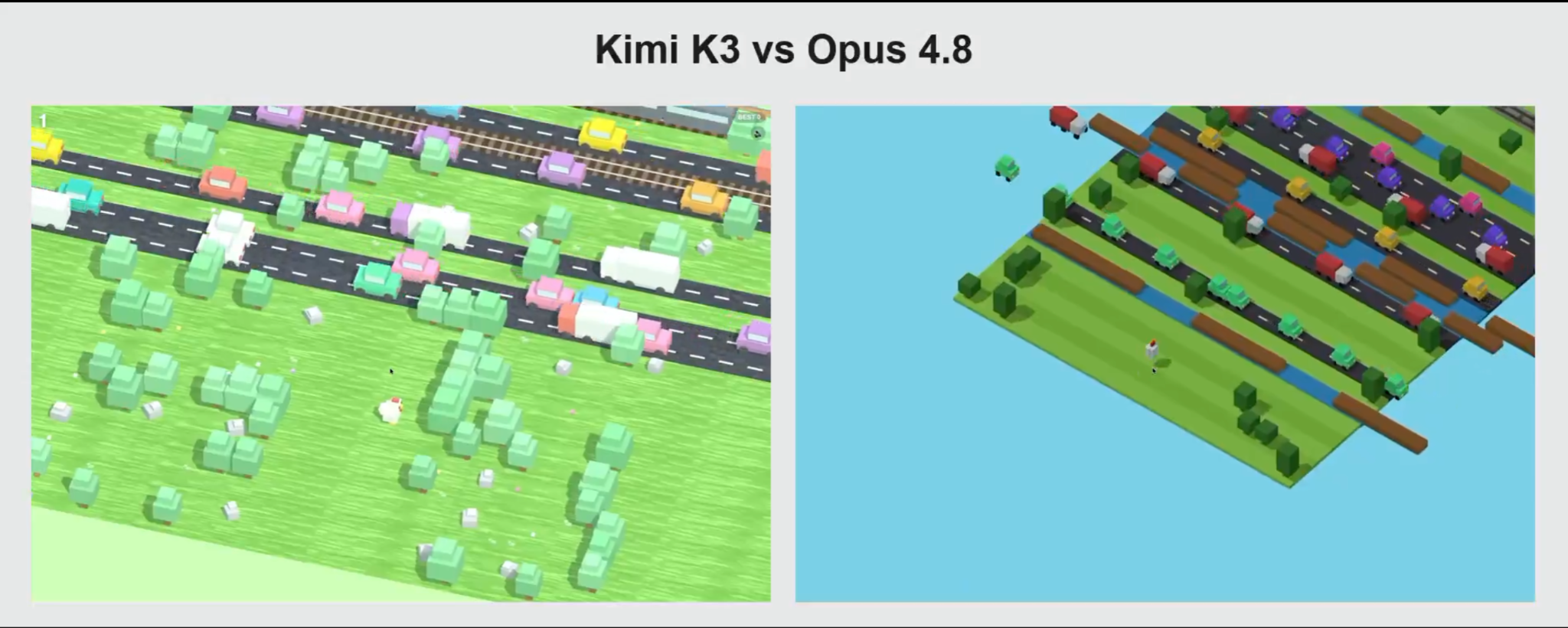
Both produced playable games and usable physical effects. K3's UI was slightly more refined, costing $7.11, while Opus cost $19.
Source: Aditya's testing records, RoundtableSpace’s recount of the MMORPG case
Sunshine Qiaomu: Three.js color guessing game and over 40 types of UI style pages
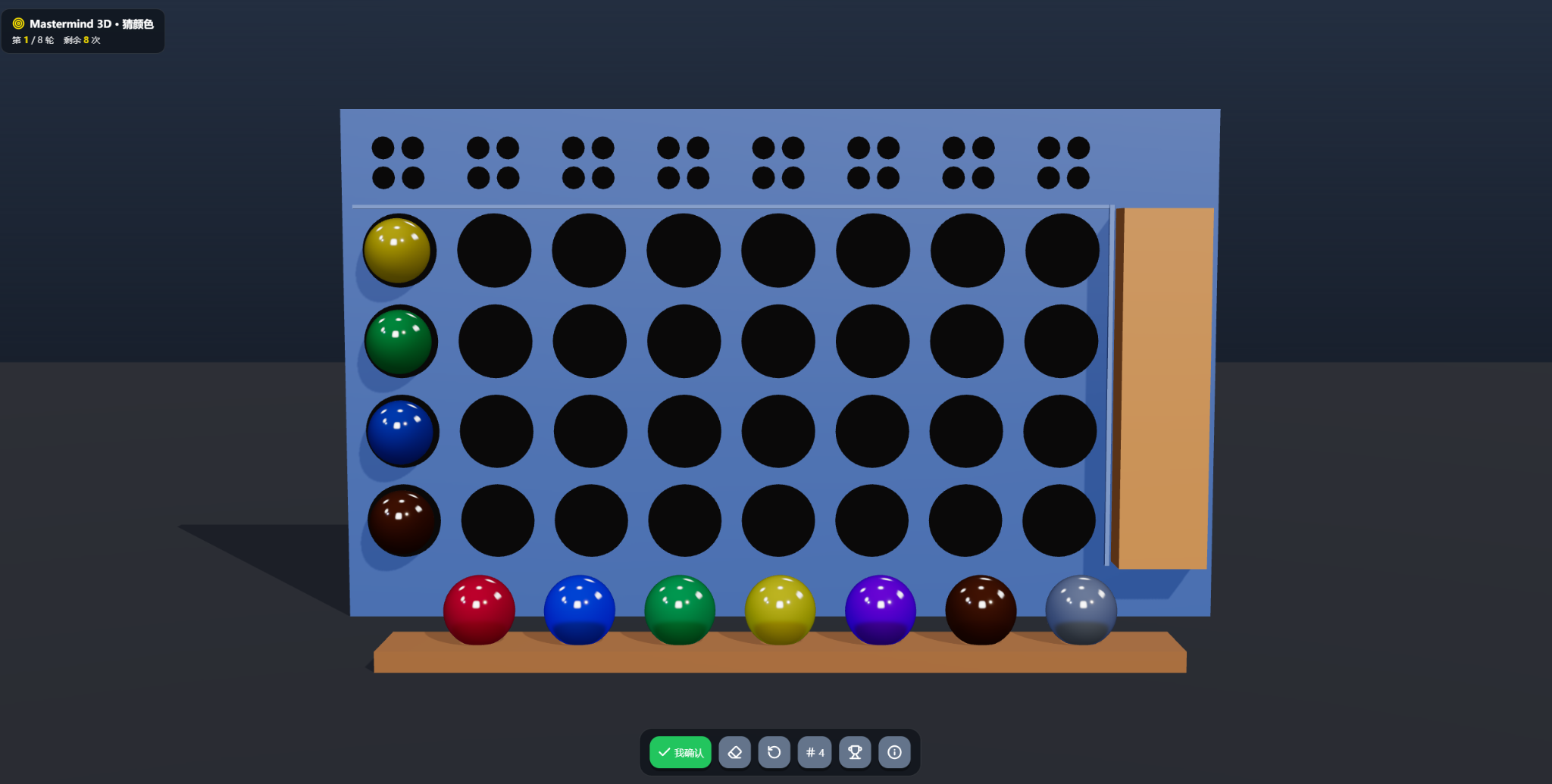
In a continuous series of 6 projects, Sunshine Qiaomu had K3 develop a 3D Mastermind color guessing game using Three.js. The first version is playable with sound effects, and later features were added, including drag-and-drop sorting, ball movement trajectories, cloud databases, and leaderboards.
Additionally, he had K3 generate a UI learning page featuring over 40 styles, covering new realism, liquid glass, and minimalist designs, to observe the model's capabilities in interface, spatial layout, and visual style coverage.
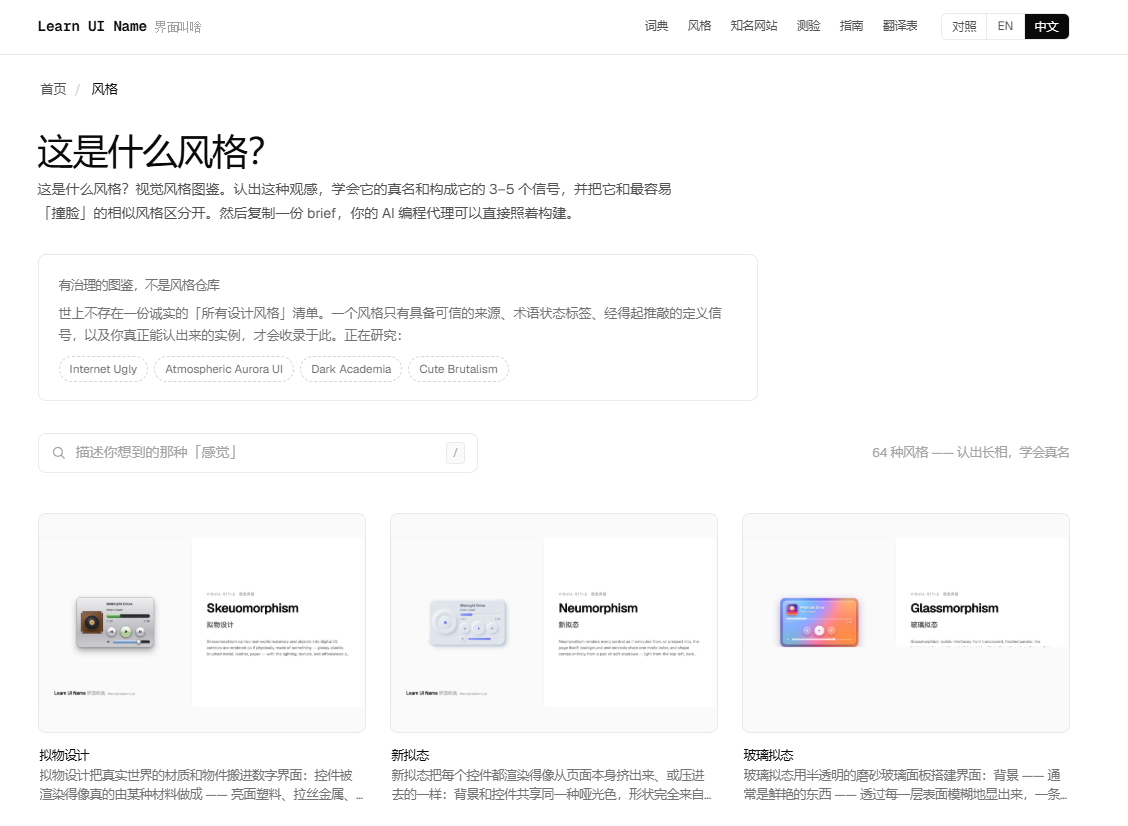
Project experience addresses include Mastermind 3D Game and UI Style Learning Page.
Source: Complete test by Sunshine Qiaomu
2. Full-Stack Development, Existing Codebases, and Long Context Tasks
Generating a demo from scratch only indicates that the model can set up frameworks. Reading old code, identifying constraints, modifying multiple modules, and then compiling, testing, and deploying all bring it closer to real development.
Sunshine Qiaomu: Gave server permissions, continuously developed and launched 6 projects
Sunshine Qiaomu granted K3 server permissions and continuously developed and launched 6 projects, covering front-end, back-end, databases, AI APIs, optimization of existing codebases, and tool development. A typical process he recorded involved completing the MVP in one round of dialogue, followed by 2 to 5 rounds for feature additions, interface fixes, and deployment.
One task involved auditing an existing iOS GitHub repository. K3 reported 5 high-risk vulnerabilities, 4 performance issues, and 2 architectural problems, then initiated 5 subagents for division of labor in fixing, completing compilation, and launching an iOS simulator for hands-on experience.
Another task was to create a GIF compression skill for WeChat public accounts. Constraints included a file size not exceeding 10MB, a total frame count not exceeding 300 frames, and a frame rate controlled between 12 and 20fps. K3 completed tool development in about 10 minutes, and the final product could merge long periods of still frames, delete redundant frames, and retain the quality as much as possible while meeting size limits.
This project has publicly released its source code: qiaomu-tiny-gif GitHub repository
Sunshine Qiaomu also provided about 820,000 lines of Rust code to both K3 and GPT-5.6 Sol Ultra for full analysis; there was also an arXiv Chinese search website that completed development, deployment, and GitHub uploads in nighttime long tasks. The public experience address is arXiv Chinese Search Website. 
Source: Complete test by Sunshine Qiaomu
3. Hardware and Software System Integration
Electromagnetic Wave Studio: Developed and deployed a real-time voice conversation system
The task given to K3 by Electromagnetic Wave Studio was not “generate a piece of speech,” but rather to set up a real-time voice dialogue system within an RTX 3090 deployment environment.

The public video provided data on various aspects: end-to-end response time of about 1.5 to 2.5 seconds, STT recognition around 0.88 seconds, LLM first token about 0.3 to 0.5 seconds, and TTS first speech onset about 0.19 seconds, with memory usage of about 20GB/24GB. The next step is to reduce response latency to under 500 milliseconds.
Source: Electromagnetic Wave Studio's voice system testing
4. Agent Workflows and Code Security
Kun Chen: Integrated with FirstMate, observed command adherence and resource consumption
Kun Chen connected K3 to FirstMate, using it continuously for a whole morning. FirstMate's long system prompts continuously required the model to diagnose problems, assign tasks, and adhere to workflows, making it easier to expose adherence issues compared to a one-off web demo.
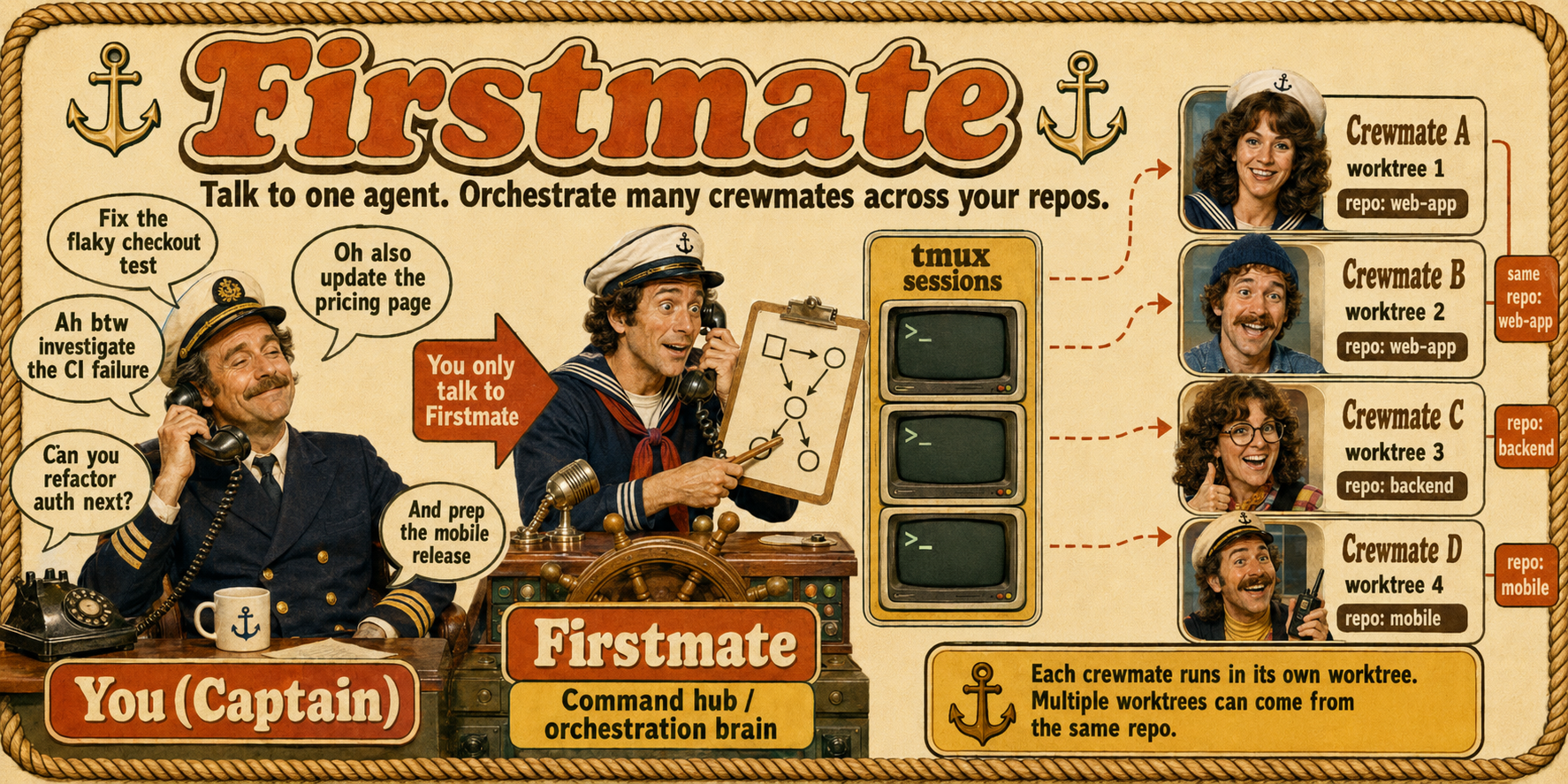
He used a $40 plan. In a single session with about 200K context, only a few prompts were run, consuming about one-third of a 5-hour resource window. In practice, K3 was able to understand intent, diagnose problems, and delegate tasks, but the response speed was slow and it occasionally missed some constraints in the system prompts.
FirstMate has been open-sourced: kunchenguid/firstmate GitHub repository
Source: Kun Chen’s K3 test
Malte Ubl: Conducted security assessments on an old version of a real codebase using Deepsec
The Malte Ubl team used the open-source security agent Harness Deepsec to test multiple models on an undisclosed open-core application's old Git commit. This version was prior to a lot of security issues being fixed; the task was for the model to find real vulnerabilities within a large codebase while avoiding the public question bank.
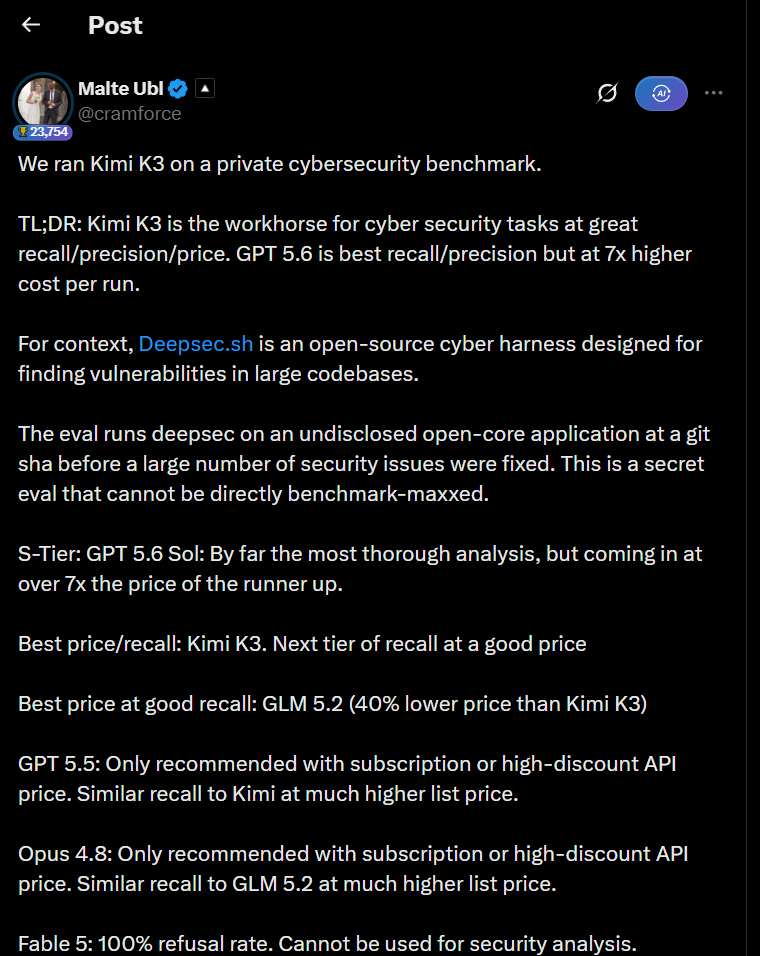
Public results indicated that GPT-5.6 Sol had the highest recall and precision, but its individual run cost was over 7 times that of the second place. K3 was more balanced between recall rate, precision, and cost. GLM-5.2 was about 40% cheaper than K3, but had lower recall levels.
Deepsec has been open-sourced: vercel-labs/deepsec GitHub repository
Source: Malte Ubl's private assessment of Deepsec
2. KOL Evaluations: How Did They Judge K3 After Completion?
Chinese KOL: Affirming visual and engineering breakthroughs while focusing more on actual delivery
1. Sunshine Qiaomu (@vista8, AI KOL, XHunt Global AI Ranking: 891): Outstanding visuals and spatial interactions, but architecture and back-end still require strong constraints
Sunshine Qiaomu believes that K3's strengths are concentrated in interactivity, interface, visuals, and spatial scenarios, making it particularly suitable for front-end engineering that requires screenshot feedback and continuous corrections. Architectural design and back-end stability still lag behind top closed-source models.
He also warned that K3 tends to be overly proactive with ambiguous tasks. When in use, it is necessary to clearly define the range of modifications, prohibitions, and acceptance criteria in the system prompts or AGENTS.md, or the model may expand the task boundaries on its own.
2. Toxic AI: High potential capability, but completion often comes from multiple rounds of fixes
Toxic AI's 7 tests showed that K3 can handle visuals, logic, demand conflicts, and debugging simultaneously, but not all tasks can be delivered in one round.
The first round of white screens, mobile layout issues, and front-end mapping bugs indicate that the high degree of completion of the final product often comes from “generating, running, discovering problems, continuing to fix,” rather than being reliable from the first generation. The visual potential is an advantage, while the time taken, resource consumption, and first round stability represent real costs.
3. Electromagnetic Wave Studio: Value lies in engineering orchestration, not running large models on a single card
The voice system case illustrates that K3 can string together voice recognition, LLM, voice synthesis, and deployment environments into a measurable chain.
It supports the judgment that “K3 possesses complex system integration capabilities,” but does not support the statement that “a complete K3 can run locally on a single 3090.”
English KOL: Comparing K3 against similar tasks and real agent workflows
1. Chris (@ChrisGPT, AI industry journalist, XHunt Global AI Ranking: 1774): Long context helps maintain a continuously evolving engineering trajectory
After three rounds of adding new mechanisms, existing functions continued to work, making Chris’s case an intuitive sample of 1M context value.
However, the $3.24 is just the model call cost and does not include art assets, gameplay design, performance testing, deployment, and manual acceptance, nor can it be used to infer the average success rate of similar games.
2. TestingCatalog (@testingcatalog, AI intelligence media, XHunt Global AI Ranking: 1924): More complexity and more eye-catching, but not necessarily more reliable
TestingCatalog's comparisons show a clear trade-off. K3 is willing to achieve more visual and interactive effects, while Fable 5 completes tasks faster, and its UX components are more stable.
Perspective anomalies triggered by 100x planetary speeds indicate that "more features" and "greater usability" must be evaluated separately.
3. Kun Chen (@kunchenguid, independent developer, XHunt Global AI Ranking: 11462): Can understand and delegate tasks, but daily experiences are constrained by speed and adherence
Kun Chen acknowledged K3's ability to understand intent, diagnose problems, and delegate tasks, while pointing out its slow speed and tendency to overlook some constraints in long system prompts, as well as not being light on actual resource consumption.
Initial service congestion during the release may have magnified delays, but command adherence and resource experience remain closer to daily use observations than those of demonstration-type demos.
5. Malte Ubl (@cramforce, Vercel CTO, XHunt Global AI Ranking: 1425): Suitable as a mainstay for continuous security scanning, but does not reach the highest quality baseline
Malte suggests first using GPT-5.6 Sol to establish a high-quality security baseline, then using Kimi K3 for continuous analysis.
This means that Kimi K3’s positioning in this private test is not for the highest recall rate, but as a compromise between quality, precision, and price.
6. Aditya (@adxtyahq, EntelligenceAI DevRel, XHunt Global AI Ranking: 27714): Kimi K3’s strength is multi-system collaboration within a single prompt
Aditya’s two cases demonstrate that K3 can simultaneously manage scene generation, physical rules, input control, and UI status within a single lengthy task, and complete a playable Crossy Road clone in a low-cost manner within the same cursor environment.
3. Consensus, Disagreements, and Reflections
After a week, several relatively stable consensuses around K3 have formed.
1. K3's most prominent capabilities are currently visual coding, front-end, 3D, and game prototyping.
2. 1M context is suitable for large repositories and long tasks, but cannot replace context screening.
3. Slow responses and high output token counts are the most common negative feedback at present.
4. The final effectiveness of an agent highly depends on the tools used, including Kimi Code, Claude Code, Cursor, etc.
5. Key production tasks still require testing, rollbacks, and manual acceptance.
Disagreements mainly focus on three issues.
1. Is it really cheaper? — Supporters emphasize low input costs after cache hits; opponents highlight total token and rework costs.
2. Is it really close to top closed-source models? — The gaps in visual and front-end tasks are small, while complex logic and overall experience still show a disparity.
3. Can open weights really promote local deployment? — The customization potential is promising, but a complete 2.8T model is not a scale that ordinary consumer-grade hardware can easily support.
In fact, combining feedback from these 10 KOLs reveals that they are genuinely arguing about what criteria should be used to measure it.
Kimi K3 has already provided sufficiently convincing results in front-end, 3D, and game prototyping. However, if the standard is stable delivery in complex production tasks, it still faces tests of speed, token efficiency, dirty data, and anomaly recovery.
Actually, as agent workflows gradually mature, a more reasonable approach may be to split tasks. For instance, delegating visual generation to Kimi K3, complex reasoning to more stable GPT 5.6 Sol or Claude Fable 5, and relatively simple retrieval and repetitive operations to lighter models, finishing off with testing and manual review for acceptance.
In this workflow, the foundational model used does not need to win first place on all benchmarks. As long as it forms a significant advantage in a high-frequency aspect while being attractively priced, contextualized, or deployable, it can become an irreplaceable part of the workflow.
The capital investment and wait time for large models ultimately have limits, and they must quickly convert into productivity.
Therefore, whether Kimi K3 or even domestically produced large models will surpass OpenAI and Anthropic remains to be seen, and the leaderboard will continue to offer new answers. But the more worth observing question has changed: as the capability gap between models narrows, those who are most easily integrated into tools, incorporated into workflows, and called upon long-term will emerge as the victors in this round of AI competition.
Note: The KOL feedback in this article is mainly derived from public discussions from July 16 to 21, 2026, classified and summarized by Biteye. Exact costs, time taken, and success rates are case-specific and do not constitute standardized benchmarks. Model parameters, pricing, context, subscriptions, and weight openness status are based on the latest information from Kimi's official sources.
免责声明:本文章仅代表作者个人观点,不代表本平台的立场和观点。本文章仅供信息分享,不构成对任何人的任何投资建议。用户与作者之间的任何争议,与本平台无关。如网页中刊载的文章或图片涉及侵权,请提供相关的权利证明和身份证明发送邮件到support@aicoin.com,本平台相关工作人员将会进行核查。


