Organization & Compilation: Deep Tide TechFlow
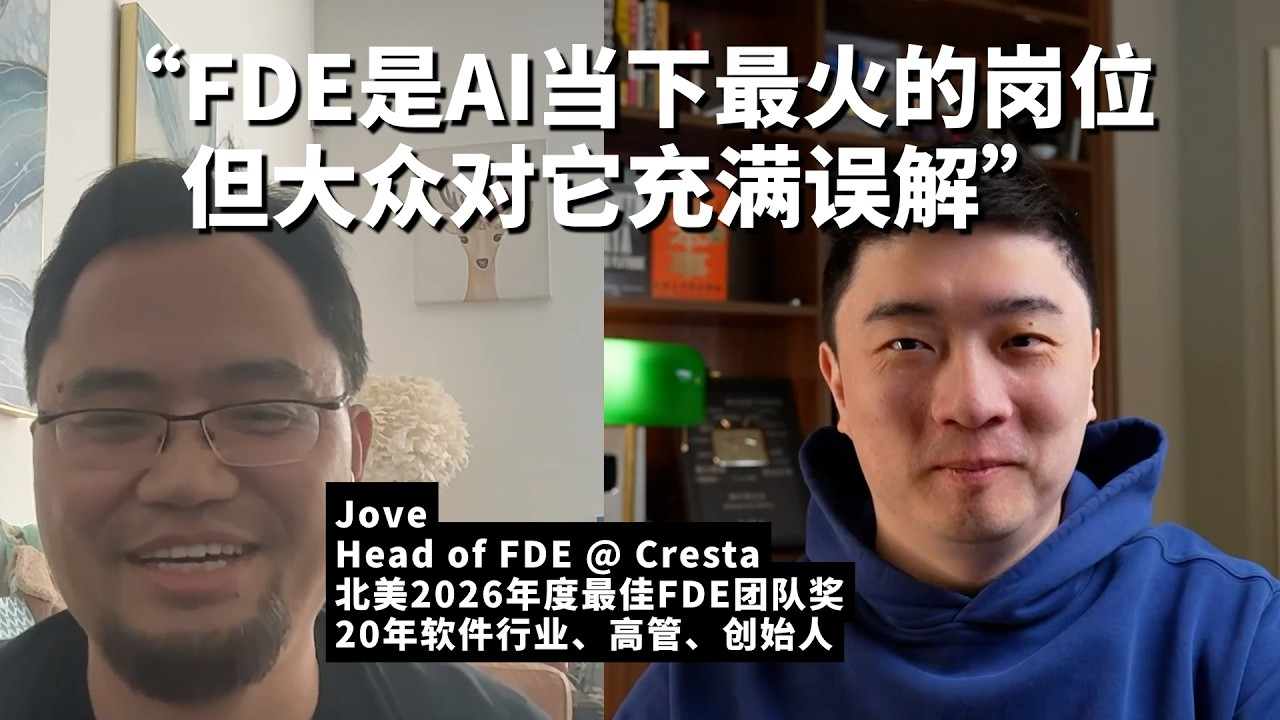
Guest: Jove Zhong, Cresta Head of FDE (Forward Deployed Engineering), responsible for the AI Agent front-line deployment team
Host: Sun Yuzheng (Class Representative Stand Still), Founder of Superlinear Academy, former evangelist at Statsig (the company was acquired by OpenAI)
Podcast Source: Class Representative Stand Still
Original Title: His FDE team expanded from 30 to 100 people, but why do many engineers in large companies not even know about this position?
Release Date: July 17, 2026
Key Points Summary
Jove currently leads the FDE team at AI call center company Cresta, expanding from a few people when he took over last year to 30 people, with a target of 100 this year, hiring globally. Cresta itself is a 9-year-old enterprise service company, with clients including Marriott and United Airlines, constantly improving customer service experience, which naturally transitioned to AI Agent deployment after the AI wave arrived.
The core tension of this conversation lies in: FDE is being coveted by top AI companies and the VC circle like OpenAI and Anthropic as the "most promising position of the AI era," but Jove found when hosting events in the Bay Area that engineers from big companies like Meta and Google have not even heard of this position. Jove's viewpoint is very clear; AI Agent FDE is not a traditional outsourced or resident engineer, it is a new species: you need to understand all the pitfalls of AI deployment (hallucination, RAG delays, VAD debugging, model version switching), you need to be able to earn the trust of the customer CTO face-to-face, and you must bring frontline lessons back to the company to improve the product. Essentially, it's about hiring a group of "startup company CTOs" to implement AI.
Highlights of Insight
The Essence of FDE
"FDE is like hiring a group of CTOs from startup companies. You need to get the deals done, implement AI, and lock in customers; but at the same time, as a CTO, you are not just thinking about how to improve the product all day long, you even need to undergo self-revolution."
"FDE in the AI era is something completely different from previous FDE. Previous FDE was not much different from outsourced resident engineers, but AI Agent FDE is a new species."
The Last Mile of AI Deployment
"These models are not particularly hard to obtain. If you are willing to spend money, you can access the best models. But so what? You may not even know how to use the model."
"FDE is like a barista. You can buy an Italian sexy mama coffee machine and buy good beans, but you may not be able to make a good cup of coffee. What the client wants is an outcome; they want a decent AI Agent experience."
What Kind of Person is Suitable for FDE
"If someone has gone through many failed experiences, that is a very good thing for me. They can articulate their past lessons learned, whether they were overly verbose in certain situations, or whether they jumped to conclusions too early."
"Are you a great AI engineer? That’s basically nonsense. If you are any software engineer now and not an AI engineer, you are basically out of the game. You must have experience developing and testing AI Agents."
Why FDE is Hard to Replace with AI
"In the past, we could survive with one skill, but that’s not the case anymore. But you can be responsible for outcomes. The closer you get to outcomes, the harder it is to be replaced because AI cannot take responsibility for the outcome; it can provide another answer just by changing the prompt."
FDE in China vs. North America
"In North America, labor is already expensive, and there is a strong demand for outcome-based solutions; SaaS is also mature, making the FDE model easier to implement in the realm of AI Agents. In China, I can only feel sorry for the workers for a few seconds."
1. When a Position is Favorably Viewed by VCs and Top AI Companies, but Not Recognized by Big Companies
Class Representative Stand Still: How many FDEs do you currently have under your command?
30 people, and it is estimated to reach 100 people this year. In the past seven to eight months at Cresta, I have personally felt that FDE is indeed a very effective way to implement AI, get people to spend money, and make a change in the world.
Class Representative Stand Still: I am particularly surprised that OpenAI and Anthropic are hiring many FDEs, and VCs also say this is the most needed position in AI, but when we hold events, especially engineers from large companies like Meta and Google, will ask, "What is FDE?"
Yes, the gap in understanding is indeed significant. I started to gain more awareness of FDE when the wave at Palantir began; Palantir, as the creator of this model, has a very unique business, because not every vendor can do military business. When they started around ten to fifteen years ago, many military clients were not happy with vague requests; they made it clear about what they wanted, and you had to meet them face-to-face, go to the same military tent, see the data before they would provide detailed responses.
Thus, Palantir hired two teams: one focused on front-line resident software engineers, and another focused on business personnel familiar with combat or rescue processes. One is technical, and the other is non-technical. FDE, as we would generally refer to it, is still a highly technical job.
2. AI Agent FDE is a New Species; Do Not Confuse with Traditional Resident Engineers
Class Representative Stand Still: Please explain what FDE is to those who have not heard of this term.
FDE stands for Forward Deployed Engineer, characterized by being an engineer who is forward deployed into projects. But I believe FDE must be placed within the framework of AI Agents.
If this is a traditional scenario involving data ETL, data transformation, and network construction, it is very hard to distinguish how FDE differs from resident engineers, outsourcing, or consulting. However, in the context of AI Agents, it is completely different: many people want AI Agents, and you can access relatively new model access and use voice models like ElevenLabs and Deepgram, but you may not have the capability to create an AI Agent that fits your business scenario.
The role of FDE is to combine your business logic, utilize all functions on the AI Agent platform, and create an AI system that meets your specific needs, complete with guardrails, tests, and evaluations. These aspects are very difficult for clients to learn themselves. They might have an engineering team that knows how to build a website or mobile app, but building an AI Agent is a completely different matter: dealing with hallucinations, ensuring RAG or knowledge base are low-latency and high-accuracy, involves many difficult aspects, and is not straightforward.
Hence, we AI companies adopt the FDE model to allow AI experts to clearly understand what is available on the platform and what the client wants, and then to create and refine this rather than forcing clients to learn themselves. Even if they can learn, it would take them half a year to a year, and by then, competitors would have already taken the lead.
Class Representative Stand Still: In other words, AI Agent FDE and previous FDEs are two different things. Previous FDEs are not different from outsourced resident engineers; AI Agent FDE is a new species, they are particularly AI native and truly understand the various pitfalls encountered in making AI products. Model access and features are available to everyone, but truly doing well at it shows a significant gap.
Yes, and we are willing and able to provide close service to clients. We have a saying: you can talk about API over IPA, and you can quickly build good relationships with clients, gaining the trust of the CEO, CTO, or API lead. Everyone is an engineer, speaking a common language allows you to quickly understand what they want and your limitations.
3. FDE = CTO in Front of Clients, FDPM = CEO in Front of Clients
Class Representative Stand Still: It sounds like the requirements are particularly high. You must understand AI (which is inherently scarce), and also have communication skills to gain user trust, as well as understand the user’s business.
So, it’s like hiring a group of startup company CTOs. These individuals can identify where to exert effort, where to say no, and then leverage AI skills to implement things.
However, everyone's bandwidth is limited, so inspired by Palantir, in addition to Cresta's FDE team, there is an FDPM team (Forward Deployed Product Manager). They do not need to be as technical, but like a company having both a CEO and a CTO: FDPM is more concerned about business logic, acceptance criteria, risk management, and timeline.
Many times when we have meetings with clients, even internally they are not very well aligned on what they want; SOPs differ in everyone's mind. If we have FDE in every meeting, it is not the best way to utilize us. FDPM handles these non-technical work, organizing things. FDE ensures from a technical perspective that implementations are sound and tests are robust, while also bringing back experiences to improve the product.
Therefore, you can think of FDE as Forward Deployed CTO, and FDPM as Forward Deployed CEO. FDE is responsible for the best industry practices of AI, including the development of SDKs, toolkits, CLIs; FDPM is responsible for specific requirements, risk reporting, and even upselling, going from three use cases to potentially six. This separation ensures that recruitment requirements do not become too high.
Class Representative Stand Still: Transitioning from engineer to FDE feels quite natural; what about others? PM to FDPM?
Yes. The baseline for FDE is being an engineer. In interviews, there is a segment where you must write a simple Python program without any AI; it isn't LeetCode, but proving you can code. There is another round looking at engineering practices: do you understand concepts like unit tests, end-to-end, and layering?
If someone without any technical background tries to do AI Agent FDE, it may seem workable, but they won't be aware of the issues. For example, if you build a login interface, it may seem functional, but if everything is on the front end, users can easily delete the DOM tree or alter what they see. Without engineering acumen, many things may seem to work but lack best practices.
On top of that, having a consulting background, such as from Accenture or McKinsey, is great. But be careful not to use past methods to judge deal size or to measure by time. We are more of a SaaS company, and FDE is a forward deployed product engineer, part of product engineering. A primary responsibility of FDE is to demonstrate that the product PMF is sound through the development of AI Agents, and then to modify the product, REST API, microservices, UI, CLI, and documentation. Not only to ensure each deployment is successful but to make the product increasingly mature.
Class Representative Stand Still: You are not just resident to help clients solve problems but also to improve your own product.
Exactly, I am part of product engineering. My peers are those working on microservices and Kubernetes Infra, and we all report to the VP of engineering, who reports to the CEO. I know some companies place FDEs under customer success or professional services, even under pre-sales. The reason we did not do so is that we ultimately want to be a platform company and hope to have an AI Agent platform that enables many different use cases.
The ideal state for FDE is: simple tasks are replaced by automation and platform improvements, leading FDE to become increasingly specialized, becoming experts in payments, networks, and RAG, focusing only on the most challenging tasks. This also prevents us from becoming a consulting firm with a few hundred people doing repetitive labor.
4. Why AI Deployment Needs FDE So Much? Because End Users Want Outcomes, Not Models
Class Representative Stand Still: The reason I am very optimistic about FDE is that AI capabilities are currently very strong, but most people lack implementation capabilities. Many traditional industries need to use AI, but they completely lack such talents. At this point, someone is needed to turn uncertainty into certainty. For a restaurant owner, he doesn't need to think about whether it can be done; with an FDE saying, "Use our platform, let me take care of everything," implementation becomes easy.
Absolutely correct. You ask a restaurant owner or their IT team to understand the details of AI Agents, for instance, VAD (voice activity detection): you can agree while I am speaking, but you shouldn’t interrupt me; when I report my phone number or email, there will be pauses, but that doesn't mean the other party should chime in; what to do about background noise. Just VAD alone has different approaches, whether based on silence or based on LLM, or semantic-based. Teaching restaurant IT personnel these details is too much.
Clients only care about: whether the brand leans towards young people or is more mature and stable, how dishes are introduced, how to reserve for VIPs. These are special business level demands. FDE can quickly apply best practices, choose the best solutions that work. Moreover, today I serve a dumpling restaurant, and tomorrow I serve a Western restaurant, accumulating industry know-how about turnover rates and how to politely decline customers. In the end, we might understand restaurants better than the restaurants themselves.
Class Representative Stand Still: Sequoia's analysis mentioned that the software market isn’t that big, but the entire labor market is enormous. AI aims to replace this labor market. For AI to effectively replace labor, people who understand both AI and business are necessary.
5. What Cresta Does: Enabling Customer Service Centers of Marriott and United Airlines to Use AI
Class Representative Stand Still: Tell us how these traditional industries use AI, what your company does, and how big you see the gap.
Cresta was founded in 2017 and has been working on customer experience, focusing on call centers. In the era of human customer service, training new employees was a significant issue: they needed to properly disclose (e.g., "this call is being recorded"), and when calls are transferred, they must retrieve past records. There are plenty of tasks that AI can assist with, making human agents more efficient.
What we are doing now is more than just that; not every case needs a live response. For instance, many people are temporarily hired during Black Friday, and once peak periods pass, they need to be let go; the turnover rate in this industry is quite high. But if you lost a credit card one day and want to call to get a new one sent, that can be completely handled by AI.
We have clients like Marriott and United Airlines who have been using us for many years, constantly in the call center and human agent scenarios. Now getting them to use an AI Agent product more often is more like an upsell. They can select some low-hanging fruit use cases for AI Agents to handle.
My team now has 30 people, and may eventually grow to 50 or 100, hiring worldwide. Currently, we primarily focus on North America, but we are also hiring in Europe and APAC. The goal is to enhance the experience of more calls and chats through AI. No one wants to call and wait half an hour to listen to music or call for two purposes, only to be transferred and wait another half hour.
Class Representative Stand Still: What are the top three lanes for AI applications, and how do you see them?
The first is coding, with Cursor, Claude Code, and Codex doing a lot of work. The second is multimedia, generating music, images, and videos, where large companies are spending significant money. The third is enterprise AI, especially voice AI/AI Agents.
Coding has already proven to be a promising market, and FDE can also utilize coding tools without limitations, but this field is very competitive; it is hard to enter as a player. The generation of images and videos seems to work but requires significant investment. As for enterprise AI, if you ask 100 business owners, more than 50% want it. If you can save labor with AI and reduce the time customers have to wait, why not? Moreover, this technology is about to be ready; it is not completely ready yet, so you just need to find the right people and the right vendor, and you can implement it.
Class Representative Stand Still: But it is hard to imagine that a nearby restaurant needs call center-level voice AI, right?
Some do. Apart from traditional call centers, we are increasingly encountering clients who need "AI receptionists" but do not have call centers. Clients or potential clients call in and do not need to be answered by a human each time; AI can act like a front desk: What do you need? Would you like me to help you schedule an appointment? Who would you like to talk to? I can send a message or summary to the owner.
Whether it is a dentist, coffee shop, or flower shop, even personal lines, many people might want to chat with you, but you can first have AI filter through them.
6. Threshold for Becoming FDE: Experience with AI Agents is the Ticket, Experience with Startup Failures is a Bonus
Class Representative Stand Still: What kind of person is suitable for FDE? What does your recruitment profile look like?
First of all, I am currently not recruiting juniors; FDE requires more than three years of work experience and must be a good engineer. If you have been a founder, co-founder, or founding engineer, that is a plus. Experience in consulting or customer-facing roles, especially in customer communication and negotiation, is a plus.
The most crucial point: you must have experience with AI Agents. I see heaps of resumes stating, "I am an AI engineer, I am great with Claude Code, I am proficient with Codex," which is basically nonsense. At this point in time, any engineer who does not know how to use Claude Code is like someone who does not know how to type; it is meaningless. You must know how to create AI Agents to be significant.
What level of AI Agent experience do you need? I reference the six-level model of AI products by the class representative: the first level is prompt wrapper, the second level is grounded AI (knowledge-based), the third level is tool-using AI (able to call tools), and the fourth level is the LLM workflow (AI in fixed processes). Reaching the fourth level is generally sufficient for us. Because in voice AI customer service, many times when you need a refund, you need to process it outright; you cannot ask the customer, "Am I doing this right? Should I give you a 50% or 30% refund?" You need to clearly utilize knowledge base and SOPs to make low-latency tool calls.
In interviews, there is a 90-minute practical segment where you will use Claude Code or Cursor, based on our provided API and knowledge base, to create an agent and prove it is of high quality, including designing test evaluations and handling edge cases. This is much more direct than asking vague or toy project questions.
Class Representative Stand Still: Winning trust is very important, but many people just can’t. What qualities do people who can win trust possess?
If a candidate has experienced failure, that is a good thing for me. They can articulate where they might be too verbose, if they jumped to conclusions too early, or if they can speculate on motivation from the customer's perspective, then approach your proposal with a good angle, or even let the other side present their plan rather than forcefully saying no or pushing it.
Here is a red flag: If I ask a question during an interview and the other party gives me a 6-minute or 10-minute answer, that will significantly reduce their score. You lack good communication awareness and do not understand how information density should be. Listing 10 points is less effective than discussing two or three points. If you are too obsessed with spilling everything you think without filtering, that is not a good signal for an FDE.
Class Representative Stand Still: People who can really win trust have two traits: first, a willingness to listen and think from the other person’s perspective; second, they should not have a large ego. If you know, you know; if you don’t, you don’t. The goal is to get the job done. If the other person senses that you care too much about your ego, they will not trust you.
7. Comparing FDE to Baristas and Japanese Cuisine Masters: The Best Ingredients Can Be Purchased by Anyone, Creating Great Things is the Real Skill
I believe FDE is like a barista. You can buy an expensive Italian sexy mama coffee machine for several thousand dollars, but after you bring it home and set it up, you may not be able to make a great cup of coffee. You can buy great beans, but you may not have the technique.
The client wants an outcome; they want a great AI Agent experience. Just as you want to have a wonderful conversation with your best friend while enjoying a comfortable coffee in a nice café, going to Blue Bottle is enough. FDE’s role is to use good materials, high-quality beans, sophisticated machines, and strong skills, while also chatting with them, sensing whether their mood is down or upbeat today, and making them a special coffee that makes them feel great.
Similar to Omakase (the Japanese term "おまかせ," which means "chef's recommendation"): you don’t even need to ask what dishes are available today; you just have to trust us that we will use the best techniques and ingredients to give you an excellent experience. These ingredients, coffee beans, fish, correspond to models in the AI field. Models are not that hard to obtain; if you are willing to spend money, you can access the best models. But so what? You might not know how to use that model properly.
For example: if you have a complex mapping relationship, should you write it as a Markdown table or as an extensive bullet point list? Which is more efficient? Of course, saving tokens is one aspect, but which one is more prone to errors? We find that each version of ChatGPT (5.1, 5.2, 5.3, 5.4) is different. FDE has ample time to understand these AI best practices.
At the same time, you are also able to discern and have personal connections with clients. AI itself is a heap of probabilistic issues, which makes it hard to guarantee perfect outcomes all the time. When you make a mistake, how do you quickly fix it without hurting that relationship? FDE carries with it a strong charismatic personality and relational dynamics.
Class Representative Stand Still: This is about personifying trust and making it tangible. The difference between a noun and a verb. Nouns are very limited; you can learn them in ten minutes. But truly achieving excellence is found in the verbs, which are infinite and profound, and you would not know unless you do it. When you say that a person’s routing is done well, and another person’s routing is done poorly, you have no way of imagining how much effort and depth is involved.
8. Why FDE Will Become More Valuable: Models Are Forcing You to Start Over
Another interesting point. For many years, I worked at IBM and EMC with enterprise software, and there is a common mindset: if something is not broken, do not change it, especially when it comes to on-premise deployments.
But now, when working on AI Agents, if you do not make changes, your model might become obsolete, the API might stop working. For example, if you were using version 4.1, you cannot use 4.1 anymore; you have to upgrade to 5.x. Regardless of whether it is a 20% service fee or new use cases, new statements of work, you must engage continuously and use the best models or the right models to improve performance. This is not just a one-time transaction.
This is actually good for companies, pushing everyone to adopt an ARR subscription model. We do not even provide any on-premise deployments; we can only operate through SaaS. Coupled with your SaaS using the best voice engines and models, this naturally becomes an ARR. Clients will not keep asking, "When can this be installed, so I can cut ties with you?" They cannot cut ties with us.
Class Representative Stand Still: Additionally, FDE is a profession that is hard to replace with AI. In the past, we could survive with one skill; that is no longer the case. But you can be responsible for outcomes. The closer you engage with outcomes, the harder it is to be replaced, because AI can change its response just by altering a prompt; it cannot be accountable for the outcome.
9. FDE in China: Good Concept but Harsh Reality
Perhaps another topic worth discussing. We have some friends and viewers in China. Regardless of Kingdee or many other companies, there are many concerns about the FDE model.
My viewpoint is: the location of the oranges is vital. In North America, labor is already expensive, there is a strong demand for outcome-based transactions, and SaaS is relatively mature; when combined, the FDE model is relatively easy to implement in the realm of AI Agents. As for database implementation, data cleaning, or government-related tasks, FDE is not suited for such complex forms.
I also feel a bit sorry for the professionals in the domestic market. There are many issues with domestic SaaS, one of the most significant issues being the lack of an enterprise market. There are not many genuinely large enterprises in the domestic market, or rather... FDE is a relatively mature and effective solution in North America, but it is still difficult to say so in China.
免责声明:本文章仅代表作者个人观点,不代表本平台的立场和观点。本文章仅供信息分享,不构成对任何人的任何投资建议。用户与作者之间的任何争议,与本平台无关。如网页中刊载的文章或图片涉及侵权,请提供相关的权利证明和身份证明发送邮件到support@aicoin.com,本平台相关工作人员将会进行核查。


