Written by: Rita
潮向导读
The Philadelphia Semiconductor Index (SOX) has dropped about 19% since reaching an all-time high on June 22, nearing the 20% bear market threshold. AI is still declining, and JPMorgan says: don't rush to enter and bottom-fish yet.
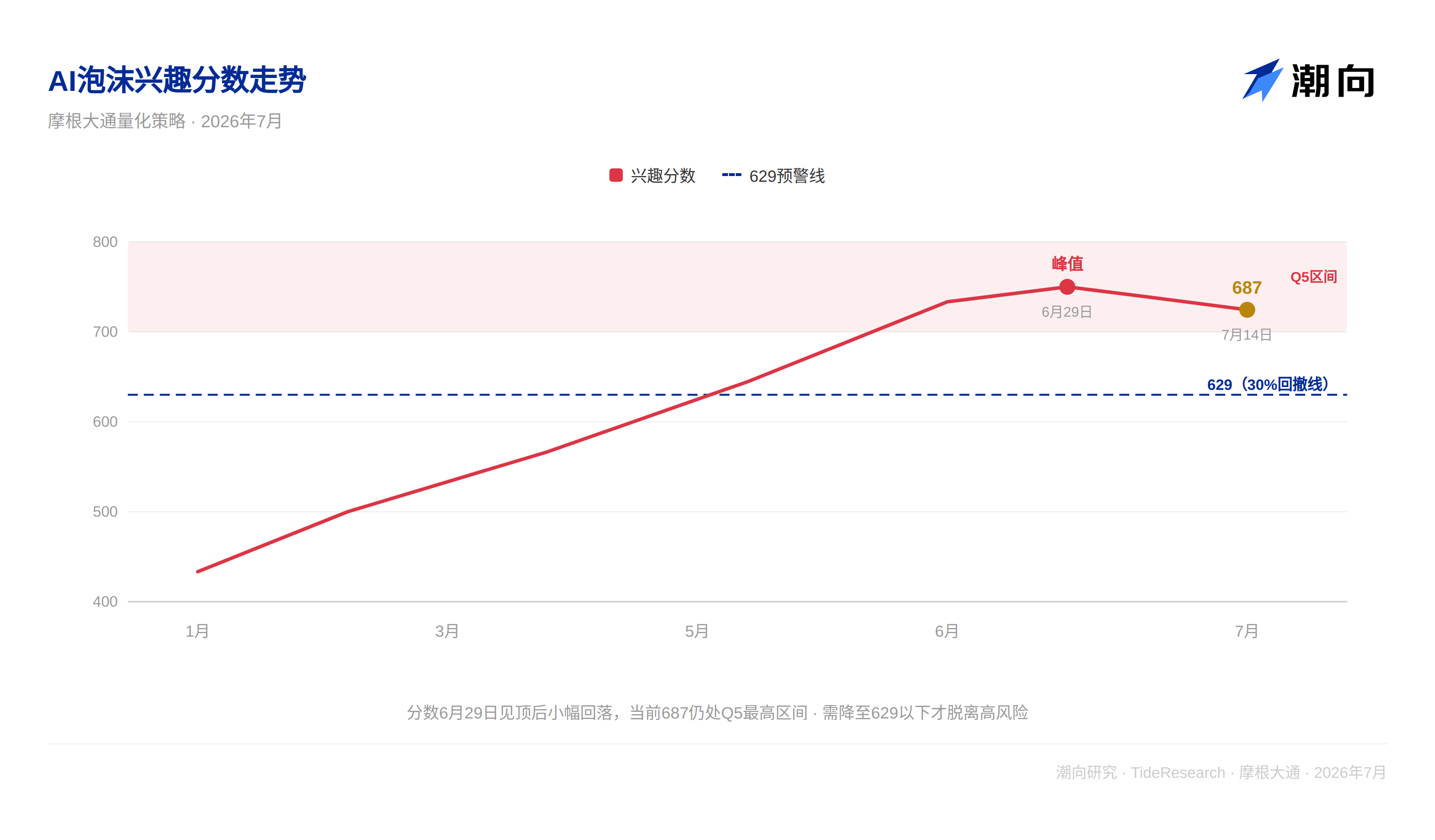
This judgment comes from JPMorgan's quantitative team, which constructed the "AI Bubble Sentiment Score," tracking how hot the discussion about the AI bubble is in global media. The score peaked on June 29 and has started to decline now. Historically, this narrative cycle of warmth to coolness lasts about 1.5 months, suggesting a low point may be reached by mid-August at the earliest.
The problem is that the absolute score is still at 687, which is in the highest quintile historically. Even if it begins to cool off now, as long as it remains in the high range, there is still a 53.8% chance that SOX will experience a pullback of over 8% in the next 20 days.
JPMorgan's quantitative model is very straightforward: the AI alert has not been lifted yet. Before mid-August, bottom-fishing AI semiconductors is high-risk.
How the Alert Works
JPMorgan tracks narrative, not stock prices. This score counts the number of negative reports about the AI bubble in global media; the more reports, the more anxious the market, and the higher the score.
Historically, the cycle of anxiety receding is quite regular: from peak to trough, it averages 43 trading days, or about 1.5 months. This peak occurred on June 29, and based on historical rhythm, the lowest point might be reached around August 12 at the earliest.
However, this score needs to consider two factors: direction and level.
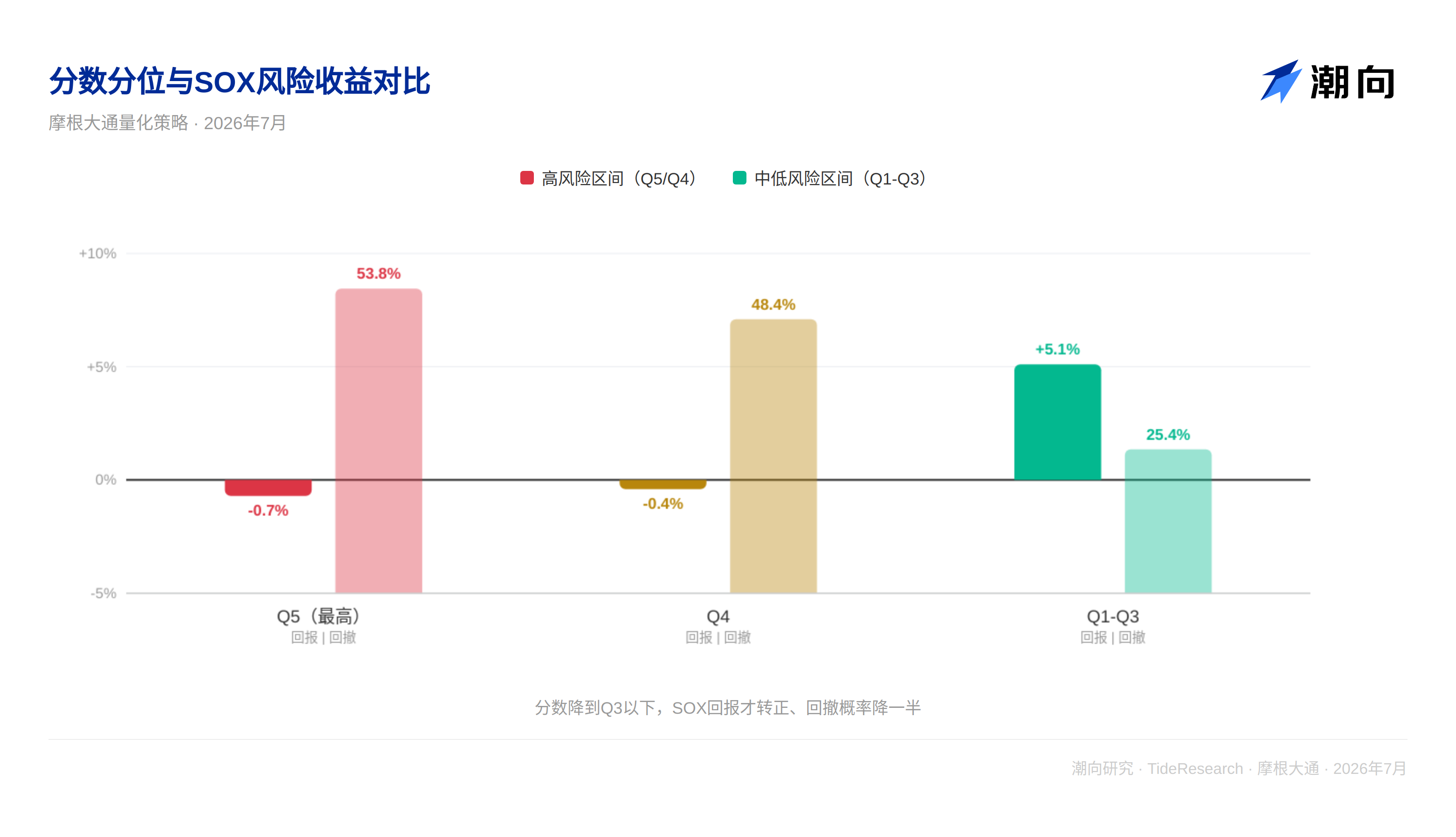
The direction is moving downward, which is a good thing, but the level is not right, still at 687, in the highest quintile (Q5) historically. JPMorgan has retroactively analyzed all past cases, finding that when the score is in the Q5 range, the average return for SOX over the next 20 days is -0.7%, and the pullback probability is 53.8%. Only when the score drops to the mid-low range does the average return turn positive (+5.1%), and the pullback probability drops to 25.4%.
In other words: the alert is shifting, but it has not been lifted yet.
Three Specific Thresholds From JPMorgan
JPMorgan translates "alert lifted" into three specific numbers:
- Score drops below 629: SOX pullback probability drops to 30%
- Drops below 560: pullback probability drops to 25%
- Drops below 418: pullback probability drops to 20%
The current score is 687. A drop to 629 requires an 8.5% decline, to 560 requires an 18.6% drop, and to 418 requires a 39.2% drop.
JPMorgan suggests entering in two phases: the first phase around 629, and the second phase around 560. Until then, each rebound may be pushed back by narrative panic.
Current Stage: Japanese stocks have almost cleared AI positions, but US stocks' panic is not over yet
The situation in Japanese stocks is different from that in US stocks.
The adjustment of positions in Japanese AI momentum stocks is nearing its end. The Nikkei 225 is dragged down by semiconductors, but TOPIX futures remain strong, with capital flowing from semiconductors to banks, finance, and materials. CTAs (Commodity Trading Advisors) still hold long positions in TOPIX futures.
The situation in US stocks is more similar to the "narrative" phase. Since reaching an all-time high on June 22, SOX has dropped about 19%, nearing the 20% bear market threshold. However, the score is still at 687, indicating that market anxiety primarily stems from the narrative "the AI bubble is about to burst," while position issues are secondary.
JPMorgan's historical data indicates a key difference: when the score begins to decline but remains high, the pullback risk for SOX is still very high. The true rebound condition is not "AI is good again"; the time to bottom-fish is when the topic of the "AI bubble" has completely cooled down.
潮向视角
The most useful information in this report transforms the vague market sentiment of the "AI Bubble" into three actionable numbers: 629, 560, 418.
For US stock investors, the quantitative alert has not been lifted yet, and now is not the time to increase positions. This framework can be used to monitor; consider entering when the score drops below 629. Until then, use PUTs or defensive sectors for hedging.
For A-share investors, the sentiment in the A-share AI sector is more fragile, and domestic AI sectors (like optical modules, servers) have higher volatility. JPMorgan's "two-phase entry" strategy can be a reference but needs to be adjusted in accordance with domestic policies and local computing logic. The performance period in August may be a key window for the Chinese AI ecosystem to regain the lead.
The long-term logic of AI has not changed. However, the short-term quantitative alert has not been lifted yet.
Disclaimer
This article is a compilation and interpretation of a third-party brokerage research report (JPMorgan, July 16, 2026) by潮向研究. The ratings, target prices, earnings forecasts, and related judgments quoted in the text are the views of the brokerage's analysts, representing only the position of their institutions and not the views of潮向研究, nor do they constitute any investment advice.
Markets have risks; decisions should be made independently. This article should not be used as a basis for buying or selling any securities.
免责声明:本文章仅代表作者个人观点,不代表本平台的立场和观点。本文章仅供信息分享,不构成对任何人的任何投资建议。用户与作者之间的任何争议,与本平台无关。如网页中刊载的文章或图片涉及侵权,请提供相关的权利证明和身份证明发送邮件到support@aicoin.com,本平台相关工作人员将会进行核查。


