SpaceX went public just a month ago, and its stock price has already fallen below the issue price, almost completely reversing its early gains. SpaceX is facing the typical confidence test post-IPO, and the impending lock-up period expiration adds further downside pressure.
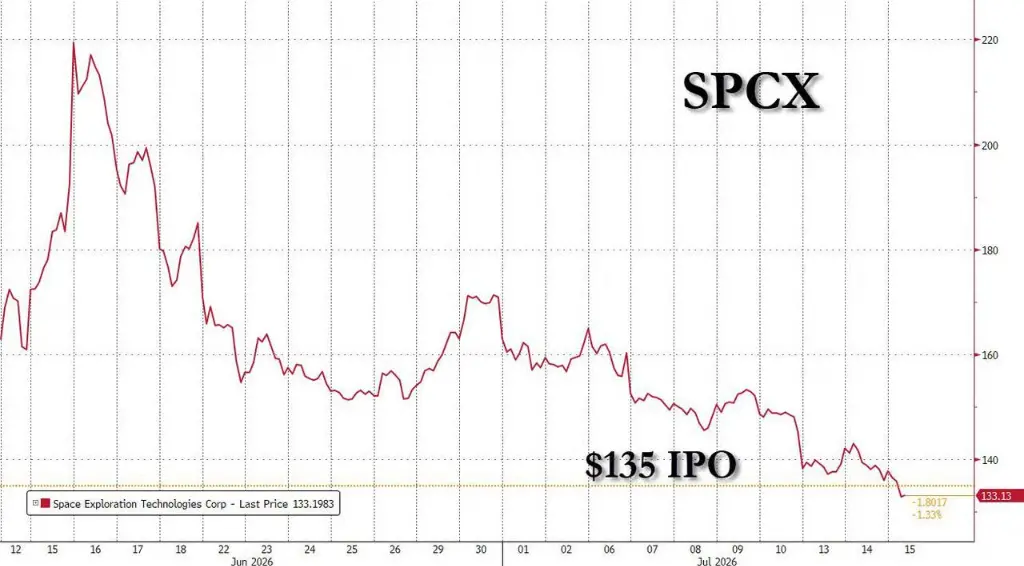
On Wednesday, SpaceX's stock price dropped by 2.9% to $132.15, falling below the IPO issue price of $135 per share from last month’s record $86 billion IPO. It ultimately closed at $136.08, slightly above the issue price.
The stock exhibited the intense volatility common in new issues: it surged nearly 50% in the first three trading days after going public and then retracted nearly a quarter of that gain in the following three trading days.
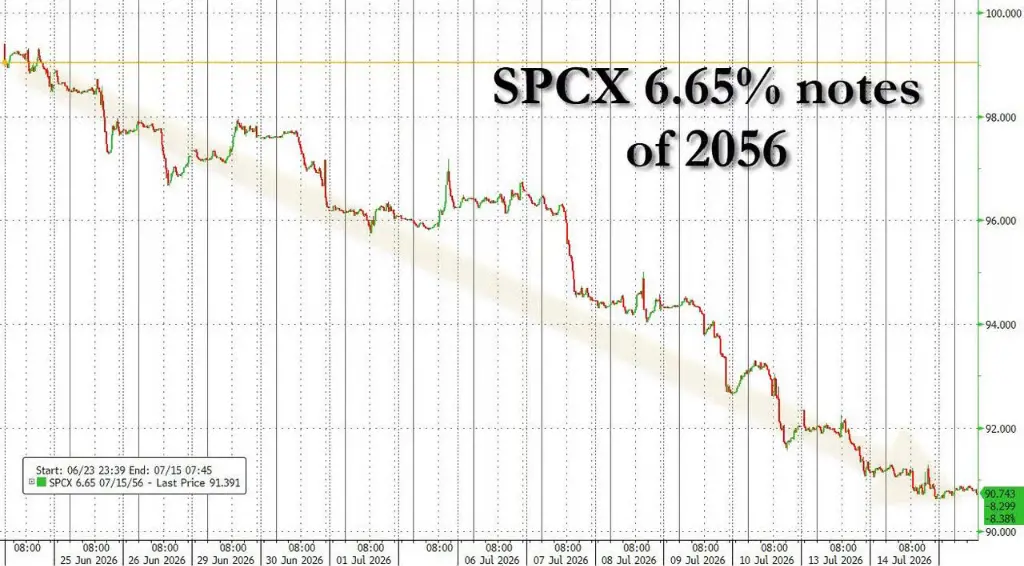
Aside from the stock price, more concerning is SpaceX's newly issued $25 billion bond, which will mature in 2056. Since trading began on June 24, its price has declined, resulting in a current yield of 7.5%, comparable to junk bonds.
Dec Mullarkey, Managing Director at SLC Management, stated:
"Investors are increasingly realizing that the SpaceX story is largely about its xAI ambitions. As the market becomes more prudent regarding the costs and benefits of massive infrastructure projects, SpaceX’s plans sound too far-fetched."
In SpaceX’s $75 billion IPO financing in June, about 20% flowed to retail investors, which is an unusually high proportion for a large-cap issuance. The stock price falling below the issue price not only punctured the narrative crafted by the company and underwriting banks but also plunged some newly listed companies into an irreversible confidence crisis.
Lock-up expiration approaching, selling pressure risk rising
Downside risk may not be fully exhausted. As SpaceX must release its first quarterly results in the coming weeks, the lock-up period for early investors' shares will soon expire. Once this lock-up expires and these investors begin to sell, the stock price will face greater selling pressure.
The sensitivity of this timing is that new stock performance disclosures often become a window for early investors to cash in. Although the current stock price has significantly receded from its peak, there remains considerable unrealized gains for early investors, making the motivation to reduce holdings substantial.
Index inclusion previously drove passive funds inflow
The early stock price surge of SpaceX may partly stem from mandatory buying by passive index funds.
After Nasdaq amended its rules, allowing newly listed large-cap companies to be included in the Nasdaq 100 Index as soon as 15 trading days post-listing, this significantly shortened the previous minimum requirement of three months. Accordingly, SpaceX was included in the index in July and joined the Russell 1000 Index about two weeks after the IPO in late June.
According to Bloomberg, analyst Rob Du Boff from Bloomberg Intelligence estimates that SpaceX’s inclusion in the Nasdaq 100 and FTSE Russell related indexes will prompt index funds to buy at least $5.4 billion worth of stock. Such a substantial passive buying pressure initially supported the stock price post-listing, but this type of technical demand often proves difficult to sustain.
Wall Street remains bullish, target price implies significant upside potential
Despite the pressure on the stock price, Wall Street remains generally optimistic about SpaceX.
As the silence period for bank analysts participating in the IPO ends, a series of bullish reports have been released, with Raymond James providing the highest target price on the street at $800.
According to Bloomberg tracking, over 80% of analysts have assigned a rating to SpaceX equivalent to "buy," with an average target price of approximately $238, suggesting an implied upside of about 78% compared to the current stock price.
免责声明:本文章仅代表作者个人观点,不代表本平台的立场和观点。本文章仅供信息分享,不构成对任何人的任何投资建议。用户与作者之间的任何争议,与本平台无关。如网页中刊载的文章或图片涉及侵权,请提供相关的权利证明和身份证明发送邮件到support@aicoin.com,本平台相关工作人员将会进行核查。


