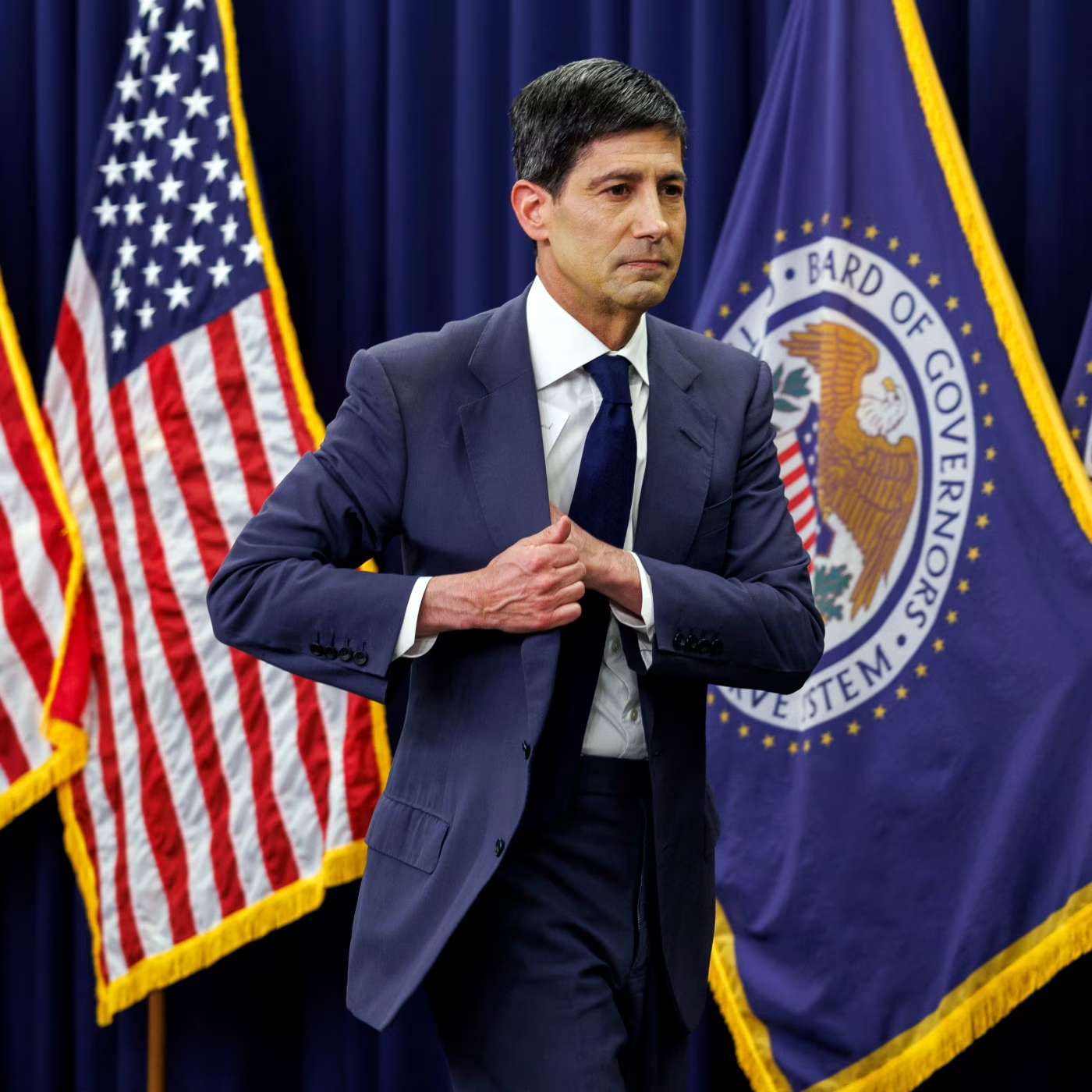
Author: Li Dan, Wall Street Journal
At the Congressional semi-annual monetary policy hearing, where he appeared for the first time since taking over the Federal Reserve, Fed Chairman Waller stated that if pressured by President Trump, he will "do my job," meaning he would take action based on data even if criticized by Trump. This is the most direct comment Waller has made so far regarding Trump's challenges to the Fed.
During his testimony before the House Financial Services Committee on Tuesday, the 14th Eastern Time, Waller was asked how he would respond if Trump continues to target the Fed, for example, by trying to dismiss Fed Governor Cook. Waller stated that the Supreme Court recently reaffirmed the Fed's independence in setting monetary policy.
Waller told the lawmakers that if he himself becomes the target, "I will continue to do my job." When asked a series of questions about whether he would still be willing to base policy on data even if Trump pressured him to lower borrowing costs, Waller said: "The independence of the Fed is sacred and inviolable." He added, "If we remain independent and are seen as independent by others, our credibility will strengthen... that is the best way for us to do our job."
Commentators believe that Waller's relationship with Trump may be tested in the coming months if high inflation persists and if calls for interest rate hikes from other Fed officials become too loud to ignore. At least for now, Waller seems to believe what Trump said when he took office, when Trump told him to be "completely independent... do not act according to my preferences."
Nick Timiraos, a reporter known as the "new Federal Reserve correspondent," pointed out that Waller told lawmakers at the hearing that the Fed has "zero tolerance" for high inflation, and he does not want excessive worry or undue comfort to arise from a single data release, quoting Waller as saying, "Some may look at this morning's (CPI) data and say, 'Great, mission accomplished, everything is perfect.' I do not see it that way."
Timiraos also pointed out that Waller reiterated the Fed's goal of controlling inflation but did not hint at the direction of interest rates and did not discuss his views on interest rates too much at the hearing, which aligns with his consistent argument that the Fed should not signal its next moves in advance, and he did not clearly define the criteria for judging high inflation evolving into persistent inflation.
Media reports indicated that at this hearing, Waller expressed a firm stance on achieving inflation targets and firmly drew the line against Trump’s interventions, trying to firmly establish his authority as a Fed leader. For the market, the Fed's future "say less, do more," introduction of new inflation indicators, and the upcoming "internal big arguments" due to balance sheet reduction and policy tools all mean that the policy path of the past few years will be thoroughly reshaped.
The Fed has the tools to achieve price stability, inflation problems are not someone else's fault
In his prepared monetary policy hearing speech, Waller emphasized that the Fed has zero tolerance for sustained high inflation. The opening remarks from Financial Services Committee Chairman French Hill also highlighted that high inflation is the focus of congressional attention. He stated that Congress expects the Fed to continue focusing on its mission of achieving price stability and to persist until the goals are achieved.
Hill not only condemned the sharp rise in inflation but also criticized the so-called "mission creep" phenomenon that has emerged in recent years at the Fed. He said: "The Fed needs to avoid repeating past mistakes, undertake self-reforms to maintain the long-term independence of its monetary policy, and reshape its reputation as a non-political institution executing congressional directives."
Hill told Waller that the Fed can control its approach to inflation. He asked how the Fed plans to achieve price stability given the existing policy tools. He said, "The Fed might choose to 'look beyond the phenomenon' and ignore these inflationary pressures, but the Fed has held this view in the past and was wrong. High inflation affects the lives of Americans now, rather than some hypothetical future based on long-term forecasts or inflation expectations."
In response, Waller acknowledged: "The current situation is complex and variable." But he reiterated that inflation is a "choice" for decision-makers.
Waller stated, "I hold a very critical view of the 2020 version of the Fed framework, which is no secret. The Fed framework back then was a mistake and was not discussed. We hope inflation increases are more contained. The Fed has the tools to maintain price stability."
Waller said: "Now is not the time for us to shirk responsibility or blame others. The Fed can and will achieve price stability. We have the tools you mentioned—whether it is interest rate policy or balance sheet policy—that can help us achieve this goal. We have the means to achieve this goal."
Waller further stated that he does not believe there is a brutal choice between stabilizing prices and achieving full employment.
Waller said that as long as the Fed ensures price stability, the economy can prosper, and businesses can hire more employees. Therefore, there is no so-called "brutal choice" between the two major responsibilities Congress has given the Fed; this is not a simple either/or question. He mentioned that on this point, his view differs slightly from some of his colleagues in the economics community.
Commitment to break "sticky prices," policies from the 90s productivity boom cannot be simply applied
Regarding the widely cooling U.S. June CPI inflation data released earlier on Tuesday, Waller reiterated that he would not claim that the Fed's inflation "mission is accomplished."
Waller refused to comment on whether interest rate hikes have ended, stating that predicting the Federal Open Market Committee (FOMC) decisions "is not my concern," and warned the market not to become complacent just because the June CPI recorded a month-on-month decline for the first time in six years.
Waller said: "While I reviewed the CPI data released this morning, which performed better than expected, I do not agree with selectively interpreting the data. I will not say 'mission accomplished'; rather, I believe there is still a lot of work to do."
Waller promised to break "sticky prices." He stated that the Fed's responsibility is to ensure that specific short-term price fluctuations "do not spread"; unfortunately, the opposite has happened in recent years. He pointed out that according to "economic principles," once inflation persists above target levels for a period, it is typically more difficult to bring it down—this is known as "sticky prices."
Waller said, "That kind of day must become a thing of the past. Our responsibility—and my commitment to all of you—is to break this sticky price phenomenon."
Media noted that at this hearing, Waller had a clever remark: "Having witnessed one productivity boom is just having witnessed that one productivity boom." A few minutes after making this statement, he also said: "Having witnessed one financial crisis is just having witnessed that one financial crisis."
Ultimately, Waller means: "I am very cautious when making analogies."
Regarding Waller's remarks about productivity booms, the media finds them quite meaningful, especially considering that some believe the current AI investment craze has similarities to the IT investment surge of the 1990s.
U.S. Treasury Secretary Mnuchin, White House National Economic Council Director Hassett, and even Waller himself have stated that in the mid-1990s, then-Fed Chairman Greenspan keenly recognized the productivity boom and maintained the Fed's low interest rate policy, which was a wise move. Waller's recent remark about productivity booms suggests that people should not simply apply that example to the current situation.
Waller acknowledged in his hearing remarks that AI is driving a significant increase in business investment, but pointed out that it is unclear to what extent the economy will benefit from AI infrastructure.
At the hearing, Waller said that AI represents a substantial improvement in productivity in the long term. The AI craze "may be the biggest transformation I have experienced since coming of age," as this technology not only changes the way innovation occurs but also accelerates the speed of innovation. He speculated that this AI technology will serve to "augment" existing jobs, though it may bring disruptive effects in the short term, "it will also create many other job opportunities."
Focusing on the Fed's dual mission of employment and inflation
During the hearing, Republican lawmakers repeatedly emphasized that the Fed has ventured beyond its "dual mission" into other matters, such as diversity and climate change issues.
Waller made it clear that the Fed's responsibilities are clearly defined; if he is at the helm, the Fed will focus on its dual mission when formulating monetary policy.
He said: "The task you (Congress) have assigned to us (the Fed) is to achieve full employment and price stability, while also assigning us many other daunting tasks. We will implement a series of reforms outside of monetary policy. Our agenda is already packed, and I assure you, we will not venture into other areas."
Adequate warnings will be given before balance sheet adjustments
Waller emphasized that the balance sheet is part of monetary policy, calling it "not just a pipeline system." Commentators believe this view suggests that Waller believes the Fed can tolerate higher volatility in short-term funding markets. Of course, the Fed has a standing repo facility to respond to market pressures, but many are reluctant to use it, so Waller may believe this backstop can handle any future turmoil in the repo market.
Waller stated that he does not seek to bring the Fed's balance sheet back to 2006 levels, that is to say, to the levels before multiple rounds of QE. However, he believes there exists a "sustainable equilibrium state," and the balance sheet size will be less than the current $6.74 trillion level. Such changes will not happen overnight; any transformation will be carefully considered and will require "a considerable length of time" from decision-making to final implementation.
He remarked that it is not news that he holds reservations about the Fed's balance sheet policy. However, he does not wish to predict what the working group for the Fed in this area might conclude and stated that any transformation would go through ample communication.
Waller said: "No adjustments to the balance sheet policy will be made without providing adequate warnings to the (Federal Reserve monetary policy) Board and the broader financial markets."
Waller indicated that he understands that during a crisis, the Fed needs to intervene in the market to establish fair prices; however, during relatively stable periods, if the Fed's asset holdings exceed the market itself, then, to quote former Fed Chairman Volcker, it pushes the Fed to the "edge of power exercise."
Waller added that he believes the Fed should avoid delving into fiscal policy when addressing balance sheet issues. "We want to stay away from fiscal policy matters," Waller stated.
Five Fed working groups are in the "initial stage" and will discuss reducing the frequency of statements
Waller outlined in his hearing speech what the newly established five Federal Reserve working groups will be responsible for. During the hearing, Waller stated that he would be happy to "regularly" update congressional lawmakers on the progress of each working group from now until the end of the year, stating: "By that time, I hope we can reach some substantive conclusions."
Waller mentioned that the five working groups are in the "initial stage," and the relevant groups will first share their views "with decision-makers." He promised that these working groups' operations will not be "conducted in secret."
Waller indicated that the functional scopes of the working groups would have some "overlap," for instance, the group responsible for the balance sheet will have functional intersections with the group responsible for communications.
Previously, Waller stated that the working group responsible for communications will evaluate the Fed's press conferences, economic forecasts, policy statements, and public speeches.
During Tuesday's hearing, Waller stated that he would not commit to establishing a fixed public standard for automatically holding press conferences on decisions and procedural changes of the Fed’s FOMC; rather, whether to hold press conferences will depend on specific circumstances.
Waller said the Fed will try to engage in deeper discussions and reduce the frequency of statement releases. He pointed out that the purpose of assessing the communication mechanism and any related adjustments is to ensure the accuracy of monetary policy.
Waller said: "I do not think any adjustments to the communication methods are intended to hide the truth or conceal information. Adjusting the communication methods aims to achieve a core goal, which is to ensure the accuracy of monetary policy." In other words, communication reform is not aimed at reducing transparency.
Some lawmakers asked Waller why the Fed should abandon the so-called "dot plot," which reflects the interest rate expectations of Fed officials. Waller indicated that he looks forward to seeing the conclusions drawn by the working groups he established and expressed that he is impressed by his Fed colleagues' willingness to reconsider the Fed's various strategies with an "open mind."
Waller also noted that, in his view, taking a "more cautious" approach in external communications would be more appropriate.
Market intervention should not be arbitrary; using the balance sheet in a crisis is an exception
Waller reiterated that he does not wish to predict the conclusions of the balance sheet working group. However, he pointed out that the Fed should be a "price taker" rather than a "price maker." From this perspective, Waller would presumably support not targeting the 10-year Treasury yield.
Waller said, "We should not intervene in the market arbitrarily." However, he also mentioned an exception—namely in emergencies: "As for during a crisis, I do not want to give the impression that we can stand by idly. I certainly wish to remain uninvolved, but that cannot be guaranteed."
Waller stated he is willing to use the balance sheet aggressively as a monetary policy tool during a crisis; when the crisis ends, monetary policy "should be driven almost entirely by interest rate policy." Interest rate policy will not favor one class while neglecting another.
It is believed that interest rates should become the dominant policy tool.
Declining to comment on Trump and other executive officials
Democratic leader of the Financial Services Committee Maxine Waters believes that Trump, while "grabbing huge profits" from his position, is also undermining the independence of federal regulators. Waller responded that the Fed will "stay true to its responsibilities" and will not engage in politics. He refused to comment on Trump’s personal financial disclosure reports.
Waters asked whether Trump and other executive officials should be allowed to hold companies within their regulatory scope, including those involving cryptocurrency assets, to which Waller declined to comment. He stated that the Fed will focus on its own responsibilities and will not comment on officials outside the Fed.
Waters then shifted to discussing the prediction market, and her comments seemed to involve insider trading related to government decision-making. Waller mentioned that he had written to Fed staff in his first week in office, emphasizing the importance of maintaining the integrity of the Fed.
免责声明:本文章仅代表作者个人观点,不代表本平台的立场和观点。本文章仅供信息分享,不构成对任何人的任何投资建议。用户与作者之间的任何争议,与本平台无关。如网页中刊载的文章或图片涉及侵权,请提供相关的权利证明和身份证明发送邮件到support@aicoin.com,本平台相关工作人员将会进行核查。


