NOXA made a killing from transaction fees in a week but shut down token issuance; where does Robinhood Chain Meme go from here?
Written by: angelilu, Foresight News
Robinhood Chain has been live for two weeks, generating an unexpectedly high level of interest through its Meme tokens—its DEX trading volume surpassed $3.1 billion in the first week, placing it among the top five blockchains in terms of DEX trading volume. On July 11, the daily Meme DEX trading volume on Robinhood Chain surged to $1.3 billion, surpassing the traditional Meme leader chain Solana (approximately $1.1 billion).
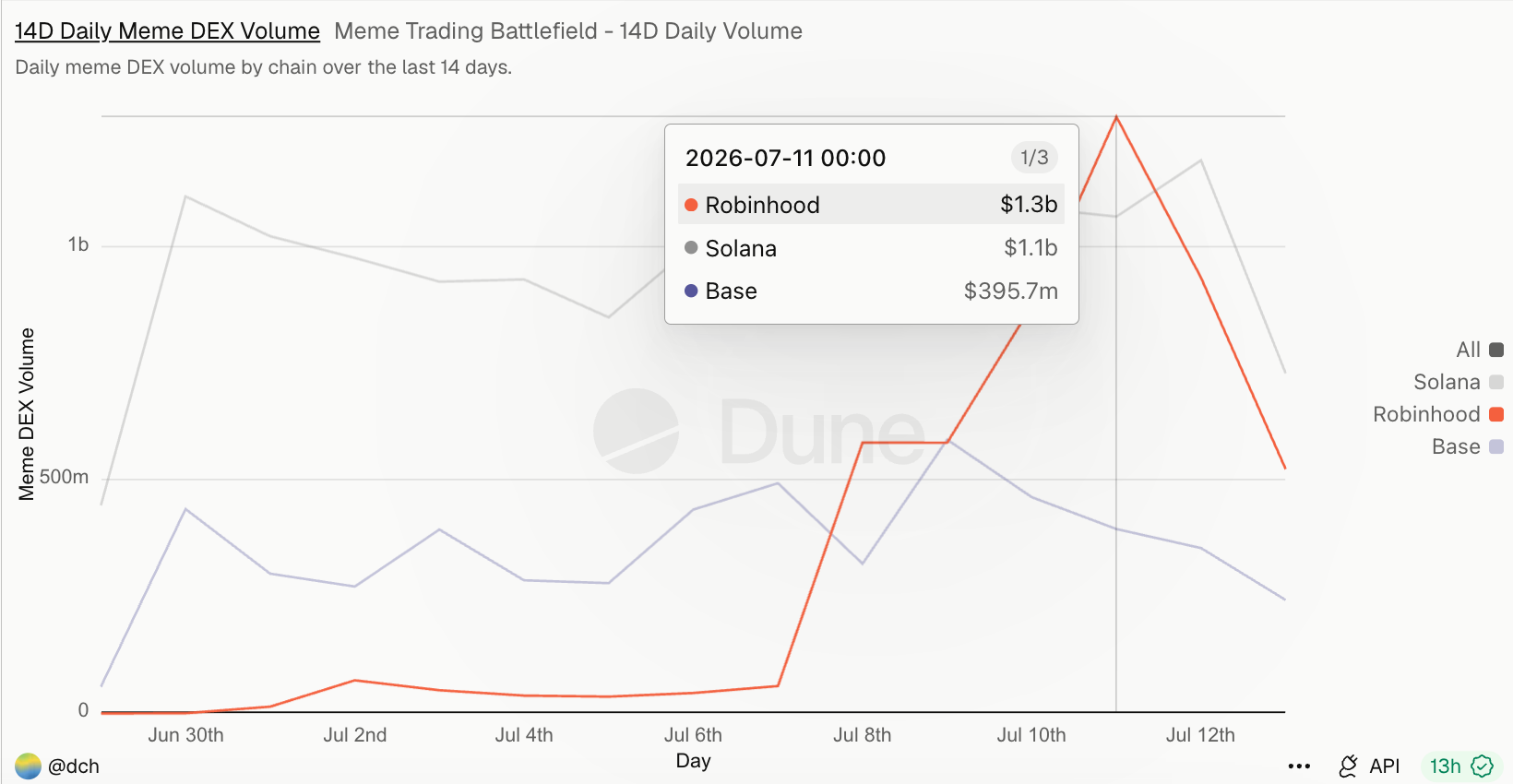
The Meme craze has spread to several “launchpads,” with the most dramatic scene being the hottest Meme launchpad on this chain, NOXA—which, after raking in substantial transaction fees, suddenly shut down its core functionality. According to Onchain Lens, the protocol earned approximately $7.66 million in fees during the week before the suspension, peaking at $2.33 million in a single day (July 11), four times the $575,000 of the same day from Pump.fun. The first major Meme on Robinhood Chain, 'CASHCAT,' also originated from it and reached a market cap of over $200 million on July 11.
However, on July 11, NOXA abruptly suspended its new token issuance feature, citing user feedback about the oversaturation of new tokens and issues with copycat tokens. The team discovered that some bots were creating and duplicating new tokens in large volumes every hour. After that, its web domain was temporarily inaccessible due to issues with Cloudflare and others, and the team claimed they were migrating the interface to an ENS domain and expected to restore it soon.
By the evening of July 14, NOXA launched a new interface, stating that “it will keep the issuance of new tokens closed, as it is the only solution to prevent dilution of core tokens.” According to NOXA, the rampant tokens in the market were “vampire attacks” and endless new token spam that exceeded its original infrastructure capacity design. The new interface only retained three features: viewing snapshots of historically issued tokens, checking the tokens issued and fees, and claiming remaining creator fees; meanwhile, transaction fees were directed 100% to creators.
This operation has also raised questions in the community. Some voices believe that the suspension of new token issuance, the team's control over the new site interface and domain, along with fee adjustments, pose a risk of “soft exit.” The official explained this rate adjustment as “100% going to creators,” while retaining historical inquiry and creator fee claiming functions. On the other hand, token holders’ assets are now highly dependent on whether a new interface that has not yet undergone a security audit can continue to operate, which still needs to be observed.
After this announcement, Meme tokens issued through NOXA experienced widespread declines. Among them, CASHCAT fell approximately 16% within an hour, with a market cap dropping to $16.3 million; JUGGERNAUT fell over 18% in one hour, with a market cap decreasing to $11.7 million.
Launchpad leader position vacant after NOXA suspension
The so-called “launchpad” is a one-click token issuance tool—ordinary people can issue Memes just by uploading an image and choosing a name without writing a line of code, and earn a share from each transaction afterward.
NOXA adopted a direct issuance model: tokens are issued directly on Uniswap V3 from the start, available for immediate trading, and liquidity is permanently locked, unlike Pump.fun which needs to run on an internal market before “graduating” to a DEX.
NOXA's dominance on Robinhood Chain relied largely on being “first to market”—this team specifically choose to deploy on newly launched or even pre-launch chains, having previously established on chains like MonadMegaETH, Merlin, and DeBank's DBK Chain, with early support for Robinhood Chain as well. It was also able to produce the Meme leader CASHCAT, which peaked at a market cap of over $200 million on July 11, gaining over 4000% in a week, and as of the time of writing is at $188 million.
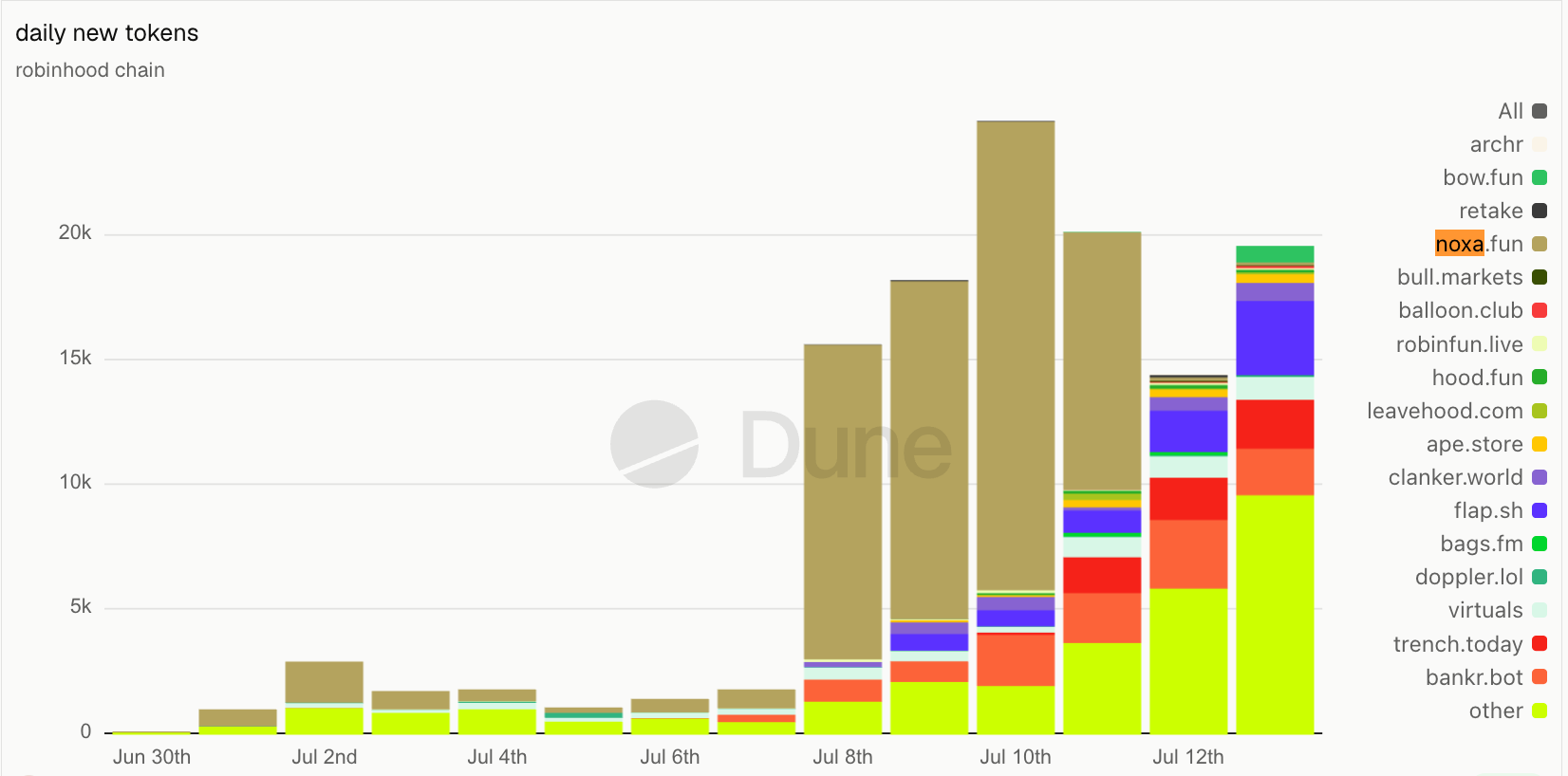
According to Dune data, there are over a dozen platforms participating in issuing tokens on Robinhood Chain—apart from NOXA, there are also Bags, Flap, Clanker, Doppler, Trench, Bow, etc., with NOXA holding a dominant position in early July, and since the suspension, no clear “successor” has emerged.
On the other hand, Uniswap brings “auctions” on-chain
However, it is worth noting that on July 13, Uniswap officially integrated its own “auction token issuance” mechanism CCA into Robinhood Chain. The competition for launchpads on Robinhood Chain has entered a new round.
The CCA brought by Uniswap, which stands for Continuous Clearing Auctions, takes a pricing approach very different from “immediate execution.”
When participating, users only need to provide two values: a budget (how much they plan to spend) and a maximum acceptable price. The protocol does not blast that amount into a single block at once but instead spreads it gradually across several remaining blocks in the auction according to the issuance rhythm (this is what “Continuous Clearing” means—segmental, continuous clearing). It clears block by block during each period, dynamically calculating a “uniform price” for that block, and everyone who trades within the same block buys at this price; those bidding above the clearing price get their full amount, those exactly at the price get part of their bids filled, and those below do not get filled for that round. As demand builds up continuously, the clearing price adjusts gradually across blocks, rather than getting inflated or shattered at the opening moment.
The entire process has also been fully automated with no coding involved: the initiator fills in parameters on the Uniswap webpage, and a factory contract deploys an ERC-20 with a supply of 1 billion; after the auction ends, the raised funds are automatically injected into a Uniswap v4 trading pool, with the fee tier set by the initiator at the time of pool creation (options include 0.01%, 0.05%, 0.3%, 1%, etc., or can be customized, taking a fixed percentage from every transaction in that pool). In the standard configuration, the LP position representing the liquidity of this pool (an NFT) is locked in a vault contract, with the developer relinquishing control, and earnings come from the transaction fees in this pool.
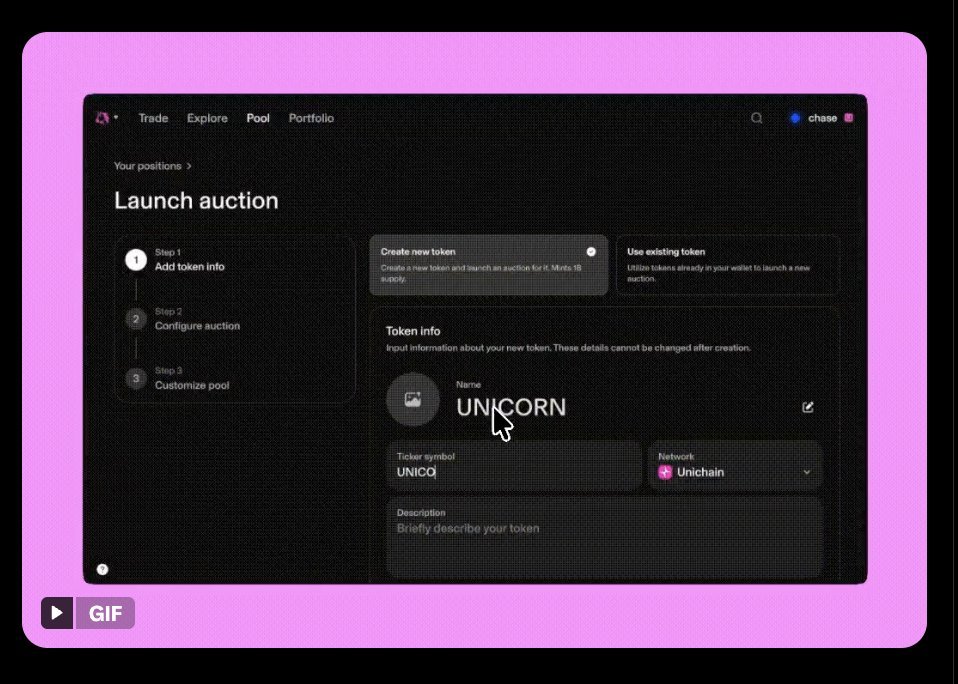
Currently, the Meme that has the highest market cap among those issued under the CCA mechanism on Robinhood Chain is UNICORN, which peaked at $2.13 million in market cap, and as of the time of writing is at $685,000. The name of this token previously appeared in Uniswap’s official presentation (note that the presentation labeled it as Unichain rather than Robinhood Chain).
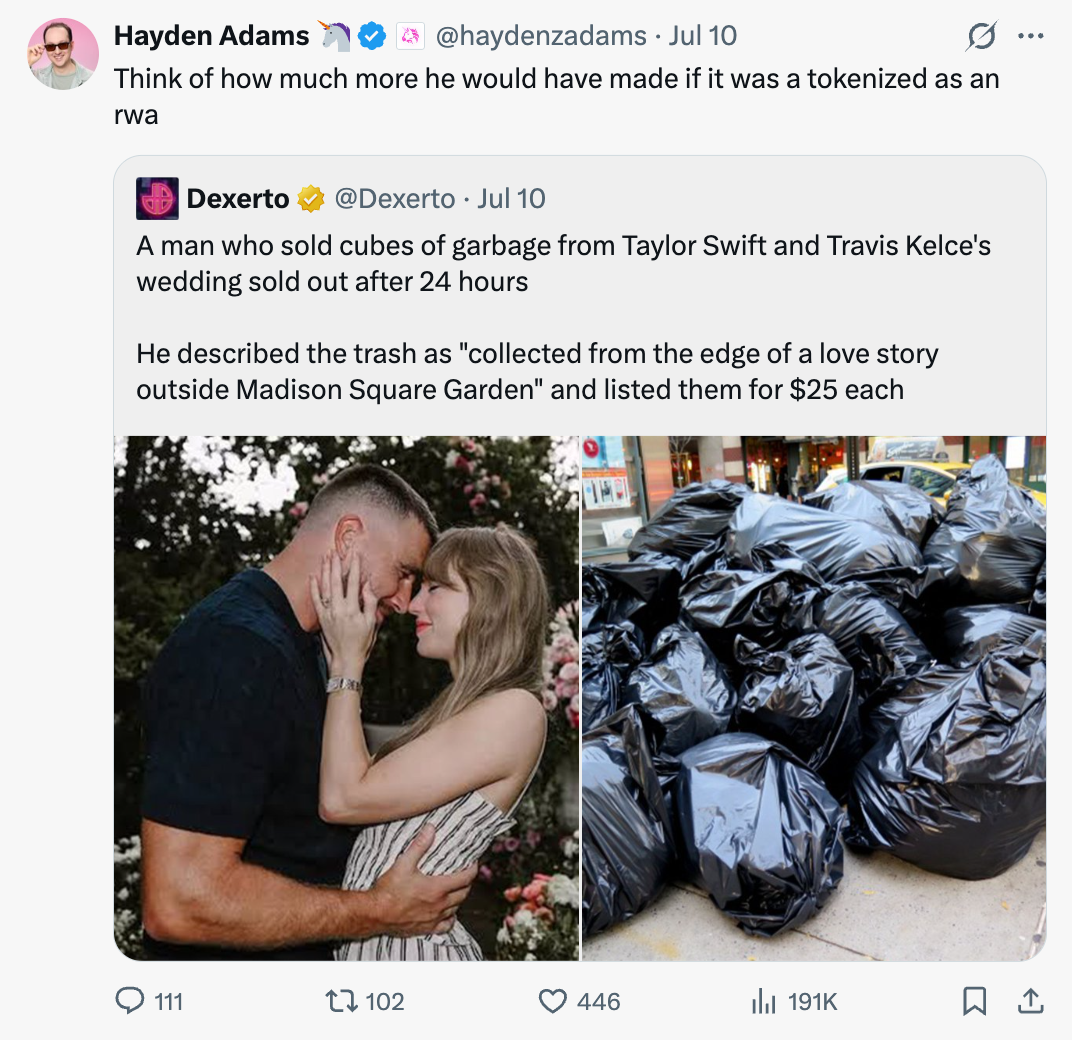
Another Meme, TRASH, had previously reached a market cap of $2.2 million, but has now dropped to around $350,000. This Meme integrates the narrative of “the trash from Taylor Swift's wedding being collected and sold at a price,” and Uniswap founder Hayden Adams once retweeted a tweet stating, “How much could be earned if this transaction were tokenized as RWA.”
Foresight News reminds that this article does not constitute investment advice, Meme tokens have little actual use case and are subject to significant price volatility; investment should be approached with caution.
There are also reserved opinions in the community regarding whether the CCA mechanism is suitable for Memes. Although the issuers do not pre-allocate tokens to themselves at the beginning, any unsold portion during the auction will revert back to them, so issuers may still accumulate a substantial amount of tokens. This “anti-sniping, heavy fairness” auction mechanism may not be well suited for Memes that rely on emotions and rapid rotations. To find new opportunities in Uniswap auctions, one needs to independently assess the issuer's holdings and selling conditions.
First run the chain with Memes, then gradually introduce RWA
For ordinary users participating in the token launches, there are a few points to remember: the CCA auction can significantly reduce the risk of being caught in a squeeze at launch, but currently, the target market caps are small and liquidity is thin; instant execution platforms are hot and quick to enter, but there are also significant risks of sniping and crashing.
For Robinhood itself, this game is already half won: regardless of which token issuance mechanism prevails, the path of “first using Memes to run the chain, then gradually introducing RWA” is being validated by the market. Whether the chain created for stocks will truly be filled with tokenized stocks ultimately depends on what remains after this wave of speculative heat recedes.
免责声明:本文章仅代表作者个人观点,不代表本平台的立场和观点。本文章仅供信息分享,不构成对任何人的任何投资建议。用户与作者之间的任何争议,与本平台无关。如网页中刊载的文章或图片涉及侵权,请提供相关的权利证明和身份证明发送邮件到support@aicoin.com,本平台相关工作人员将会进行核查。


