In the first half of 2026, tokenized assets became the main new category on major centralized exchanges.
Written by: Oluwapelumi Adejumo
Translated by: Luffy, Foresight News
As the scale of tokenized stocks and real-world asset derivatives trading continues to soar, cryptocurrency exchanges are gradually transforming into distribution platforms enabling ordinary investors to allocate Wall Street assets.
Data analysis platform CryptoRank shows that in the first half of 2026, tokenized assets ranked first in the number of new listings across major centralized exchanges, accounting for nearly one-fifth of all newly listed cryptocurrencies, while in 2025, this category represented less than 7% of new listings.
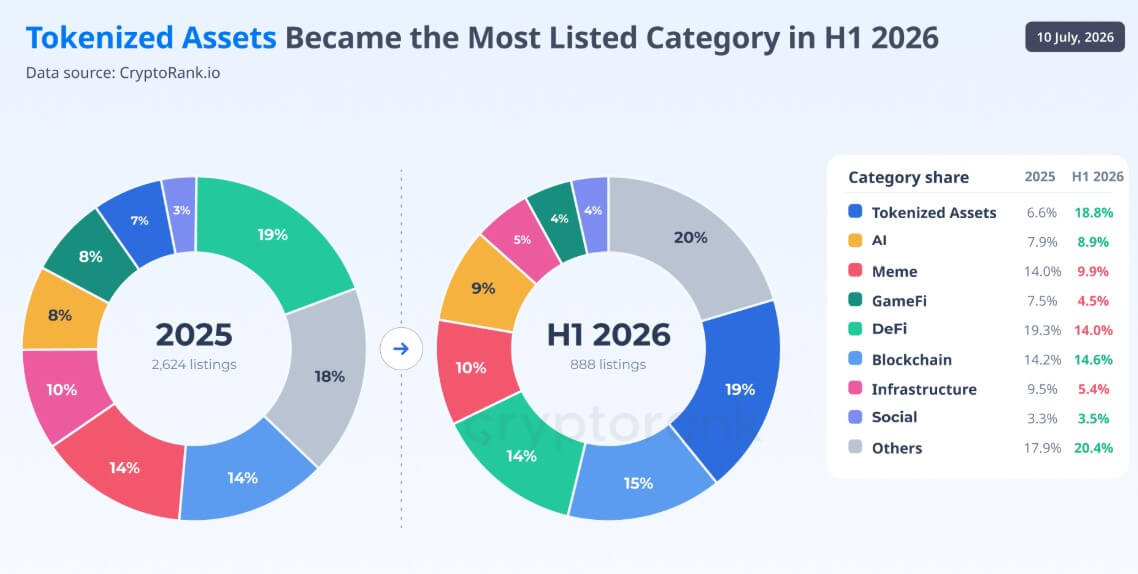
This round of expansion primarily relies on tokenized stocks issued by platforms like xStocks, bStocks, and Ondo. The rise of such products marks a significant shift in exchange operational strategies, as in recent years, meme coins and gaming tokens have long dominated new listing lists of native crypto assets.
At the same time, the enthusiasm of U.S. retail investors to directly participate in the traditional stock market continues to wane. Financial analysis firm VandaTrack indicates that in the past month, the net purchase amount of U.S. retail stocks was only $13 billion, the lowest since the onset of the pandemic in 2020; this represents a massive decrease of $18 billion compared to early 2026, a decline of 58%. The amount of direct purchases of individual stocks plummeted by 71%, totaling only $3.2 billion.
The U.S. traditional stock market and global tokenized assets belong to two separate markets and two different investment groups, making the data not directly comparable. However, crypto exchanges continue to expand stock-related derivatives to meet user demand for 24/7 continuous trading, fractional holdings, and global stock market exposure without needing traditional brokerage accounts.
Tokenized stock trading is booming
Derivative trading volumes have seen explosive growth, becoming the core driving force behind exchanges' substantial efforts to position Wall Street-related products. According to CoinDesk statistics, in June, the trading volume of perpetual contracts for real-world assets on centralized exchanges rose by 57% month-on-month, reaching a historical high of $311 billion; of this, Binance accounted for $245 billion, holding a 78.6% market share.
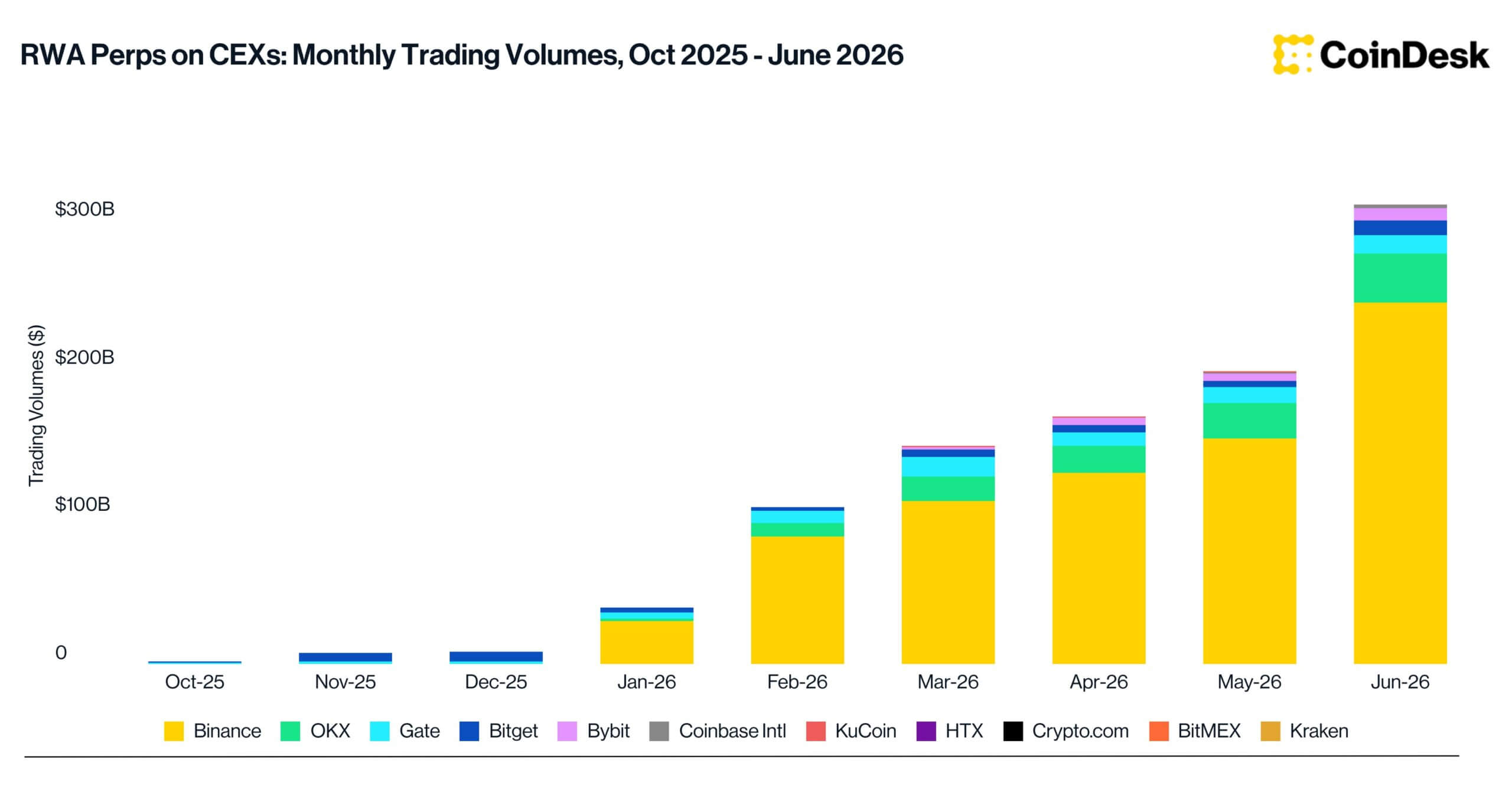
Perpetual contracts for RWA on centralized exchanges, data source: CoinDesk Data
At the end of 2025, this category saw almost no interest, but in the first half of 2026, it experienced explosive growth. The expectation of SpaceX's IPO further stimulated market demand, with numerous traders looking to bypass the entry restrictions of traditional brokers and stock markets by utilizing crypto channels to engage with traditional financial targets.
Perpetual contracts do not require the delivery of the underlying asset and have no expiration date, only betting on asset price fluctuations, making them the most active trading products on crypto exchanges. High leverage combined with round-the-clock trading characteristics amplify both trading volume and market volatility.
The growth is not limited to the derivatives sector. RWA.xyz data shows that over the past year, the total market value of tokenized stocks skyrocketed by 470%, reaching $1.87 billion; monthly on-chain transfer volumes surged to $8.4 billion, confirming that the demand for tokenized stocks is strong both for exchange trading and on-chain circulation.

Market value of tokenized stocks, source: RWA.xyz
Kraken disclosed in February that the total trading volume related to its xStocks platform exceeded $25 billion, covering transactions on centralized/ decentralized exchanges, token minting, and redemption, with on-chain interactions exceeding $3.5 billion.
A series of data confirm that tokenized stocks and traditional asset derivatives are simultaneously experiencing new listing trends and genuine trading demands.
Total new listings on exchanges are declining, Wall Street assets are replacing native crypto tokens
As the popularity of tokenized assets rises, the total number of new listings on cryptocurrency exchanges is concurrently shrinking, as the market gradually bids farewell to the speculative tracks that prevailed in the previous bull market.
According to CryptoRank statistics, in the second quarter of 2026, leading centralized exchanges listed only 351 cryptocurrencies, which is the lowest quarterly value since the third quarter of 2023; the number of new listings has declined for two consecutive quarters, marking the second time since 2024 that the number of tokens delisted exceeded the number of new listings.
When Bitcoin reached an all-time high in 2025, the volume of new listings on exchanges peaked. Platforms did not rely on issuing new native crypto projects to fill the trading volume gap, instead choosing to significantly list traditional financial asset tokenized products.
In the second quarter of 2026, exchanges newly added 42 tokenized assets, ranking second only to public chain infrastructure and DeFi sectors in new listing scale; this category also jumped from less than 7% of new listings in 2025 to becoming the largest new category in the first half of 2026.
In contrast, popular sectors from the previous bull market are experiencing a continuous decline in popularity. The number of new listings for meme coins has decreased for six consecutive quarters, from 196 meme coins listed in the fourth quarter of 2024 to just 41 in the second quarter of 2026, a drop of 79%, similarly falling to lows not seen since the third quarter of 2023. The gaming sector has contracted even more significantly, with new listings peaking in the second quarter of 2024 and only 15 gaming tokens added in the second quarter of 2026, a drop of 84%.
Meanwhile, CryptoRank also tracked the delisting rates across various sectors. As of mid-2026, about 7% of all cryptocurrencies launched in 2025 were delisted; NFT projects had the highest delisting rate of 19%, followed by gaming at 14% and meme coins at 11%. However, none of the 172 tokenized assets listed in 2025 have been delisted as of mid-2026.
The extremely low delisting rate suggests that, compared to NFTs, gaming, and meme coins, tokenized assets have a longer lifespan on exchanges, and platforms view products linked to mature traditional financial markets as long-term sustainable categories for new listings.
Cryptocurrency platforms are encroaching on the territory of traditional brokers
The weakening net purchases of U.S. retail stocks and the rising trading volume of global tokenized stocks form a stark contrast, signaling a diversification of investment channels in the global traditional financial market.
Cryptocurrency exchanges can seamlessly meet the needs of spot trading, leveraged derivatives, tokenized assets, and stablecoin settlements, allowing users to switch freely between cryptocurrency and traditional stock investments without the need for new brokerage accounts.
Tokenized products support 24/7 continuous trading, and also allow for small fractional holdings, lowering the barriers for ordinary overseas investors to participate in quality overseas targets.
However, these products also have legal and underlying mechanism flaws. Tokenized stocks represent only a claim to the earnings of the corresponding underlying stocks, a synthetic price-tracking tool, or other contractual certificates; investors often cannot hold complete shareholder rights, such as voting rights and asset custody rights of the corresponding stocks. Perpetual contracts only track prices without owning the underlying assets, and traders simultaneously bear various risks including leverage, funding rates, and forced liquidation.
Regulatory policies in various regions also set access barriers; most tokenized U.S. stock products are not open to U.S. residents, even if the underlying assets are from U.S. publicly listed companies.
Nonetheless, the new listing and trading data prove that the positioning of centralized exchanges is broadening comprehensively. In the past two bull markets, major exchanges competed to list various native cryptocurrencies; now, the core competition has shifted to distribution channels for traditional financial assets like stocks and commodities.
The next cycle of new listings on exchanges will no longer be a battle of thousands of new coins but will instead focus on launching various tokenized products linked to real financial assets on a platform that never closes for trading.
免责声明:本文章仅代表作者个人观点,不代表本平台的立场和观点。本文章仅供信息分享,不构成对任何人的任何投资建议。用户与作者之间的任何争议,与本平台无关。如网页中刊载的文章或图片涉及侵权,请提供相关的权利证明和身份证明发送邮件到support@aicoin.com,本平台相关工作人员将会进行核查。


