Organized & Compiled: Deep Tide TechFlow
Guest: EJ, Co-host of Limitless Podcast
Host: Josh, Limitless Podcast
Podcast Source: Limitless Podcast (original Bankless channel)
Original Title: The AI Trade Everyone's Getting Wrong
Broadcast Date: July 9, 2026
Key Points Summary
Samsung's latest quarterly profit is $58.5 billion, exceeding NVIDIA's $53 billion in the same period, with over 94% of its profit coming from one department: AI memory. There are only three companies globally that can produce HBM (High Bandwidth Memory): two in South Korea (Samsung and SK Hynix) and one in the United States (Micron). Every inference made by AI requires reading the entire model weights again, leading to memory demands that are 10 to 20 times that of consumer products, with each generation of models doubling the demand. Meanwhile, producing 1 GB of HBM consumes the equivalent of 4 GB of regular DRAM capacity, directly squeezing the memory supply for smartphones and computers, resulting in price increases across all Apple products.
The contradiction lies in the fact that memory companies are experiencing record profits and rising prices, yet their stock prices have collectively fallen into bear markets. Samsung's stock fell 9% on earnings day, while SK Hynix dropped 15%. The two hosts believe this is a combination of "selling news" events and cyclical panic, with no fundamental changes. SK Hynix debuted on NASDAQ in ADR form, raising about $30 billion, with 4 times oversubscription, and Leopold Aschenbrenner, as a seed investor, participated.
Exciting Insights Summary
Memory Monopoly's Profit Margins Crush Everything
"Samsung's gross margin is 52%, and SK Hynix is 72%. For every $100 of memory sold, $72 goes directly onto the balance sheet. In comparison, Apple's hardware gross margin is about 30%."
"The year-end bonuses for Samsung memory department employees are 6 times their annual salary. The sales of South Korea's luxury goods market have tripled over the past four months."
AI is a Black Hole for Memory
"AI is basically a memory black hole, more exaggerated than any consumer or enterprise technology wave we've seen."
"Every time you submit a prompt, whether it's ChatGPT or Claude, it has to read the entire model weights again. Each time."
"Every new model's memory requirement is 10 to 20 times that of its predecessor. With models containing 150 trillion parameters and 200 trillion parameters, that demand will only continue to rise."
The Price Surge is Far from Over
"Prices rose 90% in Q1, another 50 to 60% in Q2, and are expected to rise another 20% in Q3. Samsung is earning more in one year than it has in the past 40 years combined."
Record Profits, Stock Prices in Bear Market
"Samsung beat expectations on earnings day, with quarterly profits surpassing NVIDIA. Then the stock dropped 9%. SK Hynix fell 15%."
"Meta hinted at reducing AI capital expenditures. To be honest, they haven't produced anything particularly useful."
"If you bought in a month ago, it looks foolish now. But 6 to 24 months from now, these companies will still be strong businesses."
Main Text
Samsung: The Misunderstood King of AI Profits
Josh: Samsung has just become the most profitable company in the world, but hardly anyone knows exactly how they are making their money. I used to think of Samsung as just smartphones and computers, but in fact, 96% of their profits come from one department – memory. There are only three major suppliers in the memory market, and two of them happen to be in South Korea. How does it work that the two most profitable companies in the world are in the same country? EJ, how did Samsung do it?
EJ: When I was younger, I only knew Samsung as a phone seller. I’ve been hearing the name associated with AI over the past year and a half, so I’m curious what this company is really doing. Let’s look at some numbers. Samsung's Q2 profit was $58.5 billion, analysts expected $55 billion, surpassing by $3 billion. More importantly, they crushed NVIDIA, which had only $53 billion in the same period. A year ago, Samsung's profit for Q2 2025 was only $3.4 billion. What happened over the year to go from $3.4 billion to $58.5 billion?
The answer is HBM, high bandwidth memory. Samsung is currently the second largest HBM supplier in the world. Why is HBM so valuable? Because every GPU sold by NVIDIA, every TPU made by Google, and any AI chip requires a lot of memory. Notice the word "a lot"; the memory required for consumer devices (laptops, computers) is predictable, but the demand for AI memory is exponential.
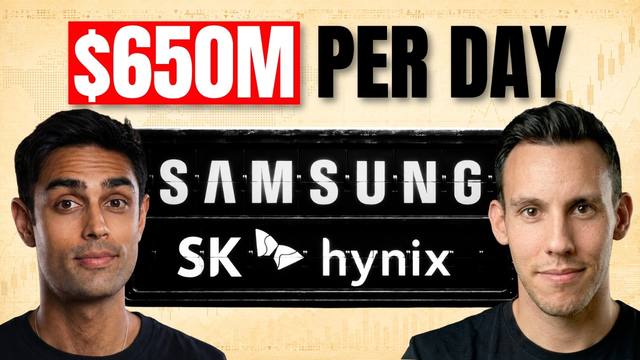
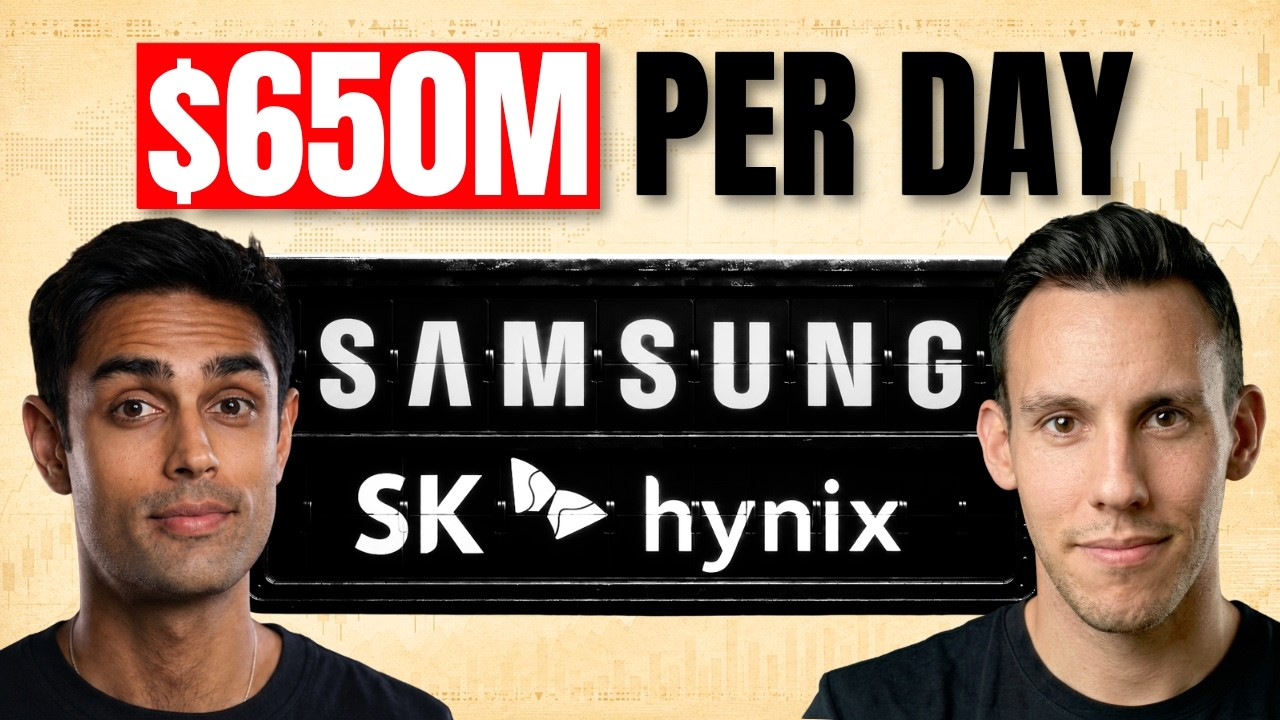
Samsung makes $650 million a day, $27 million an hour, $7,500 a second. This is more than what the world’s most valuable company earns. But Samsung is not the world's most valuable company, which is quite interesting.
The Big Three Memory Firms and HBM Monopoly
Josh: Computers need two things: a workbench (memory) and a filing cabinet (storage). There are only three companies in the world that can make these things.
EJ: Right. There are three types of memory, each with its own uses. DRAM is the DDR5 in your computer, the workbench, temporary RAM that clears when shut down. NAND is your SSD, the flash storage in the iPhone, the filing cabinet, slower but cheaper. Then there's HBM, high bandwidth memory, which is essential for the AI era.
The manufacturing of HBM is extremely complex. DRAM chips are stacked 12 to 16 layers high, resembling skyscrapers, using highly precise processes. SK Hynix holds 60% of the entire HBM market. Any AI chip produced is very likely to use their memory. The monopoly structure among the three companies has formed, and profit margins have swollen accordingly.
Josh: Here’s a very intuitive number. The wafer capacity consumed by 1 GB of HBM is equivalent to 4 GB of regular DRAM. That means for every wafer that shifts to AI memory, there’s a disappearance of 4 times the smartphone and computer memory capacity. Apple has raised prices across the board for the first time: the MacBook Air went from $1,100 to $1,300, the MacBook Pro from $1,700 to $2,000, and the Mac Studio from $4,000 to $5,300. Because buyers of the Mac Studio need to perform local inference, leading to huge memory demands, but there’s not enough memory available.
AI is a Black Hole for Memory
EJ: If I had to explain in one sentence why everyone is so optimistic about these companies: AI is essentially a memory black hole, more exaggerated than any technology wave we've seen.
When you write a prompt and submit it, whether it’s ChatGPT or Claude, it has to read the entire model weights each time. What are model weights? They are the parameters that the companies spent billions training. Every inference reads them again. Moreover, every new model's memory demand is 10 to 20 times that of the previous generation. With models containing 150 trillion and 200 trillion parameters, the demand will continue to trend upward.
But that's not the biggest part. Your chatbot remembers what you said last time, retains your information through conversations; this temporary storage utilizes NAND flash memory, which has equally huge demands. Thus, the demand for all three types of memory is being exponentially strained.
Some say this is a bubble that will burst. Historically speaking, there is some truth to that; the memory industry has always had cycles. Three years ago, SK Hynix was nearly acquired by Micron, which was the absolute bottom of the cycle. They invested in HBM, unsure if they could sell it, with Micron almost buying them out. In the end, they didn't sell and doubled down on HBM, now becoming South Korea's most valuable company.
Price Surge: From 90% to 20% Increases
EJ: Let’s take a look at prices. SK Hynix and Samsung’s pricing over the past 6 months: Q1 increased by 90%. The memory in your phone or computer suddenly doubled in price because one component increased by almost 100%. Q2 saw another 50 to 60% rise. Samsung is set to increase again by 20% in Q3.
Samsung made more money in one year than in the past 40 years combined, 19 times more than the same period last year.
In terms of gross margins, grocery stores profit $3 for every $100 in sales, automakers $7, and Apple hardware $30. Samsung’s is 52, SK Hynix’s is 72. For every $100 of memory sold, $72 goes directly into profit. Employees in Samsung's memory division receive year-end bonuses that are 6 times their annual salary. The luxury goods market in South Korea has tripled in the past four months. Someone in Taiwan took out a high-interest loan of $60,000 from the bank to buy TSMC. Some crazy things are happening in the Asian AI market.
Josh: This price increase is alarming. Consumers are beginning to feel the cost. A 32GB memory stick costs 2 to 3 times more than last year. Building a computer, one-third of the cost is memory. These prices have already reached the real consumer market. The question is: how long can this last? Can they keep raising prices?
EJ: It depends on one variable: will the number of people using AI continue to increase? This is the only proxy that can measure whether memory demand will continue to grow. If you believe that in the future everyone will run multiple AI agents, using AI in their work and life, then memory demand will be exponential.
What about the supply side? New wafer fabs won't come online until 2030. These fabs are designed in an extremely precise manner, and it’s not possible to flood supply in the short term. Demand is outpacing supply by 3 to 5 times, and for the next few years, supply will remain constrained. There’s CXMT in China making similar DRAM and HBM, but their capacity is completely consumed by domestic AI labs. Apple is trying to find alternative suppliers from China, but there’s no stock.
There’s also a narrative that if a new model architecture emerges that doesn’t require as much memory, then the situation could change. However, I think it’s exactly the opposite. As memory becomes cheaper, more scenarios can be realized, more AI agents will be deployed, leading to higher overall economic output. The demand for memory could actually be greater.
The Paradox: Record Profits, Stock Prices in Bear Market
Josh: We’ve always been optimistic about memory; Micron has risen 150% since we recommended it last year. Yet recently all memory stocks have fallen over 20% from their highs. A technical bear market. Samsung beat expectations on earnings day, with quarterly profits exceeding NVIDIA's, then dropped 9%. SK Hynix fell 15%. Profits are at record highs, prices are still rising, yet the market is saying, "slow down."
What may have spooked the market is Meta's hint at reducing AI capital expenditures. To be honest, they haven’t produced anything particularly useful either. This is the strange juncture we’re at: companies are saying, "We’re great, record profits, strong demand," while the market says, “Wait, it's risen too much too fast, there are unknown risks.” What’s your take?
EJ: My judgment is simple: this is sell the news. The quarterly earnings season has just ended, and global funds are heavily positioned in these stocks, waiting for a good price to re-enter. If you think I'm being defensive, that’s understandable. But if you are a long-term investor in AI, memory is a necessity, and only these three companies can produce it; this structure won’t change in the short term.
People are worried about the cycle. The last memory supercycle from 2017 to 2018 saw Micron’s PE drop to 4 to 5 times, followed by a 60% decline, even while profits continued to rise. History indeed repeats itself, but what’s different this time is: the last cycle was driven by smartphones, where you could predict the demand ceiling. This time, it’s driven by AI, where there’s no ceiling in sight.
Another interesting historical detail: during the last cycle's bottom, when memory prices were at their cheapest, who was desperately pushing down prices and hoarding memory? Apple. At that time, Apple had pricing power over Samsung and SK Hynix, forcing them to supply DRAM and HBM at the lowest prices. Now the tables have turned; Samsung and SK Hynix are doing what Apple did back then. In an efficient market, this is quite normal.
SK Hynix Goes Public on NASDAQ
Josh: Next up is a major test. SK Hynix is a South Korean company but is going public on NASDAQ in ADR form on July 10, raising about $30 billion. This is a crucial moment for the memory industry; how the U.S. market values SK Hynix will determine the next phase of this memory trade. EJ, will you participate?
EJ: Short answer: yes. I am bullish on memory. I hold Micron and also a DRAM ETF (a basket of memory companies). If you’re a U.S. citizen, directly buying South Korean stocks can be inconvenient, but you can allocate through these basket products. I’ve been waiting a long time for SK Hynix to enter the U.S.; I will definitely buy.
This IPO is reportedly 4 times oversubscribed. Institutions, pension funds, and retail investors are scrambling for shares. The ability to achieve this scale indicates that institutions have conducted deep research into the memory sector, intending to hold long-term.
Josh: Guess who is responsible for $2 to $3 billion of that $30 billion? Leopold Aschenbrenner. He’s back again. Last time we recorded a segment analyzing his holdings, some questioned his logic in shorting NVIDIA. As a result, NVIDIA has dropped 20% since we filmed that segment. Now he returns as a seed investor in SK Hynix’s IPO. You can question his judgment, but he hasn’t missed so far.
Long-Term Perspective: Supercycle or Bubble?
Josh: Let’s summarize conclusions. In the long run, there’s no ceiling on memory demand; the companies that can produce it are just these three, and new entrants cannot create meaningful competition in the short term. Short-term fears exist due to historical cyclical shadows, as prices have risen too much too quickly. This completely makes sense. If you bought a month ago, it looks foolish now. But in 6 to 24 months, the fundamentals of these companies will not change.
EJ: Right. Ultimately, there will be a cycle peak, which will occur when wafer capacity begins to exceed demand. But supply won’t increase until 2030; demand is 3 to 5 times the supply. Before then, margins and profit rates will continue to expand.
I’m more curious to hear what the audience thinks. AI memory isn't the sexiest topic, but it's becoming the most important component in the capital expenditure competition for AI infrastructure. It is the source driving up prices for all consumer goods. Do you think we’re too optimistic? Can margins continue to rise? Or is this just a bubble that is destined to burst, with me and Josh marking the top?
免责声明:本文章仅代表作者个人观点,不代表本平台的立场和观点。本文章仅供信息分享,不构成对任何人的任何投资建议。用户与作者之间的任何争议,与本平台无关。如网页中刊载的文章或图片涉及侵权,请提供相关的权利证明和身份证明发送邮件到support@aicoin.com,本平台相关工作人员将会进行核查。