Author: 0xKyle
Translated by: Deep Tide TechFlow
Deep Tide Reader: Gold and silver have collapsed, copper and platinum have also cooled down, last year's "super cycle of commodities" has fizzled out in less than a year. But this time it's different — AI data centers, military rearmament, and de-globalization are simultaneously at work, and some niche metals are brewing a genuine structural shortage. Tungsten, the industrial metal with the highest melting point, greatest hardness, and almost irreplaceable properties, has seen its price rise nearly tenfold in the past year, driven by a sharp reduction in Chinese supply, a surge in U.S. military demand, and an explosive new demand for cutting photovoltaic silicon wafers.
Gold and silver experienced soaring prices over the past year, followed by a sharp correction, with both showing double-digit declines from their peaks. The once anticipated "super cycle of commodities" seems to have cooled down — I remember during that period, people were going long on copper (widely used for copper wire in data center construction), platinum (shortage story), zinc, aluminum, and others.
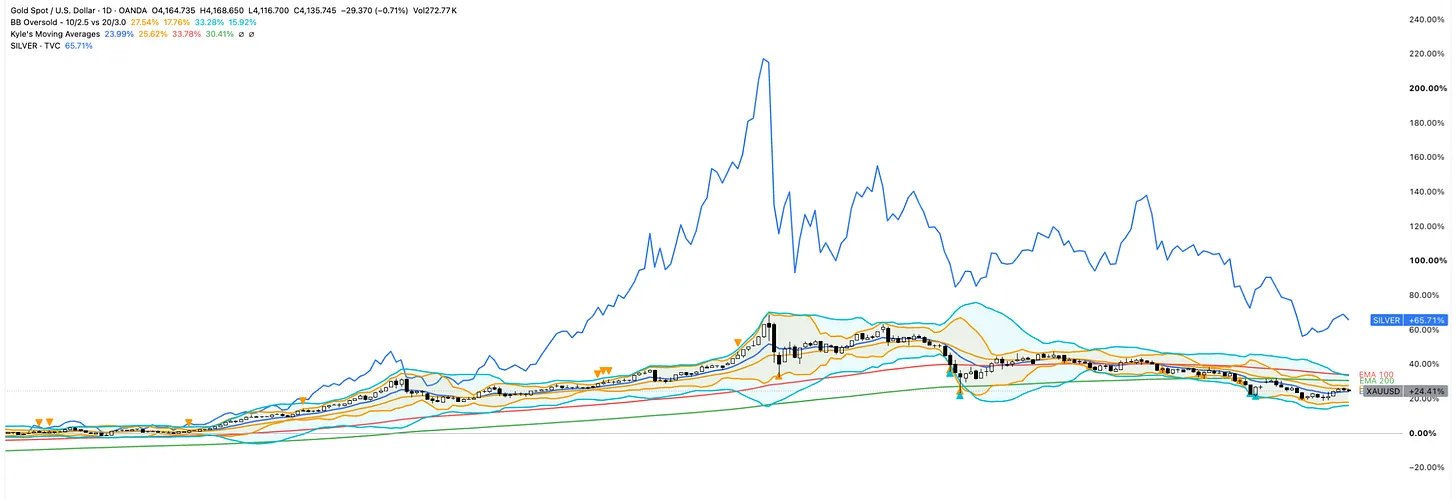
Earlier this year, we welcomed "Super Cycle of Commodities v2" — this time due to the closure of the Strait of Hormuz, leading people to believe we would face oil shortages, compounded by weather factors (El Niño) and the need to transport a large amount of fertilizers through the strait (fertilizer stocks saw a sharp rebound, with companies like CF rising over 70% at price peaks), and we are projected to lack corn and wheat during this harvest season.
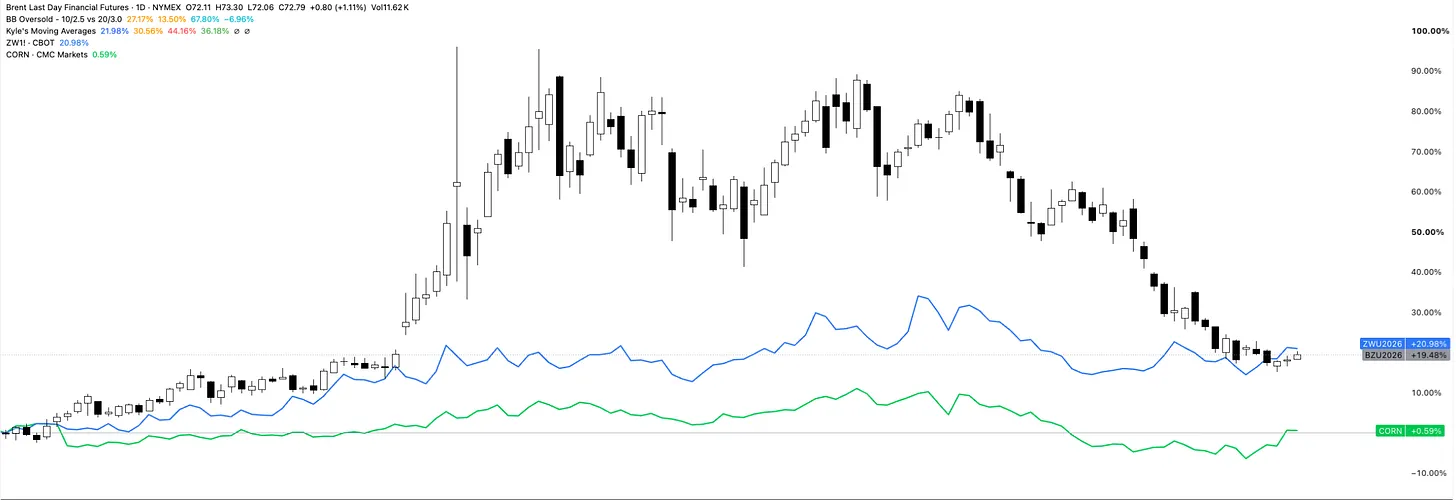
There are a few points to note. First, we are indeed undergoing a shift from bits to atoms — from software to hardware. The primary driving force is AI, with comprehensive semiconductor construction underway. Beyond that, as the U.S. aims to rebuild its manufacturing capacity, repatriate talent, and achieve self-sufficiency, protectionist measures are also being implemented. All of this has led to an increased demand for various assets, ultimately trickling down to the raw materials themselves.
It is equally true that neither of these "super cycles of commodities" have lasted too long in the market — as shown in the graph above, many of them eventually retreated to reasonable levels once the crisis passed. They were all part of a "large basket trade," with metals like platinum, zinc, and aluminum being closely related to supply shortages meeting new demand; once the demand is met, they will be significantly repriced.
However, I do not think this is the end. I think it makes sense to prepare for Super Cycle 2.0 — this time it does not resemble a single unified boom, but more like a set of fragmented independent cycles. The main factors are still at play — de-globalization, AI, and energy transition are driving a broader and more lasting cycle, compounded by years of underinvestment causing supply constraints. But it is important to select the right commodities, as each has its own reasons for going up or down. In fact, many commodities should be viewed as independent assets in the market.
Taking gold as an example, it has macro/money-driven factors, with global central banks purchasing, and de-dollarization was the key focus at the beginning of the year. Initially, the argument hinged on lower interest rates, greater Federal Reserve liquidity, and Trump's instability; gold served as a safe haven for investors looking to protect themselves from uncertainty. However, all these factors have now reversed — interest rates are expected to rise, Fed liquidity has decreased, and Middle Eastern countries like Turkey are also selling off due to regional developments.
Silver follows gold's lead, but with an industrial twist — the market also believes silver will see a significant shortage due to AI, photovoltaics (solar energy), and fleet electrification requiring silver. There will be a period of tight supply, with normal channels unable to meet delivery demands.
This reasoning can be applied to all commodities. Each commodity has its unique driving factors, going beyond their usual classification into "metals/agricultural products/etc." baskets. Therefore, with the help of AI, I filtered the scope of commodities and identified some I like. My perspective on the super cycle of commodities, as well as the conditions certain commodities must meet, is as follows:
The super cycle of commodities will be fragmented rather than broad. The market has already differentiated into various micro-markets, with a few commodities having structural advantages, while the rest trade according to their unique supply-demand and cyclical dynamics.
The characteristics have changed — it is a multi-driven cycle, making it more durable but harder to time. The old cycle had a clear narrative (China's industrialization) and a definitive endpoint. This time it is driven by multiple factors — energy transition, AI, defense restructuring, de-dollarization, repatriation of manufacturing capabilities, etc., where a single commodity may be simultaneously affected by multiple factors. This makes the winners more enduring, but since there is no singular demand engine, there is no clear bell to mark the top, nor even an indication of when it will come into play.
Even with a structural bottom, it does not mean there won’t be pullbacks. Observing the situation of gold/silver/metals + the Iranian war over the past few months has shown me that this path is extremely volatile — the peaks are significantly higher than usual, but the boom-bust characteristics of commodities mean that one must decisively take profits.
In short: as with everything in investing, selection and timing are everything.
The commodity I ultimately selected is tungsten. To be honest, AI presented me with five commodities based on the following factors: 1) real multiyear structural story; 2) true public investment vehicles — liquid futures/physical, or investable producers; it selected: copper/uranium/tungsten/silver/gold.
I narrowed the list down to uranium and tungsten simply because I intuitively felt they offered more asymmetric opportunities. Gold, silver, and copper were too large and widely covered; I feel they are more a matter of market timing, determining when they are at their best. The paths they have taken so far (for example, gold from ~3k > ~5k > ~4k) need to be traded around. Moreover, to some extent, they have already "risen too much," and the conditions for further increases appear less mature. Therefore — it's a timing issue.
Uranium is something I wish to cover in future notes on nuclear energy. Excluding these, we are left with tungsten. Before continuing, I want to emphasize that much of this content was generated by AI through multiple sources, and the numbers mentioned may not be accurate. I have fact-checked them as best as possible, and many viewpoints come from trusted second-hand sources to enhance reliability. But in the end, I am just a monkey with access to machine intelligence, and these are merely my notes. Continuing.
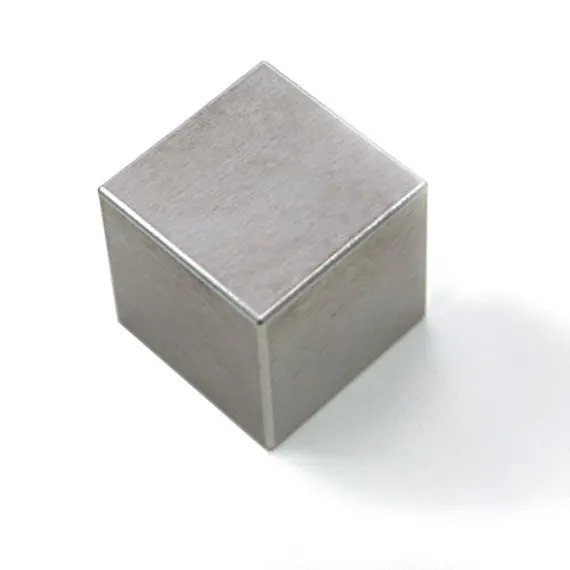
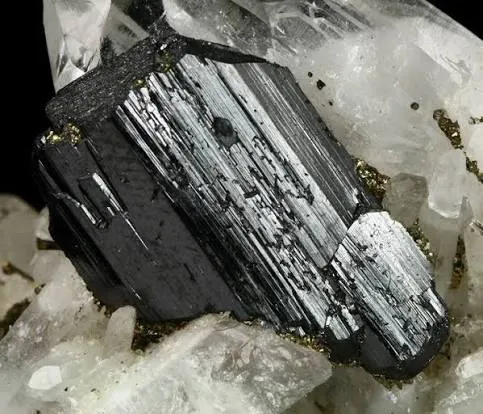
About what tungsten is and its role:
It has the highest melting point of all metals (~3422 degrees Celsius), extremely high density, and exceptional hardness, making it very suitable for industrial tools, aerospace components, military ammunition, and more. This also makes it hard to substitute — few materials can replicate this without a loss of performance.
It is mainly extracted from two ores — wolframite and scheelite — and then refined into intermediate products (ammonium paratungstate, tungsten oxide, carbide powder), which are further processed into final products.
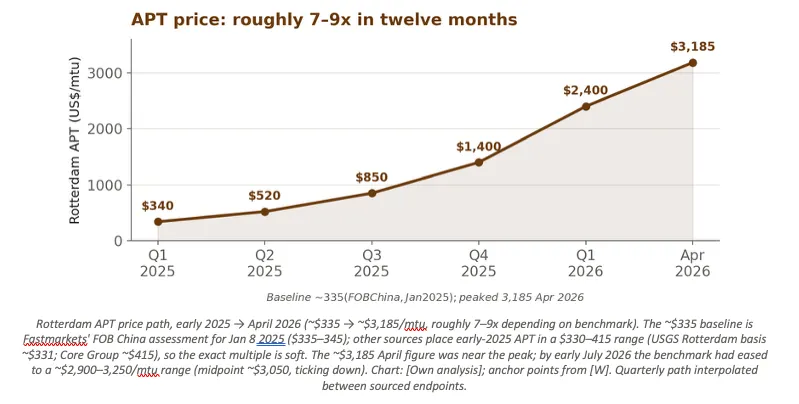
The benchmark intermediate product — ammonium paratungstate (APT) — rose from about $340/ton in early 2025 to a peak of $3185/ton by April 2026, and as of early July 2026, it has remained around $3185/ton.
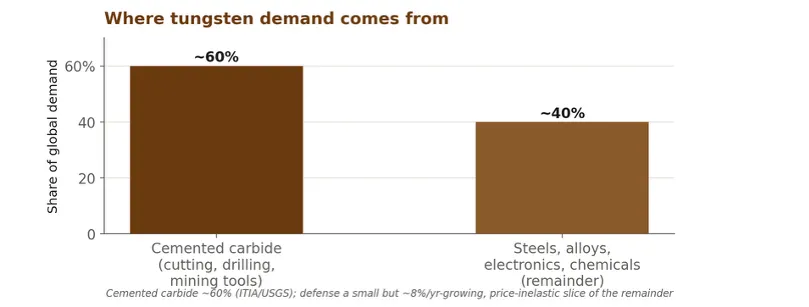
Tungsten is predominantly used in the following applications: hard metal tools (about 60% of demand): cutting tools, drill bits, and mining/construction blades. The hardness and wear resistance enable them to process steel at high speeds; ceramics, PCD, and CBN only replace them in specific fields, usually at the expense of performance or cost. Defense and ammunition: Density and hardness make it an ideal material for armor-piercing rounds, kinetic penetrators, and missile ballast; a guided multiple launch rocket carries about 50 kilograms of tungsten. Aerospace and superalloys. Heat-resistant alloys used in jet engines, turbine components, and rocket engine nozzles must withstand extreme temperatures. Semiconductors. High melting point, inertness, and sufficient conductivity make it suitable for filling nanoscale connection gaps through chemical vapor deposition (WF₆). Photovoltaic wire. Tungsten wire is increasingly replacing carbon steel wire for cutting silicon wafers — thinner wire wastes less silicon per cut, representing a rapidly growing new demand direction.
Demand/Supply Analysis
The core argument here is that tungsten runs contrary to the argument of demand exceeding supply — this is a supply-driven shortage, conflicting with the growing demand, and establishing new supply in this market takes years.
Demand Side
Cutting/hard metal tools are in steady demand and hard to replace. (Note: The tungsten carbide market report often lists automotive or mining/construction as the largest end-user verticals; this is based on downstream industries rather than first-use applications slicing the same demand)
Substitutes (ceramics, PCD, CBN, molybdenum/niobium carbides) exist, but mostly reduce rather than replace tungsten, often at the expense of performance or cost.
Supply Side
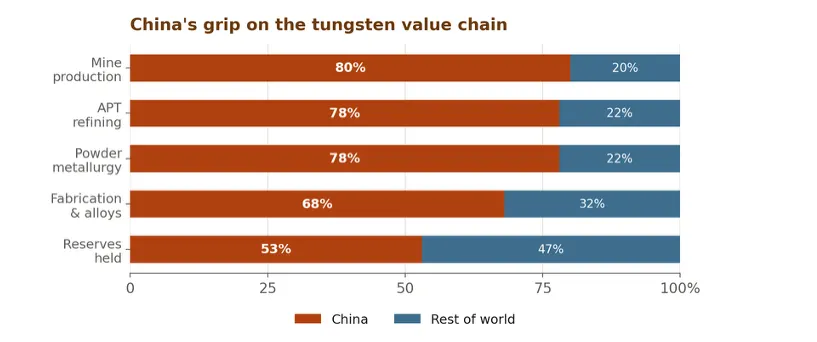
Extreme concentration: About 80-85% of global tungsten production comes from China, with an even higher share in downstream processing. In 2025, China mined about 67,000 of the 78,000 tons globally — approximately 86%, and controls 70-85% of each downstream processing stage (USGS data). This level of concentration is even greater than that of rare earths, which have gradually diversified their sources. This advantage is leveraged — from February 2025, an export licensing system was implemented for ammonium paratungstate and intermediate products, which was fully suspended at one point before being resumed; starting December 2025, tungsten exports were limited to about 15 approved enterprises.
Geographical depletion: It is reported that China's mineral production will decrease by about 10% year-on-year to about 61,000 tons in 2025, due to aging mines (some over 30 years), declining ore grades, and environmental regulations; national mining quotas were reduced by about 6.5%.
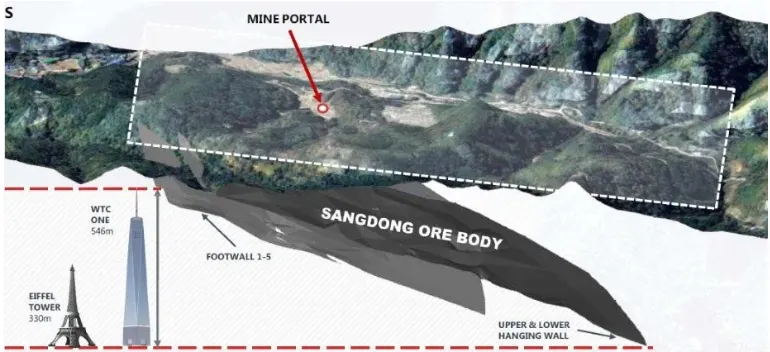
No supply from other parts of the world: The ongoing gap exists because supply cannot respond quickly. The U.S. has had no commercial tungsten mines since 2015, with tungsten mines typically requiring 5-8 years from discovery to production due to complex approval processes and specialized metallurgical requirements for low-grade polymetallic ores. Second-level dependencies complicate the issue: Most refining capacity for intermediate products is still in China, meaning that even mines outside of China may rely on Chinese processing. Almonty's Sangdong project (South Korea) is the latest new non-Chinese project — as of July 1, 2026, it has moved from development to production phase. However, this is a new project that takes time to ramp up.
Supply-Demand Balance
In summary, the structural gap will persist, with slow growth in non-China supply base. Demand is projected to grow by about 47% by 2035, while supply lags behind, and a gap will continue to exist at least until 2030.
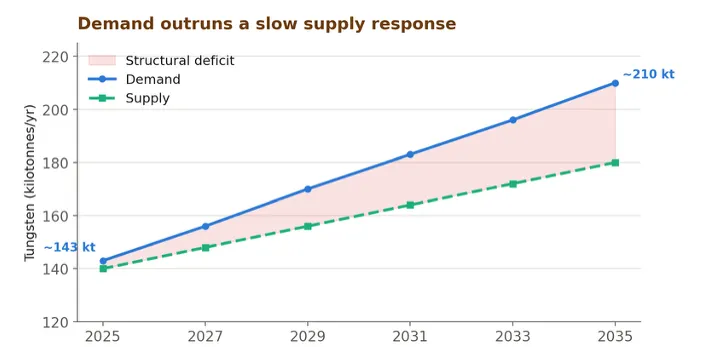
The gap is immense and narrowing slowly: demand will rise from about 143kt to approximately 210kt by 2035 (Canaccord data), while the non-China supply base starts from almost zero. Even if all planned Western projects are realized, the incremental tonnage remains limited relative to a market of about 130kt.
Structural supply lag: A 5-8 year lead time for mines, no mines in the U.S. since 2015, and most refining still located in China mean supply response lags for years rather than months.
New supply is real but small in scale: Sangdong is now producing (about 2300 tons/year, Phase II around 2027), along with Barruecopardo, Mt Carbine, Hemerdon, Mactung, and other projects — providing marginal help but unable to fill the gap.
Recycling caps upside potential but does not fill the gap: About 25-35% of demand is met by scrap, but this will only increase after prices remain high for an extended period — a delayed release valve.
Honest warning: The scale of the gap varies by predictor (CICC predicts about 20,000 MTU by 2028; other forecasts are larger). The direction is well-supported; specific annual tonnage is not definitive.
Target for Trading - ASX: EQR
Due to the lack of futures contracts and physical ETFs, exposure can only be gained through a few small, illiquid listed mining companies. Personally, I am most optimistic about ASX:EQR.
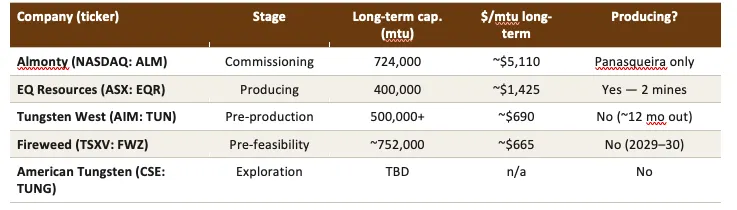
Real producers rather than promises: The only actual Western multi-mineral producer selling concentrates — producing 1678 tons of WO₃ in FY2025 from Mt Carbine (Australia) and Barruecopardo (Spain).
Strong revenue inflection point: In FY2025, revenue is projected to be AUD 66.1 million, a year-on-year increase of 146%, having signed five purchase agreements worth about USD 124 million (24-month term) — genuine visibility, within jurisdictions complying with DFARS requirements.
Huge operational leverage: Based on spot prices and the target of around 3350 tons/year, the forward multiple is only about 2x EV/EBITDA (my calculations: approximately AUD 1.4 billion enterprise value compared to about AUD 800 million model EBITDA, approximately 1.8x). If tungsten prices remain high and production ramps up, the valuation is cheap.
Currently still operating at a loss: FY2025 net loss of AUD 39.2 million (comprehensive loss), group EBITDA is negative, ROE approximately -97% — so "2x" is the best forward scenario number, not current profit.
The ramp-up is about doubling rather than a foregone conclusion: This "2x" requires production to roughly double from 1678 tons to 3350 tons and for spot prices to hold. Failure to meet either condition will amplify the multiple.
Tight balance sheet: Net debt of about AUD 85 million (70% leverage), current ratio 0.24 — net working capital deficit of approximately AUD 97 million — operating cash flow -AUD 16.9 million. Still financing through equity issuance (shares increased by 35% year-on-year = genuine dilution).
Poor liquidity and has already risen significantly: Stock price has increased more than 500% over the past year.
As mentioned earlier — each commodity has its own unique driving factors, in this case, tungsten will likely reverse similar to oil after tensions in the Strait of Hormuz ease. Specifically, there are:
Policy reversal: The biggest volatility factor is Beijing. Restoring APT exports may dissipate the political premium faster than geological gaps; structural NATO demand limits the depth of pullbacks but does not restrict the fact that sharp adjustments occur.
First are cyclical commodities: Industrial demand predominates; historical manufacturing recessions will significantly lower tungsten prices.
Recycling and inventory releases. At this price level, scrap recycling and strategic stock sell-offs will have a calming effect.
Thin liquidity, no hedging. The absence of a futures system means weak price discovery and bidirectional volatility; primary mining company positions will gap during financing events. Therefore, position management is crucial.
Long-term substitution. Currently, there are almost no effective substitutes, but sustained high prices will incentivize conservation and R&D of ceramics/replacement alloys — this is a slow long-term risk.
Tungsten is the clearest realized supply shock in the critical minerals sector: irreplaceable in core uses, extreme supply concentration weaponized by export policies, genuine geological depletion, defense cut-off deadlines, and a supply response measured in years. The pattern is structurally bullish, with gaps expected to persist until around 2030.
A skeptic's honest counterargument is that this remains a weak, unhedgeable cyclical market, with the leverage driving the upside equally capable of driving declines — the only publicly available target is a small mining company, layered atop the commodity view with execution and financing risks. The argument is valid; the path will not be smooth; "structural" describes a multiyear bottom, rather than a protection against severe adjustments along the way.
Thank you for reading Grand Line by 0xKyle! This subscription is free — hope you enjoyed this article.
If you liked this article, share it with those you think would appreciate it.
Reports and sources I referred to while writing.
Le Shrub's "Memory Vs Tungsten"
Disclaimer
This article is personal research and commentary, provided for informational and educational purposes only. It is not investment advice, financial advice, nor a recommendation to buy, sell, or hold any securities, commodities, or instruments. I am not a licensed financial advisor, and the content here is not tailored to your circumstances, goals, or risk tolerance. Please do your own research and consult licensed professionals before making any investment decisions.
Some of the content of this article — including data, numbers, and price levels — has been compiled using AI tools (Claude, Gemini) from various second-hand sources. The numbers are approximate and may contain errors, with fact-checking conducted on a best-efforts basis. In particular, prices, company financial data, production data, deficit estimates, and forward multiples should be independently verified against original sources (company filings and named research institutions) before relying on them. Cited estimates and forecasts belong to their respective authors and may change.
I may hold positions in the securities or commodities discussed in this article. I may buy or sell at any time without notice. Past performance and historical price movements do not guarantee future results. You are solely responsible for your investment decisions.
免责声明:本文章仅代表作者个人观点,不代表本平台的立场和观点。本文章仅供信息分享,不构成对任何人的任何投资建议。用户与作者之间的任何争议,与本平台无关。如网页中刊载的文章或图片涉及侵权,请提供相关的权利证明和身份证明发送邮件到support@aicoin.com,本平台相关工作人员将会进行核查。


