Author: ADI Chain
ADI Chain, a chain that starts from the backend
Unlike the well-known L2 chains, ADI Chain has a different positioning.
It is not a chain built around a single application, nor is it merely a trading venue serving Crypto users. From the very beginning, it is aimed at governments, banks, financial institutions, and enterprise-level applications, trying to undertake stablecoin settlement, tokenization of real-world assets, payment networks, and institutional asset infrastructure.
In the past few years, the common pathway for new public chains often started from within Crypto: first creating a developer ecosystem, then pulling in DeFi, NFTs, memes, airdrops, and loyalty points, using TVL, trading volume, and daily active users to prove their market presence, and then approaching the institutional world.
This pathway is now facing increasing pressure.
The activity level of a public chain largely depends on the activity of the assets, while a chain's ability to continuously create new assets, new narratives, and new reasons for transactions is limited. After the meme craze subsides, trading volume will fall; after airdrop expectations end, users will leave; even foundational networks like Ethereum face a long-term tug-of-war between application growth and asset activity.
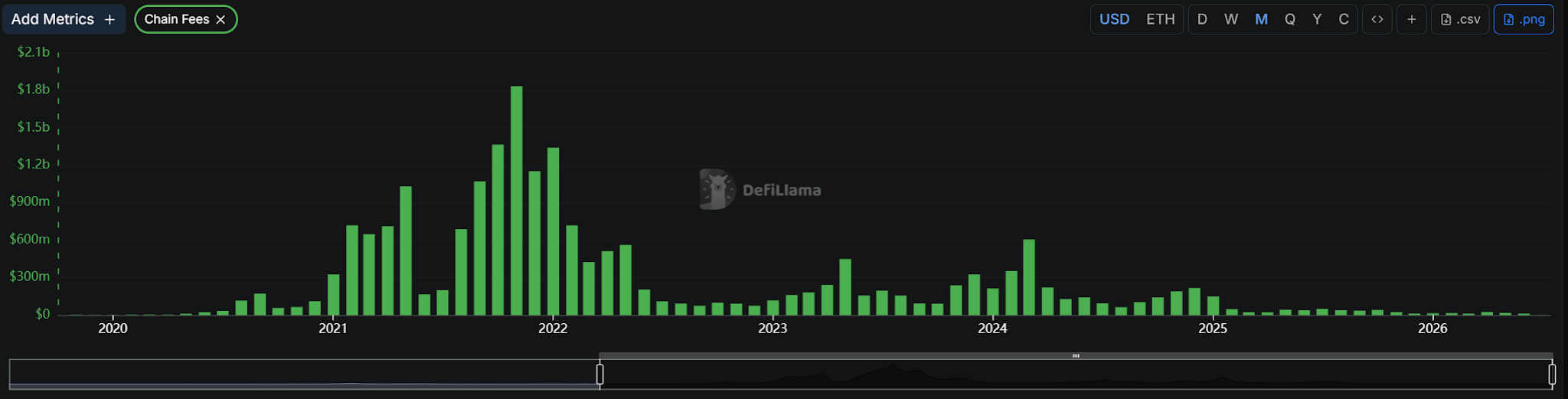
ETH network fees fluctuate significantly with the asset cycle on the chain, data from: DeFiLlama
ADI Chain's pathway is more like the opposite.
It does not create a round of asset hype on the chain first, waiting for funds and institutions to enter; it attempts to move the existing financial activities onto the chain: the issuance and settlement of stablecoins, the tokenization of real assets, the custody and circulation of institutional assets, and the movement of funds within payment networks.
This pathway is most clearly seen in stablecoins.
The best representation of ADI Chain's pathway is not the $USDT or $USDC aimed at global crypto user liquidity, but rather the more regionally and institutionally focused $DDSC.
$DDSC is a stablecoin tied to the dirham, connected behind FAB, IHC, ADQ, and the UAE Central Bank authorization framework. It does not serve generic trading scenarios but rather payment, settlement, and institutional fund circulation within the UAE's local financial system.
A recent public large transaction occurred in May.
IHC disclosed in an Abu Dhabi Stock Exchange disclosure document that it completed a transaction of 110 million dirhams, approximately 30 million dollars, on ADI Chain using $DDSC. The disclosure document stated:
This is one of the largest single stablecoin transactions in the region.
The same choice also appears in $PUSD.
This stablecoin issued by Palm Azgar Finance emphasizes not trading liquidity first, but compliance with Islamic law. According to reports, $PUSD targets corporate treasury departments, exchanges, and payment processing institutions, with a circulation of about 2.3 billion dollars, aiming at a market exceeding 3 trillion dollars in the Islamic financial system.
At this point, the first layer of ADI Chain's pathway is clear: first bring the settlement needs from the regional financial system.
$DDSC corresponds to the local institutional fund circulation in the UAE, while $PUSD corresponds to the larger Islamic finance market. They do not address the question of “is there a stablecoin on-chain,” but rather whether the money in the regional finance can enter the chain in a way acceptable to institutions.
This is also a prerequisite for the subsequent establishment of the payment network. Whether it is a partnership with Mastercard aimed at cross-border payments in the Middle East or the covering of 8 markets in Africa with over 60 million monthly active users of M-Pesa, what is truly needed is not another on-chain asset, but a set of underlying networks that can undertake settlement and capital flows.
Once the money enters and can flow, the next step is assets.
From regional settlement to institutional assets
However, ADI Chain's layout is certainly not limited to the Middle East.
If $DDSC and $PUSD prove its penetration into the regional financial system, then international institutions and infrastructure service providers such as BlackRock, Franklin Templeton, BNY Mellon, and SettleMint correspond to another line: how global assets can enter this on-chain financial network.
This matter cannot avoid custody.
In May, BNY Mellon announced a partnership with Finstreet and ADI Foundation, planning to provide institutional-level digital asset custody within ADGM, extending to ADI Chain. For institutional assets, custody is not a supporting service but the entry itself. If assets are not stored in a compliant manner, there will be no subsequent issuance, trading, or settlement.
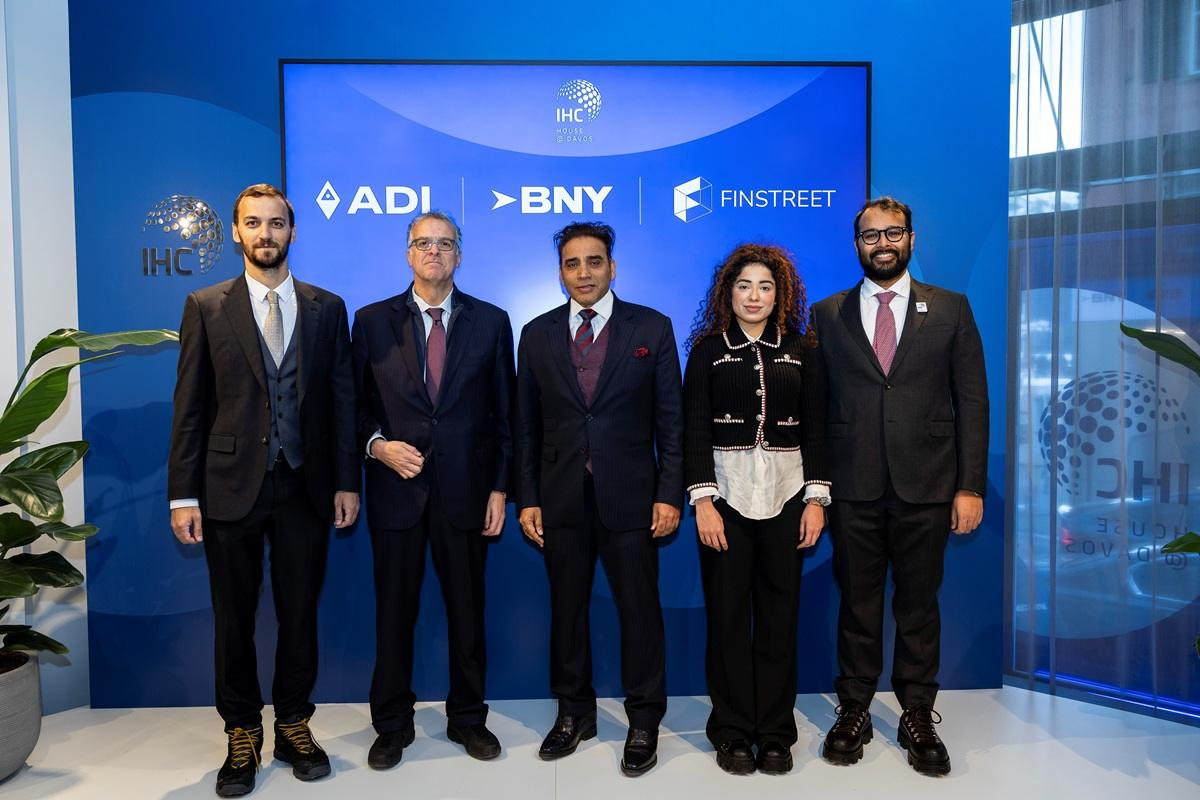
Source: Official press release
Only after custody can the issuance take place.
The collaboration between ADI Foundation and SettleMint falls on the digital securities side. SettleMint is an infrastructure service provider for tokenization aimed at institutions, and the partnership occurs under the ADGM framework. In other words, what ADI is taking on is not a packaged RWA product but the digital securities process within a regulated environment.
Moving outward, we have asset management institutions.
BlackRock and Franklin Templeton appearing here do not just add two familiar big names. If RWAs solely rely on on-chain protocols to package assets, they will soon reach the end. It is traditional asset managers, custodians, issuance tools, and settlement networks that can truly bring assets in.
When these lines are put together, the narrative of assets in ADI Chain becomes established.
It does not first write a label of “RWA” and then stuff partners into it. It starts from the most troublesome place for assets entering the financial system: where to place the assets, who will issue them, who will manage them, and finally, in which network will they circulate.
When real finance turns into on-chain costs
At this point, ADI's resource puzzle has basically unfolded.
Regional stablecoins, institutional custody, digital securities infrastructure, and asset management institutions seem to belong to different businesses, but they ultimately point to the same question: can they be continually integrated into the ADI Chain network?
This is the position of $ADI.
It is not a token serving a certain application, nor is it an accessory to a specific type of asset. The value of $ADI depends on whether ADI Chain can organize these entrances, funds, and assets into a continuously operating ecosystem.
If these collaborations are merely independent progress, what $ADI gains is only an associated narrative; if they truly occur on the same chain in terms of transactions, settlements, and asset circulation, what $ADI undertakes is the underlying fuel that ADI's ecosystem repeatedly passes through while operating.
This is also where ADI Chain's path differs from many public chains.
It does not create a round of asset hype on the chain first, waiting for external funds to enter; it attempts to first bring the existing funds, assets, and transaction processes in real finance onto the chain, and then let these flows support the use cases of $ADI.
What truly determines the value of $ADI is whether these entrances, once seen, can continue to bring funds, assets, and transactions back to ADI Chain.
免责声明:本文章仅代表作者个人观点,不代表本平台的立场和观点。本文章仅供信息分享,不构成对任何人的任何投资建议。用户与作者之间的任何争议,与本平台无关。如网页中刊载的文章或图片涉及侵权,请提供相关的权利证明和身份证明发送邮件到support@aicoin.com,本平台相关工作人员将会进行核查。


