Author: CryptoSlate
Compiled by: Deep Tide TechFlow
Deep Tide Insights: ETF capital outflows, institutional caution, AI stealing investor attention... Bitcoin has grown too large to be pushed by retail investors alone. CryptoQuant founder Ki Young Ju calculated: In 2011, $2.7 million could push BTC up 550 times, now it takes $101 billion to double it. Whether the next bull market can come depends on whether wealth advisors, corporate finances, banks, and sovereign funds are willing to consider BTC as a long-term allocation rather than a short-term trade.
The next major surge in Bitcoin might not depend on whether investors believe in this asset, but rather on how much large funds are willing to participate with real money.
CryptoQuant CEO Ki Young Ju's latest analysis shows that the world's largest cryptocurrency has grown into a market size that cannot be easily moved like it was in earlier cycles. He said, each bull market requires more capital to produce smaller percentage increases, raising the threshold for a parabolic rise to occur again.
This is particularly important now as BTC is in a long bear market, with its value having fallen to around $63,000, down 50% from the peak of over $126,000 recorded last October.
This retracement tests the institutional adoption that helped push the asset into mainstream portfolios, and the core question now is whether Bitcoin can attract enough enduring capital to offset its declining price sensitivity.
A larger market changes the cycle mathematics
The early upward momentum of Bitcoin was built on a much smaller base, allowing a small amount of new capital to produce significant price changes. As the asset matures, this relationship has weakened.
Ju's analysis compared the growth of Bitcoin's realized market capitalization during several bull market cycles with subsequent price increases. Realized market capitalization is calculated based on the price of the coin at its last on-chain movement, making it a common proxy for the amount of funds absorbed by the network.
Ju stated that during the 2011 cycle, approximately $2.7 billion in net capital inflows was associated with about a 55,000% price increase.
The current cycle has absorbed approximately $697 billion, producing an increase of about 689%, highlighting that as the asset scales up, significantly more capital is required to achieve smaller increases.
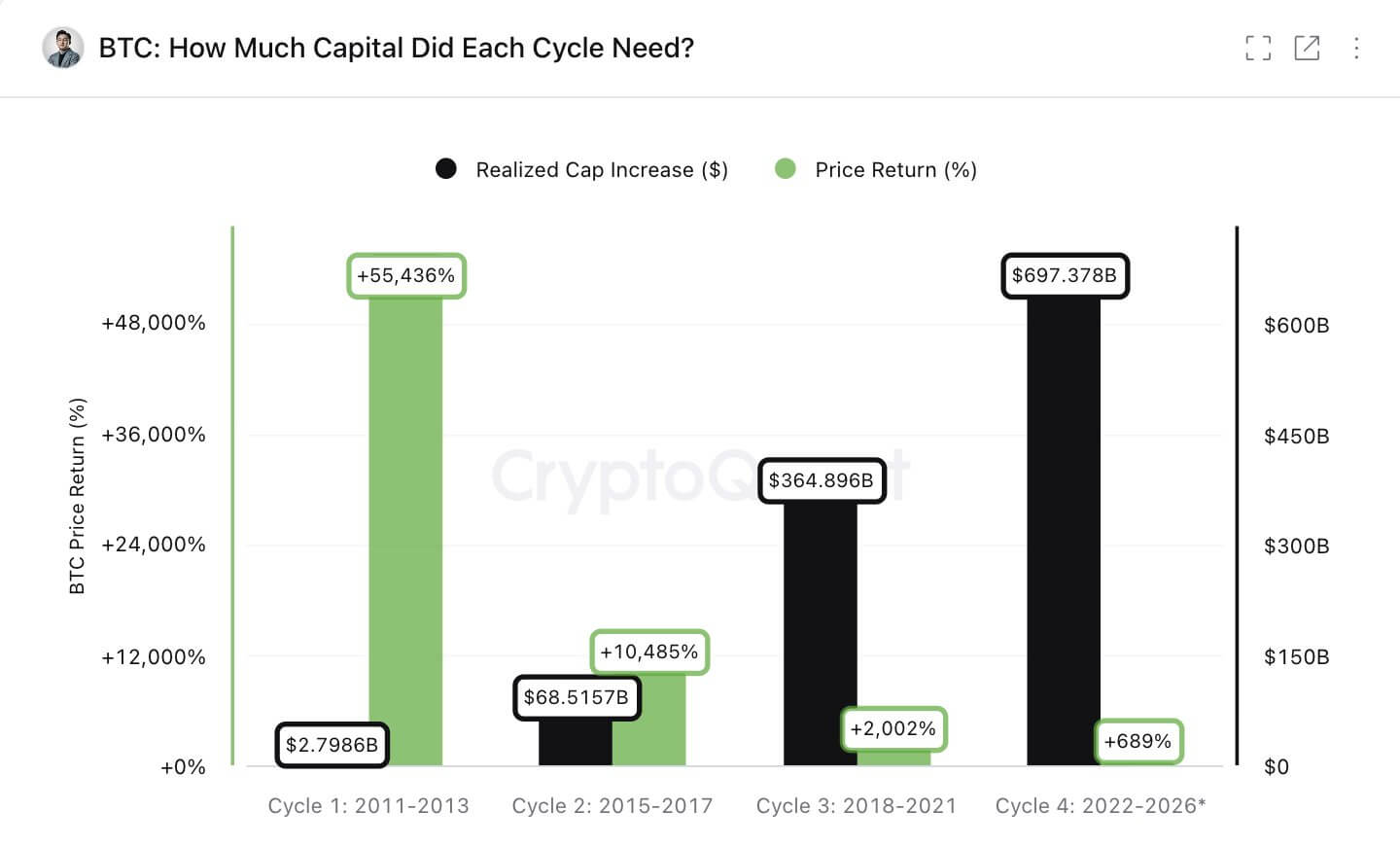
Figure: Bitcoin price returns and realized price increase limit
Source: CryptoQuant
The same pattern appears in smaller increments. Ju noted that approximately $5 million in new capital was sufficient to double Bitcoin's price in 2011. In the current cycle, this figure is about $101 billion.
While this does not end the bullish sentiment around BTC, it changes the type of demand needed to sustain that sentiment.
Ju believes that if Bitcoin becomes a more deeply integrated macro allocation, another major surge is still possible. "Bitcoin needs to be a core macro asset," he wrote, adding that the market can no longer rely solely on retail-led ETF trading.
This perspective turns Bitcoin's next cycle into a test of financial market integration. The supply shock from the halving continues to reduce new issuance, but the growth trajectory increasingly depends on whether capital allocators view Bitcoin as a regular portfolio position rather than a tactical trade.
ETF capital outflows weaken recent setups
This test has come at a time when the most visible institutional tools in the market are facing difficulties.
The U.S. spot Bitcoin ETF will launch in 2024, helping to broaden access, providing a regulated path for advisors, hedge funds, and traditional investors to enter this asset. However, recent capital flows have turned negative, weakening the argument that institutional demand is deep enough to support another significant uptrend.
Santiment data shows nearly $10 billion in capital outflows from Bitcoin ETFs since early May, with these 12 products currently experiencing eight consecutive weeks of outflows.
Speaking about these numbers, the BTC-focused analytics platform Ecoinometrics stated:
"The pattern since May has been very one-sided. Attempts to rebuild buying momentum have almost immediately stalled. Bitcoin ETFs have failed to achieve inflows lasting more than a single day, while the number of consecutive outflow days has repeatedly lasted for several days, ultimately leading to the longest outflow period since the ETF's launch."
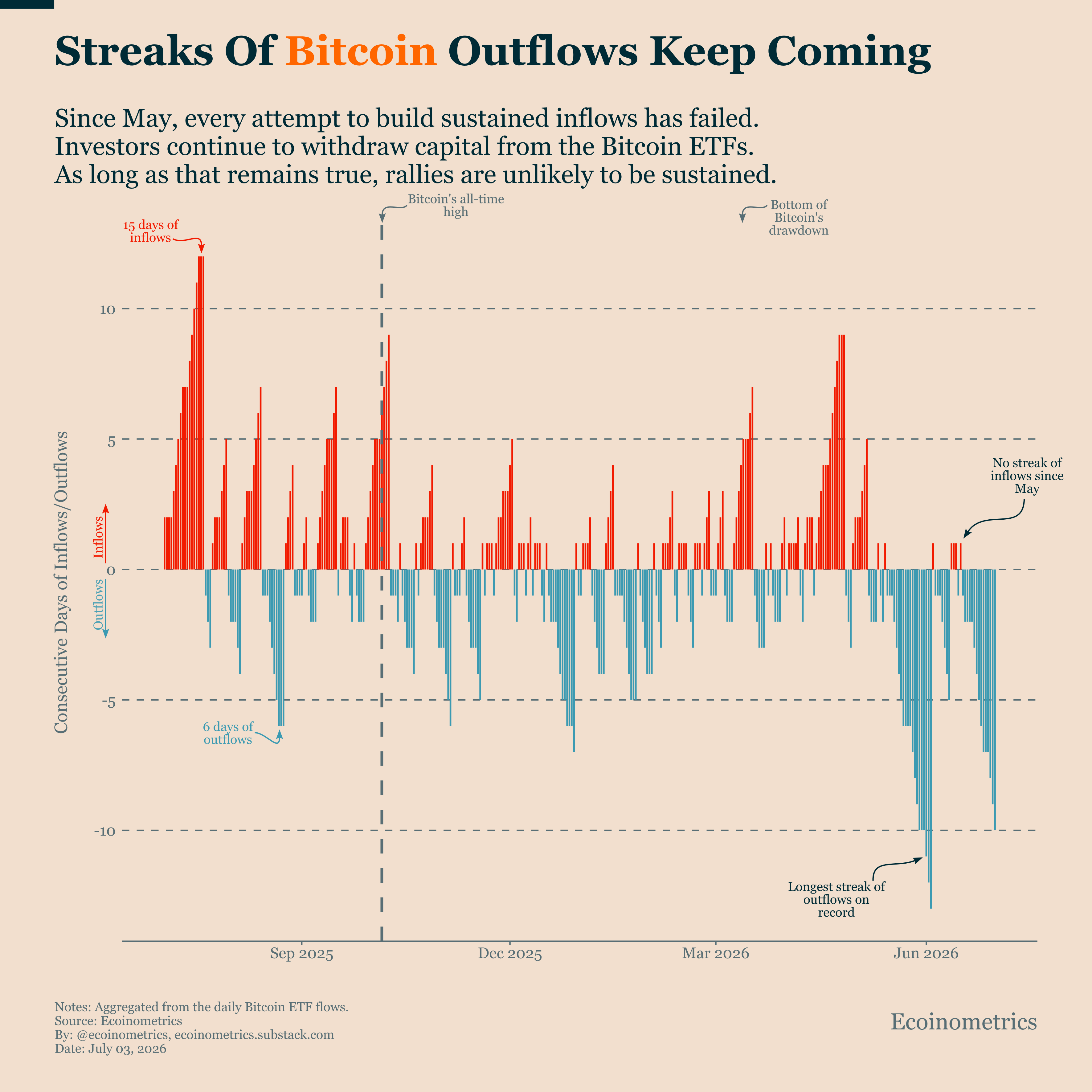
Figure: Bitcoin ETF capital outflows
Source: Ecoinometrics
These outflows complicate the possibility of a quick return to previous highs. Bitcoin's record in October occurred when investors were still rewarding ETF access and viewing the asset as a beneficiary of friendlier policies, institutional participation, and broader connections to global markets.
Now, the weakness of ETFs indicates that mere access pathways are not enough. The next phase of adoption requires more stable allocations across wealth platforms, model portfolios, corporate balance sheets, and other capital pools, which may move slower than retail traders but can be deployed at a much larger scale.
This creates a demand landscape for Bitcoin that is of higher quality but harder to win. Institutions may bring larger checks, but before allocations become enduring, they also need liquidity, risk controls, custody standards, portfolio authorizations, and compliance approvals.
Institutions are still participating, but with stricter standards
Despite these significant outflows, survey data from Coinbase suggests institutional interest has not disappeared.
A survey conducted by Coinbase and EY-Parthenon in January 2026 of 351 institutional decision-makers found that nearly three-quarters plan to increase crypto allocations, and 74% expect crypto prices to rise in the next 12 months.
The same survey found that 49% place greater emphasis on risk management, liquidity, and position size.
This combination is significant for Bitcoin's capital issues. Institutions are not approaching cryptocurrencies in the same way that defined early retail-led cycles.
They are more likely to demand regulated products, clear governance, operational resilience, and defined exposure limits.
The survey found that 66% of respondents already have exposure through spot crypto ETFs or exchange-traded products, while 81% preferred to gain spot exposure through registered instruments.
These findings support the perspective that regulated packaged instruments remain central to the next phase of adoption.
However, they also illustrate why the recent ETFs' capital outflows are a pressure point. If ETFs are the primary institutional entry point, the ongoing weakness of these products may hinder the broader allocation process.
Thus, Bitcoin's capital efficiency issue is twofold. Its larger scale may make it more acceptable to traditional finance.
But this scale also means that marginal buyers must be larger, more consistent, and less speculative than those that propelled early cycles.
Bitcoin's next buyers must compete with other Wall Street assets
This makes Bitcoin's next cycle dependent on a broader investor base than just the retail traders and crypto-native funds that fueled early upward momentum.
Strategy Executive Chairman Michael Saylor believes that Bitcoin's trajectory over the next decade will be less driven by miner issuance and more by capital flows across financial markets. Strategy is the largest corporate holder of Bitcoin, making Saylor one of the most prominent advocates of viewing the asset as a balance sheet tool rather than a speculative trade.
He stated:
"Over the next decade, Bitcoin's trajectory will be less driven by miner issuance and more by capital flows. ETF liquidity. Corporate finance flows. Sovereign reserve flows. Bank credit flows. Derivatives flows. Insurance flows. Collateral flows. Structured credit flows. Global savings flows. Halvings tighten supply. Capital flows set growth trajectories. This is the next phase of Bitcoin adoption: not just more buyers, but more balance sheets."
The emphasis is that Bitcoin's supply story is no longer fresh. Its issuance schedule is known, halving cycles are understandable, and the asset has been trading at a scale that requires larger pools of capital to meaningfully push it up.
Therefore, any new repricing must come from demand channels capable of absorbing value over a $1 trillion market.
This means that ETF demand is only part of this transformation. Stronger cycles may require advisors to add Bitcoin to model portfolios, companies to use it more actively on balance sheets, banks to build credit products around it, insurers and asset management firms to view it as macro allocation, and sovereign entities to consider exposure over time.
This transition may be slower than retail momentum cycles. It will also expose Bitcoin more to interest rate expectations, regulatory delays, liquidity shocks, and competition with other markets chasing the same institutional capital.
Notably, AI has become one of these competitors. AI-related assets and infrastructure have captured a significant portion of investor attention this year, with spending and investment forecasts reaching trillions of dollars.
In the early crypto cycles, looser speculative capital might have flowed more easily into Bitcoin. In the current market, Bitcoin must compete for the same pool of institutional money with AI stocks, private infrastructure trades, credit products, commodities, and other macro trades.
This competition is now at the center of the Bitcoin cycle debate. The asset is significant enough to enter mainstream allocation discussions, but it also means it must be compared with all other major capital uses.
The views expressed by the author of this article are solely their personal stance and do not represent the views of CryptoSlate. Any information you read on CryptoSlate should not be considered as investment advice, and CryptoSlate does not endorse any projects mentioned or linked in this article. Buying, selling, and trading cryptocurrencies should be viewed as a high-risk activity. Please conduct your own due diligence before taking any action related to the content of this article. Lastly, if you incur losses while trading cryptocurrencies, CryptoSlate bears no responsibility. For more information, please refer to our company disclaimer.
免责声明:本文章仅代表作者个人观点,不代表本平台的立场和观点。本文章仅供信息分享,不构成对任何人的任何投资建议。用户与作者之间的任何争议,与本平台无关。如网页中刊载的文章或图片涉及侵权,请提供相关的权利证明和身份证明发送邮件到support@aicoin.com,本平台相关工作人员将会进行核查。


